Have you ever wondered whether antenna and antennae mean the same thing or which one you should use in a sentence? While Antenna vs Antennae may look like a simple word choice, the difference depends on whether you’re talking about one antenna or more than one.
Antenna is the singular form of the word. It can refer to a device that sends or receives radio signals, or a sensory appendage found on insects and other animals. Antennae is the plural form traditionally used for the sensory appendages of insects and other arthropods. In modern English, antennas is also commonly used as the plural of antenna when referring to electronic devices.
Examples:
- The car has a small antenna on its roof.
- The butterfly moved its antennae as it searched for food.
The confusion is understandable. People often search for antenna vs antennae, antenna plural, antennae meaning, or is antennae plural because the two forms look and sound similar. And here’s the kicker: the correct plural can change depending on whether you’re discussing biology or technology.
In this guide, you’ll learn the complete difference between antenna and antennae, including their meanings, plural forms, pronunciation, correct usage, and examples in sentences. You’ll also discover when to use antennae vs antennas, whether antennae can refer to electronic devices, and how to choose the right word in everyday writing.
Antenna vs Antennae at a Glance
| Word | Number | Common meaning | Example |
| antenna | Singular | One insect sensory organ or one electronic device | The insect has a damaged antenna. |
| antennae | Plural | Insect or arthropod sensory organs | The insect moved its antennae. |
| antennas | Plural | Radio, television, wireless, or communication equipment | The building has several antennas. |
There’s an easy way to remember the basic distinction:
One antenna, two antennae. One electronic antenna, several antennas.
That rule isn’t an absolute law covering every specialized use of the word. For example, antennae and antennas can both occur in figurative uses. Cambridge lists both plural forms for the sense of having a natural ability to notice things and understand their importance.
Still, the biological versus technological distinction will get you right in the overwhelming majority of ordinary sentences.
What Does Antenna Mean?
Antenna is a singular count noun with several related meanings.
In biology, an antenna is one of the paired sensory structures attached to the head of an insect or certain other arthropods. In technology, an antenna is a structure that sends or receives electromagnetic signals.
The two meanings describe very different things, but they share a basic idea: an antenna interacts with information from the surrounding environment.
Antenna in Biology
An insect has a pair of antennae, which means each individual structure is an antenna.
For example:
- The ant has a long antenna.
- One antenna is bent.
- The moth’s antenna is covered with sensory structures.
- A damaged antenna can affect an insect’s ability to sense its surroundings.
Cambridge defines an insect antenna as one of two long, thin structures on the head that an insect uses to sense what surrounds it.
Although people sometimes casually call insect antennae “feelers,” the biological structures can perform much more sophisticated sensory functions than the word feeler suggests.
Depending on the species, antennae can help insects detect chemical signals, touch, movement, humidity, temperature, and other environmental information. Many insects rely heavily on their antennae to interact with their surroundings.
That makes the singular form straightforward:
One structure = antenna.
If an insect has a pair, however, you’re talking about antennae.
Antenna in Technology
The word antenna also describes equipment that transmits or receives electromagnetic waves.
You’ll encounter this meaning in contexts such as:
- Radio
- Television
- Wireless communication
- Radar
- Satellite communication
- Mobile networks
- Navigation systems
- Wi-Fi equipment
- Automotive communication systems
For example:
The technician replaced the antenna on the vehicle.
Here, antenna is singular because the sentence refers to one piece of equipment.
When there are several pieces of radio or communication equipment, American English commonly uses antennas:
The station operates several antennas.
Cambridge specifically lists antennas as the plural for the broadcasting and radio sense in American English.
What Does Antennae Mean?
Antennae is a plural noun. It is the traditional plural form of antenna and is strongly associated with the biological meaning.
For example:
- The bee moved its antennae.
- The beetle’s antennae are unusually long.
- The moth uses its antennae to detect chemical signals.
- The ant touched the surface with its antennae.
Cambridge explicitly identifies antennae as the plural of antenna.
The word is particularly common in zoology and entomology, where writers routinely discuss the paired structures of insects and other animals.
Why Do Insects Have Antennae?
Antennae aren’t simply decorative extensions from an insect’s head. They are highly useful sensory structures.
Depending on the animal and the particular sensory receptors involved, antennae can help detect:
- Chemical signals
- Odors
- Touch
- Air movement
- Humidity
- Temperature
- Vibrations
- Environmental cues
For instance, insects can use chemical information to locate food, recognize other members of their species, or respond to potential mates and threats.
That explains why a sentence such as this sounds natural:
The ants explored the area with their antennae.
The plural antennae fits because the sentence refers to multiple biological appendages.
Is Antennae the Plural of Antenna?
Yes.
Antennae is a plural form of antenna. However, it isn’t the only plural form.
English also uses antennas.
This is where many explanations become misleading. Saying that antennae is simply “the plural of antenna” isn’t technically wrong, but it leaves out an important part of modern English usage.
The more complete explanation is:
- Antenna = singular
- Antennae = plural, especially for biological structures
- Antennas = plural, especially for electronic equipment
Cambridge’s American English dictionary lists antennae for insect structures and antennas for radio and television equipment.
Why Are There Two Plural Forms?
The difference comes partly from the history of the word and partly from how English develops over time.
Antennae follows a traditional Latin plural pattern. English borrowed many technical and scientific words from Latin and Greek, and some retained forms that resemble their original plural patterns.
Antennas, on the other hand, follows the regular English plural pattern of adding -s.
Compare:
- antenna → antennae
- antenna → antennas
English speakers naturally create regular plurals such as antennas, particularly when the word refers to modern technology.
Over time, the two forms developed strong associations with different meanings.
Antennae vs. Antennas: Which Should You Use?
The easiest practical distinction is based on what you’re describing.
Use Antennae for Insects and Other Arthropods
When you’re referring to biological sensory structures, antennae is the standard choice.
Examples:
- The butterfly’s antennae are covered with sensory receptors.
- The beetle moved its antennae rapidly.
- The ants touched one another with their antennae.
- The moth’s antennae are unusually feathery.
If you’re writing about entomology, zoology, insects, or related biological subjects, antennae is the natural plural.
Use Antennas for Electronic Equipment
When you’re referring to radio, television, wireless, or communication equipment, antennas is usually the best choice in American English.
Examples:
- The radio station uses several antennas.
- The vehicle has two antennas.
- The technician installed new antennas on the roof.
- The wireless system uses multiple antennas.
This distinction appears directly in Cambridge’s American English definitions.
When Both Forms Can Appear
The distinction becomes less rigid when antenna is used figuratively.
For example:
She has excellent political antennae.
Here, antennae doesn’t literally refer to insect organs. It describes a person’s ability to notice subtle developments or understand what is happening around them.
Cambridge lists the figurative sense as having antennae or antennas, although antennae is particularly common in expressions such as political antennae.
So don’t treat the rule as “antennae is always biological and antennas is always technological.” That’s a useful shortcut, not a complete description of English.
Antenna vs Antennae Examples
Examples make the distinction much easier to see.
Biological Examples
Singular:
The insect has one damaged antenna.
Only one structure is being discussed, so antenna is singular.
Plural:
The insect moved its antennae.
Both structures are being discussed, so antennae is plural.
Another example:
The butterfly’s antennae help it detect information from its environment.
The possessive butterfly’s tells you who owns the structures. Antennae tells you there is more than one.
Technology Examples
Singular:
The radio needs a new antenna.
Only one device or structure is involved.
Plural:
The station uses several antennas.
Several electronic structures are involved, so antennas is the natural plural.
Figurative Examples
The word can also describe a person’s sensitivity to information.
For example:
Her political antennae helped her notice the change in public opinion.
Here, nobody is suggesting that the person literally has insect organs. The sentence uses antennae metaphorically to describe sharp awareness.
This figurative use has been established long enough to appear as a dictionary meaning rather than merely a creative metaphor.
Antenna vs Antennae vs. Antennas
A three way comparison clears up most confusion.
| Term | Singular or plural? | Typical context | Example |
| antenna | Singular | Biology or technology | The antenna is damaged. |
| antennae | Plural | Insects and other biological structures | The insect moved its antennae. |
| antennas | Plural | Radio and communication equipment | The tower has several antennas. |
Think of the three forms as answering two questions.
How many?
- One → antenna
- More than one → antennae or antennas
What kind?
- Biological structures → usually antennae
- Electronic equipment → usually antennas
That’s the heart of the issue.
Why Do Insects Have Antennae?
To understand why antennae is so strongly associated with biology, it helps to look at what these structures actually do.
An insect lives in a world filled with information that humans often can’t detect directly. A chemical trail, a faint air current, a change in humidity, or contact with another object can provide valuable information.
Antennae help insects gather some of those signals.
Chemical Detection
Many insects rely on chemical information in their environment. Sensory structures on the antennae can detect odors and other chemical cues.
This can help an insect locate food, identify potential mates, recognize members of its species, or respond to danger.
Touch and Physical Contact
Antennae can also provide information through physical contact.
An ant moving through a crowded colony, for example, may use its antennae while interacting with another ant or investigating its surroundings.
Environmental Awareness
Antennae can contain different types of sensory receptors. Their exact structure and function vary among species, so it’s inaccurate to assume that every insect uses its antennae in exactly the same way.
That’s an important scientific detail. Antennae are not a single-purpose organ.
Their sensory capabilities depend on the species, the structure of the antennae, and the receptors they contain.
Antenna or Antennae in a Sentence?
If you’re unsure which form belongs in a sentence, first identify whether you’re talking about one or multiple structures.
Then identify the meaning of the noun.
| Sentence | Correct? | Explanation |
| The insect has one antenna. | Yes | One biological structure |
| The insect has two antennae. | Yes | Multiple biological structures |
| The radio has one antenna. | Yes | One electronic structure |
| The radio has three antennas. | Yes | Multiple electronic structures |
| The insect has two antenna. | No | The plural needs a plural form |
| The insect moved its antennae. | Yes | Biological plural |
| The tower uses several antennas. | Yes | Electronic plural |
The key is to avoid memorizing isolated words. Instead, connect the form to the meaning.
Common Mistakes With Antenna and Antennae
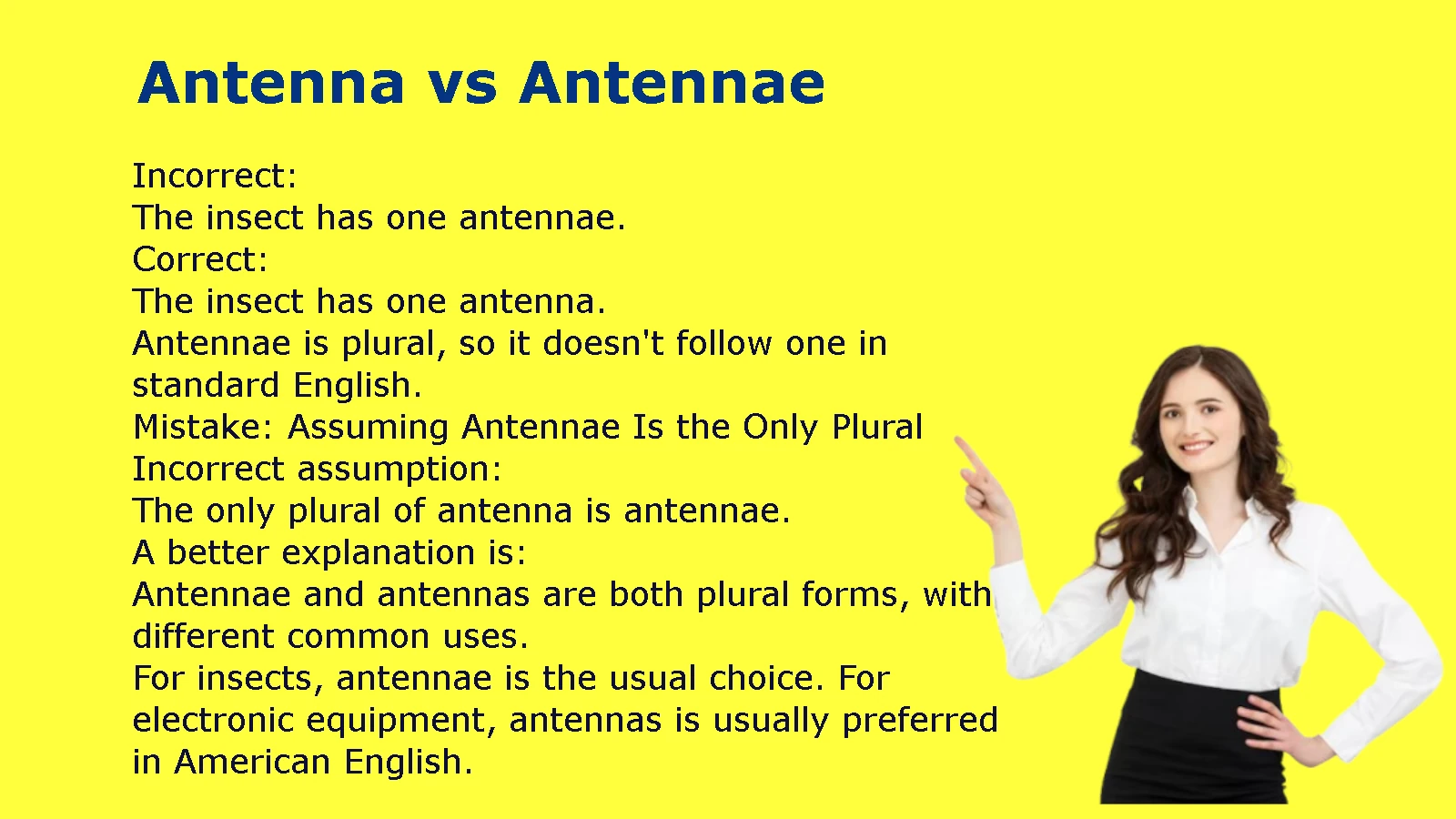
Mistake: Treating Antennae as Singular
Incorrect:
The insect has one antennae.
Correct:
The insect has one antenna.
Antennae is plural, so it doesn’t follow one in standard English.
Mistake: Assuming Antennae Is the Only Plural
Incorrect assumption:
The only plural of antenna is antennae.
A better explanation is:
Antennae and antennas are both plural forms, with different common uses.
For insects, antennae is the usual choice. For electronic equipment, antennas is usually preferred in American English.
Mistake: Using Antennas for Insect Structures
You may occasionally encounter antennas in broader or less specialized writing, but antennae is the standard form for insect structures.
For formal scientific writing, especially when discussing insects, antennae is the safer and more conventional choice.
Mistake: Assuming Antennae Always Means Insect Organs
Not necessarily.
The figurative meaning is well established:
The journalist has good antennae for political trouble.
The word describes perceptiveness rather than a physical structure. Cambridge recognizes this figurative sense and lists both antennae and antennas as possible plurals.
Mistake: Confusing Antennae With Antenna’s
These forms look similar, but they have completely different jobs.
Antennae is plural.
Antenna’s is usually singular possessive.
Compare:
The antenna is damaged.
The antenna’s cable is damaged.
In the second sentence, antenna’s means “belonging to the antenna.”
It doesn’t mean “more than one antenna.”
Antenna’s, Antennas, Antennae, and Antennae’s
These forms can look like alphabet soup at first glance, but each has a different function.
| Form | Function | Example |
| antenna | Singular noun | The antenna is broken. |
| antennae | Plural noun | The insect’s antennae are sensitive. |
| antennas | Plural noun | The building has several antennas. |
| antenna’s | Singular possessive | The antenna’s cable is loose. |
| antennae’s | Plural possessive | The antennae’s function varies by species. |
The final form is grammatically possible, but writers often avoid awkward plural possessives by restructuring the sentence.
Instead of:
The antennae’s function varies.
A clearer alternative might be:
The function of the antennae varies.
That small change can make technical writing easier to read.
Which Is Correct: Two Antenna or Two Antennae?
For ordinary English, two antennae is correct when you’re talking about the biological structures.
For example:
The insect has two antennae.
You wouldn’t normally write:
The insect has two antenna.
The singular noun antenna doesn’t normally function as the plural after two.
For electronic equipment, use two antennas:
The car has two antennas.
The distinction is therefore:
- Two insect structures → two antennae
- Two radio structures → two antennas
This is one of the most useful practical rules to remember.
How Do You Pronounce Antennae?
Antennae is pronounced approximately:
an-TEN-ee
Cambridge gives the US pronunciation as /ænˈten.i/.
The final -ae may look intimidating because English doesn’t always pronounce Latin-derived spellings predictably. In antennae, however, the ending has an ee sound.
So:
- antenna → an-TEN-uh
- antennae → an-TEN-ee
- antennas → an-TEN-uhz
The pronunciation makes the grammatical difference easier to hear.
If someone says antennae, you’re hearing the plural form associated most strongly with biological structures. If they say antennas, they’re using the regular English plural.
Why Is Antennae the Plural of Antenna?
The answer lies partly in the history of English scientific vocabulary.
Antenna is a Latin-derived word. English has retained a number of traditional plural forms from Latin, especially in scientific and technical vocabulary.
That’s why English contains pairs such as:
- criterion → criteria
- phenomenon → phenomena
- medium → media
- antenna → antennae
However, English also tends to regularize borrowed words over time. Speakers often create plurals with -s, which helps explain the development and widespread use of antennas.
This gives English two different plural patterns for the same word.
The result isn’t a grammatical accident. It’s an example of how English combines older borrowed forms with ordinary English grammar.
Antenna vs Antennae in American English
For American English, the distinction is especially useful.
Cambridge’s American English dictionary lists:
- antennae for the sensory structures of insects
- antennas for radio and television equipment
That means an American writer can comfortably use:
The bee cleaned its antennae.
and:
The station installed three new antennas.
Both sentences follow standard usage.
There is also a regional vocabulary difference worth knowing. In British English, aerial is commonly used for the radio or television equipment that Americans call an antenna. Cambridge notes that antenna for this technological meaning is mainly US and that British English usually uses aerial.
So the vocabulary can shift depending on the variety of English, even though the biological term antenna/antennae remains familiar.
A Practical Case Study: One Word, Two Worlds
Consider two sentences:
The insect has two antennae.
The communications tower has two antennas.
At first glance, the only difference seems to be the final letter.
But the difference actually tells you what the objects are.
In the first sentence, antennae identifies biological sensory structures. The reader immediately thinks of an insect or another animal.
In the second sentence, antennas identifies technological structures designed to transmit or receive electromagnetic signals.
The plural ending provides a small clue about the subject matter.
That’s why choosing the right form matters in technical writing. A single letter can help establish context.
A Quick Rule to Remember Antenna vs Antennae
If you need a simple memory trick, use this:
Bugs have antennae. Radios have antennas.
Then remember the singular:
One bug part = antenna.
Multiple bug parts = antennae.
One radio device = antenna.
Multiple radio devices = antennas.
It’s not a complete description of every possible use, especially figurative ones. Still, it’s an excellent working rule for everyday American English.
Antenna vs Antennae: Frequently Asked Questions
Is antenna singular or plural?
Antenna is singular.
Example:
The insect has one antenna.
It can also refer to one electronic device or structure:
The radio has a damaged antenna.
Is antennae singular or plural?
Antennae is plural.
It is especially common when referring to the sensory structures of insects and other arthropods.
Example:
The butterfly moved its antennae.
Cambridge explicitly defines antennae as the plural of antenna.
Is antennas a correct plural of antenna?
Yes.
Antennas is a standard plural form, particularly for radio, television, wireless, and other electronic equipment.
Example:
The tower contains several antennas.
What is the plural of antenna?
There are two established plural forms: antennae and antennas.
The usual choice depends on meaning:
- Biological structures → antennae
- Electronic equipment → antennas
Cambridge’s American English dictionary documents this distinction directly.
Do insects have antennas or antennae?
Antennae is the standard choice.
Example:
Bees use their antennae to gather sensory information.
Do radios have antennas or antennae?
Antennas is the usual choice in American English.
Example:
The radio uses two antennas.
Is antennae a possessive word?
No.
Antennae is a plural noun.
For example:
The insect’s antennae are sensitive.
Here, antennae means multiple sensory structures.
The possessive element is insect’s.
What is the difference between antennae and antennas?
Both are plural forms of antenna, but they tend to appear in different contexts.
Antennae is strongly associated with biological structures, especially insect appendages.
Antennas is strongly associated with radio, television, wireless, and communication equipment.
Both forms can also appear in figurative uses.
Is “two antennae” correct?
Yes.
The insect has two antennae.
That’s the standard plural form when discussing its biological structures.
Is “two antennas” correct?
Yes, when you’re talking about electronic equipment.
The vehicle has two antennas.
Is “two antenna” correct?
Usually, no.
After two, you need a plural form:
two antennae
or
two antennas
depending on the meaning.
How do you pronounce antennae?
It’s pronounced approximately an-TEN-ee, with the final -ae sounding like ee. Cambridge gives the pronunciation as /ænˈten.i/.
Can antennae be used metaphorically?
Yes.
For example:
She has sharp political antennae.
The word describes a person’s ability to detect subtle information, problems, or changes. Cambridge recognizes this figurative meaning and lists both antennae and antennas as possible plural forms.
Final Answer: Antenna vs Antennae
The difference between antenna and antennae becomes simple once you separate singular from plural and biology from technology.
- Antenna is the singular form.
- Antennae is a plural form, especially for insect and other arthropod sensory structures.
- Antennas is another plural form, especially for radio, television, wireless, and communication equipment.
- Antennae is pronounced approximately an-TEN-ee.
- Antenna’s is not a plural. It’s normally the singular possessive form.
- Both antennae and antennas can occur in figurative uses of antenna.
The most useful rule is simple:
Insects have antennae. Electronic systems have antennas.
So if a butterfly moves both of its sensory organs, write “The butterfly moved its antennae.” If a radio station operates several signal receiving or transmitting structures, write “The station uses several antennas.”
Once you understand that distinction, Antenna vs Antennae stops being a spelling puzzle and becomes a matter of choosing the form that matches the meaning.