Have you ever wondered whether Aging vs Ageing is the correct spelling? Both words have the same meaning, pronunciation, and grammatical function, but the spelling depends largely on the variety of English you use.
Aging and ageing both refer to the process of getting older or becoming older over time. Aging is the standard spelling in American English, while ageing is more common in British English and other varieties of English.
Examples:
- Aging: The company is studying the effects of aging on the human body.
- Ageing: The company is studying the effects of ageing on the human body.
The confusion is understandable. People often search for aging vs ageing, aging or ageing, is aging or ageing correct, or which spelling should I use because both forms appear in books, websites, academic writing, and everyday communication. And here’s the kicker: neither spelling is wrong. The right choice depends on your English variety and audience.
In this guide, you’ll learn the complete difference between Aging vs Ageing, including their meaning, spelling, pronunciation, usage, and examples. You’ll also discover when to use aging in American English, when to use ageing in British English, and how to choose the correct spelling for your writing.
Aging vs Ageing: Quick Answer
The difference between aging and ageing is mainly regional spelling, not meaning.
| Word | Preferred English variety | Meaning | Pronunciation |
| aging | American English | Becoming older or showing the effects of age | /ˈeɪ.dʒɪŋ/ |
| ageing | British English | Becoming older or showing the effects of age | /ˈeɪ.dʒɪŋ/ |
Cambridge lists aging as the US spelling and ageing as the UK spelling. It also gives the same pronunciation for both forms.
So, there’s no hidden difference in meaning.
The simple rule
Use:
- Aging when writing in American English.
- Ageing when writing in British English.
- Either form when discussing the word generally, provided the surrounding spelling follows the same variety of English.
- The spelling required by your employer, school, publisher, or style guide when one is specified.
For example:
American English:
The aging population is creating new demands on health care services.
British English:
The ageing population is creating new demands on health care services.
The meaning stays exactly the same.
What Does Aging Mean?
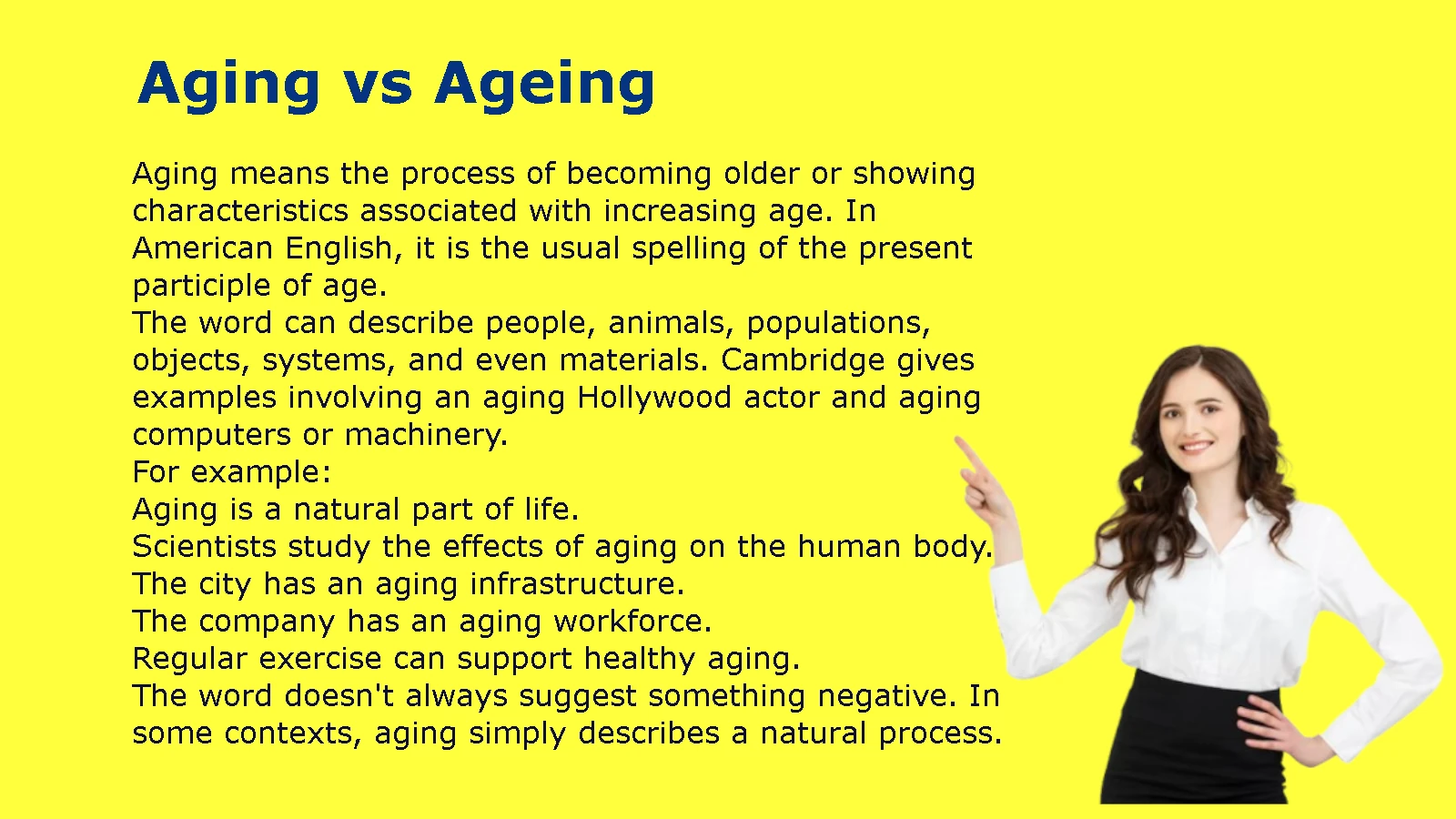
Aging means the process of becoming older or showing characteristics associated with increasing age. In American English, it is the usual spelling of the present participle of age.
The word can describe people, animals, populations, objects, systems, and even materials. Cambridge gives examples involving an aging Hollywood actor and aging computers or machinery.
For example:
- Aging is a natural part of life.
- Scientists study the effects of aging on the human body.
- The city has an aging infrastructure.
- The company has an aging workforce.
- Regular exercise can support healthy aging.
The word doesn’t always suggest something negative. In some contexts, aging simply describes a natural process.
Consider the difference between these two sentences:
The population is aging.
This is a neutral statement about demographics.
The aging equipment needs to be replaced.
Here, aging suggests that the equipment has become older and may no longer perform as well as newer equipment.
Context does much of the work.
What Does Ageing Mean?
Ageing has the same basic meaning as aging, but it follows British English spelling conventions.
It can describe the process of getting older or a person or thing that is becoming older. Cambridge gives examples such as the ageing process, an ageing actor, and ageing computers or machinery.
Examples include:
- Ageing is a natural biological process.
- Researchers are studying healthy ageing.
- The country has an ageing population.
- The company is dealing with an ageing workforce.
- The factory relies on ageing machinery.
Notice that nothing about the meaning changes when the e appears.
The following pairs communicate the same idea:
- aging population = ageing population
- aging process = ageing process
- aging workforce = ageing workforce
- aging machinery = ageing machinery
- healthy aging = healthy ageing
The only difference is the spelling convention.
Aging vs Ageing: Why Are They Spelled Differently?
The difference comes from the way English spelling developed in different regions.
The verb is age. When you add ing, you might expect the result to be ageing because the original e remains visible. British English commonly uses that spelling.
American English generally uses aging, dropping the final e before adding ing.
That creates this regional distinction:
| Base word | American English | British English |
| age | aging | ageing |
It’s important not to turn this into an absolute rule for every English word ending in e. English spelling has plenty of exceptions and historical quirks. The useful point here is simply that aging became the established American form while ageing remains the established British form.
Merriam Webster lists aging as the present participle of age and also recognizes ageing in its broader dictionary treatment of the verb.
Is Aging or Ageing Correct?
Both are correct.
That’s the most important point to remember.
Calling ageing a spelling mistake in British English would be wrong. Likewise, calling aging incorrect in American English would be wrong.
The better question is:
Which form matches the English variety you’re using?
Use aging for American English
Choose aging if your writing follows American English conventions.
Examples:
- aging adults
- aging population
- aging infrastructure
- healthy aging
- aging process
Use ageing for British English
Choose ageing if your writing follows British English conventions.
Examples:
- ageing adults
- ageing population
- ageing infrastructure
- healthy ageing
- ageing process
What if the audience is international?
If your audience includes readers from several English speaking countries, either form can work. However, the surrounding spelling should give you a clue about which variety you’re following.
If the article already uses color, behavior, center, and traveling, then aging fits naturally.
If it uses colour, behaviour, centre, and travelling, then ageing is the better match.
Consistency makes the writing look intentional rather than accidental.
Aging vs Ageing in American English
In American English, aging is the standard spelling.
You’ll commonly encounter it in everyday writing, academic research, medicine, business, demographics, technology, and lifestyle content.
Common American English expressions
- aging population
- aging process
- healthy aging
- aging adults
- aging workforce
- aging infrastructure
- aging equipment
- aging society
- anti aging products
For example:
The United States has an aging population.
Or:
Researchers continue to study healthy aging and longevity.
American publications, dictionaries, universities, and organizations routinely use aging in these contexts.
That makes the choice easy when the rest of your content follows US English.
Aging vs Ageing in British English
British English generally uses ageing.
You’ll see this spelling in British newspapers, academic writing, government publications, educational materials, and other formal contexts.
Common British English expressions
- ageing population
- ageing process
- healthy ageing
- ageing workforce
- ageing infrastructure
- ageing equipment
- ageing society
- anti ageing products
For example:
The country has an ageing population.
Or:
Researchers are examining the effects of healthy ageing.
The extra e doesn’t alter the pronunciation or meaning. It simply signals the spelling convention being followed.
Cambridge’s own author guidelines for Ageing & Society specifically require British spelling and state that writers should use “ageing,” not “aging.”
Aging vs Ageing Examples
Seeing the two forms side by side makes the distinction much easier.
Examples With Aging
Here are natural examples using the American spelling:
- The aging population needs access to appropriate health services.
- Scientists are investigating the biological effects of aging.
- The company has an aging workforce.
- The city needs to replace its aging infrastructure.
- Healthy aging depends on many factors.
- The museum is restoring an aging building.
- Researchers are studying how exercise affects aging.
- The factory still depends on aging machinery.
- The article discusses common changes associated with aging.
- The company invested in new equipment to replace its aging technology.
Examples With Ageing
Now compare those sentences using British spelling:
- The ageing population needs access to appropriate health services.
- Scientists are investigating the biological effects of ageing.
- The company has an ageing workforce.
- The city needs to replace its ageing infrastructure.
- Healthy ageing depends on many factors.
- The museum is restoring an ageing building.
- Researchers are studying how exercise affects ageing.
- The factory still depends on ageing machinery.
- The article discusses common changes associated with ageing.
- The company invested in new equipment to replace its ageing technology.
The meaning hasn’t changed. Only the regional spelling has.
Aging vs Ageing Side by Side
| American English | British English |
| The aging population is growing. | The ageing population is growing. |
| Healthy aging is an important research topic. | Healthy ageing is an important research topic. |
| The aging process varies from person to person. | The ageing process varies from person to person. |
| The company has an aging workforce. | The company has an ageing workforce. |
| The building has an aging roof. | The building has an ageing roof. |
| The city must repair its aging infrastructure. | The city must repair its ageing infrastructure. |
This table captures the central rule: same meaning, different regional spelling.
Aging vs Ageing in Different Contexts
The words appear in much more than discussions about getting older. Their meaning can shift slightly depending on what they describe.
Aging and Ageing People
When describing people, the words refer to the process of becoming older.
American English:
She is interested in healthy aging.
British English:
She is interested in healthy ageing.
Neither sentence says that the person is necessarily elderly. Aging and ageing describe a process that occurs throughout adult life rather than a specific age threshold.
Aging and Ageing Populations
The phrase aging population is common in American English, while ageing population is common in British English.
It describes a population in which the proportion of older people is increasing.
For example:
Governments are preparing for an aging population.
British version:
Governments are preparing for an ageing population.
This usage frequently appears in discussions about pensions, health care, employment, housing, and social policy.
Aging and Ageing Technology
The word can also describe things that have become old or outdated.
For example:
The company relies on aging software.
Here, aging doesn’t mean the software is literally growing older in the same way a person does. It means the technology has become old relative to newer alternatives.
The British version would be:
The company relies on ageing software.
Aging and Ageing Infrastructure
Infrastructure provides another common example.
The city is struggling with aging infrastructure.
This could refer to old roads, bridges, water systems, electrical networks, or public buildings.
In British English:
The city is struggling with ageing infrastructure.
Again, the meaning remains unchanged.
Aging and Ageing Food or Drink
The verb age can also refer to allowing certain foods or drinks to mature over time.
Merriam Webster defines age as becoming older and also recognizes the sense of acquiring desirable qualities such as mellowness or ripeness by standing for a period of time.
For example:
The cheese was aged for several months.
You may also see aging cheese in American English and ageing cheese in British English.
This meaning is different from simply saying that a person is becoming older. In food production, aging can be a deliberate process used to develop particular characteristics.
Aging vs Ageing Pronunciation
Despite the spelling difference, aging and ageing are normally pronounced the same way.
Cambridge gives both forms the pronunciation /ˈeɪ.dʒɪŋ/.
You can think of the pronunciation in simple parts:
- /eɪ/ as in day
- /dʒ/ as in jump
- /ɪ/ as in ship
- /ŋ/ as in sing
The spelling ageing doesn’t add another syllable.
So:
aging → AY jing
ageing → AY jing
The visible e in ageing affects the spelling, not the number of syllables.
Aging vs Ageing and Other Forms of Age
Understanding related forms can prevent another common source of confusion.
| Word | Part of speech | Basic meaning | Example |
| age | Noun/verb | A period of life or to become older | Age affects everyone. |
| aged | Adjective/verb form | Having reached a particular age or made older | An aged building stood nearby. |
| aging | Present participle/adjective | Becoming older | The aging building needs repairs. |
| ageing | Present participle/adjective | Becoming older | The ageing building needs repairs. |
| elderly | Adjective | Relating to older people | The program helps elderly residents. |
These words aren’t interchangeable in every sentence.
For example:
The aging bridge needs repairs.
This focuses on the bridge becoming old or deteriorating.
The aged bridge needs repairs.
This can describe a bridge that is already old, although aged may sound less natural in some everyday contexts.
The distinction is small but useful. Choosing the right form helps your sentence sound natural rather than mechanically assembled.
Common Expressions With Aging and Ageing
Some phrases appear so frequently that they’re worth learning as complete expressions.
Aging process vs Ageing process
American English: aging process
British English: ageing process
Both refer to the changes associated with growing older.
Aging population vs Ageing population
American English: aging population
British English: ageing population
Both describe demographic change involving an increasing share of older people.
Aging workforce vs Ageing workforce
American English: aging workforce
British English: ageing workforce
Both describe a workforce whose average age is increasing or whose members are getting older.
Aging infrastructure vs Ageing infrastructure
American English: aging infrastructure
British English: ageing infrastructure
Both describe infrastructure that has become old and may require maintenance, replacement, or modernization.
Healthy aging vs Healthy ageing
American English: healthy aging
British English: healthy ageing
This expression refers to approaches and conditions associated with maintaining health and well-being as people grow older.
Is “Aging” More Correct Than “Ageing”?
No.
Aging isn’t more correct than ageing. It’s simply the preferred American spelling.
Likewise, ageing isn’t more correct than aging. It’s the established British spelling.
Think of it like color and colour. One isn’t a mistake just because the other is used in another English speaking region.
The same principle applies to many regional spelling differences:
| American English | British English |
| color | colour |
| behavior | behaviour |
| center | centre |
| traveled | travelled |
| aging | ageing |
The important thing is to avoid mixing conventions unnecessarily.
Common Mistakes With Aging and Ageing
The spelling itself is rarely the real problem. Most mistakes happen when writers don’t understand the regional distinction.
Treating ageing as incorrect
A writer using American English might see ageing and assume someone made a typo.
That’s not necessarily true.
Ageing is the established British spelling.
Treating aging as incorrect
The reverse mistake happens too.
A British English writer may assume aging is wrong because ageing is the expected spelling in their variety.
Again, context matters.
Mixing both spellings
This is one of the easiest mistakes to avoid.
Imagine an article that says:
The aging population faces several challenges. Researchers also examine healthy ageing.
If the article follows American English, ageing looks inconsistent. If it follows British English, aging creates the same problem.
Choose one system and stick with it.
Assuming pronunciation determines spelling
Because both words sound the same, pronunciation won’t tell you which spelling to choose.
You need to consider the variety of English you’re writing.
Confusing aging with elderly
Aging describes a process. Elderly generally describes people who are older.
For example:
Everyone experiences aging.
But:
The program provides transportation for elderly residents.
The concepts overlap, but they aren’t grammatical substitutes.
A Simple Way to Remember Aging vs Ageing
Here’s an easy memory trick:
Aging = American English
Both begin with A, so associate the shorter spelling with American English.
Ageing = British English
The British form keeps the e.
It isn’t a grammatical rule. It’s simply a convenient reminder.
Another approach is to look at the spelling style around the word. If your document consistently uses American spellings such as color and behavior, choose aging. If it uses British spellings such as colour and behaviour, choose ageing.
Aging vs Ageing for SEO and Online Writing
For online content, spelling can matter because audiences search using different regional forms.
If a page targets readers in the United States, aging should normally be the primary spelling.
For a UK focused page, ageing may be the more natural choice.
However, there is no need to awkwardly repeat both versions throughout an article. Search focused writing still needs to sound natural.
A sensible approach is:
- Choose the spelling that matches your target audience.
- Use that spelling consistently in headings.
- Include the alternative spelling naturally when explaining the difference.
- Don’t stuff both versions into every paragraph.
- Match the spelling used by the publication or brand when a style guide exists.
For example, an American English article can naturally use aging vs ageing in its main heading because that’s the topic. The rest of the article can primarily use aging.
That gives readers the information they searched for without making the writing sound robotic.
A Practical Case Study: Choosing the Right Spelling
Imagine two organizations publish nearly identical reports.
The first organization is based in New York and writes for a US audience. Its report uses:
- color
- behavior
- center
- traveling
- aging
That spelling system is internally consistent.
The second organization is based in London. Its report uses:
- colour
- behaviour
- centre
- travelling
- ageing
Its spelling system is also consistent.
Neither organization needs to “correct” the other.
The problem would arise if either report mixed the two systems without a reason. For example:
The ageing population in the center of the city is growing.
That sentence combines British ageing with American center. It isn’t impossible to understand, but it creates an inconsistent style.
A polished publication chooses one spelling system and follows it throughout.
When Should You Use Aging?
Choose aging when:
- You’re writing in American English.
- Your primary readers are in the United States.
- Your organization’s style guide uses US spelling.
- You’re following an American publication’s established conventions.
- The surrounding text uses American spellings.
Examples:
Healthy aging can involve physical activity and social connection.
The city must address its aging infrastructure.
Researchers are studying the aging process.
When Should You Use Ageing?
Choose ageing when:
- You’re writing in British English.
- Your primary readers are in the United Kingdom.
- Your organization follows British spelling.
- A British publisher or journal requires it.
- The surrounding text uses British spellings.
Examples:
Healthy ageing can involve physical activity and social connection.
The city must address its ageing infrastructure.
Researchers are studying the ageing process.
Aging vs Ageing: Which One Should You Use?
The answer depends on your audience.
| If you’re writing for… | Use |
| United States | aging |
| United Kingdom | ageing |
| American English publication | aging |
| British English publication | ageing |
| US academic writing | aging unless a specific style guide says otherwise |
| UK academic writing | ageing unless a specific style guide says otherwise |
| A brand with its own style guide | Follow the style guide |
| An international audience | Match the chosen English variety consistently |
Don’t overthink it.
The spelling isn’t a measure of intelligence or correctness. It’s a matter of regional convention and editorial consistency.
Frequently Asked Questions About Aging vs Ageing
Is aging or ageing correct?
Both are correct. Aging is the standard American English spelling, while ageing is the standard British English spelling.
Is aging American or British English?
Aging is the standard American English spelling.
Is ageing American or British English?
Ageing is the standard British English spelling.
Do aging and ageing have the same meaning?
Yes. Both refer to the process of becoming older or to something that is becoming older.
Are aging and ageing pronounced differently?
No. Standard pronunciation dictionaries give the same pronunciation, /ˈeɪ.dʒɪŋ/, for both forms.
Is ageing a spelling mistake in American English?
Not necessarily. Americans generally prefer aging, but ageing is recognizable as the British spelling.
Is aging wrong in British English?
No. British English generally prefers ageing, but aging is understood as the American variant.
Which is correct: aging population or ageing population?
Both are correct.
Use aging population in American English and ageing population in British English.
Which is correct: aging process or ageing process?
Again, both are correct.
- American English: aging process
- British English: ageing process
Is healthy aging or healthy ageing correct?
Both are correct. The preferred version depends on the English variety:
- healthy aging = American English
- healthy ageing = British English
Does the extra “e” in ageing change the pronunciation?
No. The additional e is a spelling difference. It doesn’t create another syllable.
Can aging describe things other than people?
Yes. It can describe populations, infrastructure, machinery, technology, buildings, materials, and other things that become older or less modern over time. Cambridge specifically gives examples involving aging computers and machinery.
Can ageing describe food?
Yes. The related verb age can describe allowing certain foods or drinks to mature over time. Merriam Webster includes this sense in its definition of age.
Aging vs Ageing: Final Verdict
The aging vs ageing question has a straightforward answer.
Aging is the preferred spelling in American English.
Ageing is the preferred spelling in British English.
Both words have the same basic meaning. Both describe becoming older or the effects associated with increasing age. They also have the same standard pronunciation. Cambridge explicitly identifies aging as the US spelling of ageing and ageing as the UK spelling of aging.
The best choice isn’t about picking the “more correct” word. It’s about matching the English variety, audience, and style guide.
If you’re writing for Americans, use aging.
If you’re writing for British readers, use ageing.
And once you’ve chosen one, stick with it. Consistency is the real key.
Aging vs Ageing: Quick Reference
| Question | Answer |
| Are aging and ageing different words? | No. They are regional spelling variants. |
| Do they have different meanings? | No. Their core meaning is the same. |
| Is aging American English? | Yes. |
| Is ageing British English? | Yes. |
| Are they pronounced differently? | No. |
| Which should US writers use? | Aging |
| Which should UK writers use? | Ageing |
| Is one spelling universally correct? | No. |
| Should both forms be mixed in one article? | Generally, no. Follow one consistent English variety. |
| Can the words describe objects? | Yes. |
| Can they describe populations? | Yes. |
| Can the related verb age describe food or drink maturing? | Yes. |
The takeaway is simple: aging and ageing mean the same thing, but American English prefers aging while British English prefers ageing. Once that distinction clicks, choosing the right spelling becomes a piece of cake.