Have you ever wondered whether you should use Process vs Processes when talking about one method or several steps? Although process and processes look almost identical, they can have different meanings depending on the context, number, and grammar of the sentence.
Process is usually a singular noun that refers to a series of actions or steps taken to achieve a particular result. It can also be used as a verb meaning to deal with, handle, or work on something. Processes is the plural form of the noun process, referring to more than one series of actions or methods.
Examples:
- The hiring process takes several weeks.
- The company has improved its internal processes.
- We need to process these applications today.
The confusion is understandable. People often search for process vs processes, processes meaning, process plural, or when to use processes because the word can function as both a noun and a verb, and its plural form can sometimes sound unusual in everyday speech. Here’s the tricky part: processes can also have more than one pronunciation depending on whether you’re using it as a noun or a verb.
In this guide, you’ll learn the complete difference between Process vs Processes, including their meanings, pronunciations, plural forms, grammar rules, and examples in sentences. You’ll also discover when to use process or processes, how the words differ in professional and everyday English, and common mistakes to avoid.
Process vs. Processes at a Glance
The fastest way to understand process vs. processes is to look at how each word functions in a sentence.
| Word | Function | Meaning | Example |
| process | Singular noun | One procedure, series of actions, or development | The hiring process is simple. |
| processes | Plural noun | Two or more processes | The company changed its internal processes. |
| process | Base verb | Perform an action involving processing something | We process applications daily. |
| processes | Third person singular verb | One person, thing, or system performs the action | The system processes applications daily. |
The distinction becomes especially clear when you look at the words around them.
Consider these two sentences:
- The process is complicated.
- The processes are complicated.
The first sentence refers to one process. The second refers to multiple processes.
Now compare them with:
- The company processes applications.
- The companies process applications.
Here, the difference isn’t about singular and plural nouns. It comes from subject verb agreement. A singular subject such as company takes processes, while a plural subject such as companies takes process.
That small change can completely alter the grammar of the sentence.
What Does “Process” Mean?
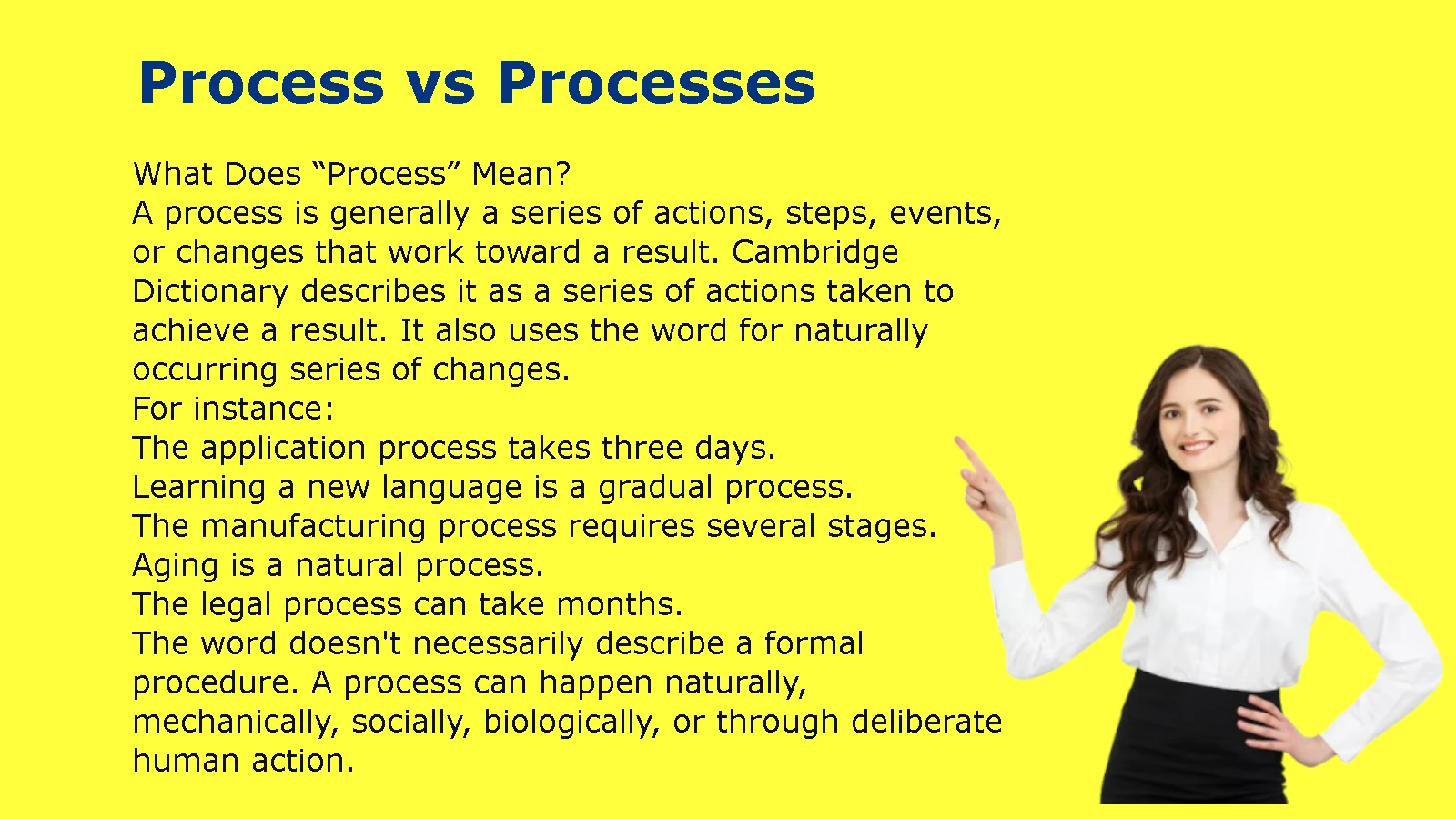
A process is generally a series of actions, steps, events, or changes that work toward a result. Cambridge Dictionary describes it as a series of actions taken to achieve a result. It also uses the word for naturally occurring series of changes.
For instance:
- The application process takes three days.
- Learning a new language is a gradual process.
- The manufacturing process requires several stages.
- Aging is a natural process.
- The legal process can take months.
The word doesn’t necessarily describe a formal procedure. A process can happen naturally, mechanically, socially, biologically, or through deliberate human action.
Process as a Singular Noun
When process functions as a noun, it can refer to one identifiable series of actions or changes.
For example:
The hiring process begins with an online application.
The sentence refers to one overall system for hiring employees. That system might contain several steps, but it remains one process when those steps form one connected sequence.
The same idea applies to:
The process of making bread involves several stages.
Although kneading, shaping, proofing, and baking are separate actions, they can collectively form one process.
This is why you shouldn’t automatically use processes just because a process contains many steps. The number of steps doesn’t determine whether the noun is singular or plural. The number of distinct processes does.
Process as a General Concept
Process can also describe a broad concept rather than one specific workplace procedure.
Examples include:
- the aging process
- the learning process
- the healing process
- the decision making process
- the creative process
- the grieving process
- the development process
In these examples, the word describes an overall progression or series of changes.
Cambridge specifically gives examples involving natural changes, such as the aging process.
So this sentence is correct:
Learning is a lifelong process.
You aren’t necessarily pointing to a single checklist. You’re describing learning as an ongoing progression.
What Does “Processes” Mean?
Processes has two major grammatical uses.
First, it is the plural noun of process. Second, it is the third person singular present tense of the verb process.
Dictionary.com lists processes as the plural of process.
Processes as a Plural Noun
Use processes when you mean two or more separate processes.
For example:
The factory uses several production processes.
Here, processes refers to multiple methods or operations.
Other examples include:
- Several biological processes occur simultaneously.
- The company reviewed its internal processes.
- Different manufacturing processes produce different results.
- These chemical processes require careful monitoring.
- The software automates several business processes.
Notice the words that often appear before processes:
- several
- many
- multiple
- various
- different
- these
- those
- all
These words naturally signal that you’re talking about more than one.
Processes as a Verb
Now consider:
The computer processes the information automatically.
Here, processes isn’t a plural noun. It’s a verb.
The subject is computer, which is singular. Therefore, the present tense verb takes the third person singular form processes.
The same pattern appears in:
- She processes customer requests.
- He processes the paperwork.
- The machine processes raw materials.
- The software processes the data.
- The bank processes payments electronically.
Cambridge lists process as a verb meaning to deal with something according to a particular set of actions. It also uses the verb for computers performing operations on information and for industrial treatment of materials.
Process vs. Processes as Nouns
When process and processes function as nouns, the distinction comes down to number.
Singular: Process
Use process when you mean one.
- a process
- the process
- this process
- one process
- each process
Examples:
This process requires careful planning.
The approval process takes five days.
Each process has a specific purpose.
Plural: Processes
Use processes when you mean more than one.
- several processes
- the processes
- these processes
- multiple processes
- different processes
- each of the processes
Examples:
These processes require additional testing.
Several processes occur during production.
The company needs to improve its internal processes.
The basic rule matches the general grammatical distinction between singular and plural nouns: singular refers to one, while plural refers to more than one.
Process vs. Processes Examples
A side by side comparison makes the difference easier to remember.
| Singular | Plural |
| The process is efficient. | The processes are efficient. |
| This process takes an hour. | These processes take an hour. |
| The process needs improvement. | The processes need improvement. |
| One process failed. | Several processes failed. |
| Each process has a purpose. | All processes have a purpose. |
| The manufacturing process is complex. | The manufacturing processes are complex. |
The verb in each sentence changes too.
With process as a singular noun, you might say:
The process is efficient.
With processes as a plural noun:
The processes are efficient.
This is an important clue. If processes acts as a plural noun, it normally takes a plural verb such as are, require, or work.
Process vs. Processes as Verbs
The situation changes when the words function as verbs.
Process With I, You, We, and They
Use the base verb process after:
- I
- you
- we
- they
- plural subjects
Examples:
I process the applications.
You process the orders.
We process payments every morning.
They process customer requests.
The employees process the documents.
Processes With He, She, and It
Use processes with a singular third person subject in the present tense.
Examples:
She processes the applications.
He processes the orders.
The machine processes the materials.
The system processes the data.
The company processes thousands of requests.
This follows the same basic pattern seen with many regular English verbs:
- work → works
- manage → manages
- handle → handles
- process → processes
Why “Processes” Can Be Confusing
The word processes can look identical whether it functions as a plural noun or a verb.
Compare:
The company’s internal processes need improvement.
Here, processes is a plural noun.
Now look at:
The company processes customer information.
Here, processes is a verb.
The easiest way to tell the difference is to look at the sentence structure.
If processes names things, it is probably a plural noun.
If processes describes what a singular subject does, it is a verb.
Process vs. Processes in Common Contexts
The words appear across many fields. The underlying grammar doesn’t change, but the meaning can become more specialized.
Business and Workplace
Business writing uses process constantly.
Common expressions include:
- hiring process
- recruitment process
- approval process
- payment process
- onboarding process
- production process
- business process
- internal processes
For example:
The hiring process includes three interviews.
This refers to one overall hiring system.
But:
The company is reviewing its hiring and onboarding processes.
Now two distinct systems are involved.
The distinction matters in workplace documents because confusing singular and plural forms can make a sentence unclear.
Science and Biology
Science frequently uses process to describe a natural sequence of changes.
Examples include:
- biological process
- chemical process
- cellular process
- digestive process
- aging process
- evolutionary process
When scientists discuss several distinct mechanisms, they use processes.
For example:
Photosynthesis is a complex biological process.
But:
Several biological processes contribute to plant growth.
The first sentence focuses on one process. The second discusses multiple processes.
Technology and Computing
In computing, process can refer to a running program or a series of operations performed by a computer system.
Examples:
The operating system manages each process.
Several background processes are running.
The verb also appears frequently:
The server processes thousands of requests per second.
Here, processes means that the server performs operations on those requests.
Manufacturing
Manufacturing provides another clear example.
A company may have one production process for a particular product.
However, a large facility may use multiple production processes for different materials or products.
For example:
The production process has five stages.
versus:
The facility uses different production processes for steel and aluminum.
The difference isn’t about how complicated the operation is. It depends on whether the sentence identifies one process or several distinct processes.
Law and Government
The word process also appears frequently in legal and government contexts.
Examples include:
- legal process
- application process
- approval process
- court process
- administrative process
For instance:
The legal process can take several months.
If you discuss several separate systems, you can use the plural:
The agency is updating its administrative processes.
The noun remains singular when the entire system is treated as one connected process.
Common Mistakes With Process and Processes
Most errors involving process vs. processes come from treating the words as interchangeable. They aren’t.
Mistake: Using “Processes” for One Process
Incorrect:
The approval processes is complicated.
Correct:
The approval process is complicated.
The subject here is one approval process. Therefore, process is the correct noun.
Mistake: Using “Process” for Multiple Processes
Incorrect:
Several business process need improvement.
Correct:
Several business processes need improvement.
The word several tells you that more than one process exists.
Mistake: Confusing the Noun and Verb
Consider:
The software processes data.
Some writers mistakenly treat processes as a plural noun because it ends in es. But that’s not what’s happening.
Software is the singular subject. Processes is the verb.
Compare:
The software processes data.
The software systems process data.
When the subject changes from singular to plural, the verb changes too.
Mistake: Ignoring Subject Verb Agreement
Incorrect:
The machine process the material.
Correct:
The machine processes the material.
Why? Machine is singular.
Now compare:
The machines process the material.
Here, machines is plural, so the base verb process is correct.
This pattern is worth remembering because it applies far beyond this particular word.
Process vs. Processes in Sentences
Paired sentences can reveal the distinction better than definitions alone.
Singular Noun
The application process takes two weeks.
One application system is being discussed.
Plural Noun
The application and approval processes take two weeks.
Two distinct processes are being discussed.
Singular Verb
The system processes applications automatically.
The singular subject system performs the action.
Plural Verb
The systems process applications automatically.
The plural subject systems takes the base verb.
Another Useful Comparison
The process is designed to reduce errors.
The processes are designed to reduce errors.
The software processes the records.
The employees process the records.
The spelling tells only part of the story. Sentence structure tells you what the word is doing.
A Simple Way to Choose Between Process and Processes
When you’re unsure, use this three step check.
Step One: Ask How Many?
Are you talking about one process?
Use process.
Are you talking about two or more?
Use processes.
For example:
One process
Three processes
Step Two: Ask Whether It’s a Noun or Verb
If the word names a procedure or series of actions, it is a noun.
If the word describes an action performed by a singular subject, it is a verb.
Compare:
The processes are different.
Noun.
The machine processes the materials.
Verb.
Step Three: Check the Subject
If processes is a verb, find the subject.
A singular subject normally takes processes:
The computer processes the data.
A plural subject takes process:
The computers process the data.
This quick check catches most errors.
Process vs. Processes: A Practical Case Study
Imagine a company that receives online orders.
The company has one overall order process. That process might include receiving an order, checking payment, preparing the item, and shipping it.
A sentence describing the whole system might say:
The company’s order process is efficient.
Now imagine that the company has separate processes for online orders, wholesale orders, and international orders.
The sentence changes:
The company uses three different order processes.
Finally, consider what the software does:
The system processes online orders automatically.
The same root word appears three times, but each form serves a different purpose:
| Sentence | Word | Function |
| The order process is efficient. | process | Singular noun |
| The company uses different order processes. | processes | Plural noun |
| The system processes orders automatically. | processes | Singular verb |
This is the key distinction behind the entire process vs. processes question.
Process vs. Processes Pronunciation
Pronunciation can create another layer of confusion.
In American English, dictionaries record more than one pronunciation for process, including pronunciations beginning with the vowel sound represented by prɑ and another represented by proʊ. Cambridge lists both American pronunciations.
The plural processes adds another syllable.
Dictionary.com lists several pronunciations for processes, reflecting variation in English usage.
The important point for writing is that pronunciation doesn’t change the grammatical distinction.
Whether someone says process one way or another, the written forms still follow the same rules:
- process = singular noun or base verb
- processes = plural noun or third person singular present verb
Process vs. Processes vs. Processing
Another related word often causes confusion: processing.
These three forms have different grammatical jobs.
| Word | Main function | Example |
| process | Singular noun or base verb | The process is simple. |
| processes | Plural noun or singular verb | The system processes data. |
| processing | Present participle or gerund | Data processing takes time. |
Processing isn’t the plural of process. It’s a form of the verb process and can also function as a noun.
For example:
The bank is processing the application.
Here, processing is part of the verb phrase.
In:
Data processing requires specialized software.
Processing functions as a noun.
Cambridge defines processing in contexts such as handling documents, performing computer operations, and treating materials.
So don’t write processings simply because you mean more than one process. In ordinary usage, the plural noun is processes.
Process vs. Processes vs. Procedure
Process and procedure overlap in meaning, but they’re not always interchangeable.
A process generally emphasizes a series of actions, stages, or changes that lead toward an outcome.
A procedure tends to emphasize a particular method or established way of carrying something out.
For example:
The hiring process takes several weeks.
This describes the broader sequence from application to employment.
But:
The interview procedure requires two interviewers.
This focuses on a specific established method.
Dictionary.com defines procedure in terms of a particular course or mode of action, while process can refer to a series of progressive and connected steps.
The distinction becomes especially useful in technical, business, and policy writing.
Common Expressions With “Process”
Some common expressions use process in the singular because they refer to one overall activity or progression.
Examples include:
- the hiring process
- the application process
- the learning process
- the aging process
- the legal process
- the decision making process
- the manufacturing process
- the approval process
- the creative process
- the recruitment process
For example:
The application process is straightforward.
The learning process takes time.
The legal process can be complicated.
The singular form works because each expression refers to one overall concept or system.
Common Expressions With “Processes”
Use processes when the context identifies several separate systems, mechanisms, or operations.
Examples include:
- business processes
- biological processes
- chemical processes
- manufacturing processes
- internal processes
- administrative processes
- natural processes
- cognitive processes
- production processes
- operating processes
For example:
Several biological processes affect plant growth.
The company needs to streamline its internal processes.
Different chemical processes can produce different compounds.
Again, the deciding factor is number.
Process vs. Processes: Quick Grammar Test
Choose process, processes, or the appropriate verb form in each sentence.
- The hiring ___ takes three weeks.
- Several manufacturing ___ operate at this facility.
- The computer ___ thousands of records every minute.
- These ___ require additional testing.
- We ___ customer applications every morning.
- The company ___ payment requests automatically.
- Each ___ follows the same basic structure.
- The laboratory uses several testing ___.
- The approval ___ has been updated.
- The machines ___ raw materials continuously.
Answer Key
- process
One hiring process is being discussed. - processes
Several indicates more than one. - processes
Computer is singular, so the verb takes processes. - processes
These indicates multiple processes. - process
We takes the base verb. - processes
Company is singular, so the verb takes processes. - process
Each refers to one at a time. - processes
Several requires the plural noun. - process
One approval process is being discussed. - process
Machines is plural, so the base verb is required.
Frequently Asked Questions About Process vs. Processes
Is “processes” the plural of “process”?
Yes. Processes is the standard plural form of the noun process. Dictionary.com explicitly lists processes as the plural of process.
Is “process” singular or plural?
Process is singular when it functions as a noun.
For example:
The process is complete.
The sentence refers to one process.
Is “processes” singular or plural?
As a noun, processes is plural.
For example:
The processes are complete.
However, processes can also be a singular verb:
The machine processes the data.
What is the plural of process?
The plural of process is processes.
For example:
- one process
- two processes
- several processes
- many processes
Is “processes” a verb?
Yes. Processes is the third person singular present form of the verb process.
For example:
The software processes the information.
Should you say “the process” or “the processes”?
Use the process when referring to one process.
Use the processes when referring to multiple processes.
Compare:
The hiring process is efficient.
The hiring and onboarding processes are efficient.
Which is correct: “the process is” or “the process are”?
The process is is correct because process is singular.
Example:
The process is almost complete.
For the plural:
The processes are almost complete.
Which is correct: “the system process” or “the system processes”?
It depends on the meaning.
If process is a noun:
The system process requires attention.
If processes is a verb:
The system processes the information.
The second sentence is much more common when you mean that the system performs an action.
Is “process” a noun or a verb?
It can be both.
As a noun:
The process takes time.
As a verb:
We process the applications.
This flexibility is one reason the word appears in so many different sentence structures.
Is “processes” always plural?
No. When processes functions as a noun, it is plural. But it can also be the singular present tense form of the verb process.
Compare:
The processes are automated.
Plural noun.
The software processes the files.
Singular verb.
Process vs. Processes: Final Verdict
The difference between process vs. processes becomes easy once you identify what the word is doing in the sentence.
Process is the singular noun:
The hiring process is lengthy.
Processes is the plural noun:
The company has several hiring processes.
Processes is also the third person singular present form of the verb:
The system processes applications automatically.
The most useful rule is simple:
One process = process. More than one = processes. One singular subject doing the action = processes.
When you’re unsure, don’t focus only on the spelling. Look at the whole sentence. Ask whether you’re naming one procedure, describing multiple procedures, or saying that one subject performs an action.
Once you make that distinction, choosing between process and processes is straightforward.