Have you ever wondered whether you should say “scissors” or “scissor” when talking about the tool used for cutting paper, fabric, or other materials? The difference between Scissors vs Scissor can be confusing because scissors is normally treated as a plural noun, even though it refers to a single cutting tool.
Scissors is the standard word for the handheld cutting tool with two blades joined in the middle. Scissor can also be correct, but it is usually used as a verb meaning to cut or move like scissors, or as an adjective in certain terms such as scissor kick.
Examples:
- I need a pair of scissors to cut this paper.
- She used her scissors to trim the fabric.
- The blades scissor through the material.
The confusion is understandable. People often search for scissors vs scissor, is scissor a word, is scissors singular or plural, or scissor vs scissors because the word behaves differently from many ordinary nouns. You may also wonder whether it is correct to say “a scissor” or “a pair of scissors.”
In this guide, you’ll learn the complete difference between Scissors vs Scissor, including their meaning, grammar, correct usage, examples in sentences, and whether scissors is singular or plural. You’ll also discover when to use scissor, why we say a pair of scissors, and the common mistakes to avoid.
Scissors vs. Scissor: What’s the Difference?
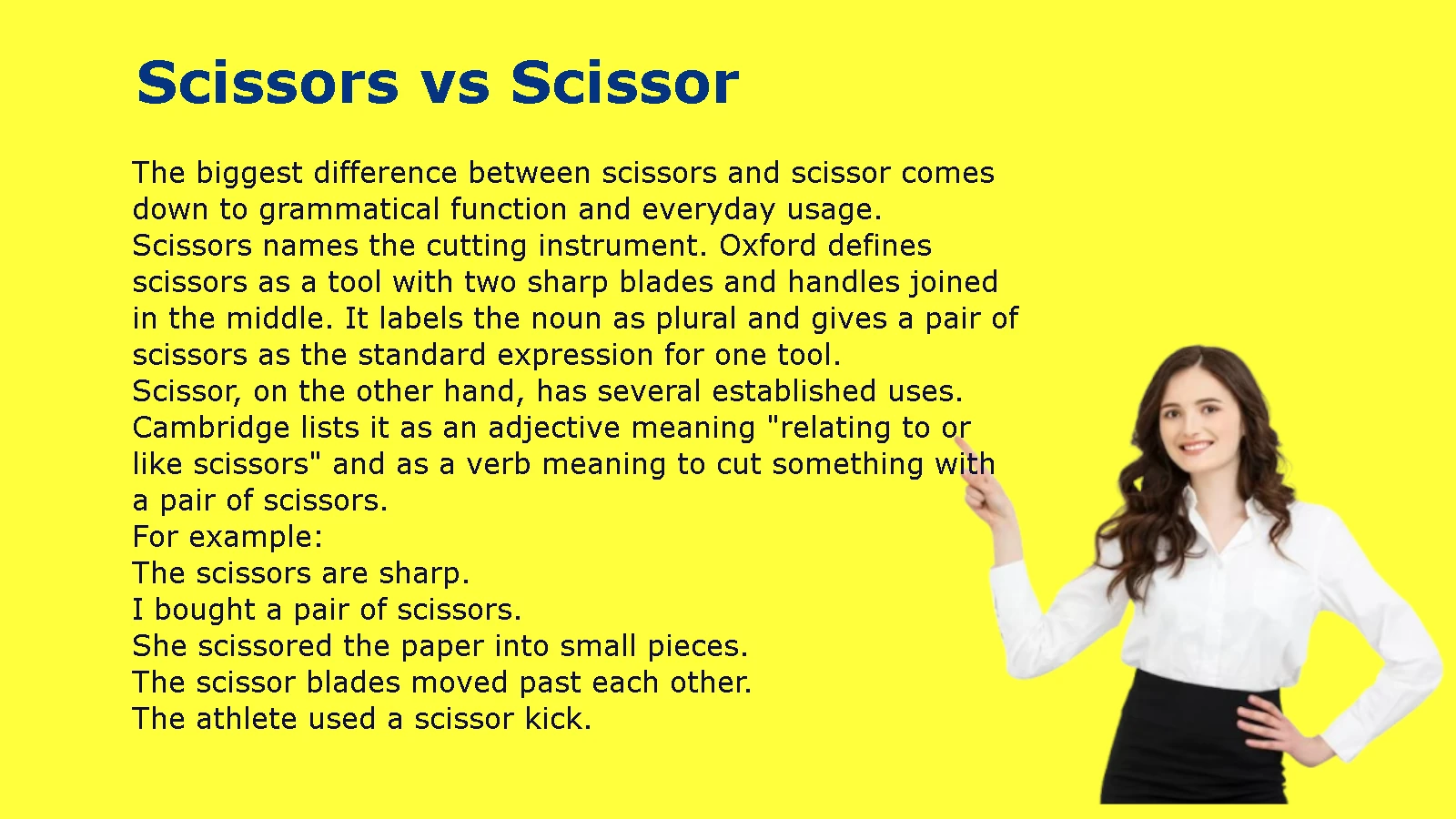
The biggest difference between scissors and scissor comes down to grammatical function and everyday usage.
Scissors names the cutting instrument. Oxford defines scissors as a tool with two sharp blades and handles joined in the middle. It labels the noun as plural and gives a pair of scissors as the standard expression for one tool.
Scissor, on the other hand, has several established uses. Cambridge lists it as an adjective meaning “relating to or like scissors” and as a verb meaning to cut something with a pair of scissors.
For example:
- The scissors are sharp.
- I bought a pair of scissors.
- She scissored the paper into small pieces.
- The scissor blades moved past each other.
- The athlete used a scissor kick.
This means you shouldn’t think of scissor simply as the singular version of scissors. That shortcut doesn’t explain how English speakers actually use the words.
Quick Comparison of Scissors and Scissor
| Feature | Scissors | Scissor |
| Names the ordinary cutting tool | Yes | Sometimes listed as a noun, but not the usual everyday choice |
| Common everyday noun | Yes | No |
| Can work as a verb | No | Yes |
| Can work as an adjective/modifier | Less common | Yes |
| Usually used with a pair of | Yes | No |
| Example | These scissors are new. | She scissored the paper. |
The distinction matters because a word can exist in a dictionary without being the most natural choice in ordinary conversation.
What Does “Scissors” Mean?
Scissors refers to a cutting tool made from two blades joined at a central pivot. Each blade normally has a handle with a finger opening, allowing the blades to open and close against each other.
People use scissors to cut materials such as:
- Paper
- Fabric
- Hair
- Cardboard
- Thread
- Tape
- Food packaging
- Other lightweight materials
Cambridge defines scissors as a device with two sharp blades joined in the middle and handles with holes for the fingers. Oxford similarly describes scissors as a tool with two sharp blades and handles joined together.
Here are some natural examples:
Please pass me the scissors.
These scissors are very sharp.
I used scissors to cut the paper.
The scissors are in the kitchen drawer.
Notice something important: the word remains scissors even when you’re talking about only one physical tool.
That’s where English gets a little quirky.
Is “Scissors” Singular or Plural?
In standard usage, scissors is plural in form. Oxford labels the ordinary noun as plural, while Cambridge also labels it noun [plural].
Merriam Webster adds an important nuance: scissors is plural in form but can be singular or plural in construction, depending on the sense and usage.
For the ordinary cutting tool, the safest everyday pattern is:
The scissors are sharp.
Not:
The scissors is sharp.
Consider these examples:
| Sentence | Standard everyday usage |
| The scissors are on the table. | ✅ |
| These scissors are sharp. | ✅ |
| Where are the scissors? | ✅ |
| The scissors is on the table. | ❌ |
| This scissors is sharp. | ❌ |
The apparent contradiction is easy to understand. Scissors refers to one physical object, but the word itself behaves like a plural noun in ordinary use.
English has several words that create similar situations.
For example:
- The pants are clean.
- My glasses are broken.
- The pliers are in the toolbox.
- The tongs are beside the stove.
You don’t normally create a singular form of these words by simply removing the final s.
The same principle applies to scissors.
Why Do We Say “A Pair of Scissors”?
The phrase a pair of scissors gives English speakers a way to identify one complete tool while keeping the established plural form scissors.
This construction works because pair becomes the grammatical head of the phrase.
Compare:
A pair of scissors is on the desk.
Here, pair is singular. Therefore, the verb is is.
Now compare:
Two pairs of scissors are on the desk.
Here, pairs is plural. Therefore, the verb becomes are.
The pattern looks like this:
| Number | Correct expression | Verb |
| One tool | a pair of scissors | is |
| Two tools | two pairs of scissors | are |
| Several tools | several pairs of scissors | are |
This distinction becomes particularly useful in formal writing.
Examples With “A Pair of Scissors”
- I need a pair of scissors.
- She bought a new pair of scissors.
- This pair of scissors is very sharp.
- He left a pair of scissors on the desk.
- Can you bring me a pair of scissors?
When the sentence begins with this pair, use is:
This pair of scissors is expensive.
When it begins with these scissors, use are:
These scissors are expensive.
The grammatical head changes the verb.
Is “A Scissor” Correct?
This is where the answer requires a little more care.
In ordinary American English, a scissor is not the normal way to refer to one cutting tool. The natural expression is a pair of scissors.
So if you’re writing an email, school assignment, article, instruction manual, or everyday conversation, choose:
I need a pair of scissors.
rather than:
I need a scissor.
However, saying that scissor isn’t a real word would be inaccurate.
Merriam Webster lists scissor as a noun with the definition scissors, as well as a verb meaning to cut with scissors or shears. Its dictionary record also gives the noun’s first known use as the 15th century.
Collins likewise records scissor as a noun in American English and notes its use for scissors, particularly in attributive constructions.
So there are two different questions:
Is “scissor” a real word?
Yes.
Should you normally say “a scissor” when referring to one everyday cutting tool?
No. A pair of scissors is the natural choice.
That distinction is important because dictionary possibility and everyday idiomatic usage aren’t always identical.
What Does “Scissor” Mean?
Scissor has several legitimate uses in English.
The most important ones are its verb and adjective uses.
“Scissor” as a Verb
As a verb, scissor means to cut something with scissors. Merriam Webster defines it as cutting, cutting up, or cutting off with scissors or shears.
For example:
She scissored the paper into strips.
The designer scissored the fabric along the marked line.
He scissored the photograph out of the magazine.
The verb has several forms:
| Form | Example |
| Base form | scissor |
| Present tense | scissors |
| Past tense | scissored |
| Present participle | scissoring |
Cambridge also records a second verb sense involving movement in a pattern where lines or limbs cross each other.
For example, writing about movement:
The athlete’s legs scissored through the air.
That use has nothing to do with treating scissor as the ordinary singular noun for the tool.
“Scissor” as an Adjective
Scissor can also modify another noun.
Cambridge gives examples such as scissor blade and scissor action. Oxford also lists scissor as an adjective used before a noun, with scissor action as an example.
Common examples include:
- scissor blade
- scissor action
- scissor movement
- scissor kick
- scissor lift
- scissor hold
In these phrases, scissor tells you that something relates to or resembles the movement or structure of scissors.
For example:
The blades moved in a scissor action.
Here, scissor describes the action. It doesn’t name one cutting tool.
“Scissor” as a Noun
The noun scissor exists in dictionaries, too.
Merriam Webster gives scissor as a noun meaning scissors.
Collins also records the noun, including the meaning a pair of scissors in American English.
That doesn’t mean you should replace scissors with scissor in every sentence.
Language depends on convention as much as dictionary definitions. In everyday American English, most speakers naturally say:
Pass me the scissors.
or:
Pass me a pair of scissors.
They don’t normally reach for the phrase:
Pass me a scissor.
The first two sound ordinary. The last one sounds unusual.
Scissors vs. Scissor in Example Sentences
Seeing the words in context makes the difference much easier to remember.
| Word or phrase | Example | Why it works |
| scissors | The scissors are on the table. | Names the cutting tool |
| scissors | These scissors are sharp. | Plural form takes plural agreement |
| a pair of scissors | I bought a pair of scissors. | Refers to one complete tool |
| pairs of scissors | We need three pairs of scissors. | Refers to multiple tools |
| scissor | She scissored the paper. | Verb meaning cut with scissors |
| scissor | The blades moved in a scissor action. | Adjective/modifier |
| scissor | The machine uses a scissor mechanism. | Describes a mechanism resembling scissors |
| scissor kick | The athlete performed a scissor kick. | Established compound expression |
The safest rule is straightforward: use scissors for the tool and scissor when the sentence requires the verb or modifier.
Common Grammar Mistakes With Scissors and Scissor
Because scissors looks plural but refers to one physical object, it creates several predictable mistakes.
“The Scissors Is” vs. “The Scissors Are”
For the ordinary cutting tool, use are.
The scissors are on the desk. ✅
The scissors is on the desk. ❌
Oxford and Cambridge both treat the ordinary noun as plural.
The easiest way to remember this is to treat scissors like other plural only nouns.
“A Scissor” vs. “A Pair of Scissors”
When you want to count one ordinary pair of scissors, use:
a pair of scissors
For example:
She bought a pair of scissors for the craft project.
Don’t normally write:
She bought a scissor for the craft project.
Although dictionaries recognize scissor as a noun, a pair of scissors remains the clearest and most natural everyday expression.
“This Scissors” vs. “These Scissors”
Because scissors normally behaves as plural, use these rather than this when directly referring to the tool.
These scissors are sharp. ✅
This scissors is sharp. ❌
If you want a singular demonstrative, change the construction:
This pair of scissors is sharp. ✅
Now pair controls the grammar.
“This Pair of Scissors Is” vs. “These Scissors Are”
These two sentences may describe exactly the same physical object:
This pair of scissors is new.
These scissors are new.
Both can work because they use different grammatical structures.
In the first sentence, pair is singular.
In the second, scissors is plural.
This is one of the most useful patterns to learn.
“Two Scissors” vs. “Two Pairs of Scissors”
When counting separate tools, two pairs of scissors is the standard clear construction.
We need two pairs of scissors.
This tells the reader that you mean two complete cutting tools.
For everyday writing, that expression avoids ambiguity and follows the normal countable construction for this plural form.
Why Is “Scissors” Plural?
The history of scissors helps explain why the modern word looks strange.
Merriam Webster traces the word through Middle English and Middle French to the Latin caedere, meaning to cut.
Merriam Webster’s explanation of the word’s history is especially useful because it shows that the plural form wasn’t simply created because someone decided that two blades must require a plural noun. The word entered English with a plural form that eventually became established for the single cutting instrument.
According to that historical explanation, the Latin form referred to a cutting instrument. The French form developed a plural shape, and English later adopted the plural form scissors for the tool. The word appeared in English by the 15th century.
That history explains an important point:
The word’s plural appearance doesn’t mean English speakers are talking about two separate tools.
The plural form became the normal name for one tool.
That’s why saying scissor is the singular form of scissors can be misleading. Modern English doesn’t normally operate that way.
Scissors and Other Plural Only Nouns
Scissors belongs to a broader group of English nouns that can describe one physical object while appearing in a plural form.
Examples include:
- pants
- trousers
- shorts
- glasses
- pliers
- tongs
- tweezers
- scissors
Consider the pattern:
| Noun | Example |
| scissors | The scissors are sharp. |
| pants | My pants are clean. |
| glasses | Her glasses are on the table. |
| pliers | The pliers are in the toolbox. |
| tongs | The tongs are beside the grill. |
You wouldn’t normally invent a singular noun simply by removing the final s.
For example, pant and glas don’t work as ordinary singular equivalents for pants and glasses. Likewise, scissor doesn’t function as the normal everyday singular equivalent of scissors.
Instead, English uses constructions such as a pair of.
When Should You Use “Scissors”?
Use scissors when you’re referring to the actual cutting tool.
Typical situations include:
- Asking someone to hand you the tool.
- Describing where the tool is.
- Talking about its condition.
- Explaining how to use it.
- Referring to different types of cutting scissors.
- Talking about several tools in a classroom, workshop, salon, or kitchen.
Examples:
The scissors are in the drawer.
Please use these scissors for the fabric.
Where did you put the scissors?
These scissors don’t cut very well.
She used kitchen scissors to open the package.
The hairstylist cleaned the scissors after the appointment.
Oxford’s examples include constructions such as these scissors and phrases describing scissors as sharp, blunt, or used for specific materials.
Types of Scissors
The word scissors also appears in many specific compound expressions:
- kitchen scissors
- nail scissors
- hair cutting scissors
- fabric scissors
- left handed scissors
- pinking scissors
- craft scissors
In each case, scissors remains the name of the tool.
When Should You Use “Scissor”?
Use scissor when its grammatical role calls for something other than the ordinary noun naming the tool.
Use “Scissor” as a Verb
Choose scissor when you mean to cut with scissors.
Examples:
She scissored the paper into narrow strips.
The tailor scissored along the marked line.
He scissored the photograph out of the page.
The verb can also describe a crossing or opening and closing movement:
The gymnast’s legs scissored through the air.
Cambridge records both the cutting sense and the movement sense.
Use “Scissor” as a Modifier
Use scissor before a noun when you want to describe something connected with scissors or resembling their movement.
Examples include:
- scissor blade
- scissor action
- scissor kick
- scissor movement
- scissor lift
- scissor mechanism
Oxford specifically records scissor as an adjective used before nouns, while Cambridge gives scissor blade and scissor action as examples.
Scissors vs. Scissor in American English
For American English, the practical rule remains simple.
If you’re naming the common cutting tool, use scissors.
I need scissors.
If you’re referring to one complete tool in a countable construction, use a pair of scissors.
I need a pair of scissors.
If you’re describing an action performed with scissors, scissor can work as a verb.
She scissored the paper into pieces.
If you’re describing something related to scissors, scissor can work as a modifier.
The machine uses a scissor mechanism.
This approach fits the usage recorded by major dictionaries. Cambridge lists scissors as a plural noun and scissor as an adjective and verb. Merriam Webster records scissor as both a noun and verb.
The important point isn’t that one word is “correct” and the other is “wrong.” They serve different grammatical purposes.
Scissors vs. Scissor Pronunciation
The words also differ slightly in pronunciation.
In American English:
- scissors: /ˈsɪzərz/
- scissor: /ˈsɪzər/
Cambridge gives the American pronunciation of scissors as /ˈsɪz.ɚz/ and scissor as /ˈsɪz.ɚ/.
The main difference is the final z sound in scissors.
You can think of the contrast like this:
scissor → SIZ er
scissors → SIZ erz
When people speak quickly, the difference may sound small. Context usually makes the intended word clear.
Scissor commonly works as a verb or modifier. It also has dictionary recorded noun uses.
Shears refers to cutting tools and can describe larger or specialized scissors, particularly in contexts such as gardening, tailoring, or cutting hair.
For example:
- She used scissors to cut the paper.
- The gardener used pruning shears.
- The blades moved in a scissor action.
The word scissor can also appear in technical terms such as scissor lift, where it describes the crossing, folding mechanism used to raise the platform.
So don’t treat the three words as simple grammatical variations.
A Practical Case Study: Choosing the Right Word
Imagine you’re writing instructions for a classroom craft project.
You want students to cut a sheet of paper.
Which sentence sounds natural?
Take a scissor and cut along the line.
It may be understandable, but it doesn’t sound natural in standard everyday American English.
A better version is:
Take a pair of scissors and cut along the line.
You could also write:
Use scissors to cut along the line.
Now imagine you’re describing the action itself:
She scissored the paper into several strips.
Here, scissored works because you’re using scissor as a verb.
Finally, suppose you’re describing the tool’s movement:
The blades moved in a scissor action.
Here, scissor works as a modifier.
The physical object hasn’t changed. The grammatical job of the word has changed.
That’s the key.
Scissors vs. Scissor: Quick Comparison
| Question | Best answer |
| What do you call the cutting tool? | Scissors |
| How do you refer to one complete tool? | A pair of scissors |
| How do you refer to several complete tools? | Two pairs of scissors |
| Does scissor exist as a word? | Yes |
| Can scissor be a verb? | Yes |
| Can scissor modify another noun? | Yes |
| Is a scissor the normal everyday expression? | No |
| Should you say “the scissors are”? | Yes, for the ordinary cutting tool |
| Should you say “this pair of scissors is”? | Yes |
| Should you say “these scissors are”? | Yes |
Common Questions About Scissors vs. Scissor
Is “scissor” the singular of “scissors”?
Not in the normal everyday sense.
English generally uses scissors for the cutting tool and a pair of scissors when it needs to identify one complete tool.
Although dictionaries record scissor as a noun meaning scissors, calling it simply “the singular of scissors” oversimplifies actual usage.
Can you say “a scissor”?
You may encounter scissor as a noun in dictionary records, but a scissor is not the normal everyday expression for the cutting tool in American English.
Use:
a pair of scissors
instead.
Is “scissors” always plural?
For the ordinary cutting tool, scissors is plural in form and normally takes a plural verb:
The scissors are sharp.
However, Merriam Webster notes that scissors can be singular or plural in construction in different senses and uses.
So “always plural” works as a useful everyday grammar rule for the physical tool, but it doesn’t capture every dictionary recorded use of the word.
Is it “the scissors is” or “the scissors are”?
For the ordinary cutting tool, use:
The scissors are on the table.
The plural form scissors normally takes are.
Is “a pair of scissors” singular or plural?
A pair of scissors is grammatically singular because pair is singular.
Therefore:
A pair of scissors is on the desk.
The word scissors remains plural inside the phrase, but the main noun is pair.
What is the plural of “a pair of scissors”?
Use:
two pairs of scissors
For example:
The teacher bought two pairs of scissors for the classroom.
Is “scissor” a real word?
Yes.
Major dictionaries recognize scissor as a real English word. It can function as a noun, a verb, and an adjective or modifier depending on the dictionary and usage.
Its verb uses include cutting with scissors and describing crossing movements. Its modifier use appears in phrases such as scissor blade and scissor action.
Which is correct: “scissor” or “scissors”?
It depends on what you’re trying to say.
Use scissors when naming the cutting tool:
The scissors are sharp.
Use scissor as a verb:
She scissored the paper.
Use scissor as a modifier:
The scissor blades crossed.
Use a pair of scissors when you want to refer clearly to one tool:
I bought a pair of scissors.
Final Answer: Scissors or Scissor?
The difference between scissors vs. scissor becomes much easier once you stop thinking of scissor as simply the singular form of scissors.
Scissors is the standard everyday noun for the cutting tool. It has a plural form even when it refers to one physical object, so you normally say:
The scissors are sharp.
When you want to count one tool, say:
A pair of scissors is on the table.
Scissor is also a legitimate English word, but it has different grammatical roles. It can act as a verb meaning to cut with scissors, as in:
She scissored the paper into strips.
It can also work as a modifier, as in:
Major dictionaries support these distinctions. Oxford and Cambridge identify scissors as the standard plural noun for the cutting tool, while Cambridge records scissor as a verb and adjective. Merriam Webster also records scissor as a noun and verb.
The easiest rule to remember is this:
Once that pattern clicks, scissors vs. scissor stops being a tricky grammar question and becomes a simple matter of choosing the word that fits the sentence.