Submission vs Submitting comes down to the difference between a noun and a verb form. Submission refers to the act of presenting something for consideration or to the item being presented, while submitting describes the action of providing something or can name that action within a sentence. Both words relate to the verb submit, but they fit different grammatical structures.
Understanding submission meaning, submitting meaning, and the difference between submit and submission helps you write clearer emails, academic assignments, job applications, and business documents. These words also appear in phrases such as submission date, submission of a document, and submission vs. submittal. Although they share a root, each expression serves a different purpose.
This guide explains when to use each word, compares real-world examples, and clears up common confusion between submit and summit.
Submission vs Submitting: What’s the Difference?
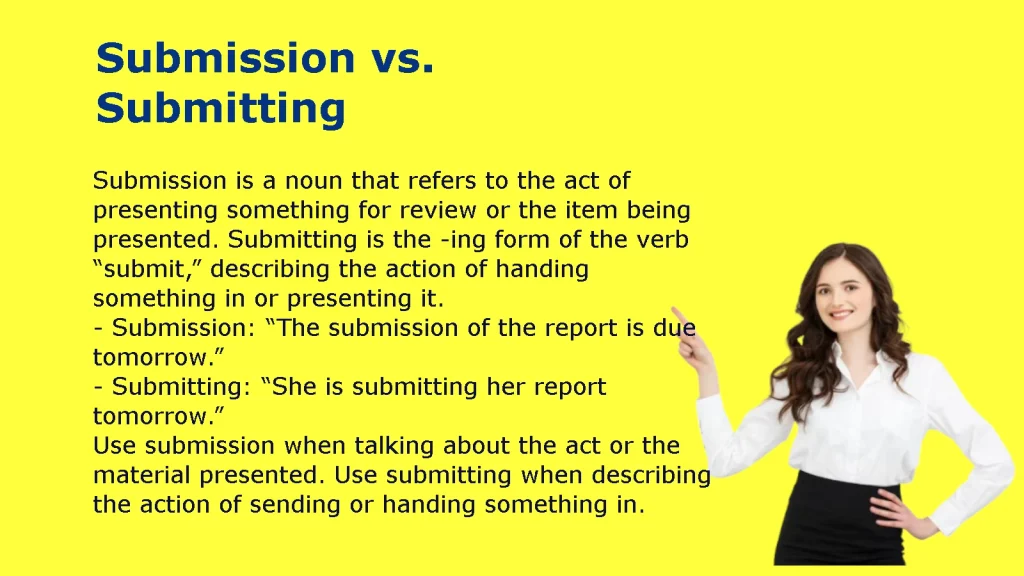
Submission is a noun that refers to the act of presenting something or the thing presented. Submitting is the -ing form of the verb submit. It appears in continuous tenses, such as “She is submitting the report,” and in gerund phrases, such as “Submitting the report takes time.”
The main difference is grammatical: submission names an act or item, while submitting usually expresses an action or treats that action as a noun.
Submission vs Submitting at a Glance
| Feature | Submission | Submitting |
| Part of speech | Noun | Verb form; also a gerund |
| Basic meaning | The act of submitting or an item submitted | The action of submitting |
| Common use | Documents, applications, proposals, assignments | Ongoing actions, instructions, and activities |
| Example | Your submission is complete. | She is submitting her application. |
| Common phrase | Submission deadline | Submitting an application |
| Can refer to a document? | Yes | No, not by itself |
| Can describe an ongoing action? | Not directly | Yes |
Consider these examples:
- Submission: The professor reviewed my submission yesterday.
- Submitting: I am submitting my assignment before the deadline.
- Submission: The submission contains three supporting documents.
- Submitting: Submitting all the required documents may take several minutes.
In the first and third examples, submission identifies an item or act. In the second and fourth, submitting describes an action or activity.
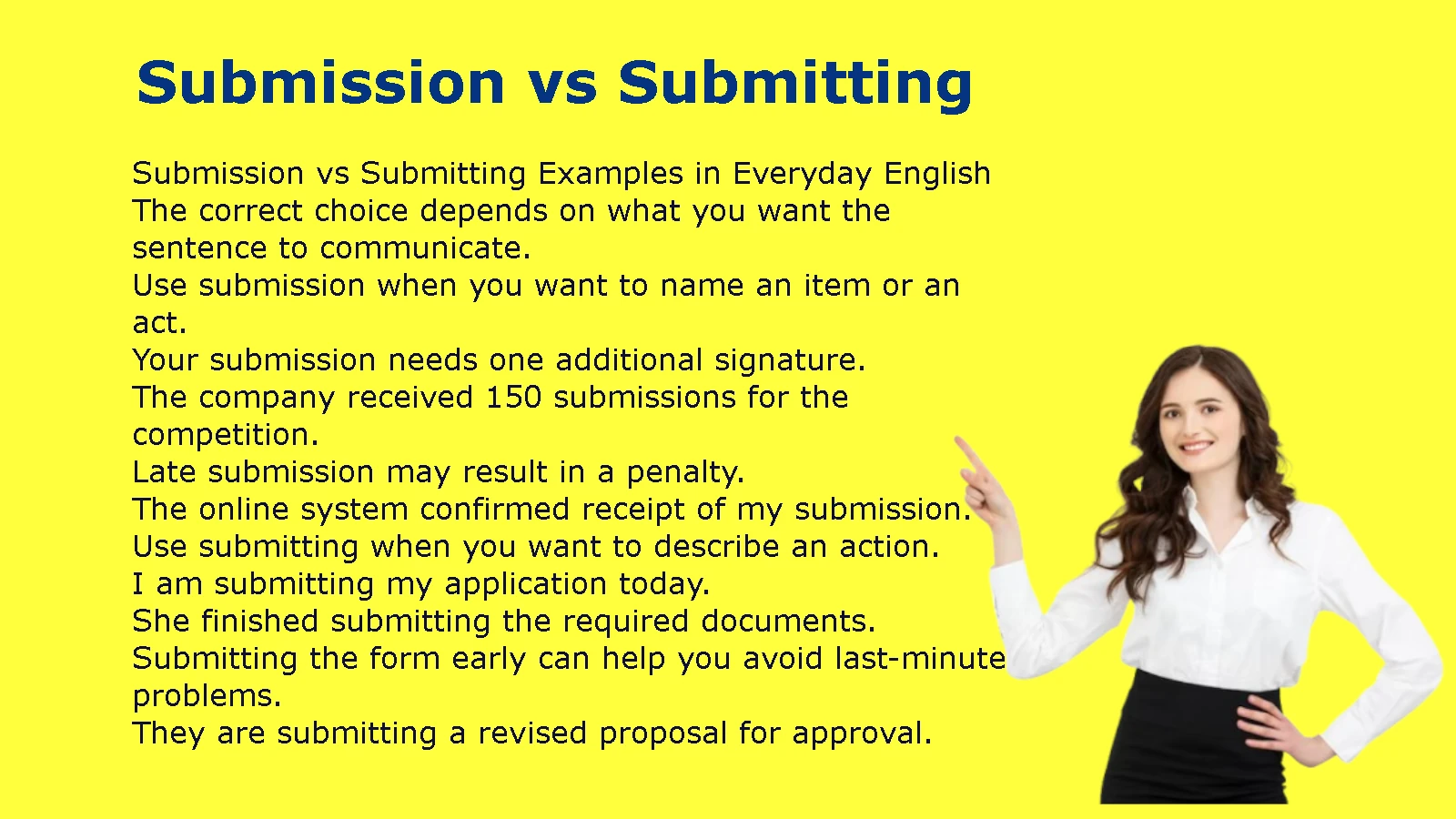
Submission vs Submitting Examples in Everyday English
The correct choice depends on what you want the sentence to communicate.
Use submission when you want to name an item or an act.
- Your submission needs one additional signature.
- The company received 150 submissions for the competition.
- Late submission may result in a penalty.
- The online system confirmed receipt of my submission.
Use submitting when you want to describe an action.
- I am submitting my application today.
- She finished submitting the required documents.
- Submitting the form early can help you avoid last-minute problems.
- They are submitting a revised proposal for approval.
A useful test is to replace the word with the act of submitting. If the sentence still makes sense, you may be using a gerund. If you mean a specific file, application, or proposal, submission will often be the better choice.
Submission Meaning and Examples
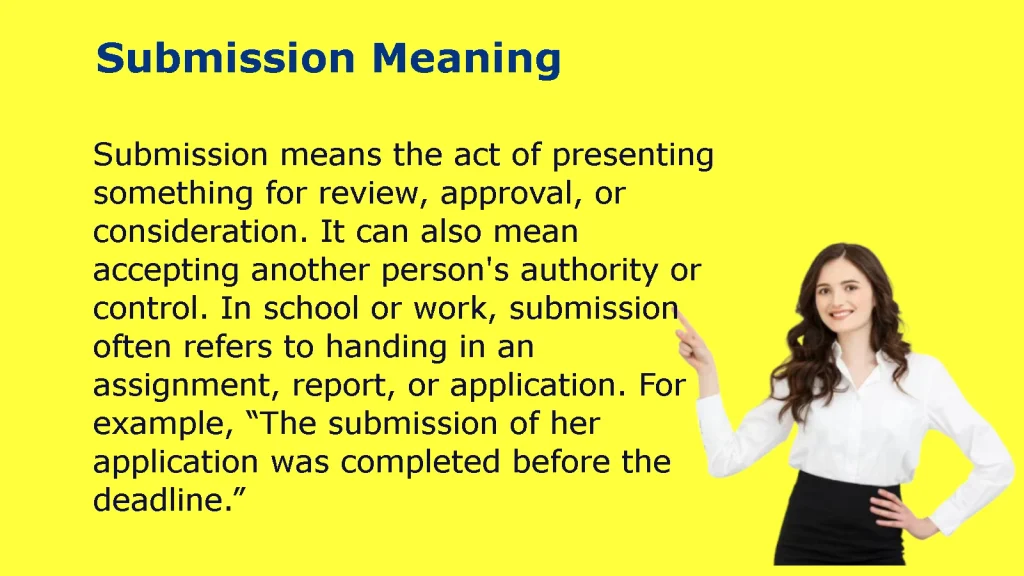
Submission is a noun with two major groups of meanings. In academic, business, and administrative settings, it usually means presenting something for review or consideration. In other contexts, it can mean yielding to authority, control, or another person’s demands.
The surrounding words usually make the intended meaning clear.
What Does Submission Mean?
The word submission commonly refers to:
- The act of presenting a document, application, proposal, or assignment.
- The document or other material presented for consideration.
- The act of yielding to authority, control, or a demand.
- A formal entry in a competition, publication process, or selection procedure.
For example, when a student uploads an essay, the essay may be called a submission. The act of uploading it is also called submission. In a different context, submission to authority means accepting or yielding to someone’s authority.
The word therefore does not always have a negative meaning. In professional settings, it often describes an ordinary administrative process.
Different Meanings of Submission
Submission as the act of presenting something
This meaning appears frequently in schools, workplaces, government offices, and online services.
Examples:
- The submission of the application took less than ten minutes.
- The agency requires electronic submission of tax forms.
- Our team completed the submission of the project proposal.
- The editor confirmed receipt of my article submission.
Here, the word refers to the process of providing material to another person or organization.
Submission as the item presented
A submission can also mean the actual document, proposal, entry, or set of materials someone provides.
Examples:
- Your submission must include a completed application form.
- The judges selected three submissions for the final round.
- I revised my submission after receiving feedback.
- The reviewer returned the submission with suggested changes.
Notice the difference between the submission of the report and the submission itself. The first emphasizes the act; the second can refer to the report or package being reviewed.
Submission as yielding or surrendering
In interpersonal, legal, sporting, and other contexts, submission can refer to yielding to another person’s authority or control.
Examples:
- The negotiations ended with the submission of one party to the agreed terms.
- The rules required the athlete to signal submission when unable to continue.
- The policy addressed the submission of individuals to unlawful pressure.
Context matters here. Submission may describe voluntary acceptance of legitimate authority, a competitive outcome, or an unequal power relationship. It does not automatically mean agreement, respect, or willing cooperation.
Submission in a Sentence
The following examples show how submission works in different situations.
| Context | Example sentence | Meaning |
| Education | The professor rejected my late submission. | An assignment provided for review |
| Employment | Your job application submission is complete. | The act or record of applying |
| Business | The client requested a revised proposal submission. | A proposal presented for consideration |
| Publishing | The magazine accepts online article submissions. | Articles sent to the magazine |
| Government | Electronic submission is required for this form. | The process of filing information |
| Competition | Her photograph was the winning submission. | An entry in a competition |
| Authority | The order demanded submission to its terms. | Yielding or compliance |
When writing, choose the meaning that matches your context. In an office email, submission will usually refer to paperwork or a proposal. In a discussion about authority, it may describe a relationship between people or groups.
Submitting Meaning and Examples
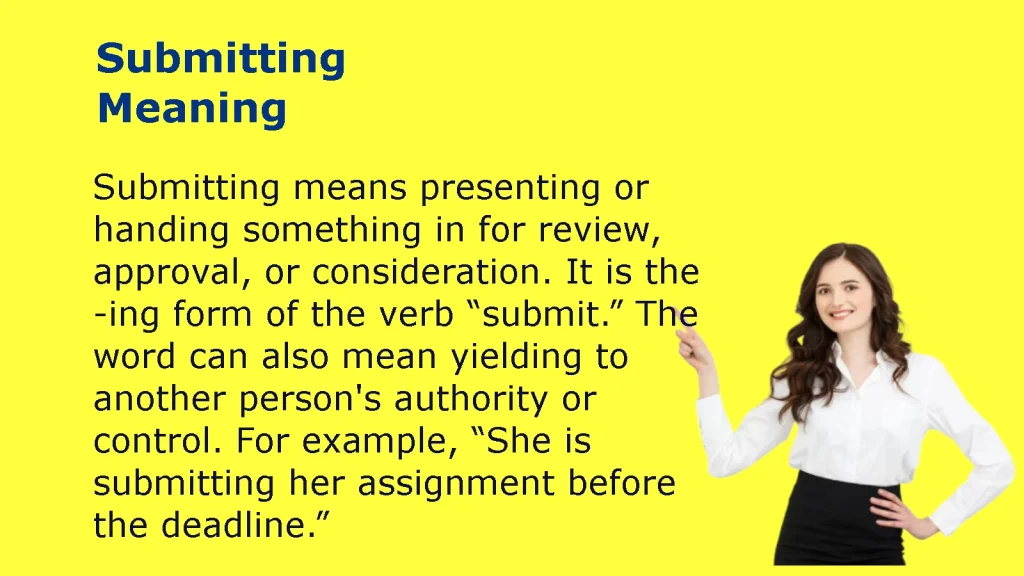
Submitting is the -ing form of submit. It can describe an action in progress, as in “I am submitting the application,” or function as a gerund, as in “Submitting the application early is advisable.” The sentence structure determines its grammatical role.
What Does Submitting Mean?
The word submitting generally means presenting something for review, approval, consideration, or processing. It can also mean yielding to authority or accepting a demand.
Its form stays the same in several grammatical patterns, but its function changes.
As part of a continuous verb tense:
- I am submitting the report now.
- She was submitting her application when the website crashed.
- They are submitting a revised budget this afternoon.
In these examples, submitting works with a form of be to express an ongoing action.
As a gerund:
- Submitting the report early reduces deadline pressure.
- He considered submitting a formal complaint.
- We discussed submitting the proposal again.
Here, the activity of submitting acts as a noun within the sentence.
When to Use Submitting
Use submitting when the sentence focuses on an action, activity, or process.
After certain verbs
Some verbs can take a gerund as their object.
Examples:
- She avoided submitting an incomplete application.
- He considered submitting a second proposal.
- They discussed submitting the report next week.
- I finished submitting the documents before noon.
The gerund names the activity that follows the main verb.
As the subject of a sentence
A gerund phrase can serve as the subject of a sentence.
Examples:
- Submitting your application early gives you time to correct mistakes.
- Submitting the wrong file can delay approval.
- Submitting supporting evidence strengthens the application.
In these sentences, the entire phrase—not just the word submitting—functions as the subject.
In continuous tenses
Use a form of be before submitting when you want to describe an action in progress.
Examples:
- I am submitting the final version.
- She is submitting the documents through the portal.
- We were submitting our entries when the deadline passed.
A common mistake is writing I submitting the report. The sentence needs a helping verb: I am submitting the report.
Submitting in a Sentence
Here are examples from common writing situations.
Academic writing
- I am submitting my research paper before the deadline.
- Submitting the assignment through the correct portal is mandatory.
Job applications
- She is submitting her resume and cover letter today.
- Submitting an application does not guarantee an interview.
Business communication
- We are submitting the revised quotation for approval.
- The team discussed submitting a new project proposal.
Online forms
- Please wait while the system is submitting your information.
- If you experience an error while submitting the form, check your internet connection before trying again.
These examples show why submitting works well when the focus falls on the action rather than the resulting document.
Submit vs. Submission vs Submitting
The words submit, submission, and submitting share the same root, but they serve different grammatical purposes.
Submit as a Verb
Submit means to present something for consideration, review, or approval. It can also mean to yield to authority or accept a demand.
Examples:
- Please submit the completed form by Friday.
- The contractor must submit the revised drawings.
- She decided to submit her article to a journal.
- The group refused to submit to unreasonable demands.
The verb often takes a direct object, such as the form, the report, or the proposal.
A simple sentence pattern is:
Subject + submit + object
For example: The applicant submitted the required documents.
In this sentence, submitted is the past-tense form of the verb submit.
Submission as a Noun
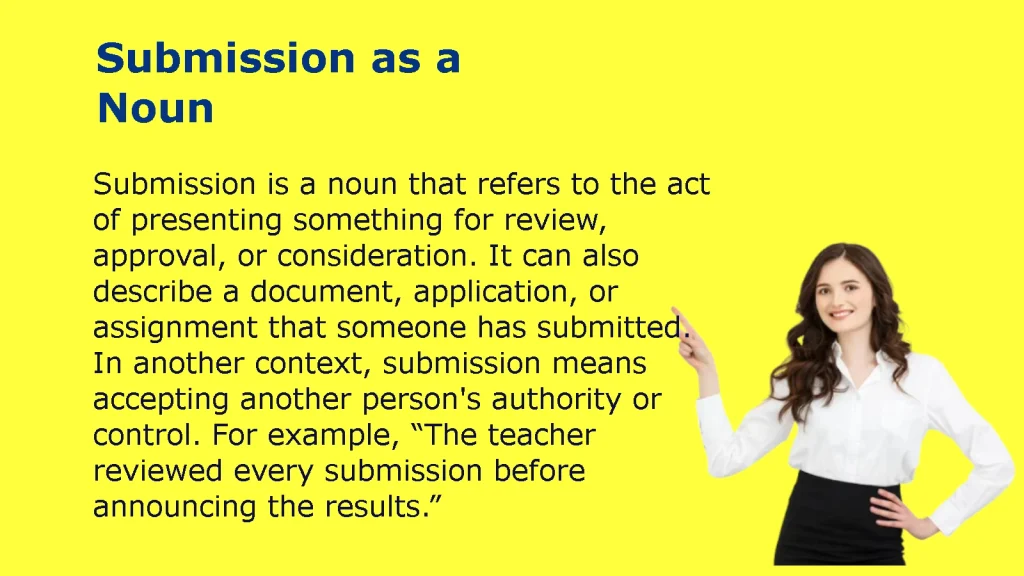
Submission names the act of submitting or the item presented.
Examples:
- The submission arrived before the deadline.
- Your submission requires further review.
- The company confirmed receipt of the submission.
- We completed the submission of the final report.
Common phrases include:
- Submission deadline
- Submission date
- Online submission
- Document submission
- Proof of submission
- Submission confirmation
These expressions are common in formal communication because a noun can identify a process, requirement, or record without describing an action in progress.
Submitting as a Verb Form and Gerund
Submitting has two important uses.
As a verb form:
- She is submitting the documents.
- They were submitting their entries.
As a gerund:
- Submitting documents online saves time.
- He postponed submitting the application.
- We appreciate your submitting the requested information.
The last example uses a possessive construction that can sound formal. In everyday business English, We appreciate you submitting the requested information is also common.
How to Choose the Correct Word
Use this table when deciding which form belongs in your sentence.
| Intended meaning | Correct form | Example |
| Give something for review | Submit | Please submit the report today. |
| Identify the item provided | Submission | Your submission is complete. |
| Describe an ongoing action | Submitting | She is submitting the application. |
| Name an activity | Submitting | Submitting early can prevent delays. |
| Refer to the date an item was filed | Submission | The submission date is October 20. |
| Describe a past action | Submitted | I submitted the form yesterday. |
A quick editing rule helps: if you need an instruction or action, use a form of the verb submit. If you need to name the item or process, consider submission. If you want to describe an ongoing activity or make the activity the subject of a sentence, use submitting.
Submission of a Document: Meaning and Usage
Submission of a document means providing a document to a person, organization, or system for review, approval, processing, or recordkeeping. The phrase is common in academic, legal, administrative, and business communication. It emphasizes the act of formally providing the document rather than the action’s ongoing nature.
What Does Document Submission Mean?
Document submission can involve sending a file electronically, uploading a form to a portal, handing over printed paperwork, or delivering a package of supporting materials.
The exact requirements depend on the organization receiving it.
For example, a university might require a student to submit a transcript, identification document, and application form. A company might ask a supplier to provide a signed contract and proof of insurance.
In both cases, the organization receives documents for a specific purpose.
A complete document submission may require:
- The correct document or file format.
- All mandatory fields and signatures.
- Supporting evidence or attachments.
- Submission through the approved channel.
- Delivery before the applicable deadline.
- Confirmation that the receiving system accepted the documents.
A document can be sent without being accepted as complete. For instance, an online portal might receive an application but flag a missing attachment. That distinction matters when a deadline or approval process is involved.
How to Use Submission of a Document in a Sentence
The phrase submission of a document fits formal sentences, especially when the writer wants to emphasize a process or requirement.
Examples:
- The submission of the document must occur before the deadline.
- We received confirmation of the submission of the contract.
- The agency requires electronic submission of the application form.
- The submission of supporting documents is part of the review process.
For shorter, more direct writing, you can often use submitting the document or submit the document.
Compare:
- Formal: The submission of the document is required by Friday.
- Direct: You must submit the document by Friday.
- Process-focused: Submitting the document takes approximately five minutes.
All three sentences communicate related ideas, but their grammatical structures differ.
Document Submission vs Submitting a Document
These phrases are similar in meaning but do not always fit the same sentence.
| Phrase | Grammatical role | Example |
| Document submission | Noun phrase | Document submission closes at 5 p.m. |
| Submission of a document | Noun phrase | The submission of a document is required. |
| Submitting a document | Gerund phrase or verb phrase | Submitting a document online is simple. |
| Submit a document | Verb phrase | Submit a document through the portal. |
| Submitted document | Participial adjective plus noun | The submitted document needs a signature. |
Use document submission when labeling a process, heading, or administrative requirement. Choose submitting a document when you want to discuss the activity itself.
Common Document Submission Phrases
These expressions appear frequently in professional and administrative writing.
Document submission: A general term for providing documents.
Example: Document submission is required before approval.
Submission of documents: A formal phrase referring to providing one or more documents.
Example: The submission of documents must follow the stated procedure.
Submitting the required documents: A gerund or verb phrase that emphasizes the action.
Example: Submitting the required documents completes the first stage.
Submit the document: A direct instruction.
Example: Submit the document through the official portal.
Proof of submission: Evidence that a document was sent or received.
Example: Keep the confirmation email as proof of submission.
For important applications, save the confirmation number, email receipt, or timestamp. These records can help resolve disagreements about whether you submitted material before a deadline.
Submission Date vs. Submitting Date
Submission date is the usual expression for the date on which a document, application, assignment, or proposal is submitted or recorded as received. Submitting date is less common and usually sounds unnatural in ordinary administrative English. Use submission date for forms, records, deadlines, and official communication.
What Does Submission Date Mean?
A submission date identifies when someone submitted an item or when the system recorded that submission.
The exact meaning can depend on the form or organization. A database may record the date a user clicks Submit, while an office may record the date staff receive the paperwork.
For example:
- The submission date for the application was October 18.
- Enter the submission date in the designated field.
- The system automatically records the submission date.
- Please confirm the submission date shown on your receipt.
When timing matters, check whether the organization uses the date of sending, receipt, or acceptance. These events may not happen at the same time.
Is Submitting Date Correct?
In most standard contexts, submission date is the natural choice.
The reason is grammatical. English often uses nouns to modify other nouns. In submission date, the noun submission identifies the type of date.
Examples of similar noun combinations include:
- Application date
- Registration date
- Payment date
- Delivery date
- Approval date
- Submission deadline
Although submitting date may appear in some contexts, it is not the usual choice for a general administrative label.
Compare these sentences:
- Natural: Enter your submission date.
- Less natural: Enter your submitting date.
- Natural: The submission date is listed on the receipt.
- Natural: The applicant is submitting the form today.
The last example uses submitting correctly because it describes an action.
Submission Date Examples
Academic setting
The submission date for the final essay is November 12.
The phrase identifies the date associated with providing the assignment.
Job application
Please check the submission date on your application confirmation.
The date can help an applicant verify when the system recorded the application.
Business project
The project manager updated the submission date in the tracking sheet.
The phrase refers to a date stored in a project record.
Online service
Your submission date and confirmation number appear on the receipt.
The system provides a record of the transaction.
Submission Date vs. Due Date
A submission date and a due date are related, but they do not always mean the same thing.
| Term | Meaning | Example |
| Submission date | The date an item was submitted or recorded | The submission date was November 10. |
| Due date | The deadline by which an item must be submitted or completed | The due date is November 12. |
| Actual submission date | The date the person actually submitted the item | I submitted the form on November 10. |
| Extended due date | A revised deadline | The instructor extended the due date to November 15. |
An item can have a due date of November 12 and an actual submission date of November 10. If someone submits it on November 14, the submission date falls after the original deadline.
This distinction is useful in school assignments, contract management, invoice processing, and application tracking.
Submission vs. Submittal: What’s the Difference?
Submission is the more general term for presenting something for consideration or referring to the item presented. Submittal is also a noun, but it often appears in technical and professional settings, particularly construction, engineering, and project administration, where it can refer to materials formally provided for review.
Both words are valid. The appropriate choice depends on context and established terminology.
Submission Meaning in General English
Use submission in everyday, academic, administrative, and business communication.
Examples:
- The journal accepts online submissions.
- Your application submission is incomplete.
- The committee reviewed the submission.
- We confirmed the submission of the final report.
The term works across many industries because it can refer to an action, an entry, or a set of documents.
Submittal Meaning in Professional English
A submittal often refers to an item or package of information formally submitted for review, approval, or coordination. In construction, for example, a contractor may provide product data, material samples, shop drawings, or technical documents for review before work proceeds.
Examples:
- The contractor prepared a submittal for the proposed roofing material.
- The project team returned the submittal with comments.
- The engineer reviewed the equipment submittal before installation.
- The supplier revised the technical submittal to address the review notes.
In these settings, submittal can function as a specialized term for a defined part of the project’s documentation process.
However, usage varies by industry, company, and contract. A technical team may use submittal because its procedures define that term. Another organization may use submission for the same general activity.
Submission vs. Submittal Examples
| Situation | Common wording | Explanation |
| Sending a college assignment | Assignment submission | General academic English |
| Sending a job application | Application submission | General administrative English |
| Sending a product specification for construction review | Product submittal | Common technical terminology |
| Providing shop drawings to an engineer | Shop drawing submittal | Refers to a technical review package |
| Sending an article to a magazine | Article submission | Standard publishing terminology |
| Providing a general business proposal | Proposal submission | Broad business usage |
Which Word Should You Use?
Choose submission when writing for a general audience or discussing applications, assignments, proposals, articles, and other materials.
Choose submittal when working in a field where the term has a specific professional meaning, especially if your contract, project manual, or internal procedures use it.
For example, a university student would normally refer to an assignment submission. A construction project manager might refer to a material submittal.
When in doubt, follow the terminology used by the organization receiving the documents. Consistency matters more than replacing a recognized technical term with a more familiar alternative.
Submitting to Someone: Meaning and Examples
Submitting to someone generally means yielding to that person’s authority, control, or demands. Depending on the context, it can describe voluntary acceptance of authority, compliance with rules, or an unequal relationship in which one person gives up control. The phrase does not automatically mean that someone agrees with the other person.
What Does Submitting to Someone Mean?
The meaning depends on what the person is submitting to and why.
For example, an employee may submit to a manager’s legitimate workplace instructions because the role requires it. A person may also submit to pressure because they feel they have no choice.
These situations differ in motivation and power.
Examples:
- He refused to submit to unreasonable demands.
- She agreed to submit to the authority of the appointed supervisor.
- The group was unwilling to submit to external control.
- The athlete signaled submission when he could no longer continue.
In each sentence, the phrase relates to yielding or accepting another person’s authority or control.
Submitting to Authority or Rules
In formal contexts, submitting to authority can mean accepting the decisions or control of someone with recognized power.
Examples:
- Employees must follow the organization’s lawful policies.
- The applicant agreed to submit to the required checks.
- The team accepted the supervisor’s decision after reviewing the evidence.
- The parties agreed to submit to arbitration to resolve their dispute.
The last example has a specific legal meaning: the parties agree to have a dispute resolved through arbitration under the applicable arrangement. It does not simply mean obeying another person’s personal wishes.
Submitting in Relationships and Everyday Life
In personal relationships, submitting to someone may suggest giving another person control over decisions or accepting their demands.
Context matters. People can willingly agree to different roles, but pressure, threats, or fear change the nature of that agreement.
Compare:
- She agreed to let her partner choose the restaurant. This describes a small, voluntary decision.
- He felt forced to submit to every demand. This suggests a lack of meaningful choice.
- They agreed to follow the same household rules. This describes shared expectations rather than necessarily one person controlling the other.
The word submission can sound stronger than cooperation or agreement. If you mean that two people worked together voluntarily, choose language that reflects that relationship accurately.
Submission vs. Cooperation vs. Compliance
| Word | Main meaning | Typical implication | Example |
| Submission | Yielding to authority or control | May suggest unequal power | He resisted submission to the demands. |
| Cooperation | Working together toward a goal | Usually mutual participation | The teams cooperated on the project. |
| Compliance | Acting according to a rule or requirement | Emphasizes following a standard | The company ensured compliance with the policy. |
| Agreement | Sharing a decision or accepting terms | Emphasizes consent or a shared position | Both parties reached an agreement. |
These terms overlap in some situations, but they are not interchangeable. Someone can comply with a rule without personally agreeing with it. Two people can cooperate without one submitting to the other.
Submit vs. Summit: Meaning and Spelling Difference
Submit is a verb meaning to present something for consideration or to yield to authority. Summit is a noun referring to the highest point of a mountain or a high-level meeting between leaders. The words look and sound somewhat similar, but their meanings and grammatical roles differ.
What Does Submit Mean?
The verb submit describes the act of presenting something or yielding to authority.
Examples:
- Please submit your application before the deadline.
- The company will submit its proposal for review.
- She decided to submit a complaint.
- The team refused to submit to unfair pressure.
The word also has several related forms:
- Submit: Please submit the form.
- Submits: She submits a report every month.
- Submitted: We submitted the documents yesterday.
- Submitting: He is submitting the application.
- Submission: The submission contains the final report.
Recognizing these forms helps prevent confusion when writing instructions, reports, and emails.
What Does Summit Mean?
A summit can refer to the highest point of a mountain or hill. It can also refer to a formal meeting between senior leaders, government representatives, or experts.
Examples:
- The climbers reached the summit before sunset.
- The two countries organized a climate summit.
- Business leaders attended an international economic summit.
- The trail becomes steep near the mountain’s summit.
Unlike submit, summit is commonly used as a noun. It can also be used as a verb in some contexts, meaning to reach the summit of a mountain, although that use is less common in everyday writing.
Submit vs. Summit in Sentences
| Submit | Summit |
| Submit your assignment by Friday. | The climbers reached the summit. |
| We will submit the proposal tomorrow. | The leaders attended a global summit. |
| She submitted her application online. | The mountain’s summit was covered in snow. |
| The contractor must submit the drawings for review. | The trade summit brought industry leaders together. |
Common Submit and Summit Spelling Mistakes
The easiest way to remember the distinction is to connect each word with its meaning.
- Submit relates to sending, presenting, or yielding.
- Summit relates to a peak or a high-level meeting.
A common error is writing summit an application when the intended word is submit. The correct sentence is: Submit your application before the deadline.
Similarly, the leaders submitted at the meeting does not mean they attended a high-level conference. If you mean a formal meeting, write: The leaders attended the summit.
Check the meaning before correcting the spelling. A spell-checker may not flag the wrong word because both words are correctly spelled.
Common Mistakes When Using Submission and Submitting
The most common mistakes involve confusing a noun with a verb form, choosing an unnatural phrase, or mixing up words that look similar. Understanding the grammatical role of each word makes these errors easier to spot.
Using Submission When a Verb Is Needed
Incorrect: Please submission the report by Monday.
Correct: Please submit the report by Monday.
Why? Submission is a noun. The sentence gives an instruction, so it needs the verb submit.
Another example:
Incorrect: She will submission her application tomorrow.
Correct: She will submit her application tomorrow.
After will, use the base form of the verb.
Using Submitting as a Standalone Noun in Formal Phrases
Some expressions sound more natural with submission.
Less natural: Please enter your submitting date.
More natural: Please enter your submission date.
Less natural: The submitting deadline is Friday.
More natural: The submission deadline is Friday.
However, submitting is correct in sentences that focus on the action:
- Submitting the application early is advisable.
- She is submitting the final document now.
The distinction is not that submitting is wrong. It is that some standard labels use the noun submission.
Confusing Submission with Submittal
Both words can refer to material provided for review, but their usage differs by context.
For example:
- General business: The client reviewed our proposal submission.
- Construction: The engineer reviewed the material submittal.
If a technical project uses submittal as a defined term, changing it to submission may create inconsistency in project records. Follow the language used in the relevant contract or procedure.
Confusing Submit with Summit
Incorrect: I will summit the application today.
Correct: I will submit the application today.
Incorrect: The climbers submitted the mountain’s peak.
Correct: The climbers reached the mountain’s summit.
The words differ by only a few letters, so proofreading for meaning is as important as checking spelling.
Practical Case Study: Choosing the Right Word in a Work Email
Imagine that a project coordinator must send a revised report to a manager before Friday. The coordinator wants to describe the action, refer to the file, and record the date.
Here is how the word choice changes across the message.
Draft:
I am completing the submitting of the report. I will submission it tomorrow. Please confirm the submitting date.
Revised version:
I am preparing the final report and will submit it tomorrow. Please confirm the submission date once you receive the file.
The revised version uses each term correctly:
- Submit describes the action of sending the report.
- Submission date identifies the date associated with that action.
- Report identifies the item being provided.
If the coordinator later writes a project update, the wording might change again:
The submission is complete, and the manager has received the revised report.
The best word depends on what the sentence needs to express, not simply on which word appears most often in the topic.
Quick Reference: Submission vs Submitting
Use this table as a final reference when editing an email, assignment, report, or application.
| Word | Part of speech | Core meaning | Example |
| Submit | Verb | Present something for consideration or yield | Submit the form today. |
| Submission | Noun | The act of submitting or the item provided | Your submission is complete. |
| Submitting | Verb form or gerund | The act of submitting; an action in progress | She is submitting the form. |
| Submittal | Noun | A formal item or package provided for review, often in technical contexts | The engineer approved the submittal. |
| Summit | Usually a noun | A mountain’s highest point or a high-level meeting | The leaders attended a summit. |
| Submitted | Past-tense or past-participle verb form | Presented or provided previously | I submitted the application yesterday. |
A Simple Rule to Remember
Ask yourself what you want to communicate:
- Are you telling someone to do something? Use submit.
- Are you naming a document or the act of providing it? Use submission.
- Are you describing an action in progress or treating the action as an activity? Use submitting.
- Are you referring to a technical review package? Submittal may be appropriate.
- Are you talking about a mountain peak or a high-level meeting? Use summit.
This approach works across most everyday and professional situations.
Frequently Asked Questions
Is Submission the Same as Submitting?
No. Submission is a noun that names the act of submitting or the item presented. Submitting is the -ing form of the verb submit, used in continuous tenses and gerund phrases. For example, the submission is complete names the item or process, while she is submitting the form describes an action.
What Is the Difference Between Submit and Submission?
Submit is a verb, while submission is a noun. Use submit to describe the action of providing something for consideration: Please submit the report. Use submission to name the act or item: Your submission has been received.
Is It Submission Date or Submitting Date?
Submission date is the standard, natural expression in most administrative and professional contexts. It identifies the date associated with providing a document or application. Submitting date is less common and generally sounds awkward when used as a label on a form.
Is Submission or Submittal Correct?
Both are correct, but their typical uses differ. Submission is the general term used for applications, assignments, articles, and proposals. Submittal often appears in technical settings, especially construction and engineering, where it may refer to documents or materials provided for formal review.
What Does Submitting to Someone Mean?
Submitting to someone means yielding to that person’s authority, control, or demands. The phrase may describe accepting legitimate authority, complying with a requirement, or giving in under pressure. The surrounding context determines whether the action is voluntary, required, or coerced.
What Is the Difference Between Submit and Summit?
Submit means to present something for review or yield to authority. Summit usually means the highest point of a mountain or a high-level meeting between leaders. For example, you submit an application but attend a summit.
Conclusion: Choose Submission or Submitting Based on Context
The difference between Submission vs Submitting becomes simple once you understand how each word functions. Submission is a noun that refers to the act of presenting something or to the material presented. Submitting is the -ing form of submit, used to describe an ongoing action or an activity.
Use submit for instructions and direct actions, submission for documents and formal processes, and submitting when the sentence focuses on the action itself. Choose submittal when it matches established technical terminology, and remember that summit refers to a peak or a high-level meeting.