Stabilize vs Stabilise is a common spelling question for writers who want to use the correct form of English. Stabilize is the standard American English spelling, while stabilise is the standard British English spelling. Both words mean to make something steady, secure, balanced, or less likely to change. The difference comes from regional spelling conventions, not meaning or pronunciation.
You will encounter these words in everyday conversations, medical reports, business discussions, engineering, and technology. Understanding the difference also helps you choose the right form of related words, such as stabilized, stabilising, and stabilisation. Whether you are searching for the stabilise meaning, a stabilise synonym, or the correct UK spelling, this guide explains the rules with practical examples.
Stabilize vs Stabilise: Which Spelling Is Correct?
Both stabilize and stabilise are correct spellings. American English generally uses stabilize, whereas British English commonly uses stabilise. The words have the same basic meaning, grammatical function, and standard pronunciation. Your choice depends on the variety of English you are writing.
For example:
- American English: The engineers worked to stabilize the bridge.
- British English: The engineers worked to stabilise the bridge.
Both sentences communicate the same idea. Neither spelling is universally correct in every English-speaking context.
Stabilize: American English Spelling
Stabilize is the preferred spelling in American English. It means to make something stable, prevent it from changing unexpectedly, or bring it into a more secure condition.
American publications, schools, businesses, and professional organizations generally use the -ize ending in this word.
Consider these examples:
- The government introduced measures to stabilize prices.
- The doctor worked to stabilize the patient’s condition.
- A tripod can help stabilize a camera during recording.
- The company changed its pricing strategy to stabilize revenue.
- Engineers reinforced the foundation to stabilize the building.
Notice that the word works in several fields without changing its core meaning. In each example, someone or something makes a condition steadier or less likely to fluctuate.
If you are writing for an American audience, use stabilize, stabilized, stabilizing, and stabilization.
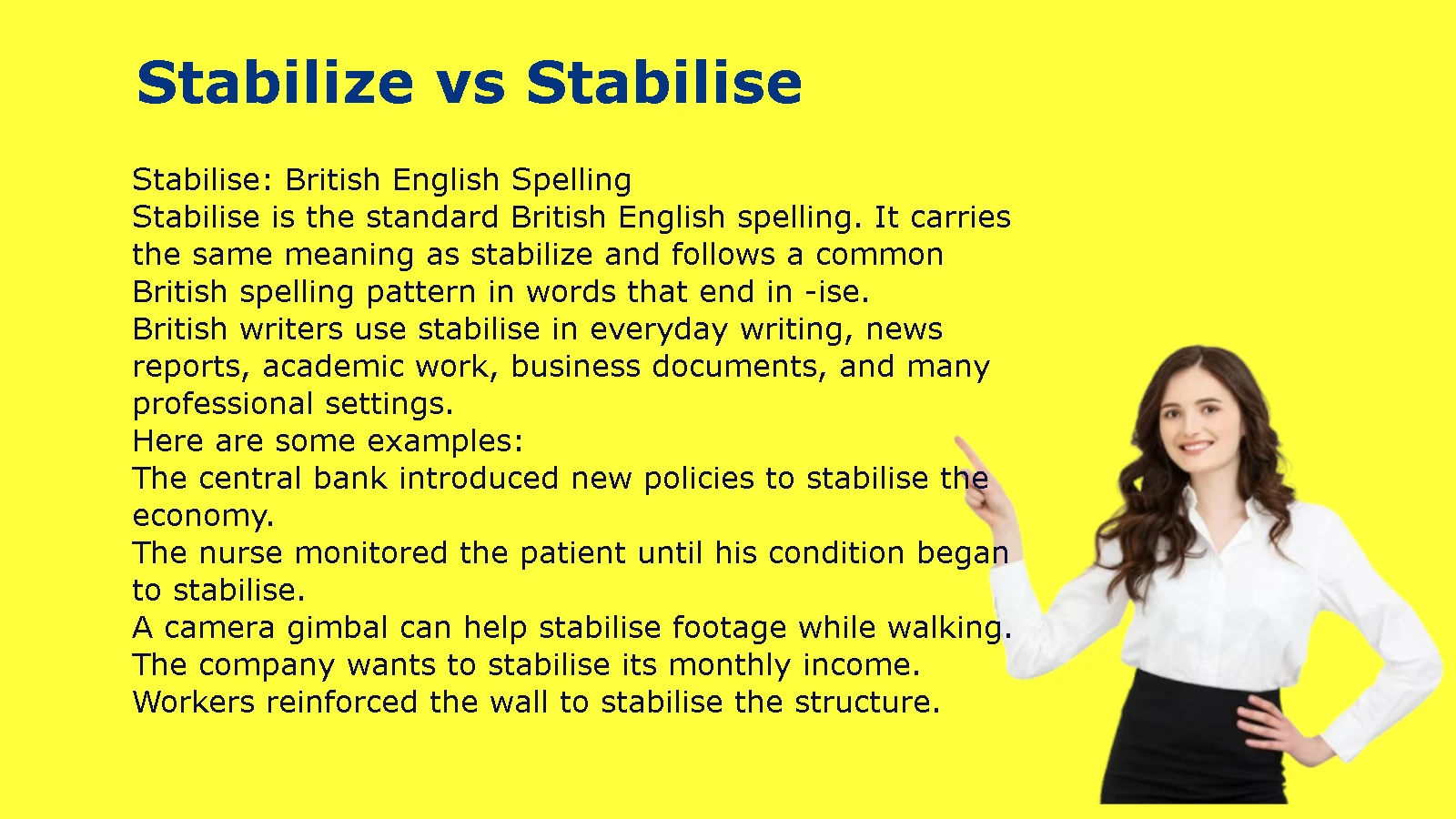
Stabilise: British English Spelling
Stabilise is the standard British English spelling. It carries the same meaning as stabilize and follows a common British spelling pattern in words that end in -ise.
British writers use stabilise in everyday writing, news reports, academic work, business documents, and many professional settings.
Here are some examples:
- The central bank introduced new policies to stabilise the economy.
- The nurse monitored the patient until his condition began to stabilise.
- A camera gimbal can help stabilise footage while walking.
- The company wants to stabilise its monthly income.
- Workers reinforced the wall to stabilise the structure.
The spelling changes, but the meaning remains the same.
British English also uses related forms such as stabilised, stabilising, and stabilisation. However, some British style guides accept or prefer -ize spellings in certain words. Follow your publication’s style guide rather than assuming every British writer must use -ise.
Stabilise or Stabilize UK: Which One Should You Use?
If you are writing in standard British English, stabilise is the usual choice. If you are writing in American English, use stabilize. Both forms are understood internationally, but matching your audience’s spelling conventions makes your writing more consistent.
Use this simple guide:
| Writing context | Recommended spelling | Example |
| American English | Stabilize | We need to stabilize the system. |
| British English | Stabilise | We need to stabilise the system. |
| British publication using an -ize house style | Stabilize may be preferred | The team will stabilize the network. |
| International document | Follow the chosen style guide | The report explains how to stabilize or stabilise the process. |
For website content, consistency matters. If your article targets readers in the United States, use American spellings throughout the page. If it targets the United Kingdom, use British spellings where appropriate.
Avoid switching between stabilize and stabilise randomly in the same article. Readers may understand both, but inconsistent spelling can make your content look poorly edited.
Stabilise Meaning and Definition
Stabilise means to make something steady, secure, balanced, or less likely to change. It can describe a physical object, a person’s condition, a financial situation, or a process that needs to become more predictable. The American spelling, stabilize, has the same definition.
The meaning depends on the context. A mechanic might stabilise a vehicle, a doctor might stabilise a patient, and a business might stabilise its finances. Each situation involves reducing instability or preventing an unwanted change.
Stabilise Meaning in Everyday English
In everyday English, stabilise often describes making a situation calmer or more reliable.
For example, imagine that a table rocks whenever someone places a glass on it. You adjust its legs until it stands firmly. You have stabilised the table because you have reduced its movement.
The same idea applies to situations that are not physical.
Consider these examples:
- Emotions: She took a few minutes to calm down and stabilise her emotions before answering.
- Finances: The family reduced unnecessary expenses to stabilise its budget.
- Work: The manager reassigned tasks to stabilise the team’s workload.
- Weather: The weather conditions began to stabilise after several hours of heavy rain.
- Business: The company introduced a new plan to stabilise sales.
In each sentence, the word describes a movement toward greater steadiness or control.
However, stabilise does not always mean returning something to its original condition. A business might stabilise at a lower level of revenue, for instance. Its income has stopped falling rapidly, but it has not necessarily recovered.
This distinction matters in professional writing because stability and improvement are not the same thing.
Stabilize vs Stabilise: Meaning and Grammar
Both spellings function primarily as verbs. A verb describes an action or a change in condition.
The word can appear in two common grammatical patterns.
Transitive use: The verb takes a direct object.
- The technician stabilised the machine.
- The doctor stabilized the patient.
- The company stabilised its cash flow.
In these sentences, the subject acts on something to make it more stable.
Intransitive use: The verb describes a change without a direct object.
- The patient’s condition stabilised.
- Prices began to stabilise.
- The network stabilised after the update.
Here, the subject itself becomes stable or reaches a more consistent condition.
The word can also appear in different tenses:
| Grammatical form | British English | American English | Example |
| Base verb | Stabilise | Stabilize | We need to stabilise the platform. |
| Third-person singular | Stabilises | Stabilizes | The device stabilises the image. |
| Past tense | Stabilised | Stabilized | The situation stabilised yesterday. |
| Present participle | Stabilising | Stabilizing | The team is stabilising the process. |
| Past participle | Stabilised | Stabilized | The system has stabilised. |
The grammatical rules remain the same regardless of spelling convention.
For example, both The team has stabilised the system and The team has stabilized the system use the present perfect tense. Only the regional spelling differs.
Stabilise Word Forms: Stabilised, Stabilising, and Stabilisation
When you use stabilise in a longer article, you may need related words. The spelling pattern generally continues across the word family.
| British English | American English | Part of speech |
| Stabilise | Stabilize | Verb |
| Stabilises | Stabilizes | Verb |
| Stabilised | Stabilized | Past tense or past participle |
| Stabilising | Stabilizing | Present participle |
| Stabilisation | Stabilization | Noun |
| Stabiliser | Stabilizer | Noun |
A stabiliser or stabilizer is a person, device, or substance that helps make something stable. A stabilisation or stabilization is the process or result of making something stable.
Examples:
- The technician used an image stabilizer to reduce camera shake.
- The patient required medical stabilisation.
- The company focused on the stabilization of its supply chain.
- The engineer tested the system while it was stabilising.
A useful spelling rule is to check the entire word family, not just the base verb. If you choose British English, forms such as stabilised and stabilisation may fit your chosen style. If you choose American English, use stabilized and stabilization.
Remember that the -ize ending also appears in some British style conventions. Your style guide determines whether to use that form consistently.
Stabilise Pronunciation
Stabilise and stabilize generally have the same pronunciation in standard British and American English. Their spelling differs, but the final letters do not normally create a different spoken word. Accent and regional speech may affect the exact vowel sounds.
The word has three syllables: sta-bi-lise. Speakers generally place the main stress on the first syllable.
A simple pronunciation guide is STAB-uh-lyze. The ending sounds like the verb rise, rather than the noun lease.
How to Pronounce Stabilise
To pronounce stabilise naturally, divide it into three syllables:
- STAB — the stressed first syllable.
- uh — the shorter middle syllable.
- lyze — the final syllable.
Say the word slowly at first, then blend the syllables together.
Practice with these sentences:
- We need to stabilise the platform before testing it.
- The doctor helped stabilise the patient’s condition.
- This software can stabilise shaky video footage.
Pay attention to the first syllable. It carries the main stress, while the middle syllable is usually less prominent.
The pronunciation does not change simply because you replace the British s with the American z in writing. Both spellings typically represent the same spoken form.
Is Stabilize Pronounced Differently in American English?
Usually, no. American English uses stabilize, and British English commonly uses stabilise, but the words generally sound alike.
Individual accents can produce small differences in vowels, rhythm, or consonant quality. Those variations do not establish a separate pronunciation rule for the two spellings.
For example, an American speaker might say, “We need to stabilize the market,” while a British speaker says, “We need to stabilise the market.” The difference is primarily visible in writing.
If you are learning English, focus on the stress pattern and the final sound. Do not assume that the British spelling requires a different pronunciation.
Stabilise Synonym: Words With Similar Meanings
A stabilise synonym is a word that expresses a similar idea, such as making something steady, secure, controlled, or less likely to change. Useful alternatives include steady, secure, settle, reinforce, and regulate. The best choice depends on what you are describing.
Although these words overlap in meaning, they are not interchangeable in every sentence. Choosing the right synonym helps you communicate the exact type of stability you mean.
Synonyms for Stabilise in Everyday English
Here are five common alternatives and the situations in which they work best.
| Synonym | Main meaning | Example |
| Steady | Make something firm or less variable | She steadied the ladder before climbing. |
| Balance | Bring different forces or elements into proportion | He balanced the budget by reducing costs. |
| Secure | Make something safe or firmly fixed | They secured the loose shelf to the wall. |
| Settle | Become calmer or less disturbed | The dust settled after the vehicle passed. |
| Strengthen | Make something stronger or more resistant | The team strengthened the frame to support the load. |
Steady is useful when something moves, shakes, or fluctuates. For example, you can steady your hand while writing or steady a ladder before using it.
Balance works when several forces, amounts, or needs must remain in proportion. You might balance a budget, a workload, or competing priorities.
Secure suggests safety or firm attachment. A worker can secure a piece of equipment so it does not move unexpectedly.
Settle often describes a reduction in activity or disturbance. Prices may settle after a period of rapid movement, although the word does not necessarily mean they have reached an ideal level.
Strengthen focuses on increasing resistance or durability. Reinforcing a bridge may help stabilise it, but strengthening and stabilising do not mean exactly the same thing.
Synonyms for Stabilise in Technical and Professional Writing
Professional writing often requires a more precise alternative. The right word depends on whether you are controlling variation, maintaining a condition, or reinforcing a structure.
| Synonym | Best context | Example |
| Regulate | Controlling a process or variable | The device regulates the temperature. |
| Maintain | Keeping a condition at a desired level | The system maintains consistent pressure. |
| Reinforce | Adding strength or support | Engineers reinforced the retaining wall. |
| Standardize | Making procedures or formats consistent | The company standardized its testing process. |
| Equalize | Making quantities or conditions more equal | The equipment equalizes pressure across the chamber. |
These words describe different actions.
For instance, a thermostat regulates temperature by controlling a heating or cooling system. A maintenance team maintains a machine by keeping it in working condition. Engineers reinforce a structure by adding support.
Similarly, a company may standardize procedures to reduce differences between teams. However, standardizing a process does not automatically guarantee that the process will remain stable.
Use stabilise when your main point is reducing instability. Choose a more specific synonym when you want to explain exactly how that stability is achieved.
Stabilise vs. Steady vs. Secure
These three words overlap, but each emphasizes a different aspect of stability.
| Word | Main emphasis | Natural example |
| Stabilise | Reduce instability or unwanted change | The team stabilised the network. |
| Steady | Reduce movement or variation | She steadied the camera. |
| Secure | Prevent movement or improve safety | He secured the camera to the tripod. |
Imagine a camera operator filming while walking.
First, the operator secures the camera to a suitable mount. Next, the operator steadies the equipment while recording. Finally, software may stabilise the footage by reducing visible movement.
The distinctions are subtle but useful. Choosing the correct verb makes a sentence more precise and reduces the need for additional explanation.
Stabilized Meaning in Medical Contexts
In medical contexts, stabilized generally means that a patient’s condition has become sufficiently steady for immediate problems to be controlled or managed. It does not automatically mean the patient has recovered, can leave the hospital, or faces no further danger.
The spelling depends on the variety of English used in the document. American medical writing commonly uses stabilized, while British writing may use stabilised.
What Does It Mean When a Patient Is Stabilized?
When medical professionals describe a patient as stabilized, they generally mean that the patient’s immediate condition has become more controlled than it was before treatment.
Depending on the situation, treatment may involve supporting breathing, controlling bleeding, managing blood pressure, treating a dangerous heart rhythm, or addressing another urgent problem.
For example, consider this illustrative case:
A patient arrives at an emergency department after a serious accident. The medical team treats significant bleeding and provides the necessary support to maintain vital functions. After treatment, the patient’s blood pressure becomes more consistent, and the immediate emergency is better controlled.
The team might describe the patient as stabilized, depending on the clinical findings and circumstances.
However, stabilization does not necessarily mean the injury has healed. The patient may still need surgery, intensive monitoring, medication, or further treatment.
It helps to distinguish three terms:
- Stabilized: The immediate condition has become more controlled or steady.
- Recovering: The patient is progressing toward improvement or healing.
- Recovered: The patient has regained the relevant level of health or function, although the exact meaning depends on the condition.
These terms are not interchangeable. A patient can be stabilized without being recovered.
Stabilised vs. Stabilized in Medical Writing
The difference between stabilised and stabilized is a spelling convention, not a medical distinction.
| Context | Common spelling | Example |
| American medical report | Stabilized | The patient’s condition stabilized after treatment. |
| British medical report | Stabilised | The patient’s condition stabilised after treatment. |
| American clinical documentation | Stabilization | The team continued stabilization efforts. |
| British clinical documentation | Stabilisation or stabilization, depending on style | The patient required further stabilisation. |
Medical writing requires more care than ordinary spelling comparisons. Writers should describe the actual clinical situation rather than use stabilized as a vague synonym for safe or healthy.
For example, “The patient was stabilized” gives less information than a statement describing the relevant improvement. Where appropriate and supported by the medical record, a more specific sentence might explain that the patient’s breathing improved or that bleeding was controlled.
Never infer that a patient is out of danger solely because a report uses the word stabilized.
Stabilize Video: What Does Video Stabilization Mean?
Video stabilization is a technique that reduces unwanted camera movement in recorded footage. It can make a video look smoother when the camera shakes because someone is walking, holding a phone, or recording from a moving vehicle.
The term often appears in camera settings, editing software, smartphones, action cameras, and video-production tutorials. American documentation usually uses stabilize video, while British documentation may use stabilise video.
Optical vs. Electronic Video Stabilization
Video stabilization can work through hardware, software, or a combination of both. The main methods include optical image stabilization and electronic or software-based stabilization.
| Method | How it works | Main advantage | Potential limitation |
| Optical image stabilization (OIS) | Moves or adjusts camera components to counteract some movement | Helps reduce blur and shake during capture | Cannot eliminate every kind of movement |
| Electronic image stabilization (EIS) | Uses electronic processing to compensate for movement | Can smooth footage without a moving optical assembly | May crop the image or reduce the usable frame area |
| Software stabilization | An editing application analyzes footage and adjusts frames | Can improve existing recordings | May introduce distortion or require extra processing |
Optical stabilization works during recording. Depending on the camera design, it can adjust a lens element or sensor to compensate for movement.
Electronic stabilization typically analyzes motion and shifts or transforms frames to reduce visible shake. Many systems crop the image slightly to create room for these adjustments.
Software stabilization can process footage after recording. Editing tools may analyze frame movement and reposition, rotate, or warp images to create smoother playback.
Each method has limits. Stabilization cannot always fix severe motion blur, rapid camera movement, or footage with too little usable image information.
How to Stabilize a Shaky Video
You can often improve shaky footage with a video editor that includes a stabilization feature.
Follow these steps:
- Import the video: Open your footage in an editing application.
- Find the stabilization tool: Look for an option labeled Stabilize, Video Stabilization, or Reduce Camera Shake.
- Apply the effect: Let the software analyze the footage and estimate unwanted movement.
- Preview the result: Watch for unnatural edges, excessive cropping, or a distorted background.
- Adjust the settings: Reduce the strength if the video looks warped or unnaturally smooth.
- Export the clip: Save the processed video and compare it with the original.
For better results, use footage with adequate lighting and avoid excessive movement while recording. A tripod or gimbal can also reduce the amount of shake that software must correct.
If the video contains fast-moving subjects, such as a runner or a car, check the stabilized version carefully. The software may smooth the background while creating strange movement around the subject.
The goal is not to eliminate every visible movement. It is to reduce distracting shake while preserving a natural appearance.
Stabilized Fallout 76: What Does the Term Mean?
The search phrase stabilized Fallout 76 belongs to a gaming-related search intent rather than the general spelling question. Its meaning depends on the specific item, perk, quest, crafting requirement, or other in-game reference the player has encountered.
In a game, stabilized might describe a particular property or state, but the word alone does not identify one universal mechanic. The surrounding phrase matters.
How to Interpret Stabilized in a Fallout 76 Search
If you encounter the term while playing Fallout 76, use the context to identify what it refers to.
- An item description: Check the complete item name and its listed effects.
- A perk or equipment reference: Read the exact wording to determine whether the term describes a bonus, requirement, or equipment feature.
- A quest or crafting instruction: Review the full objective rather than relying on the isolated word.
- A player discussion: Check whether the phrase refers to a specific build, item, or game version.
For example, a player searching for a phrase that includes stabilized may be looking for a particular equipment effect. Another player may be referring to a crafting material or an instruction. Those searches need different answers.
This topic has a different purpose from Stabilize vs Stabilise. If you are building a gaming website, consider creating a dedicated guide for the exact Fallout 76 term after verifying the game’s current terminology.
For a spelling and grammar website, keep this section brief. It acknowledges the related search without distracting readers who mainly want to understand the difference between British and American English.
Common Mistakes When Using Stabilize and Stabilise
The most common mistake is treating one spelling as universally correct. Both forms are established, but each fits different spelling conventions. Other errors involve mixing regional spellings or misunderstanding what stabilize means in a particular context.
Assuming Stabilise Is Incorrect in American English or Stabilize Is Incorrect Everywhere Else
American English normally uses stabilize, while British English commonly uses stabilise. That does not make either spelling inherently wrong.
However, context matters. A British publication that follows an -ise style may edit stabilize to stabilise. An American publication will generally make the opposite choice.
Correction: Identify your audience and follow the relevant style guide.
Mixing British and American Spellings
Consider this sentence:
“The team stabilised the network and analyzed the results.”
The sentence mixes a common British spelling of stabilised with the American spelling analyzed. A publication may accept some mixed conventions, but many editors prefer consistent regional spelling.
A British-style revision might read:
“The team stabilised the network and analysed the results.”
An American-style revision might read:
“The team stabilized the network and analyzed the results.”
Correction: Check related words throughout the document rather than editing one word in isolation.
Confusing Stabilization With Recovery
In medical writing, stabilized does not necessarily mean recovered. It usually indicates that a condition has become more controlled or steady.
Similarly, stabilizing a business’s finances does not guarantee that the business has become profitable. It means that financial conditions have become less volatile or more predictable.
Correction: Describe the actual outcome. Use recovered, improved, returned to normal, or another more specific expression only when the facts support it.
Using Stabilise When a More Precise Verb Would Help
The word stabilise is broad. Sometimes a more specific verb communicates the intended action better.
For example:
- “The technician stabilised the temperature” may be appropriate, but regulated the temperature can better emphasize active control.
- “The worker stabilised the shelf” may be correct, but secured the shelf to the wall explains how the worker made it safe.
- “The company stabilised its process” may need clarification if the intended action was to standardize procedures or reduce production errors.
Correction: Choose the verb that describes the actual action, not just the general goal.
How to Choose the Right Spelling
Choosing between stabilize and stabilise becomes easy once you identify the intended audience and the writing conventions you need to follow.
Use this practical process.
Identify the audience. If you are writing for readers in the United States, stabilize is the normal choice. For a British audience, stabilise is common.
Check the style guide. Publications, universities, and organizations may specify whether to use -ize or -ise spellings. Some British style guides prefer -ize in words where that spelling follows their conventions.
Review the entire word family. Check stabilized, stabilising, stabilization, and related forms. A consistent approach improves readability.
Use the right word for the context. In a medical report, explain the patient’s condition accurately. In a video tutorial, specify whether you mean optical, electronic, or software stabilization.
Proofread before publishing. Search your document for both stabilize and stabilise. If both appear, make sure the difference is intentional.
A Practical Editing Example
Suppose you are preparing a guide for a British technology website.
Your draft says:
“Our software stabilizes video and helps users maintain a steady image. The latest update also improved image stabilisation.”
The paragraph mixes stabilizes with stabilisation. If the publication follows a consistent British -ise style, you could revise it to:
“Our software stabilises video and helps users maintain a steady image. The latest update also improved image stabilisation.”
For an American audience, you could instead write:
“Our software stabilizes video and helps users maintain a steady image. The latest update also improved image stabilization.”
The second version uses the American spellings. Both paragraphs communicate the same information.
This example shows why checking only the primary keyword is not enough. Consistent spelling applies to the full word family, including verbs, participles, and nouns.
Conclusion: Stabilize or Stabilise?
The difference between Stabilize vs Stabilise comes down to regional spelling conventions. Stabilize is the standard American English form, while stabilise is commonly used in British English. Both words mean to make something steady, secure, or less likely to change, and they generally share the same pronunciation.
The correct choice depends on your audience, publication requirements, and preferred style guide. Remember that related forms also differ: American English commonly uses stabilized and stabilization, while British English often uses stabilised and stabilisation.
When writing about medicine, technology, finance, or everyday situations, focus on the meaning as well as the spelling. For example, a stabilized patient has not necessarily recovered, and video stabilization does not always remove every trace of camera movement.













