Esthetic and aesthetic have the same basic meaning: relating to beauty, appearance, or the appreciation of beauty. The main difference is that aesthetic is the standard and more widely used spelling, while esthetic is a less common variant, especially in American English.
If you’re searching for “esthetic vs aesthetic,” “esthetic or aesthetic,” or “is esthetic a word,” you’re likely trying to understand which spelling is correct and when to use each one. Both words are valid, but aesthetic is generally the safer choice in most writing.
| Question | Answer |
|---|---|
| What is the difference between esthetic and aesthetic? | They have the same basic meaning, but aesthetic is the more common spelling. |
| Is esthetic a word? | Yes. Esthetic is a valid variant of aesthetic. |
| Which is more common, esthetic or aesthetic? | Aesthetic is much more common in general English. |
| Which spelling should I use? | Use aesthetic in most general writing unless a specific style or context calls for esthetic. |
Esthetic vs Aesthetic: Quick Answer
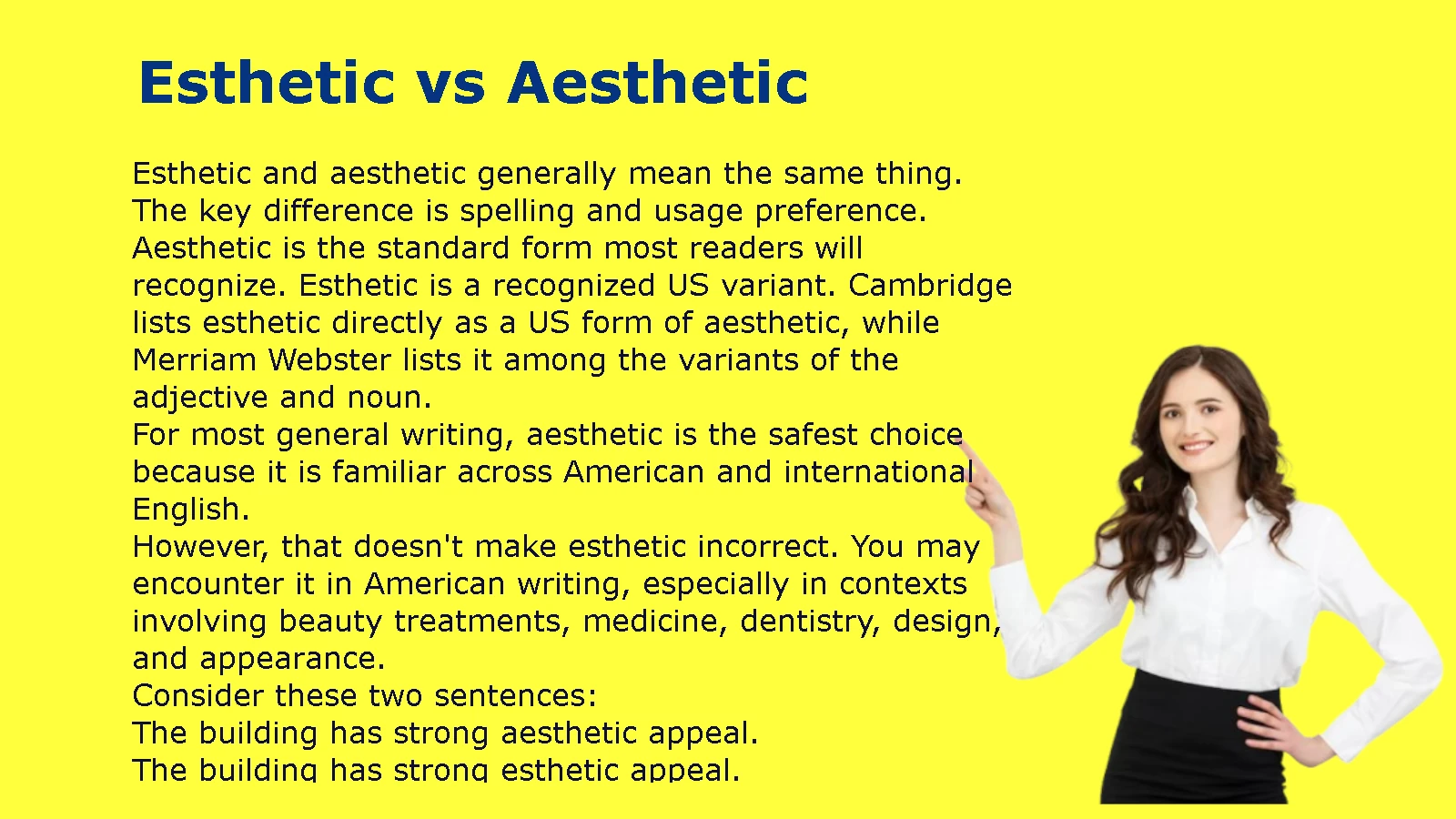
Aesthetic is the standard form most readers will recognize. Esthetic is a recognized US variant. Cambridge lists esthetic directly as a US form of aesthetic, while Merriam Webster lists it among the variants of the adjective and noun.
For most general writing, aesthetic is the safest choice because it is familiar across American and international English.
However, that doesn’t make esthetic incorrect. You may encounter it in American writing, especially in contexts involving beauty treatments, medicine, dentistry, design, and appearance.
Consider these two sentences:
The building has strong aesthetic appeal.
The building has strong esthetic appeal.
Both sentences can communicate essentially the same idea. The spelling changes, but the underlying meaning does not.
The simplest rule
If you need one practical rule to remember, use this:
Choose “aesthetic” for most writing. Treat “esthetic” as a legitimate US variant rather than an error.
That distinction is much more useful than memorizing a rule that says one word is correct and the other is wrong.
What Does Aesthetic Mean?
Aesthetic has several closely related meanings, all connected to beauty, art, appearance, taste, or sensory appeal.
As an adjective, it can describe something related to beauty or aesthetics. It can also describe something artistic or something that looks attractive. Merriam Webster includes meanings related to aesthetics, artistic qualities, attractiveness, sensory appreciation, and appearance enhancement.
For example:
- The designer considered the building’s aesthetic qualities.
- The website has a clean, modern aesthetic.
- The sculpture has considerable aesthetic value.
- The company redesigned its packaging for aesthetic reasons.
- The clinic offers several aesthetic treatments.
The word can therefore cover much more ground than simply “beautiful.”
Aesthetic as an adjective
When aesthetic functions as an adjective, it modifies a noun.
For example:
- aesthetic appeal
- aesthetic value
- aesthetic qualities
- aesthetic experience
- aesthetic judgment
- aesthetic design
- aesthetic treatment
- aesthetic medicine
Cambridge specifically includes appearance related uses such as aesthetic dentistry and treatments intended to improve someone’s appearance.
Aesthetic as a noun
Here’s where the word gets especially interesting.
Aesthetic can also function as a noun.
As a noun, it can refer to a particular style, appearance, artistic approach, or set of ideas about beauty.
For example:
- The restaurant has a minimalist aesthetic.
- Her personal aesthetic combines vintage clothing with modern accessories.
- The designer developed a distinctive aesthetic.
- The film has a dark, futuristic aesthetic.
Cambridge defines the noun as a particular style or appearance and also uses it for principles associated with a particular artistic movement.
That noun use has become especially common in everyday discussions about fashion, interiors, photography, branding, architecture, and social media.
Someone might say:
“I love the aesthetic of this room.”
Here, aesthetic doesn’t simply mean “beautiful.” It refers to the room’s overall visual style and character.
What Does Esthetic Mean?
Esthetic means essentially the same thing as aesthetic.
The spelling without the first a is recognized as a US variant. Cambridge’s entry for esthetic directs readers to aesthetic, while its main definition identifies the word as a US form.
Merriam Webster takes the same approach. Its entry for aesthetic lists esthetic as a US variant for both the adjective and noun.
So these sentences can express the same idea:
- The procedure produced excellent aesthetic results.
- The procedure produced excellent esthetic results.
Likewise:
- The building has an unusual aesthetic.
- The building has an unusual esthetic.
The difference is primarily orthographic, not semantic.
Esthetic as an adjective
Like aesthetic, esthetic can describe things associated with beauty, artistic qualities, attractiveness, or appearance.
Examples include:
- esthetic appeal
- esthetic value
- esthetic qualities
- esthetic considerations
- esthetic treatment
- esthetic dentistry
- esthetic medicine
The spelling appears particularly in American contexts where the shorter form has been established.
Esthetic as a noun
Esthetic can also function as a noun.
For example:
The designer’s esthetic combines traditional materials with modern shapes.
The meaning is essentially the same as:
The designer’s aesthetic combines traditional materials with modern shapes.
Merriam Webster identifies esthetic as a less common noun variant of aesthetic.
That “less common” point matters. Correctness and frequency aren’t the same thing. A word can be perfectly legitimate without being the form most writers choose.
Is Esthetic or Aesthetic Correct?
Both are correct.
That’s the central answer.
The difference lies in usage and spelling preference rather than grammatical correctness.
Merriam Webster lists esthetic as a US variant of aesthetic. Cambridge does the same.
Why does “aesthetic” look more familiar?
The spelling aesthetic preserves more of the word’s historical form. English borrowed the term through German and New Latin from Greek roots associated with perception and sensation. Merriam Webster gives the first known use of aesthetic as 1812 and the noun sense as dating to 1822.
Over time, the spelling became firmly established in English.
The shorter spelling esthetic developed as a variant. It didn’t create a new concept. Instead, it simplified the beginning of the word while retaining the same core meaning.
Think of it as a spelling fork in the road rather than two completely different roads.
Aesthetic vs Esthetic in American English
American English recognizes both aesthetic and esthetic.
However, the two forms don’t have equal familiarity.
Aesthetic is the spelling most readers are likely to recognize immediately. It appears extensively in discussions about art, fashion, architecture, design, beauty, medicine, and popular culture.
Esthetic is also legitimate, but it is less familiar to many readers.
| Situation | Better default |
| General US writing | Aesthetic |
| International audience | Aesthetic |
| Academic writing | Aesthetic unless a style guide says otherwise |
| Art criticism | Aesthetic |
| Design writing | Aesthetic |
| Casual discussion of style | Aesthetic |
| Established US professional terminology | Aesthetic or esthetic, depending on usage |
| Preserving an organization’s official terminology | Follow that terminology |
The important point is that American English does not require you to use esthetic instead of aesthetic.
The reverse is also true. Using aesthetic does not make your writing less American.
Esthetic in American professional language
The shorter form can appear in fields concerned with appearance.
For example, readers may encounter:
- esthetic dentistry
- esthetic treatment
- esthetic restoration
- esthetic considerations
Yet aesthetic is also common in these fields. Cambridge, for example, uses aesthetic dentistry in its dictionary examples.
That makes one thing clear: context matters more than a rigid spelling rule.
Esthetic vs Aesthetic in British English
If you’re writing for a British audience, aesthetic is the normal choice.
Cambridge distinguishes the US pronunciation and usage from the British form while identifying esthetic as a US spelling.
That doesn’t mean British readers cannot understand esthetic. They certainly can. It simply means that aesthetic is the expected spelling in standard British usage.
For international content, therefore, aesthetic usually gives you the broadest reach.
This is especially useful for websites that attract readers from several English speaking countries. Choosing the more widely recognized spelling can prevent needless confusion.
Esthetic vs Aesthetic: Difference in Usage
Once the definitions are clear, the practical question becomes easier:
Which one should you actually use?
In most cases, choose aesthetic.
There are several good reasons.
Use aesthetic when writing for a broad audience
If your readers could come from the United States, United Kingdom, Canada, Australia, or elsewhere, aesthetic is the safer general choice.
It’s widely recognized and doesn’t depend on a regional spelling preference.
Use aesthetic in academic and formal writing
Academic discussions of art, philosophy, literature, architecture, and culture overwhelmingly benefit from the familiar form.
For example:
- aesthetic theory
- aesthetic experience
- aesthetic judgment
- aesthetic philosophy
- aesthetic value
The word also has a well established philosophical meaning.
The APA Dictionary of Psychology defines aesthetics as the philosophical study of beauty and art, including questions about taste, value, and aesthetic experience.
Use esthetic when an established US usage calls for it
There are situations where esthetic may be the appropriate choice.
For example, a business might officially use esthetic in its name, branding, service descriptions, or professional terminology. If you’re reproducing that established wording, changing it to aesthetic could actually make the text less accurate.
The same principle applies to quotations and official names.
Don’t “correct” an established spelling simply because another form is more common.
Aesthetic vs Esthetic Examples
Seeing the words in real sentences makes the distinction much easier.
| Aesthetic | Esthetic |
| The building has strong aesthetic appeal. | The building has strong esthetic appeal. |
| The designer focused on aesthetic details. | The designer focused on esthetic details. |
| The room has a modern aesthetic. | The room has a modern esthetic. |
| The treatment offers several aesthetic benefits. | The treatment offers several esthetic benefits. |
| The artist developed a unique aesthetic. | The artist developed a unique esthetic. |
| The product balances function with aesthetic appeal. | The product balances function with esthetic appeal. |
The central pattern is simple:
Changing aesthetic to esthetic usually changes the spelling, not the meaning.
Example: design
The architect wanted the building to have a simple aesthetic.
Here, aesthetic describes the building’s overall visual style.
You could also write:
The architect wanted the building to have a simple esthetic.
The meaning remains essentially unchanged.
Example: beauty treatment
The clinic specializes in aesthetic treatments.
You could use esthetic as the variant:
The clinic specializes in esthetic treatments.
Cambridge recognizes the use of aesthetic for treatments intended to improve appearance.
Example: personal style
Her personal aesthetic is bold, colorful, and playful.
Here, aesthetic means her recognizable visual style.
That modern noun usage is especially common in conversations about clothing, photography, interiors, branding, and online content.
Common Phrases With Aesthetic
Some combinations occur naturally and are worth learning as complete phrases.
Aesthetic appeal
Aesthetic appeal refers to the attractiveness or visual quality of something.
The new packaging gives the product greater aesthetic appeal.
Aesthetic value
Aesthetic value refers to the value something has because of its beauty or artistic qualities.
The painting has significant aesthetic value.
Aesthetic qualities
This phrase describes characteristics connected with beauty, appearance, or artistic effect.
The designer carefully balanced the practical and aesthetic qualities of the chair.
Aesthetic experience
An aesthetic experience involves responding to beauty, art, design, nature, or sensory qualities.
The concert created a powerful aesthetic experience.
Aesthetic judgment
An aesthetic judgment is an evaluation concerning beauty, artistic quality, taste, or sensory appeal.
Critics disagreed about the film’s aesthetic value.
Aesthetic design
This phrase usually emphasizes visual or artistic aspects of design.
The product’s aesthetic design complements its practical features.
Common Phrases With Esthetic
Because esthetic is a variant, many of the same combinations can use the shorter spelling.
Examples include:
- esthetic appeal
- esthetic value
- esthetic qualities
- esthetic considerations
- esthetic treatment
- esthetic dentistry
- esthetic medicine
However, aesthetic remains the more familiar choice for general readers.
That distinction is worth remembering when writing for a broad audience. A technically correct word isn’t always the clearest word.
Good writing isn’t only about what you can say. It’s also about what your reader expects to see.
Aesthetic vs Esthetic vs Cosmetic
These words overlap in some contexts, but they aren’t interchangeable.
| Word | Main idea | Example |
| Aesthetic | Related to beauty, art, appearance, style, or sensory appeal | The chair has strong aesthetic appeal. |
| Esthetic | Variant of aesthetic | The chair has strong esthetic appeal. |
| Cosmetic | Related specifically to improving or altering appearance | She underwent a cosmetic procedure. |
Aesthetic has the broadest meaning.
It can describe a painting, building, website, fashion style, philosophical idea, or medical treatment.
Cosmetic, by contrast, more specifically concerns appearance and products or procedures intended to change it.
For example:
The website has a modern aesthetic.
You wouldn’t normally replace aesthetic with cosmetic because the website isn’t undergoing an appearance enhancing treatment.
Likewise:
She had a cosmetic procedure.
Aesthetic could potentially describe the purpose or nature of the procedure, but cosmetic is more direct when the focus is on changing appearance.
Aesthetic vs Esthetic Pronunciation
The two spellings are also pronounced similarly.
Cambridge gives the US pronunciation of aesthetic as approximately /esˈθet̬.ɪk/ and identifies esthetic as the US variant.
The key sound occurs in the middle of the word, where the th represents the voiceless sound found in words such as think.
The stress falls on the middle syllable:
es-THET-ic
The British pronunciation can differ, particularly in the first syllable. Cambridge lists both British and US pronunciations.
For everyday American English, the practical point is simple: aesthetic and esthetic don’t have a major pronunciation distinction caused by the spelling difference.
Aesthetic vs Esthetics
Another source of confusion is the difference between aesthetic, aesthetics, esthetic, and esthetics.
These forms are related but serve different grammatical roles.
| Form | Typical role | Meaning |
| aesthetic | Adjective or noun | Related to beauty; a style or visual character |
| esthetic | Adjective or noun | US variant of aesthetic |
| aesthetics | Noun | Study of beauty and art; qualities of beauty or style |
| esthetics | Noun | Variant of aesthetics |
What does aesthetics mean?
Aesthetics has two especially important uses.
First, it can refer to the study of beauty, art, and taste.
For example:
She studied aesthetics as part of her philosophy degree.
Second, it can refer to the qualities or style that make something visually or artistically appealing.
For example:
The aesthetics of the building reflect its historical setting.
Merriam Webster recognizes aesthetics as the plural form associated with both artistic or beautiful qualities and the philosophical field concerned with beauty, art, and taste.
Why is aesthetics sometimes treated as singular?
This is a more advanced grammatical point.
Although aesthetics looks plural, it can function as a singular discipline when it refers to the field of study.
For example:
Aesthetics is an important branch of philosophy.
Here, aesthetics works much like other names of academic fields ending in -ics, such as linguistics or economics.
However, aesthetics can also refer to multiple qualities or styles:
The aesthetics of the two buildings are completely different.
The surrounding context tells you how the word functions.
The History Behind Aesthetic
The spelling difference makes more sense when you look at the word’s history.
Merriam Webster traces aesthetic through German ästhetisch and New Latin aestheticus to Greek aisthētikós, a term connected with sense perception and being sensitive or perceptive.
The word’s earliest English use was not limited to Instagram style boards, interior design, or beauty treatments. Its history is deeply connected to philosophy, perception, art, and the nature of beauty.
The philosophical use became especially important through thinkers such as Alexander Baumgarten and Immanuel Kant. Merriam Webster notes that the term was established as a philosophical concept in the eighteenth century before entering broader English usage.
That history explains why aesthetic can still refer to both something as everyday as a room’s appearance and something as abstract as a philosophical theory of beauty.
Aesthetic in Modern Everyday English
The word has expanded well beyond traditional art criticism.
Today, people use aesthetic to describe a recognizable visual identity.
For example:
- minimalist aesthetic
- vintage aesthetic
- modern aesthetic
- industrial aesthetic
- coastal aesthetic
- gothic aesthetic
- retro aesthetic
- luxury aesthetic
In these expressions, aesthetic often means the overall visual style or mood associated with something.
Consider the difference:
The room is beautiful.
This gives a general judgment.
The room has a minimalist aesthetic.
This tells you something more specific about its style.
The second sentence suggests a collection of visual choices: perhaps clean lines, limited decoration, neutral colors, and simple forms.
That is why aesthetic has become such a useful noun in modern English.
Common Mistakes With Esthetic and Aesthetic
The spelling itself causes fewer problems than the assumptions people make about it.
Mistake: Assuming esthetic is wrong
Esthetic is not automatically a spelling error.
Major dictionaries recognize it as a variant.
If a spell checker flags it, that doesn’t necessarily mean the word is invalid. Some software uses a narrower dictionary or a preferred style.
Mistake: Assuming the words have different meanings
They generally don’t.
The two forms can perform the same grammatical roles and express the same basic ideas.
Mistake: Thinking aesthetic only describes physical beauty
It can describe much more.
You can discuss:
- aesthetic theory
- aesthetic judgment
- aesthetic experience
- aesthetic qualities
- aesthetic style
- aesthetic value
- aesthetic design
Beauty is central to the word, but art, taste, perception, style, and sensory experience also belong to its semantic range.
Mistake: Confusing aesthetic with aesthetics
These aren’t simply interchangeable forms.
The website has a clean aesthetic.
Here, aesthetic refers to a style.
Aesthetics is a branch of philosophy.
Here, aesthetics refers to the study of beauty and art.
Mistake: Treating aesthetic and cosmetic as synonyms
They overlap when discussing appearance, but aesthetic has a much broader range.
A building can have an aesthetic.
A painting can have an aesthetic.
A medical procedure can have aesthetic purposes.
A cosmetic product, however, is specifically associated with appearance and personal care.
Which Is More Common: Esthetic or Aesthetic?
For most readers, aesthetic is the more familiar spelling.
That doesn’t make esthetic incorrect. It simply means that aesthetic is generally the better choice when your goal is maximum recognition.
This distinction matters in SEO content, educational writing, business communication, and international publishing.
Suppose a reader searches for information about the visual style of a website. Aesthetic is the spelling most readers expect.
Likewise, if you’re explaining a philosophical concept related to beauty, aesthetic is the natural choice.
Use esthetic when there is a specific reason to preserve that spelling.
A Practical Case Study: Choosing the Right Spelling
Imagine two businesses.
Business A publishes an international article titled:
How to Create a Modern Aesthetic for Your Website
The audience includes readers from the United States, United Kingdom, Canada, and Australia. In this situation, aesthetic is the obvious choice because it is widely recognized across English varieties.
Now consider Business B, which has an established US brand called an “Esthetic Studio.”
If an article discusses that business, changing the name to “Aesthetic Studio” would be a mistake.
The lesson is straightforward:
Use the spelling that fits the context.
Don’t change an established name simply to follow your preferred dictionary form.
Aesthetic or Esthetic: Which Should You Use?
For most writers, the answer is aesthetic.
Choose aesthetic when:
- You want the most widely recognized spelling.
- You’re writing for an international audience.
- You’re discussing art or philosophy.
- You’re writing about design or visual style.
- You’re writing general US English.
- You’re unsure which form your readers expect.
Choose esthetic when:
- You’re following an established US spelling.
- A company, organization, or professional source uses that spelling.
- You’re preserving a proper name or official terminology.
- Your publication’s style guide specifically prefers it.
There’s no need to force the shorter spelling simply because you’re writing in American English.
Likewise, there’s no need to “correct” esthetic when it is being used legitimately.
Esthetic vs Aesthetic: Final Verdict
Esthetic and aesthetic are both correct.
The most important difference is their spelling and usage preference, not their core meaning.
- Aesthetic is the more familiar and widely used form.
- Esthetic is an accepted US variant.
- Both can function as adjectives.
- Both can function as nouns.
- Aesthetics refers to the study or qualities of beauty, art, and taste.
- Esthetics is a variant form of aesthetics.
- Aesthetic has a broader range than cosmetic.
- For most general writing, aesthetic is the best default.
In short, if you’re choosing a spelling and have no special reason to use the shorter form, go with aesthetic. It’s clear, familiar, and works naturally for both American and international readers.
Esthetic isn’t wrong. It’s simply the less familiar US variant.
Frequently Asked Questions About Esthetic vs Aesthetic
Is esthetic the same as aesthetic?
Yes. Esthetic is a recognized variant of aesthetic, particularly in US English. The two words generally have the same meaning and can often be used in the same contexts.
Is esthetic a correct word?
Yes. Esthetic is a correct English word. Major dictionaries recognize it as a variant of aesthetic.
Is aesthetic or esthetic more common?
Aesthetic is generally the more familiar form. It is widely used in American English and British English, while esthetic is specifically recognized as a US variant.
Is esthetic American or British?
Esthetic is primarily identified as a US variant. Cambridge labels it as the US form of aesthetic.
Should I use aesthetic or esthetic?
For most writing, use aesthetic. It is broadly recognized and works well for general, academic, professional, and international audiences.
Use esthetic when a particular US usage, organization, brand, or style guide calls for it.
Can aesthetic be a noun?
Yes. Aesthetic can be a noun meaning a particular style, appearance, artistic approach, or conception of beauty.
For example:
The designer has a distinct aesthetic.
Cambridge recognizes this noun use for a particular style or appearance.
Is aesthetic the same as beautiful?
Not exactly.
Beautiful directly describes something as pleasing or attractive. Aesthetic can describe beauty, but it can also refer to artistic qualities, style, taste, perception, or a broader approach to appearance.
For example:
The painting is beautiful.
makes a direct judgment.
The painting has a minimalist aesthetic.
describes its artistic style.
Is aesthetic the same as cosmetic?
No.
Aesthetic has a broader meaning connected with beauty, art, appearance, style, and sensory appeal.
Cosmetic generally relates more specifically to improving or altering appearance.
What is the plural of aesthetic?
The answer depends on the meaning.
When aesthetic means a particular style or approach, you can use aesthetics:
Different cultures have different aesthetics.
Aesthetics can also refer to the philosophical study of beauty and art.
What is the difference between aesthetics and aesthetic?
Aesthetic can be an adjective or a singular noun.
Aesthetics is a noun that can refer to the study of beauty and art or to the qualities and styles associated with beauty.
For example:
The building has a striking aesthetic.
Aesthetics is an important area of philosophy.
Is esthetics a word?
Yes. Esthetics is a recognized variant of aesthetics. Merriam Webster lists esthetics alongside aesthetics in its dictionary information.
Does aesthetic always mean visual?
No.
Although modern everyday usage often focuses on visual style, the word has deeper roots in sense perception, beauty, art, taste, and sensory experience. Its meaning can therefore extend beyond simply what something looks like.
What is the easiest way to remember esthetic vs aesthetic?
Remember one simple rule:
Aesthetic is the standard default. Esthetic is an accepted US variant.
If you aren’t following a specific style or established terminology, aesthetic is usually the clearest choice.