The attract meaning refers to causing someone or something to move toward, notice, like, or become interested in you or something else. The exact meaning can depend on the context. Terms such as draw, appeal to, interest, entice, allure, fascinate, and captivate are related to “attract,” but they can have slightly different uses and levels of meaning.
Attract means to draw someone or something toward you, often because of a quality, appearance, action, or force that creates interest or appeal. If you’ve come across the word “attract” and wondered what it means, how it is used, or what someone means when they say that a person, idea, or thing “attracts” them, the term is closely connected to interest, appeal, attention, attraction, desire, and influence.
In this guide, you’ll learn what “attract” means, how to use it in sentences, what it means in different contexts, and how “attract” differs from related words such as “appeal,” “entice,” and “allure.” You’ll also see clear examples to make the meaning easy to understand.
By the end, you’ll know exactly what attract means and how to use this common English word naturally and correctly.
What Does “Attract” Mean?
Attract means to draw someone or something toward you or itself because of a quality, force, feature, or appeal.
Attract definition
In simple terms:
Attract = to draw someone or something toward you, or to make someone interested in you or something.
The word works in both literal and figurative situations.
| Context | Meaning of “attract” | Example |
| Physical | Pull something toward another object | Magnets attract iron. |
| Attention | Make people notice something | The headline attracted attention. |
| Interest | Make something appealing | The course attracted many students. |
| Social | Draw people toward a place or activity | The festival attracted thousands of visitors. |
| Romantic | Cause someone to feel personal or sexual interest | She was attracted to him. |
| Business | Bring customers, investors, or money | The company wants to attract new customers. |
| Scientific | Cause an object or substance to move toward another | Gravity attracts objects toward Earth. |
So, although the basic idea remains the same, the exact meaning of attract depends on what is being drawn toward what.
Attract meaning in simple words
A very simple way to remember the word is:
Attract means “draw toward.”
Consider these examples:
- A bright light attracts insects.
- A popular restaurant attracts customers.
- A funny video attracts attention.
- A talented athlete attracts fans.
- A strong personality may attract other people.
- A magnet attracts certain metals.
In every example, something creates a pull.
That pull doesn’t always involve physical movement. Attention, curiosity, admiration, money, customers, and romantic interest can all be “drawn” toward something.
Attract pronunciation
Attract is pronounced:
/əˈtrækt/
It sounds roughly like uh-TRAKT, with the stress on the second syllable.
The pronunciation is essentially the same in American and British English.
Part of speech
Attract is primarily a verb.
It is commonly used as a transitive verb, meaning it normally takes an object.
For example:
- The store attracted customers.
- The movie attracted viewers.
- Her speech attracted attention.
- The flowers attracted butterflies.
The grammatical forms include:
- Base form: attract
- Third-person singular: attracts
- Past tense: attracted
- Past participle: attracted
- Present participle: attracting
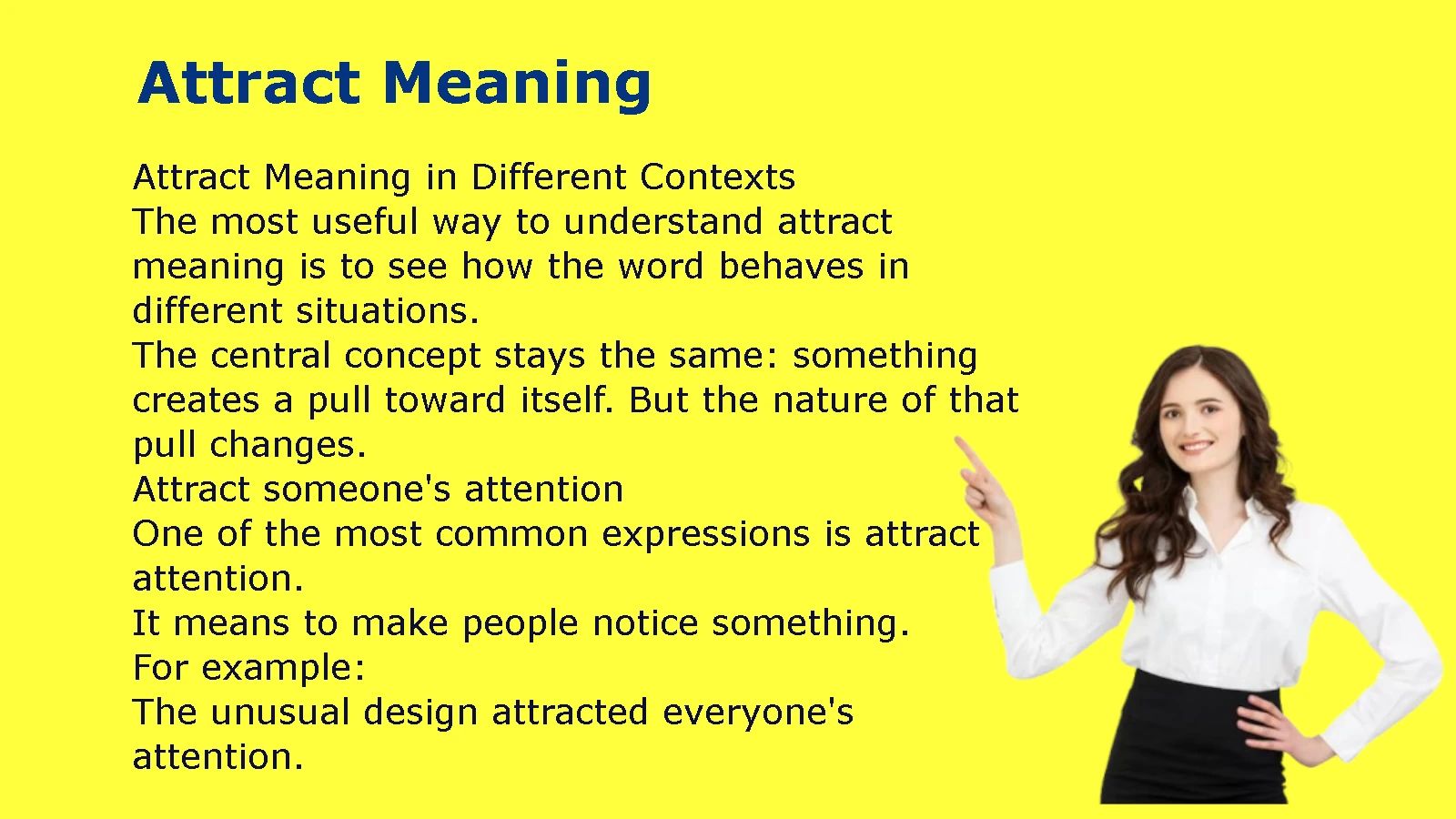
Attract Meaning in Different Contexts
The most useful way to understand attract meaning is to see how the word behaves in different situations.
The central concept stays the same: something creates a pull toward itself. But the nature of that pull changes.
Attract someone’s attention
One of the most common expressions is attract attention.
It means to make people notice something.
For example:
The unusual design attracted everyone’s attention.
Here, the design doesn’t physically pull people toward it. Instead, it makes them notice it.
You can attract:
- attention
- notice
- publicity
- criticism
- interest
- concern
- curiosity
For example:
- The announcement attracted widespread attention.
- His comments attracted criticism.
- The discovery attracted scientific interest.
- The unusual noise attracted the police’s attention.
Attract people or interest
Something can attract people because it is useful, entertaining, beautiful, unusual, convenient, or otherwise appealing.
For example:
The museum attracts thousands of visitors every year.
The museum doesn’t force anyone to visit. Its exhibits, reputation, location, or other qualities make people want to come.
This use is especially common with:
- visitors
- tourists
- audiences
- fans
- customers
- students
- employees
- investors
You might say:
- The beach attracts tourists during the summer.
- The university attracts international students.
- The tournament attracted a large audience.
- The company hopes to attract talented employees.
Attract romantic interest
In relationships, attract takes on a more personal meaning.
If you say:
I’m attracted to her.
you generally mean that you feel a strong personal, physical, or sexual interest in her.
Similarly:
He was attracted to her confidence.
This can mean that her confidence contributed to his romantic or personal interest.
However, attraction isn’t always sexual.
You can feel attracted to someone’s:
- personality
- intelligence
- confidence
- sense of humor
- kindness
- appearance
- creativity
- values
Context determines the intended meaning.
For example, “I was attracted to the idea” obviously doesn’t describe romantic attraction. It means the idea seemed appealing or interesting.
Attract customers
Businesses frequently use attract when discussing customers.
To attract customers means to give people a reason to visit, purchase, subscribe, or otherwise engage with a business.
For example:
The restaurant introduced a lunch special to attract new customers.
Common business expressions include:
- attract customers
- attract clients
- attract investors
- attract funding
- attract talent
- attract visitors
- attract buyers
- attract subscribers
Attract physical objects
The word also has a literal scientific meaning.
A force can attract one object toward another.
The classic example is magnetism:
Magnets attract iron.
Gravity provides another example:
Earth’s gravity attracts objects toward its center.
This gives you an important clue about the word’s broader meaning.
Whether we’re talking about a magnet attracting metal or a movie attracting viewers, the underlying concept is a force or quality that creates a pull.
Attract Examples in Sentences
Seeing attract in complete sentences makes its different meanings much easier to recognize.
Everyday examples
- The colorful flowers attract butterflies.
- The new restaurant attracts large crowds.
- Her friendly personality attracted many people.
- The bright sign attracted my attention.
- The park attracts visitors throughout the year.
- The smell of fresh bread attracted customers.
- His unusual clothing attracted attention.
- The town’s historic buildings attract tourists.
- The advertisement was designed to attract younger buyers.
- The loud music attracted everyone’s attention.
Examples involving people and relationships
The meaning becomes more personal when attract describes interpersonal relationships.
- I was immediately attracted to her confidence.
- He is attracted to people who are independent.
- What first attracted me to the job was the opportunity to travel.
- She wasn’t physically attracted to him, but she admired his personality.
- His sense of humor attracted her attention.
- They were attracted to each other from the beginning.
Notice that attracted to can describe romantic interest, while attracted to an idea means interested in or drawn toward an idea.
Examples involving attention and interest
The object of attract doesn’t have to be a person.
You can attract:
- attention
- interest
- criticism
- sympathy
- support
- publicity
- concern
Examples:
The research attracted considerable attention.
The proposal attracted criticism from several groups.
Her performance attracted widespread praise.
The discovery attracted interest from scientists around the world.
Collins also identifies uses involving support, publicity, money, and investment.
Business and marketing examples
Businesses use the word constantly because successful businesses need to draw people toward products and services.
Examples include:
- The company launched a campaign to attract new customers.
- The discount helped attract more buyers.
- The city is trying to attract foreign investment.
- The company offers flexible hours to attract talented workers.
- The new product is designed to attract younger consumers.
- The hotel uses special packages to attract tourists.
Scientific or physical examples
The physical meaning is especially common in science.
- A magnet attracts iron.
- Earth’s gravity attracts objects toward its center.
- Oppositely charged particles attract each other.
- Certain chemical forces can attract molecules.
The important distinction is that physical attraction involves a force, whereas figurative attraction usually involves interest, appeal, attention, or desire.
Attract Synonyms
There isn’t one perfect synonym for attract in every sentence.
Words such as draw, appeal to, entice, lure, captivate, fascinate, charm, and allure overlap with attract, but each carries a slightly different shade of meaning. Cambridge and Collins list many of these words among the related synonyms of attract.
| Synonym | Main idea | Example |
| Draw | Pull or bring toward | The festival drew a large crowd. |
| Appeal to | Be interesting or pleasing | The offer appeals to young buyers. |
| Entice | Encourage someone with something desirable | The discount enticed shoppers. |
| Lure | Draw someone, often with temptation | The advertisement lured customers in. |
| Allure | Attract through charm or appeal | The city’s history allures tourists. |
| Captivate | Hold someone’s attention strongly | Her performance captivated the audience. |
| Fascinate | Create intense interest | The subject fascinated him. |
| Charm | Attract through pleasant qualities | Her warmth charmed everyone. |
Draw
Draw is one of the closest general synonyms.
The concert attracted thousands of people.
can become:
The concert drew thousands of people.
Both sentences mean that the concert brought people toward it.
Appeal to
Appeal to emphasizes that something is pleasing, interesting, or desirable to a particular person or group.
The design appeals to younger customers.
This doesn’t necessarily mean those customers physically go anywhere. It means the design has qualities they like.
Entice
Entice suggests encouraging someone through something attractive or desirable.
The restaurant enticed customers with a free dessert.
The word can sound more deliberate than attract because it often suggests that something is being offered as an incentive.
Lure
Lure means to attract someone or something, often through temptation.
The bright lights lured shoppers into the store.
Unlike neutral attract, lure can sometimes suggest manipulation or danger.
Fascinate
Fascinate is stronger than ordinary attract when something holds someone’s attention through intense interest.
The ancient ruins fascinated the students.
Captivate
Captivate suggests that something strongly captures someone’s attention, admiration, or imagination.
The speaker captivated the audience.
Attract synonyms by context
The best synonym depends on the situation.
- Attract attention → draw attention
- Attract customers → draw customers
- Attract interest → generate interest
- Attract someone romantically → appeal to someone
- Attract through temptation → entice
- Attract through danger or temptation → lure
- Attract through intense interest → fascinate
- Attract through charm → charm
This is why simply replacing attract with a random synonym can change the tone of a sentence.
Attract Antonyms
The clearest general opposite of attract is repel.
If attraction creates a pull toward something, repulsion creates a push away from it.
| Antonym | Meaning | Example |
| Repel | Push or drive away | The substance repels water. |
| Repulse | Drive away or cause strong dislike | The behavior repulsed him. |
| Discourage | Reduce someone’s desire to act | High prices discouraged buyers. |
| Deter | Make someone less likely to do something | Security measures deter crime. |
| Push away | Cause someone to move or withdraw | His behavior pushed people away. |
| Disgust | Cause strong dislike | The smell disgusted him. |
Repel is particularly useful because it works in both physical and figurative contexts.
For example:
Magnets can attract or repel one another.
You can also say:
His rude behavior attracted a few people but repelled many others.
Attract Word Forms
Understanding the related forms of attract can improve both vocabulary and grammar.
| Word form | Part of speech | Example |
| Attract | Verb | The store attracts customers. |
| Attracts | Verb | The park attracts tourists. |
| Attracted | Verb/adjective | She was attracted to the idea. |
| Attracting | Verb | The company is attracting talent. |
| Attraction | Noun | There was an immediate attraction. |
| Attractive | Adjective | The offer is attractive. |
| Attractively | Adverb | The room was attractively decorated. |
Attract
Good products attract customers.
Attracts
Use attracts with a singular third-person subject in the simple present.
This museum attracts thousands of visitors.
Attracted
Attracted is the past form of attract.
The event attracted a large crowd.
It can also function as an adjective:
She was attracted to his confidence.
Attracting
Attracting is the present participle.
The company is attracting new investors.
Attraction
Attraction is the noun form.
It can describe a place people visit:
The castle is a popular tourist attraction.
It can also describe personal interest:
There was an immediate attraction between them.
Attractive
Attractive is an adjective meaning pleasing, appealing, or likely to create attraction.
The hotel offers an attractive package.
She has an attractive personality.
Attract vs. Related Words
Several words resemble attract, but they’re not interchangeable in every sentence.
Attract vs. appeal
Attract means to draw someone or something toward you.
Appeal means to be interesting, desirable, or pleasing to someone.
Compare:
The colorful display attracted customers.
The simple design appealed to customers.
The first emphasizes drawing customers in. The second emphasizes what customers liked about the design.
Attract vs. entice
Entice usually implies that something desirable encourages someone to act.
The store attracted customers with its location.
The discount enticed customers to buy.
The second sentence gives a stronger sense of temptation or incentive.
Attract vs. lure
These words can overlap, but lure can carry a negative implication.
The beautiful beach attracted tourists.
The scam lured victims with promises of easy money.
You wouldn’t normally describe an ordinary tourist destination as “luring” visitors unless you deliberately want a stronger or more dramatic tone.
Attract vs. interest
Interest means to make someone curious or mentally engaged.
The documentary interested me.
Attract is broader:
The documentary attracted my attention.
Something can attract attention without necessarily producing deep interest.
Attract vs. draw
Draw is perhaps the most versatile synonym.
The event attracted a crowd.
The event drew a crowd.
Both are natural.
However, draw can sound especially natural when discussing crowds, attention, or participation.
How to Use “Attract” Correctly
The word attract is relatively straightforward, but several sentence patterns appear repeatedly in natural English.
Attract + object
The most common structure is:
Subject + attract + object
Examples:
The advertisement attracted customers.
The speaker attracted attention.
The flowers attracted butterflies.
The university attracts talented students.
Here, the object is the person, thing, or response being drawn toward something.
Attract someone’s attention
Attract someone’s attention is a very common fixed expression.
Examples:
I raised my hand to attract the teacher’s attention.
The unusual sound attracted my attention.
The bright colors attracted everyone’s attention.
You can also say:
- attract public attention
- attract media attention
- attract widespread attention
- attract unwanted attention
- attract considerable attention
Attract interest
Attract interest means to make people interested in something.
The new technology has attracted considerable interest.
You can specify whose interest:
The project attracted interest from investors.
Attract customers
The standard construction is:
attract + customers
For example:
The company changed its pricing strategy to attract new customers.
You can also use:
- attract new customers
- attract potential customers
- attract loyal customers
- attract more customers
- attract local customers
Attract attention vs. attract someone
These constructions aren’t quite the same.
Attract someone’s attention means make someone notice you or something.
The noise attracted my attention.
Attract someone can mean make someone interested in or drawn toward you.
Her confidence attracted him.
The difference matters because attention can be brief, while attraction can describe a deeper or more personal response.
Common mistakes with “attract”
Here are a few mistakes worth avoiding.
Incorrect: The advertisement attracted to me.
Correct: The advertisement attracted me.
Or:
The advertisement appealed to me.
Another common problem is using attract when you actually mean interest.
The topic attracted me.
This is grammatically possible, but in many contexts:
The topic interested me.
sounds more natural.
Similarly, attracted to is different from simply attracted when describing romantic or personal interest:
I am attracted to her.
not:
I am attracted her.
The preposition to is important in this construction.
Is “Attract” Positive or Negative?
Attract is neutral by itself.
The word doesn’t automatically mean something positive or negative.
The surrounding noun determines the emotional tone.
Positive uses of attract
The restaurant attracts loyal customers.
Her kindness attracts people.
The program attracts talented students.
Here, attract describes a desirable result.
Neutral uses
The building attracts tourists.
The advertisement attracted attention.
Gravity attracts objects toward Earth.
These statements don’t necessarily express approval or disapproval.
Negative contexts
The same word can describe something undesirable:
His behavior attracted criticism.
The incident attracted unwanted attention.
The decision attracted widespread opposition.
So attract does not mean “cause something good.” It simply means draw something toward you or cause something to come your way.
This distinction is important when interpreting sentences.
Attract Meaning in Different Fields
The word appears across many areas of life, from relationships and advertising to psychology and physics.
Attract in relationships
In relationship contexts, attract usually refers to qualities that create personal or romantic interest.
Someone might be attracted to another person because of:
- physical appearance
- personality
- confidence
- humor
- intelligence
- kindness
- shared interests
- values
- communication style
For example:
What attracted me to her was her confidence.
The construction attract someone to something is particularly useful:
What attracted him to the university was its research program.
Here, the word doesn’t describe romance. It simply means the feature that drew him toward the university.
Attract in business and marketing
Businesses use attract to describe the process of bringing potential customers, employees, investors, or attention toward an organization.
Common expressions include:
- attract customers
- attract clients
- attract investors
- attract funding
- attract talent
- attract attention
- attract visitors
- attract buyers
For example:
A strong brand can attract customers who share its values.
Attract in psychology
In psychology and everyday conversation, attraction can describe a person’s positive interest in another person, activity, object, or idea.
The noun attraction is broader than romantic interest.
You can experience:
- social attraction
- interpersonal attraction
- romantic attraction
- physical attraction
- intellectual attraction
Context is essential. If someone says:
I’m attracted to the idea of working abroad.
they are expressing interest in an idea, not romantic attraction.
Attract in physics
Physics gives the word its most literal sense.
Objects can exert forces that pull them toward one another. Gravity is a familiar example, while magnetic interactions provide another.
The everyday phrase opposites attract also comes from the broader idea of attraction, although its use in relationships is figurative.
A simple comparison helps:
| Type of attraction | What creates the “pull”? |
| Magnetic | Magnetic force |
| Gravitational | Gravity |
| Visual | Appearance or design |
| Intellectual | Ideas or knowledge |
| Social | Personality or behavior |
| Romantic | Personal, emotional, or sexual interest |
| Commercial | Value, usefulness, price, branding, or convenience |
The word therefore connects very different concepts through one basic idea: something draws something else toward it.
A Simple Case Study: How “Attract” Changes With Context
Consider a fictional coffee shop called Maple Street Coffee.
The shop opens in a busy neighborhood.
At first, its colorful storefront attracts attention. People walking past notice the unusual design.
Then the smell of freshly roasted coffee attracts customers.
The shop’s comfortable seating attracts students who want a place to study.
A social media campaign attracts new followers.
A limited-time discount attracts more buyers.
Eventually, the shop’s reputation attracts investors.
Notice what happened: the same verb works with several different objects.
| Sentence | What “attract” means |
| The storefront attracts attention. | Makes people notice it |
| The coffee attracts customers. | Makes customers come in |
| The seating attracts students. | Appeals to students |
| The campaign attracts followers. | Draws people toward the account |
| The discount attracts buyers. | Gives buyers a reason to purchase |
| The reputation attracts investors. | Makes investors interested |
That’s the core of attract meaning in real-world English. The verb stays stable while the type of attraction changes.
Why “Attract” Is Broader Than “Be Attractive”
A common misunderstanding is assuming that attract and attractive mean exactly the same thing.
They are related, but they serve different grammatical roles.
Attract is a verb:
The design attracts customers.
Attractive is an adjective:
The design is attractive.
The first describes an action or effect. The second describes a quality.
Compare:
The hotel attracts tourists.
The hotel is attractive to tourists.
Both sentences communicate a similar idea, but the grammatical structure differs.
This distinction becomes useful when you’re writing professionally because it lets you vary your sentence construction without changing the underlying meaning.
Attract Meaning: Quick Reference
| Question | Answer |
| What does attract mean? | To draw someone or something toward you or itself. |
| What is the simplest meaning of attract? | To draw toward. |
| Is attract a noun or verb? | Primarily a verb. |
| What is the noun form? | Attraction. |
| What is the adjective form? | Attractive. |
| What is the opposite of attract? | Repel. |
| How do you pronounce attract? | /əˈtrækt/ |
| What does attracted to someone mean? | Feeling personal, romantic, or sexual interest in that person, depending on context. |
| What does attract attention mean? | To make someone notice something. |
| What does attract customers mean? | To make customers interested enough to visit, buy, or engage. |
Frequently Asked Questions About Attract Meaning
What does attract mean in simple words?
Attract means to draw someone or something toward you or itself. It can describe physical forces, attention, interest, customers, visitors, or romantic interest.
What is an example of attract?
A simple example is: “The bright flowers attract butterflies.” Other examples include “The advertisement attracted attention” and “The restaurant attracts many customers.”
What is a synonym for attract?
Common synonyms include draw, appeal to, allure, entice, lure, fascinate, captivate, and charm. The best choice depends on the context because these words have slightly different meanings and tones.
What is the opposite of attract?
The most direct opposite is repel. Depending on the context, related opposites include repulse, discourage, deter, disgust, and push away.
What does it mean to attract someone?
To attract someone means to cause that person to feel interested in, drawn toward, or impressed by you. In a romantic context, being attracted to someone often refers to romantic or sexual interest.
What is the difference between attract and appeal?
Attract emphasizes drawing someone or something toward you, while appeal emphasizes being pleasing, interesting, or desirable to someone. For example, a discount may attract customers, while a product’s design may appeal to customers.
Final Takeaway
The simplest way to remember the attract meaning is “to draw toward.”
That basic idea appears in many forms. A magnet attracts metal. A flower attracts butterflies. A headline attracts attention. A restaurant attracts customers. A fascinating idea attracts interest. And a person can be attracted to someone because of that person’s appearance, personality, or other qualities.
The word is flexible because the “pull” doesn’t have to be physical. It can be emotional, intellectual, social, commercial, or scientific.
If you understand that central idea, you’ll have little trouble recognizing attract in everyday conversation, academic writing, business English, and relationship contexts.