Have you ever wondered whether you should write “Apologize” or “Apologise”? Both words have the same meaning, pronunciation, and basic usage, but the correct spelling depends on the type of English you are using. If you’re writing for an American audience, this small spelling difference can make a big difference.
Apologize is the standard spelling in American English, while Apologise is the standard spelling in British English and is also common in other varieties of English. Both words mean to say that you are sorry for something you did or said.
Examples:
- I apologize for being late.
- I apologise for the misunderstanding.
The confusion is understandable. People often search for apologize vs apologise, apologise or apologize, is apologize correct, or which spelling should I use because both forms appear in dictionaries, books, emails, and online writing. And here’s the kicker: neither spelling is wrong. The key is choosing the form that matches your preferred variety of English.
In this guide, you’ll learn the complete difference between Apologize vs Apologise, including their meaning, spelling, pronunciation, American vs British English usage, and examples in sentences. You’ll also discover when to use apologize or apologise and how related forms such as apologized, apologised, apologizing, and apologising differ.
Apologize vs. Apologise: What’s the Difference?
The difference between apologize and apologise is primarily a matter of spelling.
Both words are verbs. Both mean to express regret for something you did or said, especially when your action caused a problem, inconvenience, or unhappiness. Cambridge Dictionary defines apologize as telling someone that you’re sorry for something that caused problems or unhappiness. It also identifies apologise as the usual UK form.
Here’s the simplest comparison:
| Feature | Apologize | Apologise |
| Part of speech | Verb | Verb |
| Meaning | Express regret | Express regret |
| American English | Standard | Not the standard US spelling |
| British English | Used in some British contexts | Usual spelling |
| Pronunciation | Same basic pronunciation | Same basic pronunciation |
| Past tense | apologized | apologised |
| Present participle | apologizing | apologising |
The important point is that neither spelling changes the meaning.
For example:
- American English: I apologize for the delay.
- British English: I apologise for the delay.
The message remains the same. Only the spelling changes.
Is “Apologize” Correct?
Yes. Apologize is the standard American English spelling.
It appears in American dictionaries and is the form you’ll normally want when writing for readers in the United States. Merriam Webster defines apologize as expressing regret for something done or said or making an apology.
For example:
- I apologize for the confusion.
- We apologize for the inconvenience.
- She apologized for arriving late.
- He apologized to his manager.
- I want to apologize for my mistake.
If your document follows American spelling throughout, apologize is the natural choice.
Is “Apologise” Correct?
Yes. Apologise is also correct.
It is the usual British English spelling of the verb. Merriam Webster specifically lists apologise as the British spelling of apologize.
For example:
- I apologise for the confusion.
- We apologise for the inconvenience.
- She apologised for arriving late.
- He apologised to his manager.
- I want to apologise for my mistake.
So if you’re writing according to British English conventions, apologise fits the style.
What Does “Apologize” or “Apologise” Mean?
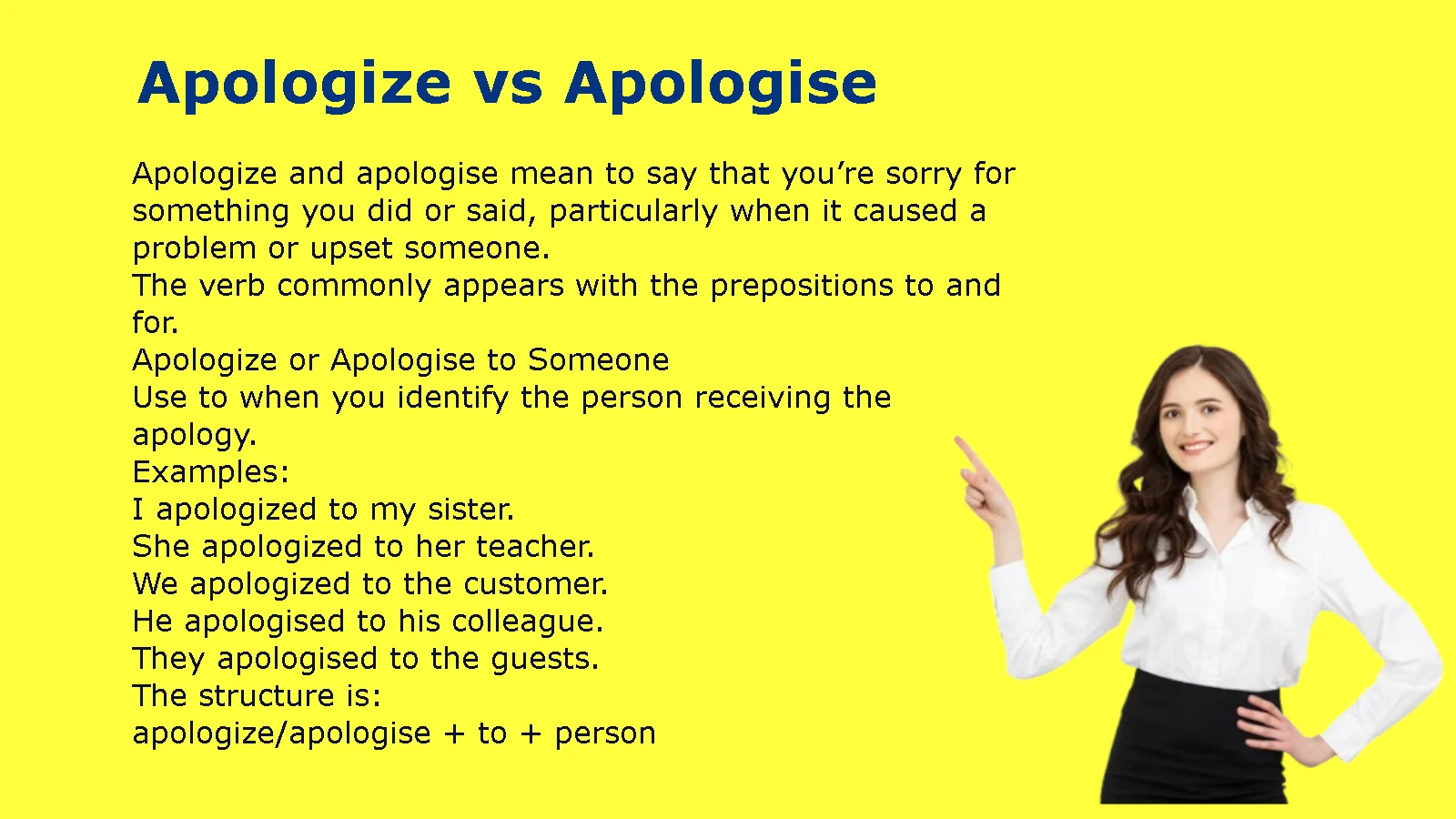
Apologize and apologise mean to say that you’re sorry for something you did or said, particularly when it caused a problem or upset someone.
The verb commonly appears with the prepositions to and for.
Apologize or Apologise to Someone
Use to when you identify the person receiving the apology.
Examples:
- I apologized to my sister.
- She apologized to her teacher.
- We apologized to the customer.
- He apologised to his colleague.
- They apologised to the guests.
The structure is:
apologize/apologise + to + person
For example:
I apologized to Maria.
The same structure works with the British spelling:
I apologised to Maria.
Apologize or Apologise for Something
Use for when you explain what you’re sorry about.
Examples:
- I apologize for the mistake.
- She apologized for being late.
- We apologize for the delay.
- He apologised for his rude comment.
- They apologised for the inconvenience.
The basic structure is:
apologize/apologise + for + noun or -ing form
You can combine both patterns when necessary:
I apologize to you for the misunderstanding.
Or:
I apologise to the customer for the delay.
Oxford lists both apologize to somebody and apologize for something as standard constructions.
When Should You Use “Apologize”?
Use apologize when your writing follows American English spelling conventions.
That makes it appropriate for:
- American business emails
- US academic writing
- American websites
- Customer service messages aimed at US readers
- American publications
- Everyday writing in the United States
Consider a customer service email:
We apologize for the delay and appreciate your patience.
That spelling fits American English.
Likewise:
I apologize for not responding sooner.
There’s nothing informal or incorrect about this construction. It works in both everyday and professional communication.
“Apologize” in Formal Writing
Apologize works perfectly well in formal writing.
For example:
We sincerely apologize for any inconvenience caused by the change in schedule.
Or:
I apologize for the error in the original report.
You don’t need to replace apologize with a more complicated phrase simply because the situation is formal. Clear language usually works better.
“Apologize” in Everyday Writing
The word also fits ordinary conversation:
- I’m sorry. I apologize.
- I should apologize for what I said.
- You should apologize to her.
- I apologize for being late.
In casual speech, people often simply say sorry. Still, apologize is completely natural when you want to emphasize the act of expressing regret.
When Should You Use “Apologise”?
Use apologise when you’re following British English spelling conventions.
This spelling is common in writing intended for audiences in the UK and in other contexts that follow British spelling conventions.
For example:
We apologise for any inconvenience.
Or:
I apologise for the misunderstanding.
British English has several spelling patterns that differ from American English. The -ise/-ize distinction is one of them. Cambridge English gives apologise/apologize as an example of this difference.
“Apologise” in Professional Writing
British businesses commonly use apologise in formal messages:
We apologise for the delay in processing your order.
You might also see:
We sincerely apologise for any inconvenience.
Or:
I must apologise for the confusion caused by the earlier announcement.
These sentences are grammatically equivalent to their American versions. The spelling simply follows a different regional convention.
Apologize vs. Apologise Examples
Seeing the two forms side by side makes the distinction almost impossible to miss.
| American English | British English |
| I apologize for being late. | I apologise for being late. |
| She apologized for the mistake. | She apologised for the mistake. |
| We apologize for the delay. | We apologise for the delay. |
| He apologized to his manager. | He apologised to his manager. |
| They apologized for the confusion. | They apologised for the confusion. |
| I apologize for my behavior. | I apologise for my behaviour. |
| The company apologized to its customers. | The company apologised to its customers. |
| We apologize for the inconvenience. | We apologise for the inconvenience. |
Notice something important in the examples above.
The spelling difference can appear alongside other American and British spelling differences. For example, American English generally writes behavior, while British English generally writes behaviour. The same document should follow one consistent style.
A Workplace Example
Imagine that a company sends an email after a scheduled meeting gets canceled.
American English:
We apologize for canceling today’s meeting. We understand that the change may have disrupted your schedule.
British English:
We apologise for cancelling today’s meeting. We understand that the change may have disrupted your schedule.
The difference goes beyond the z/s in apologize/apologise. Canceling/cancelling also reflects different spelling conventions.
That’s why style consistency matters more than choosing one spelling as somehow “better.”
Apologize vs. Apologise in Different Verb Forms
The spelling difference continues when you change the tense or form of the verb.
| Verb form | American English | British English |
| Base form | apologize | apologise |
| Third person singular | apologizes | apologises |
| Past tense | apologized | apologised |
| Past participle | apologized | apologised |
| Present participle | apologizing | apologising |
Base Form
Use apologize in American English:
I apologize for the mistake.
Use apologise in British English:
I apologise for the mistake.
Third Person Singular
The American form becomes apologizes:
She apologizes whenever she makes a mistake.
The British form becomes apologises:
She apologises whenever she makes a mistake.
Past Tense
American English:
He apologized after the meeting.
British English:
He apologised after the meeting.
Present Participle
American English:
She is apologizing to the customer.
British English:
She is apologising to the customer.
The pattern is consistent for this verb:
American English: z
British English: s
However, don’t turn this into a universal rule for every English word. British English permits both -ise and -ize spellings in some words, depending on the word and style being followed. Cambridge English specifically notes that British English can use both forms for words ending in -ise/-isation, while American English uses the -ize/-ization forms.
Apology vs. Apologize: What’s the Difference?
Here’s where another common mistake appears.
Apology and apologize aren’t alternative spellings. They are different parts of speech.
- Apology is a noun.
- Apologize is a verb.
- Apologise is the British spelling of that verb.
- Apologies is the plural of the noun apology.
Compare these sentences:
I owe you an apology.
I apologize for what I said.
The first sentence uses a noun. The second uses a verb.
Oxford defines apology as a word or statement that says sorry for something done wrong or something that caused a problem.
Apology as a Noun
Examples include:
- I owe you an apology.
- She offered an apology.
- He accepted my apology.
- The company issued an apology.
- We received a written apology.
Apologies as a Plural Noun
Examples include:
- Please accept my apologies.
- My apologies for the delay.
- The company sent its apologies to customers.
- She offered her apologies for the mistake.
Merriam Webster lists apologies as the plural form of apology.
Why “I Apologies” Is Wrong
A common error is writing:
I apologies for the mistake.
That’s incorrect because apologies is a noun, not the present tense verb.
Use:
I apologize for the mistake.
Or, in British English:
I apologise for the mistake.
Cambridge Grammar specifically distinguishes the verb apologize/apologise from the noun apology and gives examples showing why forms such as an apologize and my apologise don’t work as nouns.
Apologize vs. Apologise in American and British English
The spelling difference fits into a broader pattern between American and British English.
Some familiar examples include:
| American English | British English |
| color | colour |
| favor | favour |
| organize | organise |
| recognize | recognise |
| realize | realise |
| apologize | apologise |
| center | centre |
| defense | defence |
| analyze | analyse |
These differences don’t mean that American and British English are separate languages. They are different varieties of English with overlapping vocabulary and grammar but different conventions in spelling, pronunciation, vocabulary, and usage.
For apologize/apologise, the regional distinction is especially straightforward:
American English → apologize
British English → apologise
Cambridge English identifies apologise/apologize among the spelling differences between British and American English.
Why Does the Z/S Difference Exist?
The history of English spelling is complicated. It isn’t simply a matter of one country changing a letter overnight.
Merriam Webster traces apologize to apology plus the suffix -ize and records the verb’s first known use in English as 1596. Earlier uses could mean something closer to defend or justify, rather than the modern everyday sense of expressing regret.
The noun apology is older. Merriam Webster traces it to Middle English and ultimately to Greek apologia, meaning a speech or argument in defense.
That older meaning explains something interesting: apology didn’t originally mean only “I’m sorry.”
Over time, the word developed the familiar modern sense of expressing regret.
So the word has a deeper history than its modern spelling question suggests.
Which Spelling Should You Use?
The easiest way to decide is to identify your audience and your chosen style guide.
Use “Apologize” for American English
Choose apologize when you’re writing for:
- A US audience
- An American company
- An American school
- An American publication
- A US-based website
- A document that follows American English style
For example:
We apologize for the inconvenience.
Use “Apologise” for British English
Choose apologise when you’re following British English conventions.
For example:
We apologise for the inconvenience.
This choice is appropriate when the surrounding document uses British spellings such as colour, favour, centre, and organise.
What If You Write for an International Audience?
International writing creates a slightly different challenge.
If your readers come from several countries, choose a consistent English variety based on your organization’s established style. If no style guide exists, decide which audience you primarily serve.
For example, an American company publishing a worldwide help center might reasonably use American English throughout:
We apologize for the inconvenience.
A British organization might use:
We apologise for the inconvenience.
Neither approach is automatically superior.
Consistency beats random switching.
Imagine reading an article that begins with apologize, later uses apologise, and then switches between color and colour. The reader can understand everything, but the inconsistency makes the writing look less polished.
Is “Apologize” or “Apologise” More Correct?
Both are correct.
The better question is:
Which English variety are you using?
For American English, apologize is the standard spelling.
For British English, apologise is the usual spelling.
Cambridge Dictionary labels apologise as the usual UK form, while its American dictionary uses apologize.
Merriam Webster likewise identifies apologise as the British spelling of apologize.
Therefore, saying that one spelling is simply “correct” and the other is “wrong” misses the actual issue.
A better explanation is:
The spelling depends on the variety of English you’re following.
Common Mistakes With Apologize and Apologise
Most errors involving these words aren’t complicated. They usually come from mixing spelling systems or confusing the verb with the noun.
Mixing American and British Spellings
A document can contain both forms if you’re discussing the difference between them. In ordinary writing, however, switching between them without a reason looks inconsistent.
For example:
We apologize for the delay. Later, the company apologised for the confusion.
If the document follows American English, use:
We apologize for the delay. Later, the company apologized for the confusion.
If it follows British English, use:
We apologise for the delay. Later, the company apologised for the confusion.
Using “Apologise” in American English
If you’re writing standard American English, apologize is the conventional spelling.
American: I apologize for the error.
Not:
I apologise for the error.
The second form will still be understood by American readers. It simply follows a British spelling convention rather than standard American spelling.
Using “Apologize” in British Style
The reverse situation can happen when you’re writing for a British audience.
If the surrounding document uses British spelling, apologise will normally fit better:
I apologise for the delay.
The American apologize is recognizable and used in British contexts too. Still, writers following a consistently British style commonly choose apologise.
Confusing “Apology” With “Apologize”
Remember the part of speech:
I owe you an apology.
I apologize for my mistake.
You can’t swap the two words simply because they relate to the same idea.
Using “Apologies” as the Verb
This mistake is particularly common in quick emails:
I apologies for the delay.
Correct:
I apologize for the delay.
British version:
I apologise for the delay.
Or use the noun:
My apologies for the delay.
Those three constructions are grammatically different:
| Incorrect or correct | Example | Why |
| ❌ Incorrect | I apologies for the delay. | Apologies is a noun |
| ✅ US English | I apologize for the delay. | Apologize is the verb |
| ✅ British English | I apologise for the delay. | Apologise is the British verb |
| ✅ Both | My apologies for the delay. | Apologies is a plural noun |
Apologize or Apologise in a Sentence
The most common sentence patterns are easy to remember.
Apologize or Apologise for Something
Use for to introduce the reason for the apology.
American:
I apologize for the mistake.
British:
I apologise for the mistake.
Other examples:
- We apologize for the delay.
- She apologized for her behavior.
- He apologized for the misunderstanding.
- They apologized for the inconvenience.
Apologize or Apologise to Someone
Use to when naming the person receiving the apology.
American:
She apologized to her manager.
British:
She apologised to her manager.
Other examples:
- I apologized to my friend.
- He apologized to his parents.
- We apologized to the customer.
- They apologised to their neighbors.
Apologize or Apologise for Doing Something
When the reason involves an action, use for + -ing.
Examples:
I apologize for arriving late.
She apologized for interrupting the meeting.
He apologised for speaking too loudly.
We apologize for keeping you waiting.
This construction is especially useful in professional communication because it lets you identify the problem clearly without writing a long explanation.
A Practical Case Study: Choosing the Right Spelling
Consider two writers preparing similar customer service emails.
Case Study: A US Company
A US-based software company needs to tell customers about a service interruption.
Its preferred style is American English.
The natural wording is:
We apologize for the interruption in service. Our team is working to restore normal access as quickly as possible.
Why?
Because apologize matches the company’s American English spelling system.
Case Study: A UK Company
Now imagine a British company sending a similar message:
We apologise for the interruption in service. Our team is working to restore normal access as quickly as possible.
The meaning remains identical. The spelling simply follows British convention.
The Lesson
The choice isn’t about sounding more formal, educated, polite, or intelligent.
It’s about style and audience.
That’s the part many quick explanations miss.
Apologize vs. Apologise: A Useful Style Checklist
Before publishing or sending your writing, check these points:
- Identify your English variety.
- Use apologize for standard American English.
- Use apologise when following the usual British spelling.
- Keep related forms consistent.
- Write apologized/apologised according to the same style.
- Write apologizing/apologising according to the same style.
- Don’t confuse apology with apologize.
- Don’t write I apologies when you need the verb.
- Use to for the person receiving the apology.
- Use for for the reason or action.
- Follow your organization’s style guide when one exists.
- Check the surrounding spelling before deciding which form fits.
How to Remember the Difference Between Apologize and Apologise
There’s a simple memory trick for this particular word:
US → Z → apologize
UK → S → apologise
Think of the final letter as a tiny signpost pointing toward the spelling system.
For example:
US English
- apologize
- apologized
- apologizing
British English
- apologise
- apologised
- apologising
Just remember that this is a memory aid for this spelling pattern, not a universal rule that explains every British and American spelling difference.
Apologize vs. Apologise: Quick Comparison
| Question | Answer |
| Are apologize and apologise different words? | No. They are regional spellings of the same verb. |
| Do they have the same meaning? | Yes. |
| Is apologize American English? | Yes. |
| Is apologise British English? | Yes. It is the usual British spelling. |
| Is apologise understood in the US? | Yes, but it isn’t the standard US spelling. |
| Is apologize understood in the UK? | Yes, although apologise is the usual British spelling. |
| Do they sound different? | Generally, no. |
| Is apologize a verb? | Yes. |
| Is apology a noun? | Yes. |
| Is apologies a verb? | No. It’s the plural of the noun apology. |
| Which should you use? | Match the spelling to your English variety and stay consistent. |
Frequently Asked Questions About Apologize vs. Apologise
Is “apologize” American or British?
Apologize is the standard American English spelling. British English commonly uses apologise. Cambridge identifies apologise as the usual UK form.
Is “apologise” correct in English?
Yes. Apologise is a standard British English spelling of the verb apologize. Merriam Webster explicitly identifies it as the British spelling.
Are “apologize” and “apologise” pronounced the same?
Yes. The spelling changes, but the words have the same basic pronunciation. Cambridge provides UK and US pronunciation information for apologize and identifies apologise as the usual UK spelling.
Do “apologize” and “apologise” mean the same thing?
Yes. Both mean to express regret for something you did or said, particularly when it caused a problem or unhappiness.
Which is correct in the US: apologize or apologise?
Use apologize in standard American English.
I apologize for the delay.
Which is correct in the UK: apologize or apologise?
Apologise is the usual British spelling.
I apologise for the delay.
Is “apologies” the same as “apologize”?
No.
Apologize is a verb.
Apologies is the plural of the noun apology.
Compare:
I apologize for the mistake.
Please accept my apologies for the mistake.
Merriam Webster lists apologies as the plural form of apology.
Is “I apologies” grammatically correct?
No.
Use:
I apologize for the mistake.
Or:
I apologise for the mistake.
You can also write:
My apologies for the mistake.
The first two use a verb. The third uses a plural noun.
Should I use “apologize” or “apologise” in formal writing?
Use whichever spelling matches the English variety you’re following.
For American English:
We apologize for the inconvenience.
For British English:
We apologise for the inconvenience.
Both are suitable for formal writing.
Can British English use “apologize”?
Yes. British English can use -ize spellings in some words, and British English style isn’t universally limited to -ise. Cambridge English notes that British English permits both -ise and -ize forms in this category, while American English uses the -ize form.
For ordinary British writing, however, apologise is the usual form.
Can I use both “apologize” and “apologise” in the same article?
You can when you’re explicitly comparing the two forms, as this article does. In normal writing, though, you should choose one spelling system and use it consistently.
What is the past tense of apologize?
The American English past tense is apologized.
She apologized for being late.
The British form is apologised.
She apologised for being late.
What is the -ing form of apologize?
The American English form is apologizing.
The British form is apologising.
Examples:
He is apologizing for the mistake.
He is apologising for the mistake.
What is the noun form of apologize?
The noun is apology.
Its plural is apologies.
For example:
She offered an apology.
She offered her apologies.
The verb remains apologize in American English and apologise in British English.
Final Answer: Apologize or Apologise?
The answer is refreshingly simple once you know the spelling convention.
Apologize is the standard American English spelling.
Apologise is the usual British English spelling.
Both forms mean to express regret or say that you’re sorry, and both function as verbs. The difference doesn’t change the meaning.
Use this quick rule:
American English → apologize
British English → apologise
Then keep the rest of the verb consistent:
| American English | British English |
| apologize | apologise |
| apologizes | apologises |
| apologized | apologised |
| apologizing | apologising |
And don’t confuse the verb with its related noun:
I apologize for the mistake.
I apologise for the mistake.
Please accept my apology.
Please accept my apologies.
Once you separate regional spelling from meaning and grammar, the choice becomes straightforward. When in doubt, look at the spelling style used throughout the document and match it. That’s the safest way to keep your writing clear, polished, and consistent.