Have you ever seen maneuver and manoeuvre and wondered which spelling is correct? While maneuver vs manoeuvre can look confusing, both words have the same meaning and pronunciation. The main difference is the variety of English in which each spelling is used.
Maneuver is the standard spelling in American English, while manoeuvre is the standard spelling in British English and other varieties that follow British spelling conventions. Both words can refer to a careful movement, a skillful action, or a plan designed to achieve a particular result.
Examples:
- The driver made a quick maneuver to avoid the obstacle.
- The driver made a quick manoeuvre to avoid the obstacle.
The confusion is understandable. People often search for maneuver vs manoeuvre, maneuver or manoeuvre, maneuver meaning, and manoeuvre meaning because the spelling changes depending on the type of English being used. And here’s the kicker: neither spelling is wrong. You simply need to choose the one that matches your audience and writing style.
In this guide, you’ll learn the complete difference between maneuver and manoeuvre, including their meaning, pronunciation, spelling, correct usage, and examples in sentences. You’ll also discover when to use maneuver in American English, when to use manoeuvre in British English, and how to remember the difference.
Maneuver vs. Manoeuvre: Quick Answer
The easiest way to remember the difference is this:
| Word | Main spelling convention | Meaning |
| maneuver | American English | A skillful movement, action, or strategic move |
| manoeuvre | British English | A skillful movement, action, or strategic move |
| manoeuvre | Canadian English | The preferred Canadian spelling |
| maneuver | US English | The standard American spelling |
The Language Portal of Canada states that manoeuvre is preferred in Canada and Britain, while maneuver prevails in the United States.
Cambridge makes the distinction equally direct: maneuver is the US spelling of manoeuvre, while manoeuvre is the UK spelling of maneuver.
That means you don’t need to memorize two definitions. You only need to remember which spelling matches your audience.
The simplest rule
- Writing for a US audience? Use maneuver.
- Writing for a British audience? Use manoeuvre.
- Writing for a Canadian audience? Manoeuvre is the preferred form.
- Following a specific publication style guide? Follow that guide consistently.
The choice is about spelling, not meaning.
What Does Maneuver Mean?
Maneuver can function as both a noun and a verb. Its meanings are closely related, but the exact sense depends on the context.
As a noun, it can describe a physical movement that requires skill or care. It can also refer to a strategic action intended to create an advantage.
Merriam-Webster lists military movements, training exercises, expert physical movements, evasive movements, changes in tactics, and controlled aircraft movements among its meanings.
Maneuver as a noun
A maneuver can be a deliberate physical movement.
For example:
The driver made a quick maneuver to avoid the fallen branch.
Here, maneuver refers to the driver’s controlled movement.
The word can also describe a strategic decision:
The company’s latest maneuver gave it an advantage over its competitors.
In this sentence, no physical movement occurs. The maneuver is a planned action or tactic.
Cambridge similarly defines the noun as a movement requiring skill and care or a well planned action intended to gain an advantage.
Common noun uses include:
- A difficult driving maneuver
- A military maneuver
- An evasive maneuver
- An aircraft maneuver
- A political maneuver
- A business maneuver
- A tactical maneuver
The shared idea is deliberate action. Someone isn’t simply moving randomly. They’re making a controlled move for a reason.
Maneuver as a verb
As a verb, maneuver means to move, position, or handle something with care or skill.
For example:
She maneuvered the car into the narrow parking space.
The verb can also describe managing a complicated situation:
He maneuvered around several obstacles before reaching an agreement.
Cambridge defines the verb as turning and directing an object and gives examples involving things that can be difficult to move.
The verb can therefore describe both physical movement and strategic behavior.
Consider these examples:
- The pilot maneuvered the aircraft around the storm.
- The driver maneuvered the truck into the loading area.
- The player maneuvered past the defender.
- The negotiator maneuvered around the disagreement.
- The manager maneuvered the company through a difficult period.
The context changes, but the central idea remains: skillful or strategic movement toward a desired result.
What Does Manoeuvre Mean?
Manoeuvre has the same meanings as maneuver. The difference is spelling.
British English commonly uses manoeuvre, while American English uses maneuver. Canadian English also prefers manoeuvre.
Manoeuvre as a noun
In British English, manoeuvre can describe a careful physical movement:
The driver made a difficult manoeuvre in the narrow street.
It can also describe a strategic action:
The political manoeuvre surprised the opposition.
The word appears in military, aviation, sports, business, politics, and everyday descriptions of movement.
Manoeuvre as a verb
As a verb, manoeuvre means to move or position something carefully or skillfully.
For example:
The pilot manoeuvred the aircraft into position.
Or:
She manoeuvred the car into the tight parking space.
The Canadian government’s Language Portal provides examples such as manoeuvre carefully, manoeuvred the ship, and manoeuvring.
Notice something important here: the meaning doesn’t change when the spelling changes.
Compare:
- US: The pilot maneuvered the aircraft.
- UK: The pilot manoeuvred the aircraft.
Both sentences describe the same action.
Maneuver vs. Manoeuvre: American vs. British English
This is where the distinction matters most.
American English generally favors maneuver. British English generally favors manoeuvre. Canadian English prefers manoeuvre as well.
| English variety | Preferred spelling |
| American English | maneuver |
| British English | manoeuvre |
| Canadian English | manoeuvre |
The spelling difference follows a broader pattern in English. British English often retains spellings closer to French forms, while American English has standardized some words differently.
However, don’t assume that every regional spelling difference follows one simple rule. English spelling developed through many historical influences. Each word has its own history.
Why should you care about regional spelling?
Consistency matters when you’re writing professionally.
Imagine an American company publishing a report that uses maneuver, color, center, and other American spellings. Suddenly switching to manoeuvre would make the document look inconsistent.
The same applies in British English. If a British publication consistently uses colour, centre, and manoeuvre, changing only one of those words to an American spelling can look out of place.
Neither spelling is automatically “better.”
The right spelling is the one that fits the English variety you’re using.
Maneuver vs. Manoeuvre Examples
Seeing the two forms side by side makes the difference much easier to understand.
| American English | British English |
| The driver made a careful maneuver. | The driver made a careful manoeuvre. |
| The pilot performed a difficult maneuver. | The pilot performed a difficult manoeuvre. |
| The army practiced military maneuvers. | The army practiced military manoeuvres. |
| She maneuvered the car into the space. | She manoeuvred the car into the space. |
| The team is maneuvering around the obstacle. | The team is manoeuvring around the obstacle. |
| The vehicle is highly maneuverable. | The vehicle is highly manoeuvrable. |
| The system improves maneuverability. | The system improves manoeuvrability. |
The important point is easy to miss: the regional difference continues into related words.
You shouldn’t write maneuver in one sentence and automatically assume that every related form keeps exactly the same spelling pattern. British forms such as manoeuvring and manoeuvrable retain the British spelling structure.
Maneuver vs. Manoeuvre in Driving
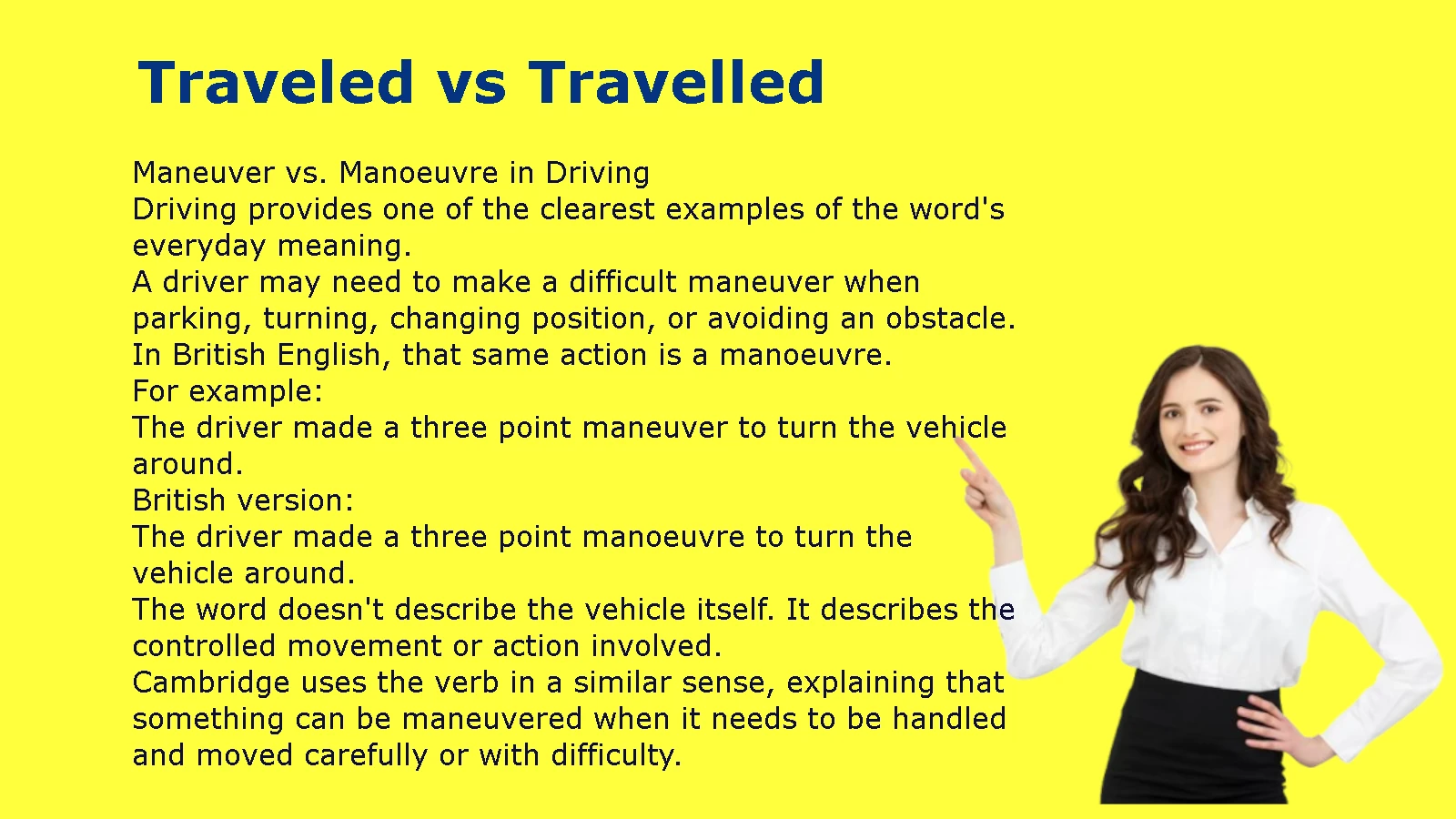
Driving provides one of the clearest examples of the word’s everyday meaning.
A driver may need to make a difficult maneuver when parking, turning, changing position, or avoiding an obstacle. In British English, that same action is a manoeuvre.
For example:
The driver made a three point maneuver to turn the vehicle around.
British version:
The driver made a three point manoeuvre to turn the vehicle around.
The word doesn’t describe the vehicle itself. It describes the controlled movement or action involved.
Cambridge uses the verb in a similar sense, explaining that something can be maneuvered when it needs to be handled and moved carefully or with difficulty.
Common driving maneuvers
Depending on the context, a maneuver can involve:
- Turning into a narrow street
- Parking in a tight space
- Reversing into a parking spot
- Avoiding an obstacle
- Changing lanes
- Positioning a large vehicle
- Turning a vehicle around
Not every movement is necessarily called a maneuver. The word usually becomes useful when the movement requires skill, control, planning, or precision.
Maneuver vs. Manoeuvre in Military Contexts
The military sense is one of the oldest important meanings of the word.
A military maneuver can involve moving troops, ships, aircraft, or other forces according to a plan. The word can also refer to a military training exercise.
Merriam-Webster defines a maneuver as a military or naval movement and also as an armed forces training exercise.
For example:
The army conducted a large maneuver during the training exercise.
In British English, the same sentence would use manoeuvre.
The military meaning also explains why the word often carries a sense of strategy. A military maneuver isn’t simply movement from one place to another. The movement usually serves a tactical purpose.
Military maneuver vs. military strategy
These terms aren’t identical.
A strategy is a broader plan for achieving a goal.
A maneuver can be one specific action within that broader strategy.
Think of it like a chess game. The overall plan might be to control the center of the board. A particular move that creates that advantage is closer to a maneuver.
Maneuver vs. Manoeuvre in Aviation
Aviation provides another precise use of the word.
An aircraft can perform a maneuver when it deliberately changes its flight path or attitude. Merriam-Webster specifically includes controlled variations from straight and level flight among the word’s meanings.
Examples include:
- Turns
- Loops
- Spins
- Inverted flight
- Other controlled changes in flight path
The same term appears in British English as manoeuvre.
Case study: aircraft maneuver
Consider a pilot approaching a difficult flight situation.
The aircraft can’t simply continue on the same path. The pilot may need to change direction, altitude, or attitude in a controlled way.
That deliberate movement is a maneuver in American English and a manoeuvre in British English.
The word is useful because it emphasizes control and intention. The aircraft isn’t merely moving. The pilot is deliberately directing its movement.
Maneuver vs. Manoeuvre in Sports
Sports provide another everyday use.
An athlete can make a maneuver to get around an opponent, create space, or reach a better position.
For example:
The player made a quick maneuver around the defender.
In British English:
The player made a quick manoeuvre around the defender.
The word can describe physical movement, but it can also describe tactical decisions.
A soccer player who changes direction to beat a defender is making a physical move. A coach who changes tactics to exploit a weakness is making a strategic maneuver.
That dual meaning makes the word especially useful in sports writing.
Maneuver vs. Manoeuvre in Business and Politics
The word isn’t limited to physical movement.
In business and politics, maneuver can describe a calculated action intended to create an advantage.
For example:
The company made a strategic maneuver to enter the new market.
Here, nobody is physically moving anything. The maneuver is a business decision.
The same idea appears in political language:
The senator’s maneuver changed the direction of the negotiations.
British English would use manoeuvre in both examples.
Cambridge specifically gives the sense of a planned action intended to obtain an advantage.
Strategic maneuver vs. manipulation
These terms can overlap in some contexts, but they aren’t perfect synonyms.
A strategic maneuver can be completely legitimate. It simply means a carefully planned action.
Manipulation usually carries a stronger negative suggestion. It often implies controlling people or circumstances unfairly or deceptively.
So, calling something a maneuver doesn’t automatically accuse someone of dishonest behavior.
Maneuvering vs. Manoeuvring
One of the most common follow up questions is how to spell the ing form.
The American form is:
maneuvering
The British and Canadian form is:
manoeuvring
| US English | British/Canadian English |
| maneuver | manoeuvre |
| maneuvered | manoeuvred |
| maneuvering | manoeuvring |
| maneuverable | manoeuvrable |
| maneuverability | manoeuvrability |
The Language Portal of Canada specifically notes these related forms and explains that the final e is dropped in forms such as manoeuvring, manoeuvrable, and manoeuvrability.
Examples of maneuvering
American English:
The driver was maneuvering through heavy traffic.
British English:
The driver was manoeuvring through heavy traffic.
Both sentences mean the same thing.
The difference is spelling convention.
Maneuvered vs. Manoeuvred
The past tense follows the same regional pattern.
American English:
The pilot maneuvered the aircraft safely.
British English:
The pilot manoeuvred the aircraft safely.
This distinction matters in polished writing because switching between forms can make a document look inconsistent.
If you’re writing an article in American English, stick with maneuvered.
If you’re writing in British English, use manoeuvred.
Maneuverable vs. Manoeuvrable
The adjective presents another spelling difference.
American English uses:
maneuverable
British and Canadian English commonly use:
manoeuvrable
The word means capable of being maneuvered or moved with relative ease.
For example:
The compact vehicle is highly maneuverable.
British version:
The compact vehicle is highly manoeuvrable.
The difference is not semantic. Both adjectives describe something that can be controlled or moved effectively.
Maneuverability vs. Manoeuvrability
The noun form follows the same pattern:
- maneuverability — American English
- manoeuvrability — British and Canadian English
It refers to how easily something can be maneuvered.
A vehicle with excellent maneuverability can change direction or position effectively.
An aircraft’s maneuverability can affect how it handles different flight conditions.
A machine’s maneuverability can determine how easily an operator can position it in a confined area.
The Language Portal of Canada explicitly lists manoeuvrability as the preferred related form in its Canadian spelling guidance.
Why Are Maneuver and Manoeuvre Spelled Differently?
The strange looking spelling makes more sense once you know the word’s history.
Both forms ultimately trace back to the French manœuvre. Merriam-Webster traces maneuver through French manœuvre to Medieval Latin manuopera, connected to the idea of performing work by hand.
The history is surprisingly practical.
The Latin elements relate to hand and work. Over time, the word moved through French and developed meanings connected with handling, movement, and eventually military tactics.
English later adopted the French word.
American English eventually settled on the spelling maneuver, while British English retained manoeuvre.
A quick word history
| Stage | Form or source | Basic idea |
| Medieval Latin | manuopera | Work done by hand |
| Old French | maneuvre | Work or manual activity |
| French | manœuvre | Work, movement, military action |
| English | maneuver / manoeuvre | Skillful movement or strategic action |
Merriam-Webster records the first known English noun use of maneuver in 1759 and the verb in 1777.
So the odd spelling isn’t random. It’s the result of a long linguistic journey.
Is Maneuver or Manoeuvre More Correct?
Neither is universally more correct.
The better question is:
Which English variety are you writing in?
If you’re using American English, maneuver is correct.
If you’re using British English, manoeuvre is correct.
Calling one spelling “wrong” without considering the intended variety misses the point.
Use maneuver when:
- Writing for readers in the United States
- Following American English spelling
- Writing an American academic paper
- Preparing US business content
- Following a US publication’s style guide
- Using American English throughout a website
Use manoeuvre when:
- Writing for readers in Britain
- Following British English spelling
- Writing for a British publication
- Following a British style guide
- Writing in Canadian English where the preferred form is required
The best practice is simple: match the spelling to your audience and remain consistent.
Is Manoeuver a Correct Spelling?
Manoeuver can cause confusion because it looks like a combination of the two standard forms.
However, it isn’t the spelling you should normally choose when you’re deciding between American and British English.
For standard usage, remember:
- American English: maneuver
- British English: manoeuvre
- Canadian English: manoeuvre
Don’t try to build a hybrid spelling by combining parts of both forms.
The same principle applies to manouver, another common misspelling. It leaves out the e found in the standard American form.
Common incorrect forms
| Spelling | Standard choice? | Better form |
| maneuver | Yes, US | — |
| manoeuvre | Yes, UK/Canada | — |
| manoeuver | No, not the standard choice | maneuver / manoeuvre |
| manouver | No | maneuver / manoeuvre |
When in doubt, don’t improvise. Choose the spelling that matches your English variety.
Common Mistakes With Maneuver and Manoeuvre
Even though the difference is straightforward, several mistakes appear regularly.
Mistake: Treating them as different words
Maneuver and manoeuvre don’t normally represent different concepts.
They are regional spellings of the same word.
Mistake: Mixing spelling systems
A document can contain both forms, especially when material comes from different sources. However, if you’re writing a single piece for a specific audience, consistency usually produces cleaner results.
Mistake: Assuming British spelling is always more formal
It’s not.
Manoeuvre isn’t inherently more formal than maneuver. British English can use manoeuvre in casual writing, while American English can use maneuver in highly formal documents.
Formality and regional spelling are separate issues.
Mistake: Assuming American spelling is incorrect
A British reader may be more accustomed to manoeuvre, but that doesn’t make maneuver an error in American English.
Cambridge explicitly identifies maneuver as the US spelling of manoeuvre.
Mistake: Forgetting related forms
Choosing maneuver doesn’t mean you can ignore its related spellings.
American English:
- maneuver
- maneuvered
- maneuvering
- maneuverable
- maneuverability
British and Canadian English:
- manoeuvre
- manoeuvred
- manoeuvring
- manoeuvrable
- manoeuvrability
Keeping the entire word family consistent prevents unnecessary spelling errors.
Maneuver vs. Manoeuvre Pronunciation
The two spellings represent essentially the same word, but pronunciation can vary slightly by accent.
Cambridge gives the US pronunciation around /məˈnuː.vɚ/ and the UK pronunciation around /məˈnuː.və/.
A simple learner friendly approximation is:
maneuver: muh-NOO-ver
manoeuvre: muh-NOO-vuh
Don’t treat those approximations as exact phonetic transcriptions. Accents differ, and dictionary pronunciation systems provide greater detail.
The important point is that the spelling difference doesn’t create two unrelated spoken words.
Maneuver vs. Manoeuvre in Formal Writing
When you’re writing a report, article, essay, email, or professional document, choose the form that matches your established spelling system.
For American English:
The aircraft performed a complex maneuver.
For British English:
The aircraft performed a complex manoeuvre.
Both are appropriate within their respective systems.
A practical editing test
Before publishing, search your document for:
- maneuver
- manoeuvre
- maneuvered
- manoeuvred
- maneuvering
- manoeuvring
- maneuverable
- manoeuvrable
If you find both American and British forms in a document that should use one variety, decide which spelling system you’re following and make the necessary corrections.
That small check can clean up an otherwise polished piece of writing.
Maneuver vs. Manoeuvre: Real Examples by Context
The word appears in several fields, but its central meaning remains remarkably stable.
| Context | American English | British English |
| Driving | parking maneuver | parking manoeuvre |
| Aviation | flight maneuver | flight manoeuvre |
| Military | military maneuver | military manoeuvre |
| Sports | tactical maneuver | tactical manoeuvre |
| Business | strategic maneuver | strategic manoeuvre |
| Politics | political maneuver | political manoeuvre |
| General movement | careful maneuver | careful manoeuvre |
This is useful because it shows why you shouldn’t define the word too narrowly.
A maneuver isn’t always a military movement. It can be a physical action, a tactical decision, or a strategic move.
Practical Case Study: A Tight Parking Space
Consider a driver trying to park in a narrow space.
The driver turns the steering wheel, reverses, adjusts the vehicle’s angle, moves forward slightly, and finally settles into the space.
In American English, you might describe this as a careful maneuver.
In British English, you might call it a careful manoeuvre.
The spelling changes, but the concept stays intact: a controlled movement that requires skill and care.
This example also shows why maneuver often suggests more than ordinary movement. Walking across a room isn’t usually described as a maneuver. Getting a large vehicle through a tight space might be.
Practical Case Study: A Strategic Business Move
Now consider a company entering a competitive market.
Instead of lowering prices, it partners with another company that already has an established customer base. That decision gives the business an advantage.
An American writer might call it a strategic maneuver.
A British writer might call it a strategic manoeuvre.
Here, nothing needs to physically move. The maneuver is a planned action designed to improve a position.
Cambridge’s definition captures this broader meaning by describing the word as a planned action intended to obtain an advantage.
Practical Case Study: Aviation
Aviation offers a more technical use.
Suppose a pilot intentionally changes the aircraft’s flight path through a controlled turn. That action can be described as a maneuver.
Merriam-Webster specifically includes controlled changes from a straight and level flight path among its definitions.
The British spelling is manoeuvre.
This use demonstrates how the word can move comfortably between everyday English and technical language.
Maneuver vs. Manoeuvre Synonyms
The best synonym depends on the meaning.
When referring to physical movement
Possible alternatives include:
- move
- movement
- action
- turn
- motion
For example:
The driver made a careful maneuver.
Could become:
The driver made a careful move.
However, move is broader. It doesn’t necessarily suggest the same level of skill or control.
When referring to strategy
Possible alternatives include:
- tactic
- strategy
- ploy
- move
- action
Again, these aren’t interchangeable in every sentence.
A ploy, for example, can suggest deception or cleverness. A maneuver doesn’t necessarily imply either.
That’s why replacing the word with a synonym requires attention to context.
Room for Maneuver vs. Room for Manoeuvre
One useful expression deserves special attention:
room for maneuver
In American English, this means having enough flexibility or freedom to make decisions or change course.
For example:
We still have room for maneuver in the negotiations.
British English commonly uses:
room for manoeuvre
Cambridge lists room for/to manoeuvre as the opportunity to change plans or choose between different ways of doing something.
This phrase is especially common in business, politics, negotiations, and discussions about rules or limitations.
Examples
American English:
The new budget leaves us little room for maneuver.
British English:
The new budget leaves us little room for manoeuvre.
The meaning remains the same: there is limited freedom to change the plan or respond to circumstances.
How to Remember Maneuver vs. Manoeuvre
If the spelling feels like a miniature spelling test every time you type it, use one simple memory rule.
Think: US = shorter spelling
maneuver
Think: UK and Canada = manoeuvre
manoeuvre
You can also remember the contrast visually:
US: maneuver
UK/Canada: manoeuvre
Don’t try to memorize every letter individually. Tie the spelling to the English variety you use.
Maneuver vs. Manoeuvre: Which One Should You Use?
The decision is straightforward.
Choose maneuver if you write in American English
Examples:
- The driver made a difficult maneuver.
- The pilot completed the maneuver safely.
- The company used a clever business maneuver.
- The athlete made a quick maneuver.
Choose manoeuvre if you write in British English
Examples:
- The driver made a difficult manoeuvre.
- The pilot completed the manoeuvre safely.
- The company used a clever business manoeuvre.
- The athlete made a quick manoeuvre.
Choose manoeuvre for Canadian English when following the preferred standard
Canada’s Language Portal explicitly identifies manoeuvre as the preferred Canadian spelling.
The bigger lesson is consistency. Once you’ve chosen your English variety, let that choice guide the related forms too.
Frequently Asked Questions About Maneuver vs. Manoeuvre
Is maneuver American or British?
Maneuver is the standard American English spelling. British English generally uses manoeuvre.
Is manoeuvre the British spelling of maneuver?
Yes. Manoeuvre is the standard British spelling corresponding to American maneuver.
Do maneuver and manoeuvre mean the same thing?
Yes. They have the same core meanings. Both can refer to a skillful movement, a military operation, an aircraft movement, or a strategic action.
Which spelling should I use in the United States?
Use maneuver.
Which spelling should I use in the United Kingdom?
Use manoeuvre.
Is manoeuvre used in Canada?
Yes. The Language Portal of Canada says manoeuvre is preferred in Canada and Britain, while maneuver prevails in the United States.
How do you spell maneuvering in British English?
The British spelling is manoeuvring.
How do you spell maneuvered in British English?
The British spelling is manoeuvred.
Is maneuvering the correct American spelling?
Yes. Maneuvering is the American form.
Is manoeuvring the correct British spelling?
Yes. Manoeuvring is the British form. Canada’s Language Portal also lists this form.
Is maneuverable or manoeuvrable correct?
Both are correct within their respective spelling systems.
- American English: maneuverable
- British and Canadian English: manoeuvrable
Is maneuverability or manoeuvrability correct?
Again, both forms are used according to regional spelling.
- American English: maneuverability
- British and Canadian English: manoeuvrability
Is manoeuver a correct spelling?
It isn’t the standard spelling you should choose when writing ordinary American or British English. Use maneuver in American English or manoeuvre in British English.
Is manouver correct?
No. Manouver is a misspelling of the standard forms.
Are maneuver and manoeuvre pronounced differently?
They can have small accent based differences, but they represent the same word. Cambridge gives US pronunciation as approximately /məˈnuː.vɚ/ and UK pronunciation as approximately /məˈnuː.və/.
Is maneuver a noun or a verb?
It can be both.
As a noun:
That was a clever maneuver.
As a verb:
She maneuvered the car into the space.
Is manoeuvre a noun or a verb?
It can also be both.
As a noun:
That was a clever manoeuvre.
As a verb:
She manoeuvred the car into the space.
What is the easiest way to remember the difference?
Remember:
American English = maneuver
British and Canadian English = manoeuvre
Final Verdict: Maneuver or Manoeuvre?
The maneuver vs. manoeuvre debate isn’t really about two different words. It’s about regional spelling.
Maneuver is the standard American English form. Manoeuvre is preferred in British English and Canadian English. Both forms describe the same basic ideas, including a skillful physical movement, a military operation, a controlled aircraft movement, or a strategic action intended to gain an advantage.
The related forms follow the same regional distinction:
| American English | British/Canadian English |
| maneuver | manoeuvre |
| maneuvered | manoeuvred |
| maneuvering | manoeuvring |
| maneuverable | manoeuvrable |
| maneuverability | manoeuvrability |
The word itself has an interesting history, tracing through French manœuvre to Medieval Latin manuopera, with roots connected to working by hand. Merriam-Webster records the first known English noun use of maneuver in 1759.
So, which spelling should you use?
Use “maneuver” for American English. Use “manoeuvre” for British and Canadian English.
That’s the whole trick. Once you know your audience, the spelling choice becomes much easier.