Have you ever confused Precede vs Proceed and wondered which word is correct? These two words look and sound similar, but they have completely different meanings. Understanding the difference between precede and proceed can help you avoid common spelling and usage mistakes in writing and conversation.
Precede is a verb that means to come before something in time, order, or position. Proceed, on the other hand, means to continue, move forward, or begin doing something after a pause or interruption.
Examples:
- A brief introduction will precede the main presentation.
- After the announcement, the meeting will proceed as planned.
The confusion is understandable. People often search for precede vs proceed, difference between precede and proceed, precede or proceed, or how to use precede and proceed in a sentence because the words differ by only a few letters. And here’s the kicker: remembering that precede means “come before” and proceed means “move forward” makes the difference much easier to remember.
In this guide, you’ll learn the complete Precede vs Proceed difference, including their definitions, pronunciations, meanings, correct usage, and examples in sentences. You’ll also discover an easy trick to remember the difference, common mistakes to avoid, and when to use precede or proceed correctly.
Precede vs Proceed: What’s the Difference?
The main difference between precede and proceed is the direction or sequence they describe.
Precede means to come before something in time, order, or position.
Proceed means to continue, move forward, or carry on with something.
| Word | Meaning | Main Idea | Example |
| Precede | To come before | Before | The speech preceded the ceremony. |
| Proceed | To continue or move forward | Forward | We proceeded with the ceremony. |
Think of them as two different points on a timeline:
Precede → BEFORE → Event → PROCEED → FORWARD
For example:
“A short introduction preceded the lecture.”
The introduction happened first.
“After the introduction, the professor proceeded with the lecture.”
The professor then continued or moved forward with the lecture.
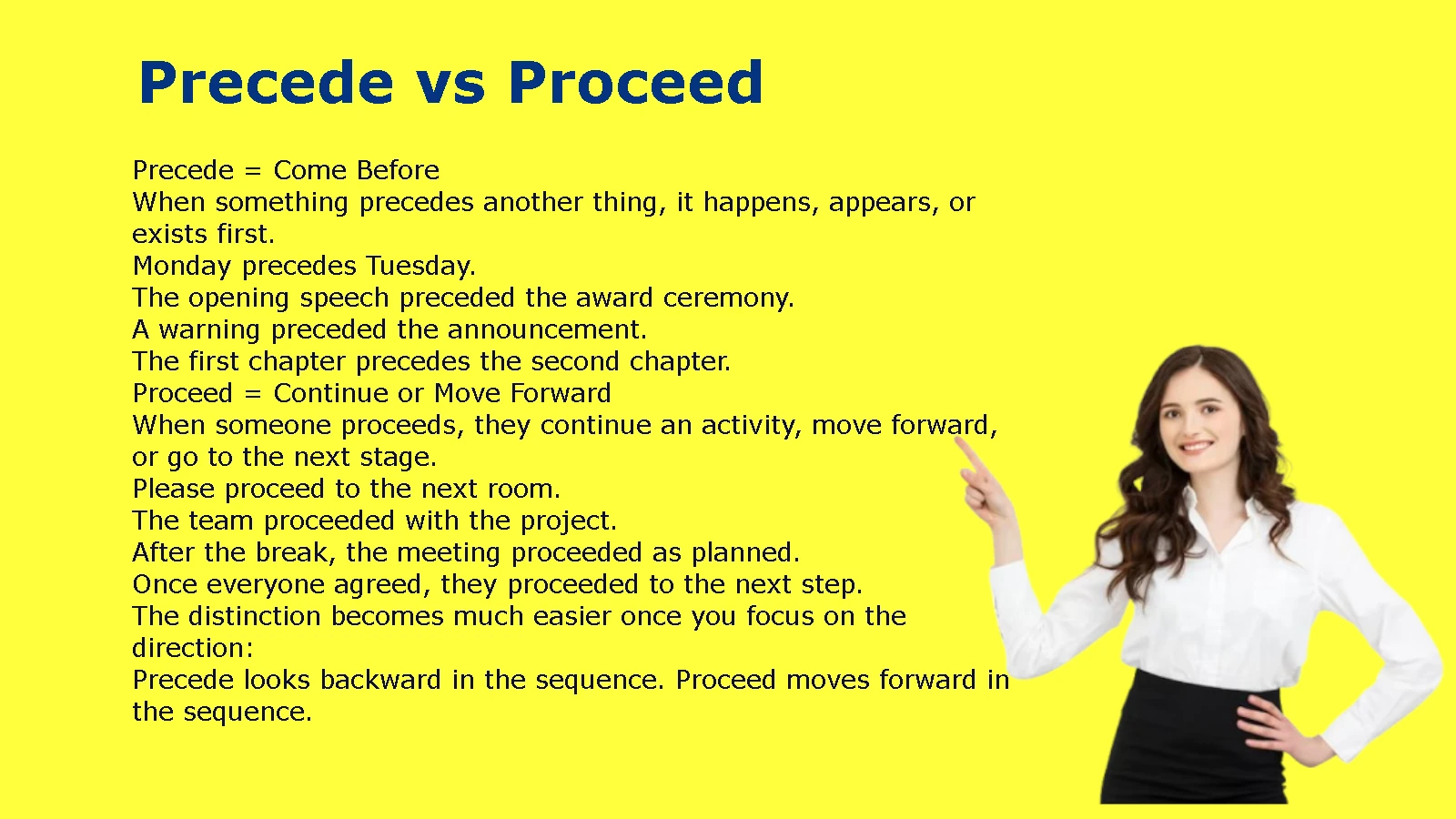
Precede = Come Before
When something precedes another thing, it happens, appears, or exists first.
- Monday precedes Tuesday.
- The opening speech preceded the award ceremony.
- A warning preceded the announcement.
- The first chapter precedes the second chapter.
Proceed = Continue or Move Forward
When someone proceeds, they continue an activity, move forward, or go to the next stage.
- Please proceed to the next room.
- The team proceeded with the project.
- After the break, the meeting proceeded as planned.
- Once everyone agreed, they proceeded to the next step.
The distinction becomes much easier once you focus on the direction:
Precede looks backward in the sequence. Proceed moves forward in the sequence.
What Does “Precede” Mean?
Precede is a verb that means to come before someone or something in time, order, position, or sequence.
The word can describe events, objects, people, words, numbers, or actions. It doesn’t necessarily mean that one thing causes another. It simply tells you that one thing comes first.
For example:
“The storm was preceded by several hours of heavy rain.”
The heavy rain happened before the storm.
Another example:
“The number 9 precedes the number 10.”
The number 9 comes before 10 in numerical order.
How “Precede” Works in a Sentence
The most common structure is:
precede + noun
Examples:
- The ceremony preceded the dinner.
- A brief introduction preceded the lecture.
- Several meetings preceded the final decision.
- The announcement preceded the official report.
You can also use preceded by when you want to describe what came before something.
“The ceremony was preceded by a short prayer.”
Here, the prayer came before the ceremony.
Examples of “Precede”
Here are several examples that show the different ways you can use precede:
- A warm-up session preceded the game.
- The letter B precedes the letter C.
- The warning preceded the evacuation.
- Several discussions preceded the final decision.
- Dark clouds preceded the storm.
- The opening remarks preceded the main presentation.
- The first chapter precedes the conclusion.
- A short introduction preceded the interview.
- The current model preceded the newer version.
- The meal was preceded by a welcome speech.
Notice that each example involves something coming first.
What Does “Proceed” Mean?
Proceed is a verb that generally means to continue, move forward, or carry on with an action or process.
It can describe physical movement:
“The passengers proceeded toward the exit.”
It can also describe continuing an activity:
“The manager proceeded with the meeting.”
In formal instructions, proceed often tells someone to move to the next stage.
“Please proceed to the registration desk.”
Here, proceed means to go forward or move to a particular place.
The Main Meanings of “Proceed”
Proceed has several closely related uses.
Continue an activity
“The meeting proceeded without interruption.”
The meeting continued.
Move forward physically
“The hikers proceeded along the narrow trail.”
They moved forward along the trail.
Continue with a plan
“The company decided to proceed with the expansion.”
The company decided to continue with the plan.
Move to the next stage
“Once your application is approved, you can proceed to payment.”
The applicant can move to the next step.
Examples of “Proceed”
- Please proceed to the main entrance.
- We can proceed with the next phase.
- The meeting proceeded as planned.
- After receiving approval, the team proceeded with the project.
- The driver proceeded slowly through the intersection.
- You may proceed to the next question.
- The investigation proceeded for several months.
- Once everyone arrived, the event proceeded normally.
- The students proceeded to the next activity.
- The company chose to proceed with the proposal.
The common thread is movement or continuation.
Precede vs Proceed Examples
Seeing the words side by side is one of the fastest ways to understand them.
Precede Examples
“The opening speech preceded the ceremony.”
The speech happened before the ceremony.
“Monday precedes Tuesday.”
Monday comes before Tuesday.
“A warning preceded the announcement.”
The warning came first.
“Several meetings preceded the final decision.”
The meetings happened before the final decision.
“The introduction preceded the main discussion.”
The introduction came first.
Proceed Examples
“Please proceed to the next room.”
Move to the next room.
“The team proceeded with the plan.”
The team continued with the plan.
“The meeting proceeded for another hour.”
The meeting continued for another hour.
“After lunch, the students proceeded with the lesson.”
The students continued the lesson.
“You may proceed to the next step.”
You may move forward to the next stage.
Precede and Proceed in the Same Sentence
Using both words in one sentence can make their difference especially clear.
“The introduction preceded the presentation, and the speaker then proceeded with the main topic.”
The introduction came before the presentation. The speaker then continued with the presentation.
Consider another example:
“Several warnings preceded the announcement, but officials proceeded with the planned event.”
The warnings came first. Officials then moved forward with their plan.
Here are more examples:
- The rehearsal preceded the performance, after which the actors proceeded to the reception.
- The opening remarks preceded the discussion, and the committee then proceeded with the first question.
- A brief inspection preceded the repair, after which the technicians proceeded with the installation.
- The training session preceded the test, and students then proceeded to complete it.
This gives you a useful mental model:
Something precedes when it comes first. Someone proceeds when they move forward.
Precede vs Proceed: Pronunciation
The words precede and proceed are pronounced differently at the beginning, even though both end with a similar “seed” sound.
- Precede: roughly pri-SEED
- Proceed: roughly pro-SEED
The first syllable helps distinguish them when speaking.
Why Pronunciation Can Cause Confusion
The ending of both words sounds similar:
- precede
- proceed
The spelling also looks nearly identical. That combination makes the pair easy to mix up, especially when writing quickly.
However, the first part gives you a useful clue:
- pre- often relates to something before
- pro- can suggest movement forward
This isn’t a rule you can apply mechanically to every English word. Still, it works as a helpful memory aid for this particular pair.
Precede vs Proceed: Word Origins
The connection between these words becomes clearer when you look at their Latin roots.
Precede comes from Latin roots associated with the idea of going before.
Proceed comes from Latin roots associated with going forward or advancing.
That meaning still appears clearly in modern English.
Precede
The basic idea is:
go before → come before → precede
Proceed
The basic idea is:
go forward → advance → proceed
Their histories therefore reinforce the modern distinction rather than creating a completely unrelated meaning.
A simple way to remember this relationship is:
Precede points to what comes first. Proceed points to what happens next.
Common Confusion Between Precede and Proceed
The biggest reason people confuse these words is their appearance.
Both words:
- Begin with pre/pro
- End with cede/ceed
- Function as verbs
- Can appear in formal writing
- Relate to sequence, movement, or events
That makes a quick proofreading check worthwhile.
Why Do People Confuse “Precede” and “Proceed”?
Consider these two sentences:
“The announcement preceded the ceremony.”
“The organizers proceeded with the ceremony.”
Both sentences discuss the same event, but the verbs perform completely different jobs.
In the first sentence, the announcement came before the ceremony.
In the second, the organizers continued with the ceremony.
The mistake happens when a writer focuses on the similar spelling instead of the intended meaning.
Common Incorrect Usage of Precede and Proceed
Incorrect: “Please precede with the next step.”
❌ Please precede with the next step.
This is incorrect because the sentence asks someone to continue or move forward.
The correct word is proceed:
✅ Please proceed with the next step.
Incorrect: “The ceremony proceeded the dinner.”
❌ The ceremony proceeded the dinner.
If you mean that the ceremony happened first, use preceded:
✅ The ceremony preceded the dinner.
Incorrect: “The warning proceeded the announcement.”
If the warning came before the announcement, the correct sentence is:
✅ The warning preceded the announcement.
Incorrect: “The team preceded with the project.”
If the team continued with the project, write:
✅ The team proceeded with the project.
The easiest way to correct these mistakes is to ask one question:
Does the word mean “come before” or “move forward”?
If it means come before, use precede.
If it means move forward or continue, use proceed.
How to Remember Precede vs Proceed
A short memory trick can save you from mixing these words up.
Precede = Before
Look at the beginning:
PREcede
Think:
PRE = before
For example:
“The introduction preceded the lesson.”
The introduction came before the lesson.
Proceed = Forward
Think:
PROceed = move forward
For example:
“Please proceed to the next step.”
You are moving forward in a process.
The Quickest Memory Trick
Precede = before. Proceed = forward.
That’s usually all you need.
You can also remember them through a simple timeline:
Precede → Event → Proceed
Something precedes the event.
Someone then proceeds with what comes next.
Precede vs Proceed: Grammar and Usage
Knowing the definitions isn’t enough. You also need to understand how each word behaves grammatically.
How to Use “Precede”
Precede + noun
This structure identifies the thing that comes before something else.
“The speech preceded the ceremony.”
“The first chapter precedes the second.”
You can use preceded by when the sentence focuses on what came first.
“The ceremony was preceded by a speech.”
You can also use preceding as a participle or adjective.
“The preceding paragraph explains the definition.”
Here, preceding means the paragraph that comes before.
How to Use “Proceed”
Proceed + adverb
“The group proceeded slowly.”
Here, proceeded describes how the group moved forward.
Proceed to + place
“Please proceed to the main entrance.”
This means to move toward a particular place.
Proceed with + noun
“The team proceeded with the project.”
This means the team continued the project.
Proceed to + verb
“She proceeded to explain the problem.”
This means she then began or continued by explaining the problem.
Common “Proceed” Expressions
Some common constructions are worth remembering:
- proceed with the plan
- proceed with the project
- proceed with caution
- proceed to the next step
- proceed to the entrance
- proceed as planned
- proceed accordingly
These expressions occur frequently in instructions, business writing, formal notices, and everyday communication.
Preceded By vs Proceeded With
These two expressions are particularly easy to confuse because both contain a form of the same root.
“Preceded By”
Preceded by means something came before another thing.
“The ceremony was preceded by a short speech.”
The speech happened first.
More examples:
- The storm was preceded by strong winds.
- The announcement was preceded by several warnings.
- The performance was preceded by a rehearsal.
- The meal was preceded by a welcome reception.
“Proceeded With”
Proceeded with means someone continued with an activity, plan, or process.
“The committee proceeded with the meeting.”
The committee continued the meeting.
More examples:
- The company proceeded with the expansion.
- The students proceeded with the assignment.
- The team proceeded with the original plan.
- The manager proceeded with the interview.
Compare them:
| Expression | Meaning | Example |
| preceded by | Came before | The ceremony was preceded by a speech. |
| proceeded with | Continued with | The organizers proceeded with the ceremony. |
This distinction is extremely useful in formal writing.
Preceding vs Proceeding
The confusion doesn’t stop with precede and proceed. Their related forms can also cause problems.
What Does “Preceding” Mean?
Preceding means coming before.
Examples:
- Read the preceding paragraph.
- The preceding chapter provides more details.
- The preceding events influenced the final decision.
- The preceding sentence explains the definition.
If something is preceding, it comes earlier.
What Does “Proceeding” Mean?
Proceeding means continuing, moving forward, or taking place.
Examples:
- The meeting is proceeding as planned.
- The project is proceeding smoothly.
- The legal proceedings continued throughout the week.
- The construction work is proceeding according to schedule.
There is another important use of proceeding as a noun.
A proceeding can refer to a formal action or process, especially a legal one.
For example:
“The court proceedings continued throughout the afternoon.”
Here, proceedings doesn’t mean simply “moving forward.” It refers to the formal events or actions of the court.
Precede vs Proceed vs Precedent
Another word that often enters the mix is precedent.
Although precede, proceed, and precedent look related, they don’t serve the same purpose.
| Word | Meaning | Example |
| Precede | Come before | The speech preceded the ceremony. |
| Proceed | Continue or move forward | The team proceeded with the plan. |
| Precedent | An earlier example used as a guide | The ruling established a legal precedent. |
Precede
“The first event preceded the second.”
Proceed
“The organizers proceeded with the second event.”
Precedent
“The earlier decision became a precedent for later cases.”
The words may share historical connections, but their modern meanings are distinct.
Precede vs Proceed vs Process
Proceed and process can also appear in similar professional contexts, but they mean different things.
Proceed means to continue or move forward.
Process means to handle, examine, or work through something.
Compare these examples:
“The company will proceed with the application.”
The company will move forward with it.
“The office will process the application.”
The office will review or handle it.
Quick Comparison
| Word | Core Meaning | Example |
| Precede | Come before | The meeting preceded the announcement. |
| Proceed | Continue or move forward | The team proceeded with the meeting. |
| Process | Handle or work through | The office processed the application. |
The context usually makes the correct choice clear.
Precede vs Proceed in Everyday Situations
These words aren’t limited to formal writing. You can use them in ordinary conversations, instructions, schoolwork, and workplace communication.
At School
“The quiz was preceded by a short review.”
The review came first.
“After the review, the teacher proceeded with the quiz.”
The teacher moved forward with the quiz.
At Work
“Several meetings preceded the final decision.”
The meetings happened first.
“The company proceeded with the project after receiving approval.”
The company continued with the project.
During Travel
“The safety briefing preceded boarding.”
The briefing happened before boarding.
“Passengers were asked to proceed to Gate 12.”
Passengers were told to move to the gate.
During an Event
“The opening remarks preceded the ceremony.”
The remarks came first.
“The guests then proceeded to the reception area.”
The guests moved forward to another location.
A Practical Case Study: Choosing the Correct Word
Imagine you’re writing about a company meeting.
The meeting begins with a presentation. After the presentation, the team discusses a new project. Once everyone agrees, the manager tells the team to continue with the implementation.
You could write:
“A short presentation preceded the discussion. After the discussion, the manager proceeded with the implementation plan.”
Why does this work?
- The presentation came before the discussion → preceded
- The manager continued or moved forward with the plan → proceeded
Now consider this incorrect version:
❌ “A short presentation proceeded the discussion. The manager preceded with the implementation plan.”
Both verbs are wrong because they’ve been swapped.
The corrected version restores the intended meanings:
✅ “A short presentation preceded the discussion. The manager proceeded with the implementation plan.”
This simple example captures the entire difference between the two words.
Another Case Study: A Formal Event
Consider a graduation ceremony.
First, the principal gives opening remarks. The graduates then receive their certificates. Afterward, everyone moves to the reception area.
A natural description would be:
“The principal’s remarks preceded the certificate presentation. After the ceremony, the graduates proceeded to the reception area.”
The first verb describes sequence.
The second describes movement.
That’s the key distinction in action.
Precede vs Proceed in Formal Writing
Both words appear frequently in formal writing because they describe sequence and continuation precisely.
Use “Precede” When Explaining Order
Academic, technical, and professional writing often needs to show that one event happened before another.
Examples:
- “The experiment was preceded by a calibration process.”
- “The final stage is preceded by a quality-control check.”
- “The conclusion was preceded by a detailed analysis.”
Use “Proceed” When Describing Continuation
Formal instructions often use proceed when telling readers what to do next.
Examples:
- “Once the form is complete, proceed to payment.”
- “After approval, the applicant may proceed with registration.”
- “The committee decided to proceed with the proposal.”
Because proceed can sound formal, it often appears in official instructions and professional documents. In casual conversation, simpler words such as continue, go ahead, or move on may sometimes sound more natural.
Synonyms for Precede
Understanding synonyms can help reinforce the meaning.
Depending on context, precede can be replaced by:
- come before
- go before
- lead up to
- predate
- occur before
- appear before
- come earlier
For example:
“The ceremony was preceded by a speech.”
Could become:
“A speech came before the ceremony.”
However, the synonyms aren’t always interchangeable in every context. Precede is especially useful when you want a concise and precise description of sequence.
Synonyms for Proceed
Depending on the context, proceed can mean:
- continue
- move forward
- go ahead
- carry on
- advance
- go on
- move ahead
For example:
“The team proceeded with the project.”
Could become:
“The team continued with the project.”
Or:
“The team moved forward with the project.”
Again, context matters. Proceed can sound more formal than continue or go ahead.
Common Phrases With Precede
Here are useful expressions containing precede or its related forms:
- precede an event
- precede a decision
- precede a statement
- precede a ceremony
- preceded by
- the preceding paragraph
- the preceding sentence
- the preceding chapter
- the preceding year
- the preceding section
Example
“As explained in the preceding section, the process has three stages.”
Here, preceding simply means the section that came before.
Common Phrases With Proceed
Some frequent expressions include:
- proceed with caution
- proceed with the plan
- proceed with the project
- proceed with the application
- proceed to the next step
- proceed to the next stage
- proceed as planned
- proceed accordingly
- proceed to the entrance
Example
“Once you have checked the information, proceed to the next step.”
Here, proceed means move forward in a process.
Quick Comparison: Precede vs Proceed
When you need a fast answer, use this table.
| Category | Precede | Proceed |
| Part of speech | Verb | Verb |
| Core meaning | Come before | Continue or move forward |
| Main idea | Earlier | Later/forward |
| Common structure | precede + noun | proceed with + noun |
| Another common form | preceded by | proceed to |
| Related adjective | preceding | proceeding |
| Memory clue | Pre = before | Proceed = forward |
| Example | The speech preceded the ceremony. | We proceeded with the ceremony. |
Precede vs Proceed: Quick Examples
Use these examples as a final practice set.
Choose “Precede”
- The introduction came before the lecture.
- Monday comes before Tuesday.
- The warning came before the announcement.
- The rehearsal came before the performance.
Correct:
- The introduction preceded the lecture.
- Monday precedes Tuesday.
- The warning preceded the announcement.
- The rehearsal preceded the performance.
Choose “Proceed”
- The team continued with the project.
- Please move forward to the next step.
- The guests moved toward the exit.
- The meeting continued after lunch.
Correct:
- The team proceeded with the project.
- Please proceed to the next step.
- The guests proceeded toward the exit.
- The meeting proceeded after lunch.
Frequently Asked Questions About Precede vs Proceed
What is the difference between precede and proceed?
Precede means to come before something in time, order, or position. Proceed means to continue, move forward, or carry on with something.
“The speech preceded the ceremony.”
The speech came first.
“The organizers proceeded with the ceremony.”
The organizers continued with it.
Does precede mean before?
Yes. Precede means to come before someone or something in time, order, or position.
For example:
“The letter A precedes B in the alphabet.”
A comes before B.
Does proceed mean continue?
Yes. Proceed can mean to continue or move forward.
“The meeting proceeded after the short break.”
The meeting continued after the break.
Is it “proceed with” or “precede with”?
The correct expression is proceed with when you mean continue with something.
Correct:
“We decided to proceed with the plan.”
Incorrect:
“We decided to precede with the plan.”
Use precede when something comes before something else.
Is it “preceded by” or “proceeded by”?
Use preceded by when you mean that something came before another thing.
Correct:
“The ceremony was preceded by a speech.”
Proceeded by does not normally express this meaning.
What is the easiest way to remember precede and proceed?
Remember:
Precede = before. Proceed = forward.
If something comes first, it precedes.
If someone continues or moves ahead, they proceed.
What is the difference between preceding and proceeding?
Preceding means coming before.
Proceeding means continuing, moving forward, or taking place.
Examples:
“Read the preceding paragraph.”
“The meeting is proceeding as planned.”
Can precede and proceed be used in the same sentence?
Yes. In fact, using them together can make their difference especially clear.
“The introduction preceded the presentation, and the speaker then proceeded with the main discussion.”
The introduction came first. The speaker then continued with the discussion.
Final Takeaway: Precede vs Proceed
The difference between precede vs proceed becomes much easier once you focus on the direction of the action.
Precede means to come before.
Proceed means to continue or move forward.
Keep this simple rule in mind:
Precede = before.
Proceed = forward.
If you’re describing something that happened earlier in a sequence, choose precede. If you’re describing someone continuing an activity, moving ahead, or reaching the next stage, choose proceed.