Habit and routine are related but have different meanings. A habit is an automatic behavior developed through repetition, while a routine is a planned sequence of actions performed regularly. When comparing Habit vs Routine, the right choice depends on whether you’re describing an unconscious behavior or an organized daily practice.
The confusion is completely understandable. A habit is an action you perform automatically with little thought, while a routine is a series of intentional tasks you follow regularly. But here’s the kicker: using the wrong word can change the meaning of what you’re trying to say, especially in conversations about productivity, health, or self-improvement.
In this guide, you’ll learn the key differences between Habit vs Routine, explore habit meaning, routine meaning, and discover habit vs routine examples that show how each word is used in real life. You’ll also learn when to use habit or routine, common mistakes to avoid, and simple memory tips to help you remember the distinction.
By the end, you’ll know exactly how to use both terms correctly and communicate with greater clarity and confidence.
Habit vs Routine: Quick Comparison
The simplest way to understand the difference is to compare how each one works.
| Feature | Habit | Routine |
| Meaning | An automatic behavior repeated regularly | A planned sequence of actions performed consistently |
| Awareness | Often happens without conscious thought | Usually requires conscious planning |
| Structure | Usually one specific action | Usually a group of related actions |
| Trigger | Often starts because of a cue | Usually starts because of a schedule or plan |
| Brain involvement | Stored as an automatic pattern | Managed through conscious decision-making |
| Example | Automatically checking your phone after hearing a notification | Following a morning schedule before work |
| Change difficulty | Often harder to change | Easier to adjust or redesign |
A simple way to remember the difference:
A routine is something you decide to do. A habit is something your brain learns to do automatically.
Both play important roles in shaping your daily life. A strong routine can create useful habits, while positive habits can make routines easier to maintain.
What Is a Habit?
A habit is a behavior that becomes automatic through repeated practice. Over time, your brain recognizes a pattern and begins performing the action with less conscious effort.
Think of habits as shortcuts your brain creates. Instead of spending energy deciding what to do every time, your brain uses a familiar pathway.
For example, when you first learn to drive, every action requires attention. You think about pressing the brake, checking mirrors, changing gears, and turning the steering wheel. After years of driving, many of these actions happen naturally because your brain has converted them into automatic patterns.
The same process happens with everyday behaviors.
You may:
- Automatically reach for your phone after waking up.
- Put your keys in the same place every day.
- Brush your teeth before bed without thinking.
- Drink coffee at the same time each morning.
- Check emails as soon as you sit at your desk.
These behaviors become habits because repetition teaches your brain that the action is familiar and useful.
How Habits Work: The Habit Loop Explained
One of the most widely recognized explanations of habit formation is the habit loop, which consists of three parts:
Cue → Behavior → Reward
This pattern explains why certain actions become automatic over time.
The Cue: What Triggers a Habit?
A cue is the signal that tells your brain to start a behavior.
A trigger can come from many sources:
- A specific time of day.
- A location.
- An emotion.
- Another activity.
- A person or situation.
Examples:
| Cue | Habit |
| Waking up | Drinking coffee |
| Feeling stressed | Eating comfort food |
| Hearing a notification | Checking a phone |
| Finishing dinner | Watching television |
| Sitting at a desk | Opening email |
The cue acts like a reminder. Your brain recognizes the situation and prepares for the familiar response.
The Behavior: The Action You Take
The behavior is the actual habit itself.
Examples include:
- Opening social media apps.
- Taking a morning walk.
- Writing a daily to-do list.
- Snacking while watching television.
- Stretching after sitting for a long time.
At this stage, repetition matters. The more often you repeat an action after the same cue, the stronger the connection becomes.
The Reward: Why Your Brain Repeats the Habit
A reward gives your brain a reason to remember the behavior.
Rewards do not always mean something big. They can be simple feelings or benefits.
Examples:
- Feeling relaxed after meditation.
- Feeling productive after completing a task.
- Feeling energized after exercise.
- Feeling connected after talking with friends.
Your brain naturally looks for behaviors that create positive results. When it finds a pattern that works, it becomes more likely to repeat it.
Examples of Common Habits in Daily Life
Habits exist in almost every area of life. Some support your goals, while others can slow you down.
Positive Habits
Examples of helpful habits include:
- Reading a few pages every night.
- Drinking water regularly.
- Reviewing goals each morning.
- Saving money automatically.
- Cleaning your workspace after finishing work.
These small actions may seem insignificant at first. However, repeated daily behaviors can create major long-term results.
For example, saving $5 every day may feel small, but consistent saving builds financial discipline over time.
Negative Habits
Some habits develop because they provide short-term comfort but create long-term problems.
Examples include:
- Constantly checking notifications.
- Delaying important tasks.
- Staying up late without a reason.
- Eating snacks whenever you feel bored.
- Spending too much time scrolling online.
The important point is that habits are learned behaviors. Because they are learned, they can also be changed.
What Is a Routine?
A routine is a set of actions you intentionally organize and repeat regularly. Unlike a habit, a routine usually requires conscious planning.
A routine answers the question:
“What actions do I want to complete in a specific order?”
For example, a morning routine might look like this:
- Wake up at 6:30 AM.
- Drink water.
- Exercise for 30 minutes.
- Shower.
- Eat breakfast.
- Review daily priorities.
Each action may require awareness and decision-making. However, repeating the routine consistently can eventually turn some parts into habits.
Examples of Different Types of Routines
Morning Routine
A morning routine helps you start the day with structure.
Common elements include:
- Waking up at a consistent time.
- Exercising.
- Planning goals.
- Eating a healthy breakfast.
- Reviewing important tasks.
A well-designed morning routine reduces decision fatigue because you already know what comes next.
Work Routine
A work routine creates a predictable system for completing tasks.
Examples:
- Checking priorities at the beginning of the day.
- Blocking time for focused work.
- Answering emails during specific periods.
- Reviewing progress before ending work.
Many successful professionals use routines because they reduce wasted time and create consistency.
Night Routine
A night routine helps signal that the day is ending.
Common activities include:
- Preparing clothes for tomorrow.
- Organizing your workspace.
- Reading.
- Avoiding unnecessary distractions.
- Creating a regular bedtime schedule.
A consistent night routine can make it easier to transition from an active day into rest.
Habit vs Routine: The Biggest Difference Explained
Although habits and routines overlap, the biggest difference comes down to automatic behavior versus intentional structure.
A habit happens because your brain has learned a pattern.
A routine happens because you have created a plan.
Consider this example:
Habit:
You automatically check your phone every morning before getting out of bed.
Routine:
You wake up, stretch, drink water, exercise, and review your schedule before checking messages.
Both involve repeated actions. However, one happens automatically while the other follows a deliberate structure.
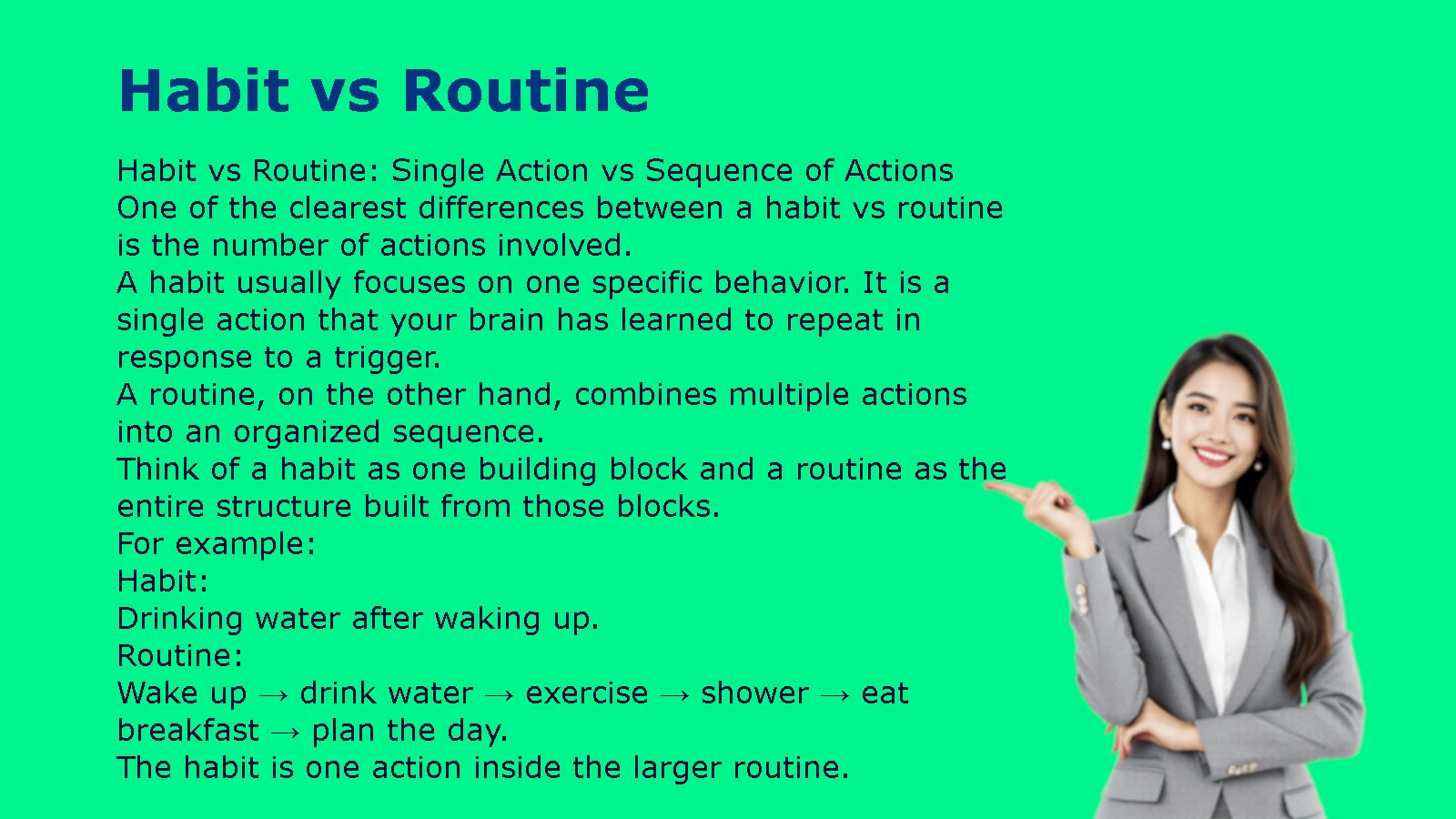
Habit vs Routine: Single Action vs Sequence of Actions
One of the clearest differences between a habit vs routine is the number of actions involved.
A habit usually focuses on one specific behavior. It is a single action that your brain has learned to repeat in response to a trigger.
A routine, on the other hand, combines multiple actions into an organized sequence.
Think of a habit as one building block and a routine as the entire structure built from those blocks.
For example:
Habit:
- Drinking water after waking up.
Routine:
- Wake up → drink water → exercise → shower → eat breakfast → plan the day.
The habit is one action inside the larger routine.
This relationship explains why many successful routines feel effortless after a while. Over time, individual habits become connected, creating a system that guides your behavior.
Habit vs Routine: Conscious Action vs Automatic Behavior
Another major difference between habits and routines is awareness.
A routine usually requires you to think:
- What should I do next?
- When should I complete this task?
- How does this fit into my schedule?
A habit often skips that decision-making process.
For example, imagine someone who checks their email every morning at 8:00 AM.
At first, they may consciously decide:
“I need to check my emails every morning before starting work.”
After months of repetition, opening the email app may happen naturally as soon as they sit at their desk.
The routine created the structure. The repetition created the habit.
Habit vs Routine: Flexibility and Adaptability
When comparing habit vs routine, flexibility is another important factor.
Routines are usually easier to change because they are planned systems.
If your morning routine no longer works because your schedule changes, you can redesign it.
For example:
Old morning routine:
- Exercise at 6 AM.
- Prepare breakfast.
- Read for 20 minutes.
New morning routine:
- Exercise after work.
- Prepare breakfast the night before.
- Read during lunch.
You can adjust a routine like changing a calendar appointment.
Habits can be more challenging because they operate automatically.
A person who automatically checks their phone whenever they feel bored may not even notice they are doing it. Changing that behavior requires identifying the trigger and replacing the action.
Habit vs Routine Examples in Everyday Life
The difference between habits and routines becomes clearer when you see practical examples.
Morning Life Example
Habit:
You immediately reach for your phone after waking up.
This behavior happens because your brain connects waking up with checking notifications.
Routine:
You follow a planned morning schedule:
- Wake up.
- Drink water.
- Stretch.
- Exercise.
- Prepare breakfast.
- Review your goals.
The routine creates structure, while individual behaviors within it may become habits.
Fitness Example
Habit:
Taking a short walk after dinner every evening.
The action becomes automatic because your brain associates finishing dinner with walking.
Routine:
Following a weekly fitness plan:
| Day | Activity |
| Monday | Strength training |
| Tuesday | Walking or cardio |
| Wednesday | Rest or stretching |
| Thursday | Strength training |
| Friday | Cardio |
| Weekend | Outdoor activities |
The workout schedule is a routine. The repeated actions inside it can develop into habits.
Learning Example
Habit:
Reviewing notes for five minutes after class.
Routine:
A complete study system:
- Review class notes.
- Organize important information.
- Complete assignments.
- Practice questions.
- Prepare for upcoming exams.
Students often succeed not because they study occasionally for long hours but because they build consistent routines.
Workplace Example
Habit:
Writing down ideas whenever they appear.
Routine:
A weekly planning system:
- Review completed tasks.
- Set priorities.
- Schedule important projects.
- Track progress.
The habit supports the routine.
Are Habits Part of Routines?
Yes, habits often become important parts of routines.
A routine can contain several habits working together.
For example, consider a healthy morning routine:
| Action | Type |
| Drinking water after waking | Habit |
| Exercising at a specific time | Habit |
| Planning daily tasks | Habit |
| Completing actions in a set order | Routine |
The routine provides the structure. The habits make the process easier.
This connection explains why building routines is often the first step toward creating lasting habits.
A person may begin by forcing themselves to follow a schedule. After enough repetition, many actions become automatic.
How Long Does It Take to Build a Habit or Routine?
Many people ask how long it takes to create a new habit. The answer depends on the person and the behavior.
A common misconception is that every habit forms in exactly 21 days. This idea became popular from older research and public discussions, but modern studies show that habit formation varies widely.
Research published in the European Journal of Social Psychology found that forming a new automatic behavior can take anywhere from several weeks to many months depending on the complexity of the behavior and individual circumstances.
Some factors that affect habit formation include:
| Factor | Impact on Habit Formation |
| Complexity | Simple habits usually develop faster |
| Consistency | Regular repetition strengthens the behavior |
| Environment | Supportive surroundings make habits easier |
| Motivation | Clear reasons improve commitment |
| Difficulty level | Harder behaviors require more time |
For example:
- Drinking a glass of water after waking may become automatic relatively quickly.
- Building a daily exercise habit usually requires more time and adjustment.
The goal is not to create a perfect streak. The goal is to repeat the behavior often enough that it becomes natural.
How to Turn a Routine Into a Habit
Creating a routine is often the first step toward developing a habit. However, repetition alone is not enough. The design of the routine matters.
Here are practical ways to make routines become automatic habits.
Start With Small Actions
Many people fail because they create routines that are too ambitious.
A person may decide:
- Wake up at 5 AM.
- Exercise for one hour.
- Read 50 pages.
- Learn a new skill.
- Cook every meal.
This sounds productive, but it can become overwhelming.
A better approach is starting small.
Examples:
Instead of:
“I will exercise every day for one hour.”
Start with:
“I will walk for ten minutes after lunch.”
Instead of:
“I will read three books this month.”
Start with:
“I will read five pages before bed.”
Small actions are easier to repeat, and repetition creates momentum.
Use Habit Stacking to Build New Behaviors
Habit stacking means attaching a new behavior to an existing habit.
The idea is simple:
After I do X, I will do Y.
Examples:
- After brushing my teeth, I will stretch for two minutes.
- After making coffee, I will write my daily priorities.
- After lunch, I will take a short walk.
- After turning off my computer, I will prepare tomorrow’s task list.
Existing habits act like anchors. They remind your brain when the new behavior should happen.
Make the Behavior Easy to Complete
The easier an action feels, the more likely you are to repeat it.
This principle is often called reducing friction.
Examples:
To exercise more:
- Keep workout clothes ready.
- Place equipment where you can see it.
- Schedule exercise at a realistic time.
To read more:
- Keep a book near your bed.
- Remove distractions.
- Set a small reading goal.
Your environment influences your behavior more than many people realize.
A well-designed environment can make good habits feel almost automatic.
Repeat Consistently Instead of Chasing Perfection
Consistency matters more than occasional intensity.
A person who exercises for 15 minutes every day often builds a stronger habit than someone who exercises for three hours once a month.
The brain learns through repetition.
Think of habit formation like creating a path through grass. Walking the same path repeatedly makes it clearer and easier to follow.
How to Break Bad Habits and Replace Them With Better Routines
Breaking a habit is not simply about stopping a behavior. Often, you need to understand why the behavior exists.
Many habits provide some type of reward.
For example:
- Stress eating may provide comfort.
- Phone scrolling may provide entertainment.
- Procrastination may temporarily reduce pressure.
Instead of only removing the habit, replace it with a healthier alternative.
Identify the Trigger
Start by asking:
- When does this behavior happen?
- Where does it happen?
- What emotion appears before it?
- What reward am I seeking?
Example:
Problem habit:
- Checking social media whenever work feels difficult.
Possible trigger:
- Feeling overwhelmed.
Possible replacement:
- Taking a two-minute break, stretching, or writing the next small task.
Understanding the trigger makes change easier.
Replace the Habit Instead of Removing It
The brain often struggles with empty spaces.
If you remove a behavior without replacing it, the old pattern may return.
| Old Habit | Better Replacement |
| Checking phone during every break | Taking a short walk |
| Staying up late watching videos | Reading before bed |
| Avoiding difficult tasks | Starting with a five-minute step |
| Snacking from boredom | Drinking water or doing a quick activity |
Benefits of Building Strong Habits and Routines
Understanding the difference between habit vs routine is useful, but the real value comes from applying both concepts in everyday life.
Strong habits and effective routines create systems that help you reach goals with less stress. Instead of relying on motivation every day, you build patterns that support your priorities.
Motivation can change depending on your mood, energy level, or circumstances. However, a well-designed routine can keep you moving forward even on difficult days.
As the saying goes:
“You don’t rise to the level of your goals. You fall to the level of your systems.”
Your systems are the repeated actions, habits, and routines that shape your results.
Benefits of Developing Good Habits
Habits Save Mental Energy
Your brain makes thousands of decisions every day. If you had to consciously decide every small action, daily life would become exhausting.
Habits reduce decision fatigue by making common actions automatic.
For example:
Without a habit:
- “Should I exercise today?”
- “When should I exercise?”
- “What workout should I do?”
With a habit:
- You already know you exercise after work.
The decision has already been made.
Habits Improve Consistency
Big results usually come from small actions repeated over time.
A person who writes 300 words every day can create a large amount of work within a year. Someone who waits for inspiration may struggle to make consistent progress.
Small habits create compound effects.
Examples:
| Daily Habit | Long-Term Impact |
| Reading 10 pages | Builds knowledge over time |
| Saving money regularly | Creates financial discipline |
| Practicing a skill daily | Improves ability gradually |
| Exercising consistently | Supports long-term health |
The action may seem small today, but repetition creates momentum.
Habits Support Personal Growth
Many successful behaviors eventually become habits.
Examples:
- Successful writers develop writing habits.
- Athletes develop training habits.
- Entrepreneurs develop planning habits.
- Students develop study habits.
The difference is rarely one huge action. More often, it is the result of repeated behaviors.
Benefits of Creating Effective Routines
Routines Provide Structure
A routine creates a framework for your day.
Without structure, people often spend more time deciding what to do instead of actually doing it.
For example:
A person without a work routine may:
- Check random tasks.
- Respond to distractions.
- Delay important projects.
A person with a work routine may:
- Review priorities.
- Complete focused tasks.
- Schedule breaks.
- Track progress.
The routine creates direction.
Routines Improve Time Management
A good routine helps you use your time intentionally.
For example, a professional might create this daily work routine:
| Time | Activity |
| 8:00 AM | Review priorities |
| 8:30 AM | Focused project work |
| 11:00 AM | Respond to messages |
| 1:00 PM | Meetings and collaboration |
| 4:00 PM | Review progress |
The schedule removes uncertainty and creates a predictable workflow.
Routines Reduce Stress
Uncertainty often creates stress.
When you already know what happens next, your brain spends less energy planning and worrying.
A simple evening routine can make mornings easier:
- Prepare clothes.
- Organize important items.
- Review tomorrow’s schedule.
- Set a consistent bedtime.
Small preparations create smoother days.
Common Mistakes People Make With Habits and Routines
Building habits and routines sounds simple, but many people struggle because they approach the process incorrectly.
Here are common mistakes and better solutions.
Trying to Change Too Many Habits at Once
One of the biggest mistakes is creating a complete life makeover overnight.
Someone may decide:
- Exercise every day.
- Stop eating unhealthy foods.
- Wake up early.
- Learn a new skill.
- Read daily.
- Become more productive.
The problem is not that these goals are bad. The problem is trying to change everything at the same time.
Your brain needs time to adjust.
A better approach:
Start with one or two important behaviors.
Example:
Instead of creating a complicated morning routine, begin with:
- Wake up at the same time.
- Drink water.
- Spend five minutes planning your day.
Once those actions become natural, add more.
Creating Unrealistic Routines
A routine should fit your actual life, not an imaginary perfect version of yourself.
Many people copy routines from successful individuals without considering differences in:
- Schedule.
- Responsibilities.
- Energy levels.
- Personal goals.
For example:
A person who works night shifts cannot follow the same morning routine as someone who starts work at 7 AM.
A useful routine is realistic and sustainable.
Ask yourself:
- Can I maintain this for months?
- Does this fit my lifestyle?
- Does it support my goals?
If the answer is no, redesign it.
Confusing Planning With Progress
Creating a detailed routine feels productive, but planning alone does not create results.
Someone can spend hours designing the perfect schedule but still avoid taking action.
A simple routine that you actually follow is better than a complicated routine that stays on paper.
Example:
Less effective:
- Creating a 20-step morning routine but following it once.
More effective:
- Creating a five-step routine and following it consistently.
Action creates improvement.
Ignoring the Environment
Your surroundings influence your behavior.
A person trying to eat healthier while keeping unhealthy snacks everywhere creates unnecessary difficulty.
A person trying to read more while keeping books hidden in a drawer creates extra friction.
Your environment can either support or fight your habits.
Examples:
encourage reading:
- Keep books visible.
- Create a comfortable reading space.
To encourage exercise:
- Prepare workout clothes beforehand.
- Schedule workouts clearly.
reduce distractions:
- Remove unnecessary notifications.
- Keep your phone away during focused work.
Good environments make good habits easier.
Habit vs Routine: Which One Is More Important?
The answer depends on your goal.
A routine and a habit are not competitors. They work together.
A routine creates the structure that guides your actions.
A habit makes repeated actions easier over time.
Think of a routine as the road map and habits as the vehicle that moves you forward.
You need both.
For example:
A person wants to become healthier.
Their routine might include:
- Planning meals.
- Scheduling workouts.
- Sleeping at a consistent time.
Their habits might include:
- Drinking water regularly.
- Choosing healthier foods.
- Walking after meals.
The routine organizes the process. The habits maintain it.
Case Study: How a Routine Creates Long-Term Habits
Example: Building a Reading Habit
Imagine someone wants to read more books.
At first, reading feels like a task that requires effort.
They create a simple routine:
Every night after brushing their teeth:
- Read for 10 minutes.
- Keep the book beside the bed.
- Avoid checking their phone.
After several weeks:
- The routine becomes familiar.
- The action requires less effort.
- Reading becomes connected with bedtime.
Eventually, reading feels natural.
The routine created the environment. Repetition created the habit.
Case Study: Building a Fitness Routine
A person decides to become more active.
Instead of starting with an intense workout plan, they create a realistic routine:
Week 1:
- Walk for 10 minutes after dinner.
Week 2:
- Increase walking time.
3:
- Add basic strength exercises.
After several months:
- Exercise becomes a normal part of their lifestyle.
The success came from consistency, not extreme effort.
Frequently Asked Questions About Habit vs Routine
Is a Habit the Same as a Routine?
No.
A habit is an automatic behavior repeated because your brain has learned a pattern.
A routine is a planned sequence of actions you intentionally follow.
Example:
- Brushing your teeth automatically = habit.
- Your complete morning schedule = routine.
Can a Routine Become a Habit?
Yes.
A routine can create habits when you repeat the same actions consistently.
For example:
A person starts a morning routine that includes meditation.
At first, meditation requires planning.
After repeated practice, meditation may become an automatic part of the morning.
Are All Habits Part of Routines?
No.
Some habits exist separately.
For example:
- Automatically checking your phone when bored.
- Tapping your foot while thinking.
- Drinking coffee at a specific time.
These behaviors may not belong to a larger routine.
However, many useful habits become part of routines.
Which Is Easier to Change: Habits or Routines?
Usually, routines are easier to change because they involve conscious planning.
You can redesign a schedule whenever your needs change.
Habits can be harder because they often happen automatically.
Changing a habit usually requires:
- Identifying the trigger.
- Replacing the behavior.
- Repeating the new pattern.
How Many Habits Should You Build at Once?
There is no universal number, but focusing on a few important habits is usually more effective than changing everything at once.
Start with behaviors that have a strong impact:
- Sleep schedule.
- Exercise.
- Planning.
- Learning.
- Nutrition.
Once these become stable, you can add more.
Final Thoughts: Habit vs Routine and the Power of Small Actions
The difference between habit vs routine becomes clear when you understand their roles.
A routine is a deliberate plan that organizes your actions.
A habit is a repeated behavior that becomes automatic.
Your routines shape your days. Your habits shape your lifestyle.
The most effective approach is to create simple routines that support positive habits. Start small, stay consistent, and focus on progress rather than perfection.
A single action may not seem powerful today. However, repeated thousands of times, small actions can completely change the direction of your life.