Opinion and perspective are both used to express thoughts or viewpoints, but they have different meanings. An opinion is a personal belief or judgment, while a perspective is the way someone views or understands a situation based on their experiences. When comparing Opinion vs Perspective, the right choice depends on whether you are expressing a belief or describing a point of view.
The confusion is understandable. An opinion is a personal belief or judgment, while a perspective is the viewpoint or way someone sees a situation. But here’s the kicker: mixing them up can lead to misunderstandings, especially when sharing ideas, giving feedback, or discussing different points of view.
In this guide, you’ll learn the difference between opinion and perspective, explore opinion vs perspective meaning, discover when to use opinion or perspective, and see opinion vs perspective examples in real sentences. You’ll also learn how to tell opinion from perspective so you can choose the right word with confidence in everyday and professional communication.
By the end, you’ll know exactly when to use opinion and perspective, helping you express your thoughts more clearly and avoid one of the most common word confusions.
Opinion vs Perspective: The Main Differences Explained
Understanding the difference between opinion and perspective becomes easier when you examine how they function.
Opinion Focuses on What Someone Thinks
An opinion answers the question:
“What do I believe about this?”
It usually expresses a judgment, preference, or conclusion.
Examples:
- “I think this movie is overrated.”
- “I believe online shopping is more convenient.”
- “I prefer working in the morning.”
These statements tell you the person’s position.
However, they do not always explain the reason behind that position.
Perspective Focuses on How Someone Sees Something
A perspective answers a different question:
“Why do I see this situation this way?”
It explains the mental framework behind an idea.
Example:
Opinion:
“This city is difficult to live in.”
Perspective:
“As someone who depends on public transportation, I find this city challenging because transportation options are limited.”
The perspective gives the background that shaped the opinion.
Opinion Is Usually a Conclusion, While Perspective Is the Lens Behind It
A useful way to understand opinion vs perspective is to look at the process behind human thinking.
People often follow this pattern:
Experiences → Perspective → Interpretation → Opinion
Your experiences influence your perspective. Your perspective affects how you interpret information. That interpretation often becomes your opinion.
For example:
Experience:
A person works remotely for several years and becomes more productive.
Perspective:
They begin viewing flexible work as valuable.
Opinion:
They believe companies should offer remote work options.
The opinion appears at the end of the process. The perspective helps explain where it came from.
Opinion vs Perspective: Differences in Scope
Another major difference between these terms is their range.
An opinion is usually narrow and specific.
A perspective is usually wider and more complex.
Compare these examples:
| Statement | Type | Why |
| “I dislike this restaurant.” | Opinion | It expresses a personal judgment |
| “I prefer restaurants that use fresh local ingredients because I value sustainability.” | Perspective | It explains the values behind the preference |
| “This phone is too expensive.” | Opinion | It evaluates a product |
| “As a student managing a limited budget, I look for affordable technology.” | Perspective | It explains the circumstances influencing the judgment |
The perspective contains more information because it includes the person’s situation.
Can Two People Have the Same Opinion but Different Perspectives?
Yes.
This is one of the most interesting parts of understanding opinion and perspective.
People can agree on the same conclusion while arriving there for completely different reasons.
For example:
Topic: Public parks
Person A says:
“Cities should build more parks.”
Their perspective:
- They care about environmental benefits.
- They enjoy outdoor activities.
Person B says:
“Cities should build more parks.”
Their perspective:
- They want more spaces for children.
- They believe communities need shared areas.
The opinion is identical, but the reasoning behind it differs.
This happens frequently in politics, business, education, and everyday conversations.
Can People Have Different Opinions From the Same Perspective?
Yes, because perspectives do not always create identical opinions.
A perspective provides a way of seeing something, but people still interpret information individually.
Example:
Two doctors may share a medical perspective focused on patient health.
However:
- One doctor may prefer traditional treatment methods.
- Another doctor may support newer technologies.
Their professional perspective is similar, but their opinions differ.
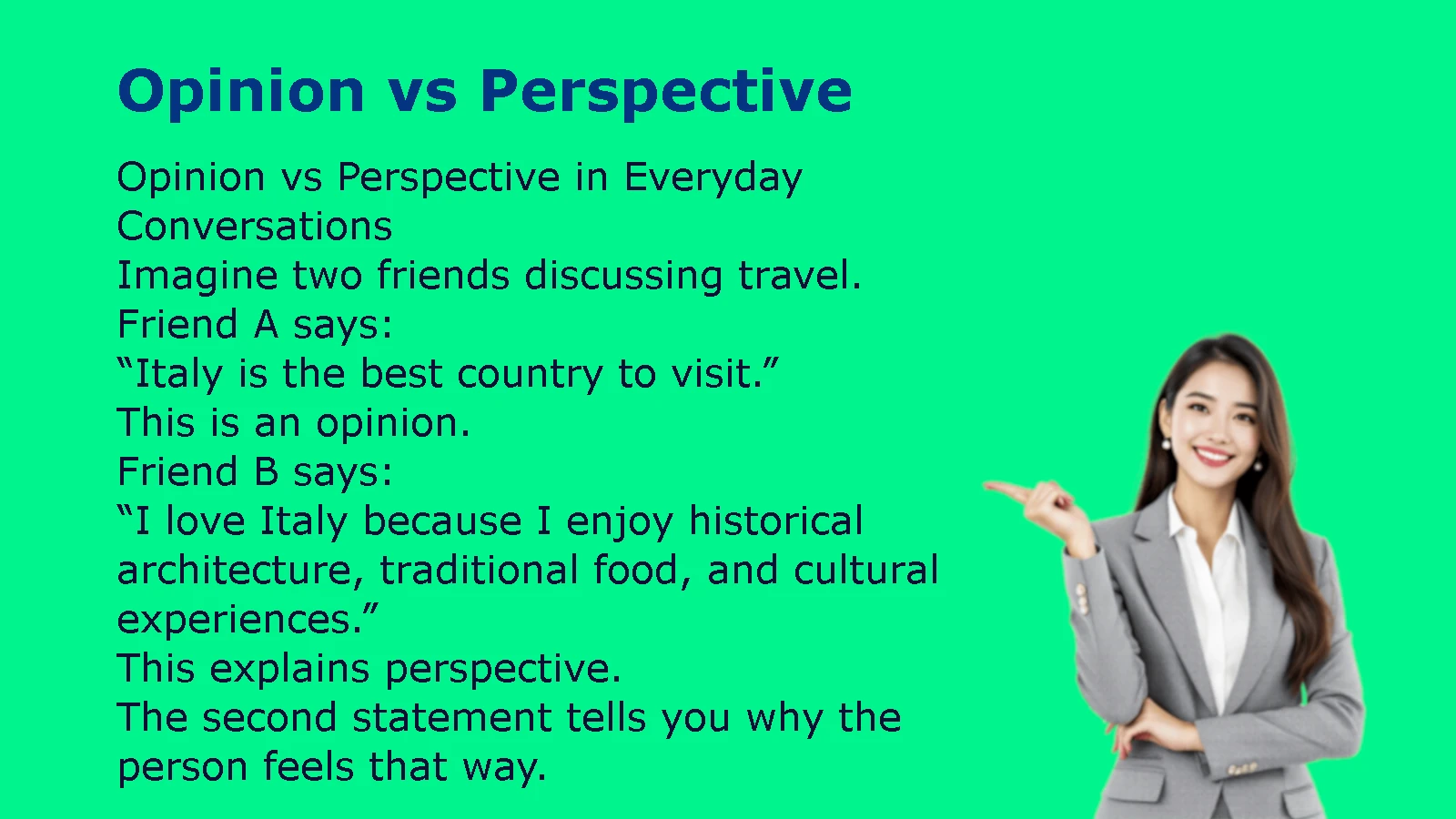
Opinion vs Perspective in Everyday Conversations
Imagine two friends discussing travel.
Friend A says:
“Italy is the best country to visit.”
This is an opinion.
Friend B says:
“I love Italy because I enjoy historical architecture, traditional food, and cultural experiences.”
This explains perspective.
The second statement tells you why the person feels that way.
Opinion vs Perspective in the Workplace
Workplace disagreements often happen because people focus on opinions without understanding perspectives.
Example:
A manager says:
“The team needs to finish this project quickly.”
This is an opinion about priorities.
An employee says:
“The deadline feels unrealistic because the project requires multiple testing stages.”
This reflects a perspective based on their role and responsibilities.
Neither viewpoint automatically cancels out the other.
The manager sees the project through business goals.
The employee sees it through execution challenges.
Understanding both perspectives can lead to better decisions.
Opinion vs Perspective in News and Media
Media discussions often involve strong opinions.
However, behind every opinion, there is usually a perspective.
For example:
Two people may discuss a government policy.
Person A may focus on:
- Economic growth
- Business opportunities
- Financial results
Person B may focus on:
- Social impact
- Community effects
- Individual experiences
Their opinions may conflict because their perspectives emphasize different factors.
This is why understanding perspective is important when analyzing information.
Opinion vs Perspective vs Point of View
Many people use opinion, perspective, and point of view interchangeably.
Although they overlap, they have different meanings.
| Term | Meaning | Example |
| Opinion | A personal belief or judgment | “I think this book is excellent.” |
| Perspective | A broader way of interpreting something | “As a teacher, I see this book as useful for learning.” |
| Point of view | The position or angle from which something is viewed | “The story is told from the main character’s point of view.” |
Understanding Point of View
Point of view often describes the position from which something is presented.
In literature, point of view refers to the narrator’s position.
Examples:
First-person point of view
The narrator uses:
- I
- Me
- My
Example:
“I walked through the forest and discovered the hidden cabin.”
The reader experiences the story through the narrator.
Third-person point of view
The narrator describes characters from outside.
Example:
“She walked through the forest and discovered the hidden cabin.”
The narrator is separate from the character.
In everyday discussions, point of view can also mean someone’s position on a topic.
Example:
“From my point of view, this decision makes sense.”
This is similar to an opinion but does not always include personal judgment.
Why Understanding Opinion vs Perspective Matters
Knowing the difference between opinion and perspective improves communication in many areas of life.
Better Conversations
Many arguments happen because people challenge opinions without understanding the perspectives behind them.
Instead of asking:
“Why do you think that?”
A more helpful question can be:
“What experiences led you to see it that way?”
This approach creates better discussions.
Stronger Critical Thinking
Understanding perspective helps you examine ideas from multiple angles.
For example, when making a decision, you can consider:
- Personal benefits
- Possible disadvantages
- Different groups affected
- Long-term effects
This creates a more balanced view.
Improved Writing Skills
Writers use perspectives to create deeper explanations.
A weak argument only states an opinion:
“Schools should change their rules.”
A stronger argument explains perspective:
“Many students believe schools should update certain rules because modern learning environments require more flexibility.”
The second statement provides context.
How to Identify Opinion vs Perspective
When reading or listening to someone’s statement, ask a few questions.
| Question | If the Answer Is Yes | Likely Category |
| Does the statement express a preference? | “I like/dislike this” | Opinion |
| Does it make a judgment? | “This is better/worse” | Opinion |
| Does it explain personal background? | “Because of my experience…” | Perspective |
| Does it describe a broader way of understanding? | “From this viewpoint…” | Perspective |
| Does it consider context? | “Given this situation…” | Perspective |
Common Mistakes When Using Opinion and Perspective
Mistake: Treating Opinions as Facts
One of the most common errors happens when people present opinions as objective truth.
Example:
Incorrect:
“This is the best restaurant in the world.”
Better:
“I think this is one of the best restaurants I have visited.”
The second version clearly shows that it is a personal opinion.
Mistake: Assuming Everyone Has the Same Perspective
People often forget that experiences shape viewpoints.
For example:
A person who loves busy cities may think:
“Living downtown is exciting.”
Someone who values quiet surroundings may think:
“Living downtown is stressful.”
Their different perspectives explain their different reactions.
Mistake: Using Perspective When You Mean Opinion
Sometimes people use “perspective” for simple preferences.
Example:
Incorrect:
“My perspective is that chocolate ice cream tastes better.”
Better:
“My opinion is that chocolate ice cream tastes better.”
A preference about taste is usually an opinion.
A perspective would explain the background behind that preference.
Opinion vs Perspective: Understanding the Difference, Meaning, and Examples
How to Use Opinion and Perspective Correctly in Writing
Good writing does more than share ideas. It helps readers understand why those ideas exist.
Knowing the difference between opinion vs perspective allows writers to create clearer arguments, stronger explanations, and more balanced discussions.
A writer who only shares opinions may tell readers what they think. A writer who explains perspectives helps readers understand the reasoning behind those thoughts.
For example:
Simple opinion:
“Remote work is better.”
This statement tells the reader the writer’s belief, but it lacks context.
Opinion supported by perspective:
“Remote work can be more effective for employees who have long commutes because flexible schedules allow them to spend less time traveling and more time focusing on their responsibilities.”
The second statement provides a perspective. It explains the situation behind the opinion.
How Writers Show Perspective
Writers can reveal perspective by including details about:
- Background
- Experiences
- Goals
- Challenges
- Values
- Knowledge
- Circumstances
A strong explanation often answers:
- Who is seeing this situation?
- What experiences influence their view?
- What factors affect their judgment?
- Why might another person see it differently?
Example: Opinion vs Perspective in an Essay
Topic: School uniforms
Opinion:
“School uniforms are unnecessary.”
Perspective:
“Students who value personal expression may view uniforms as restrictive because clothing choices can be a way to show individuality.”
The opinion gives a conclusion.
The perspective explains the reasoning behind it.
How to Express Opinions Clearly
Opinions are common in everyday conversations and writing. However, they should be presented honestly.
Useful phrases include:
- “I believe…”
- “I think…”
- “In my opinion…”
- “From my experience…”
- “I prefer…”
- “I feel that…”
Examples:
Instead of:
“This restaurant has terrible food.”
Try:
“In my opinion, this restaurant’s menu does not match my taste.”
The second version recognizes that taste is personal.
How to Express Perspectives Clearly
Perspectives often require more explanation because they involve context.
Useful phrases include:
- “From my point of view…”
- “Based on my experience…”
- “As someone who…”
- “Considering that…”
- “Looking at this from the perspective of…”
Examples:
“As a small business owner, I understand why companies carefully consider costs before making changes.”
This statement does not simply express an opinion. It reveals the person’s position and experience.
Case Studies: Opinion vs Perspective in Real Situations
Case Study: Remote Work Debate
Remote work became a major discussion topic because people viewed it through different perspectives.
Employee perspective
Many employees focus on:
- Reduced commuting time
- Better flexibility
- Improved work-life balance
Possible opinion:
“Companies should allow employees to work remotely whenever possible.”
Employer perspective
Many employers focus on:
- Team communication
- Company culture
- Productivity tracking
Possible opinion:
“Some jobs require employees to work together in person.”
The important lesson
The disagreement may not come from different goals.
Both groups may want successful businesses.
The difference comes from the perspective they use to evaluate the situation.
Case Study: Environmental Decisions
Consider a debate about banning single-use plastic.
Environmental perspective
A person focused on environmental protection may think about:
- Pollution reduction
- Wildlife protection
- Long-term sustainability
Possible opinion:
“Plastic restrictions are necessary.”
Business perspective
A small business owner may focus on:
- Product costs
- Customer expectations
- Available alternatives
Possible opinion:
“Businesses need more time before changing packaging systems.”
Both perspectives contain valid concerns.
Understanding both creates a more complete discussion.
Opinion vs Perspective in Communication
Communication becomes easier when people recognize that disagreement does not always mean one person is wrong.
Many conflicts happen because people argue against opinions without understanding the perspectives behind them.
For example:
Person A says:
“This city should build more apartments.”
Person B says:
“This city should protect existing neighborhoods.”
At first, these opinions seem opposite.
However, their perspectives reveal more:
- Person A may focus on housing affordability.
- Person B may focus on preserving community identity.
Once people understand the reasoning behind each viewpoint, they can have a more productive conversation.
The Role of Perspective in Empathy
Perspective plays an important role in empathy.
Empathy means trying to understand another person’s feelings, experiences, or situation.
When you understand someone’s perspective, you do not necessarily have to agree with their opinion.
These are two different things.
You can say:
“I understand why you see it that way, even though I have a different opinion.”
This is a powerful communication skill.
It allows people to disagree respectfully.
Opinion vs Perspective: Frequently Asked Questions
Is an opinion the same as a perspective?
No.
An opinion is a personal belief or judgment about something.
A perspective is the broader way someone understands or interprets something based on experiences, knowledge, and circumstances.
A perspective can influence many opinions.
Can an opinion become a perspective?
Usually, an opinion does not become a perspective.
Instead, a perspective often creates opinions.
For example:
Perspective:
“Education should prepare people for practical life skills.”
Possible opinions:
- Schools should teach financial literacy.
- Students should learn communication skills.
- Career preparation should begin earlier.
Can facts be part of a perspective?
Yes.
Perspectives often include facts, but they also include interpretation.
For example:
Fact:
“A city’s population has increased by 20%.”
Different perspectives:
- A business owner may see growth opportunities.
- A resident may worry about overcrowding.
- A government official may focus on infrastructure needs.
The fact stays the same. The interpretation changes.
Are perspectives always correct?
No.
A perspective represents a way of seeing something, but it does not automatically represent the complete truth.
People can have limited information, personal biases, or incorrect assumptions.
That is why examining multiple perspectives is important.
Can opinions be objective?
Most opinions contain some personal interpretation.
However, some opinions are more evidence-based than others.
For example:
Less informed opinion:
“This technology will never become popular.”
More informed opinion:
“Based on current market trends, I believe this technology may struggle to gain widespread adoption.”
Both are opinions, but the second one uses evidence.
Opinion vs Perspective: Summary Table
| Category | Opinion | Perspective |
| Basic meaning | A belief or judgment | A way of seeing and interpreting |
| Main focus | The conclusion | The reasoning behind the conclusion |
| Influenced by | Preferences and beliefs | Experiences, values, culture, and knowledge |
| Size | Narrower | Broader |
| Example | “I like this design.” | “As a minimalist, I prefer simple designs.” |
| Role | Expresses a view | Explains a viewpoint |
Final Thoughts on Opinion vs Perspective
The difference between opinion vs perspective comes down to one simple idea:
An opinion tells what someone thinks. A perspective explains how someone came to see things that way.
Opinions are the visible part of a person’s thinking. Perspectives are the deeper layers underneath.
When someone says they dislike a policy, a product, or an idea, their opinion is only part of the story. Their experiences, values, and circumstances often shape that reaction.
Learning to separate opinion and perspective helps you communicate better, write more effectively, and understand people more deeply.
The next time you disagree with someone, consider looking beyond their opinion. Ask what perspective shaped it. You may discover that the difference is not simply about who is right or wrong. It may be about two people looking at the same situation through different lenses.