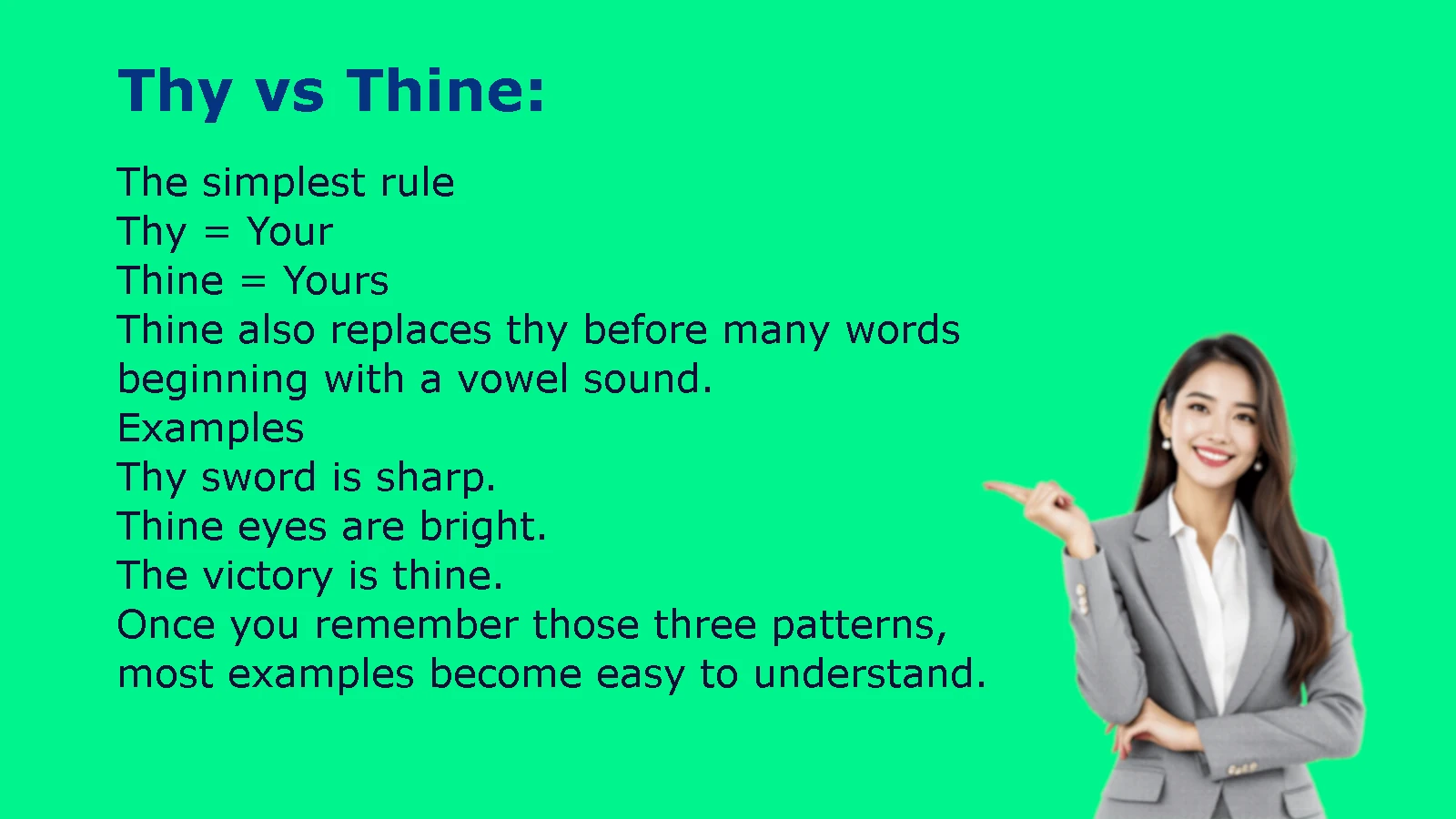
Thy vs. Thine: Both thy and thine are archaic English possessive words meaning your. Use thy before a noun (e.g., thy house), while thine is used before a vowel sound (e.g., thine eyes) or as a standalone possessive pronoun (e.g., The victory is thine). Understanding this distinction helps you use these traditional terms correctly.
The confusion is understandable. People frequently search for thy meaning, thine meaning, thy vs thine difference, and when to use thy or thine because the two words seem interchangeable. But here’s the kicker: although both show possession, they follow different usage rules depending on the word that comes next.
The good news? It’s much simpler than it looks.
In this guide, you’ll learn the difference between Thy vs Thine, discover the correct usage of thy and thine, understand how to use thy and thine in a sentence, and see plenty of real-life examples. You’ll also learn thy pronunciation, thine pronunciation, and easy memory tricks to help you remember which word belongs where.
By the end, you’ll confidently know when to use thy, when to use thine, and why these timeless words still appear in modern discussions of Biblical English, classic literature, and historical texts.
Quick Answer: Thy vs Thine
Here’s the short answer.
| Feature | Thy | Thine |
| Modern equivalent | Your | Yours (or Your before vowel sounds) |
| Grammar role | Possessive adjective | Possessive pronoun or possessive adjective |
| Comes before a noun | Yes | Only before vowel sounds |
| Can stand alone | No | Yes |
| Modern usage | Rare | Rare |
The simplest rule
- Thy = Your
- Thine = Yours
- Thine also replaces thy before many words beginning with a vowel sound.
Examples
- Thy sword is sharp.
- Thine eyes are bright.
- The victory is thine.
Once you remember those three patterns, most examples become easy to understand.
What Does Thy Mean?
Thy is an archaic possessive adjective. In modern English, it simply means your.
A possessive adjective describes ownership and always comes before a noun.
Compare modern and historical English
| Modern English | Older English |
| Your house | Thy house |
| Your friend | Thy friend |
| Your kingdom | Thy kingdom |
| Your heart | Thy heart |
| Your sword | Thy sword |
Notice that thy always appears immediately before the noun it describes.
Examples
- Keep thy promise.
- Honor thy parents.
- Lift up thy voice.
- Protect thy people.
- Follow thy conscience.
In each sentence, thy modifies a noun.
Why Was “Thy” Used?
Several centuries ago, English had different words depending on who someone was addressing.
Instead of today’s universal you, speakers used different forms for singular and plural.
| Function | Older English | Modern English |
| Subject | Thou | You |
| Object | Thee | You |
| Possessive adjective | Thy | Your |
| Possessive pronoun | Thine | Yours |
This system made English more precise because it distinguished between one person and several people.
For example:
“I give thee thy book.”
Today, the same sentence becomes:
“I give you your book.”
Over time, English simplified these forms until you, your, and yours replaced nearly all of them.
What Does Thine Mean?
Thine serves two grammatical functions, making it slightly more flexible than thy.
Thine as a Possessive Pronoun
The first and most common role is as a possessive pronoun.
A possessive pronoun replaces an entire noun phrase instead of describing a noun.
Modern comparison
| Modern English | Older English |
| The victory is yours. | The victory is thine. |
| This book is yours. | This book is thine. |
| The honor is yours. | The honor is thine. |
| The choice is yours. | The choice is thine. |
Notice that thine appears without another noun following it.
Examples
- The kingdom is thine.
- The decision is thine.
- The reward is thine.
- The glory is thine forever.
In each sentence, thine stands alone.
Thine Before Vowel Sounds
This is the rule that surprises most learners.
Instead of writing thy eyes, Early Modern English preferred thine eyes.
The same pattern appears with several other words beginning with vowel sounds.
Examples
- Thine eyes
- Thine honor
- Thine inheritance
- Thine own
- Thine enemies
This wasn’t random. It made pronunciation smoother.
Think about these pairs aloud.
- Thy eyes
- Thine eyes
The second phrase flows more naturally because the extra n bridges the two vowel sounds.
Why Does English Use This Pattern?
English has followed pronunciation-based spelling rules for centuries.
One familiar example still exists today.
| Correct | Incorrect |
| A book | An book |
| An apple | A apple |
We naturally say an apple because the extra n makes the words easier to pronounce.
The same idea influenced thy and thine.
| Historical Form | Reason |
| Thy friend | Begins with a consonant sound |
| Thy kingdom | Begins with a consonant sound |
| Thine eyes | Begins with a vowel sound |
| Thine honor | Begins with a vowel sound |
| Thine inheritance | Begins with a vowel sound |
This pronunciation rule became standard in Early Modern English, especially during the sixteenth and seventeenth centuries.
The Main Difference Between Thy and Thine
Although the two words look similar, they don’t always work the same way.
Here’s the easiest comparison.
| Thy | Thine |
| Means your | Means your or yours |
| Always comes before a noun | Can stand alone |
| Used before most consonant sounds | Used before many vowel sounds |
| Only functions as an adjective | Functions as an adjective and pronoun |
When Should You Use Thy?
Although thy is no longer part of everyday conversation, its historical grammar remains consistent.
Use thy in the following situations.
Before Most Nouns
Whenever a noun begins with a consonant sound, thy usually comes first.
Examples
- Thy house
- Thy servant
- Thy brother
- Thy family
- Thy wisdom
Example sentence:
Guard thy house well.
In Historical Writing
Writers often use thy to recreate the language of earlier centuries.
Historical novels, Renaissance plays, and fantasy stories frequently include it.
Example:
“Take thy horse and ride before sunrise.”
This instantly creates an older, more formal tone.
In Religious Texts
Many traditional prayers preserve the original wording.
Examples include:
- Thy kingdom come.
- Thy will be done.
- Thy mercy endureth forever.
Millions of readers still encounter these expressions through older Bible translations and classic Christian hymns.
When Should You Use Thine?
Thine has two main uses, so it’s important to recognize which one fits the sentence.
Before Words Beginning With a Vowel Sound
Here are common historical combinations.
| Correct Phrase | Meaning Today |
| Thine eyes | Your eyes |
| Thine honor | Your honor |
| Thine inheritance | Your inheritance |
| Thine own | Your own |
| Thine enemies | Your enemies |
Example
Open thine eyes and behold the truth.
This wording appears frequently in older literature and religious texts.
When Replacing a Noun
Use thine exactly where modern English would use yours.
Examples
- The crown is thine.
- The choice is thine.
- Victory is thine.
- The blessing is thine.
Notice that no noun follows thine.
Side-by-Side Examples of Thy vs Thine
These examples make the difference much easier to remember.
| Thy | Thine |
| Thy courage inspires everyone. | The victory is thine. |
| Thy wisdom guides us. | This kingdom is thine. |
| Thy family awaits. | The honor is thine. |
| Thy sword remains sharp. | The decision is thine. |
| Thy servant has arrived. | The reward is thine. |
Now compare another set.
| Modern English | Older English |
| Your friend is here. | Thy friend is here. |
| Your eyes are bright. | Thine eyes are bright. |
| The book is yours. | The book is thine. |
| Your kingdom is strong. | Thy kingdom is strong. |
| Your honor is respected. | Thine honor is respected. |
These comparisons reveal the pattern clearly. Thy modifies most nouns, while thine either replaces a noun entirely or appears before many words that begin with a vowel sound.
Thy vs Thine in the Bible
Many people first encounter thy and thine while reading the King James Version (KJV) of the Bible. These words weren’t chosen to sound poetic. They reflected the standard English grammar of the early 1600s when the translation was completed.
The translators aimed for accuracy while preserving the distinctions between singular and plural pronouns found in the original Hebrew and Greek texts. As a result, thy and thine appear throughout Scripture.
Common Biblical Examples
| Biblical Phrase | Modern English |
| Thy will be done. | Your will be done. |
| Honor thy father and thy mother. | Honor your father and your mother. |
| Love thy neighbor. | Love your neighbor. |
| Thine is the kingdom. | Yours is the kingdom. |
| Open thou mine eyes. | Open my eyes. |
Notice how thy comes before nouns such as will, father, mother, and neighbor. Meanwhile, thine stands alone in “Thine is the kingdom,” where it means “yours.”
Why Does the Bible Say “Thine Eyes”?
Some verses use thine eyes instead of thy eyes because eyes begins with a vowel sound. This follows the same pronunciation rule that produced phrases like an apple instead of a apple.
Here are a few familiar examples:
- Lift up thine eyes.
- Let not thine heart be troubled.
- Keep thine eyes upon wisdom.
These expressions sound unusual today. However, they followed the normal grammar of Early Modern English.
Fun Fact: Many modern Bible translations replace thy with your and thine with yours to improve readability. The King James Version retains the older forms because they reflect the language of its time.
Thy vs Thine in Shakespeare
Long before modern English settled into its current form, William Shakespeare filled his plays and sonnets with thou, thee, thy, and thine.
These weren’t decorative choices. They were the everyday pronouns of educated English speakers during his lifetime.
If you’ve read Hamlet, Romeo and Juliet, or Macbeth, you’ve already seen these words in action.
Famous Shakespearean Examples
| Original Text | Modern English |
| Thy beauty | Your beauty |
| Thy name | Your name |
| Thine own self | Your own self |
| The fault is thine. | The fault is yours. |
One of Shakespeare’s best-known lines appears in Hamlet:
“To thine own self be true.”
In modern English, this simply means:
“Be true to yourself.”
The sentence uses thine because own begins with a vowel sound.
Shakespeare Followed the Rules
A common misconception is that Shakespeare invented unusual grammar.
He didn’t.
Instead, he wrote according to the grammatical rules his audience already understood. His readers naturally recognized when to use thy and when to use thine.
For example:
- Thy sword
- Thy love
- Thine honor
- Thine own
These combinations matched everyday pronunciation and grammar during the late sixteenth and early seventeenth centuries.
Why Modern English Replaced Thy and Thine
Languages constantly evolve.
English has changed dramatically over the last thousand years. Many familiar words disappeared, while others took on new meanings.
The shift from thy and thine to your and yours happened gradually rather than overnight.
A Simple Timeline
| Period | What Happened |
| Old English (before 1100) | Complex pronoun system developed. |
| Middle English (1100–1500) | Pronouns began changing in spelling and pronunciation. |
| Early Modern English (1500–1700) | Thou, thee, thy, and thine remained common. |
| Modern English (1700 onward) | You, your, and yours became standard. |
Several factors encouraged this change.
English Became Simpler
Over time, speakers preferred one set of pronouns instead of maintaining separate forms for singular and plural.
Instead of saying:
- Thou
- Thee
- Thy
- Thine
People increasingly chose:
- You
- You
- Your
- Yours
This simplified everyday communication.
Social Customs Changed
Another reason involved politeness.
Originally, English speakers often used thou with close friends, family members, or children.
They used you to show respect or address more than one person.
Eventually, people began using you in almost every situation because it sounded more polite.
Once thou disappeared, the related forms thee, thy, and thine faded as well.
Printing and Standardization
The rise of printing presses also helped standardize English.
Publishers preferred consistent spelling and grammar. Schools adopted those conventions, making your and yours the accepted forms for future generations.
Today, thy and thine survive mainly in historical works and religious texts.
Common Mistakes With Thy and Thine
Because these words are unfamiliar today, writers often confuse them.
Fortunately, the mistakes usually follow predictable patterns.
| Incorrect | Correct | Why |
| Thine house | Thy house | House begins with a consonant sound. |
| Thy eyes | Thine eyes | Eyes begins with a vowel sound. |
| This book is thy. | This book is thine. | Stand-alone possessive requires thine. |
| Thy honor | Thine honor | Honor begins with a vowel sound. |
| The kingdom is thy. | The kingdom is thine. | Use the possessive pronoun. |
Mistake: Using Thy Without a Noun
Incorrect:
The victory is thy.
Correct:
The victory is thine.
Remember, thy must describe a noun.
Mistake: Forgetting the Vowel Rule
Incorrect:
Thy inheritance
Traditional form:
Thine inheritance
The same applies to:
- Thine eyes
- Thine enemies
- Thine honor
- Thine own
Mistake: Treating Them as Modern English
Using thy or thine in casual emails or business writing usually sounds unnatural.
For example:
❌ Please send thy report tomorrow.
Modern English prefers:
✅ Please send your report tomorrow.
Reserve thy and thine for historical, literary, religious, or stylistic purposes.
An Easy Memory Trick
The quickest way to remember the difference is to match each word with its modern equivalent.
| Old English | Modern English |
| Thy | Your |
| Thine | Yours |
Now add one extra rule.
If the following word begins with a vowel sound, older English often uses thine instead of thy.
Think about these examples.
- Thy sword
- Thy kingdom
- Thine eyes
- Thine honor
Another helpful comparison comes from modern articles.
| Article Rule | Possessive Rule |
| A book | Thy book |
| An apple | Thine apple |
Both systems adjust pronunciation to create smoother speech.
Thy, Thee, Thou, Ye, and You Explained
Many readers learn thy and thine, then immediately wonder about thee, thou, and ye.
These words all belonged to the same grammatical system.
Understanding the complete picture makes each word easier to remember.
| Word | Modern Equivalent | Grammar Role |
| Thou | You | Subject |
| Thee | You | Object |
| Thy | Your | Possessive adjective |
| Thine | Yours / Your | Possessive pronoun or adjective |
| Ye | You (plural subject) | Subject |
Thou
Thou functions as the subject of a sentence.
Examples:
- Thou art kind.
- Thou knowest the truth.
- Thou hast spoken wisely.
Modern English simply uses you.
Thee
Thee acts as the object.
Examples:
- I thank thee.
- They shall remember thee.
- We honor thee.
Today, every example becomes you.
Thy
Thy modifies a noun.
Examples:
- Thy courage
- Thy home
- Thy family
- Thy wisdom
Thine
Thine either replaces a noun or appears before many vowel sounds.
Examples:
- The prize is thine.
- Thine eyes.
- Thine inheritance.
- Thine own heart.
Ye
Ye served as the plural subject.
Examples:
- Ye shall receive.
- Ye know the truth.
Modern English again replaces it with you.
Seeing the Whole System Together
The easiest way to understand these pronouns is to compare them with today’s English.
| Modern Sentence | Historical Sentence |
| You know your friend. | Thou knowest thy friend. |
| I thank you. | I thank thee. |
| Your house is beautiful. | Thy house is beautiful. |
| The victory is yours. | The victory is thine. |
| You all are welcome. | Ye are welcome. |
Are Thy and Thine Still Used Today?
Although thy and thine disappeared from everyday conversation centuries ago, they haven’t vanished completely. You can still find them in several modern contexts where writers intentionally use traditional or historical language.
In most situations, your and yours remain the correct choices. However, thy and thine continue to add a formal, poetic, or timeless tone when used appropriately.
Religious Texts
Traditional Bible translations still preserve these words.
Examples include:
- Thy will be done.
- Love thy neighbor.
- Thine is the kingdom.
- Open thou mine eyes.
Many churches also use these expressions in hymns, prayers, and liturgical readings.
Shakespeare and Classical Literature
Students often encounter thy and thine while studying English literature.
Classic works use these pronouns because they reflected standard grammar during the authors’ lifetimes.
Common examples include:
- Thy beauty
- Thy name
- Thine own self
- The fault is thine
Understanding these forms makes older literature much easier to read.
Historical Fiction
Novelists frequently use historical language to create an authentic setting.
For example:
“Take thy horse and ride before dawn.”
or
“The castle is thine if thou canst defend it.”
Even when modern readers don’t speak this way, the wording immediately suggests another time period.
Fantasy Literature
Fantasy authors often borrow elements of Early Modern English to give kingdoms, prophecies, and magical characters a legendary feel.
You’ll commonly see phrases such as:
- Thy destiny
- Thy kingdom
- Thine enemies
- The sword is thine
Not every fantasy novel uses archaic English, but many include it sparingly to enhance atmosphere.
Poetry
Poets sometimes choose thy and thine because the words fit rhythm, rhyme, or meter better than their modern equivalents.
Compare these two lines.
Modern:
Your heart remembers every promise.
Archaic:
Thy heart remembers every promise.
The second version carries a more traditional and lyrical tone.
Ceremonial and Artistic Writing
Occasionally, speeches, songs, inscriptions, or artistic works include these words for stylistic effect.
Examples include:
- Memorial plaques
- Religious artwork
- Traditional wedding readings
- Choral music
- Historical reenactments
Outside these settings, your and yours remain the standard forms.
Quick Reference Chart
When you’re unsure which word to choose, use this table as a fast guide.
| If You Mean… | Use | Example |
| Your friend | Thy | Thy friend |
| Your house | Thy | Thy house |
| Your sword | Thy | Thy sword |
| Your eyes | Thine | Thine eyes |
| Your honor | Thine | Thine honor |
| Your inheritance | Thine | Thine inheritance |
| Yours | Thine | The victory is thine. |
Thy vs Thine Cheat Sheet
Need the shortest explanation possible? Keep this chart handy.
| Question | Answer |
| Does thy mean your? | Yes. |
| Does thine mean yours? | Yes. |
| Can thine come before a noun? | Yes, before many words beginning with a vowel sound. |
| Can thy stand alone? | No. |
| Can thine stand alone? | Yes. |
| Are these words common today? | No. They are considered archaic. |
Common Examples at a Glance
Here are some of the most common phrases you’ll encounter.
| Phrase | Meaning Today |
| Thy kingdom | Your kingdom |
| Thy servant | Your servant |
| Thy mercy | Your mercy |
| Thy wisdom | Your wisdom |
| Thine eyes | Your eyes |
| Thine honor | Your honor |
| Thine enemies | Your enemies |
| The kingdom is thine | The kingdom is yours |
| The choice is thine | The choice is yours |
| Victory is thine | Victory is yours |
Reading these side by side helps reinforce the grammar pattern.
Thy vs Thine: Practice Sentences
Test your understanding with these examples.
Choose the correct word.
- _____ house stands upon the hill.
- The victory is _____.
- _____ eyes have seen the truth.
- _____ courage inspires everyone.
- The decision is _____.
Answers
- Thy
- Thine
- Thine
- Thy
- Thine
If you answered all five correctly, you’ve already mastered the basic rule.
Frequently Asked Questions
Is thy the same as your?
Yes. Thy is the historical equivalent of your. It functions as a possessive adjective and always modifies a noun.
Example:
- Thy friend
- Thy house
- Thy kingdom
Is thine the same as yours?
Yes. Thine usually means yours when it stands alone.
Example:
- The honor is thine.
- The victory is thine.
It can also replace thy before many words beginning with a vowel sound, such as thine eyes.
Why does the Bible say thine eyes instead of thy eyes?
Early Modern English often placed thine before nouns that began with a vowel sound. This pronunciation rule made phrases flow more naturally when spoken.
The pattern resembles the difference between a book and an apple.
Can I say thine house?
Traditionally, no.
Because house begins with a consonant sound, historical English normally uses thy house.
Is thy grammatically correct today?
Yes, but only in specific contexts.
Modern English almost always prefers your. Thy mainly appears in:
- Traditional Bible translations
- Shakespeare
- Historical fiction
- Poetry
- Fantasy literature
Are thy and thine still used in everyday English?
No.
Outside of religious, literary, or historical settings, native English speakers use your and yours instead.
Why did English stop using these words?
English gradually simplified its pronoun system. Over time, you, your, and yours replaced thou, thee, thy, and thine, making communication more consistent across different regions and social groups.
What’s the difference between thy, thine, thee, and thou?
Each word has a different grammatical role.
| Word | Modern English | Role |
| Thou | You | Subject |
| Thee | You | Object |
| Thy | Your | Possessive adjective |
| Thine | Yours / Your | Possessive pronoun or adjective before vowel sounds |
Learning them together makes older English much easier to understand.
Key Takeaways
Before finishing, let’s summarize the most important rules.
- Thy means your.
- Thine means yours.
- Thine also appears before many nouns beginning with a vowel sound.
- Thy always modifies a noun.
- Thine can stand alone as a possessive pronoun.
- Both words belong to Early Modern English and rarely appear in everyday conversation today.
- You’ll most often see them in the King James Bible, Shakespeare, classical poetry, historical fiction, and fantasy literature.
Final Verdict: Thy vs Thine
The difference between thy vs thine becomes simple once you understand each word’s role.
Use thy when you mean your and the following noun begins with a consonant sound, such as thy friend, thy kingdom, or thy courage. Use thine when you mean yours, as in the victory is thine, or before many nouns that begin with a vowel sound, such as thine eyes or thine honor.
Although these forms are archaic, they remain an important part of English history. They appear throughout the King James Bible, Shakespeare’s plays, classic poetry, and historical literature. Knowing how they work not only improves your grammar but also helps you read older texts with greater confidence and accuracy.
Whenever you come across thy or thine, remember this simple formula:
Thy = Your
Thine = Yours (or Your before many vowel sounds)
That single rule will help you recognize and use these classic English pronouns correctly every time.