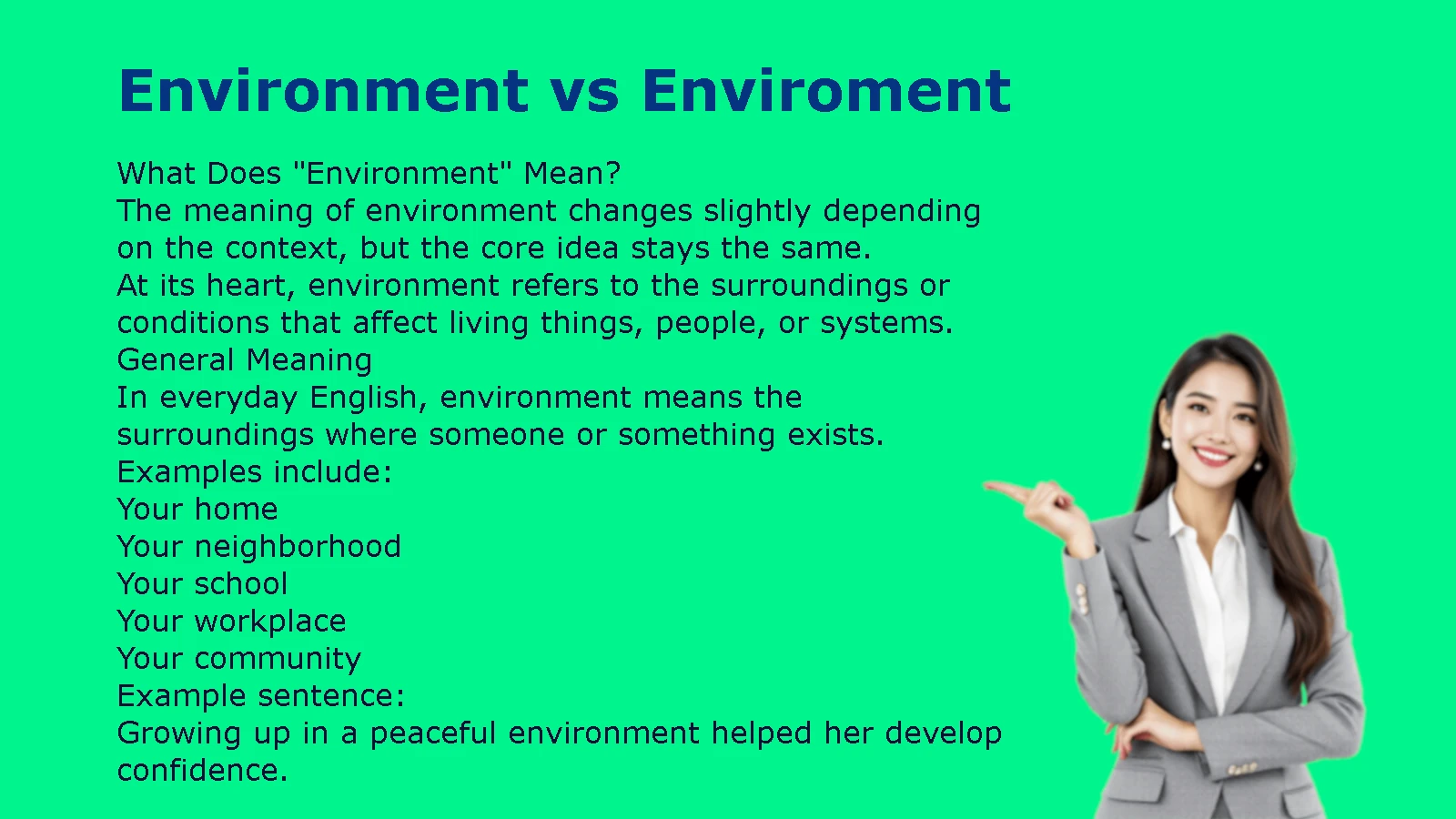
Have you ever paused while typing environment and wondered whether it should have one n or two? You’re not alone. Thousands of people search for “enviroment vs environment” every month because it’s one of the most commonly misspelled words in English. Although the mistake seems small, using the wrong spelling can affect school assignments, business emails, job applications, and even search engine optimization.
The good news is that the answer is simple. Environment is the only correct spelling. Enviroment is a spelling mistake. However, understanding why people make this error and learning how to avoid it can save you from repeating it in the future.
Whether you’re a student, teacher, writer, blogger, or professional, this guide explains everything you need to know. You’ll learn the correct spelling, pronunciation, meanings in different contexts, grammar, common mistakes, memory tricks, and real-world examples.
Quick Answer: Environment is correct. Enviroment is always incorrect in standard English.
Environment vs Enviroment: What’s the Correct Spelling?
If you’re comparing environment vs enviroment, the answer is straightforward.
| Word | Correct? | Notes |
| Environment | ✅ Yes | Standard English spelling used worldwide |
| Enviroment | ❌ No | Misspelling caused by omitting the second n |
Every major English dictionary recognizes environment as the correct spelling. The version without the second n is not accepted in academic, professional, or formal writing.
You’ll find environment in:
- Books
- Scientific journals
- News articles
- Government publications
- Business reports
- Academic research
- Legal documents
Meanwhile, enviroment appears almost exclusively because of typing mistakes or spelling errors.
The Difference Between Environment and Enviroment
Although these words look similar, only one belongs in correct English.
Environment
Environment is a noun that refers to the surroundings, conditions, or circumstances in which people, animals, plants, or objects exist.
It can describe:
- Natural surroundings
- Social conditions
- Workplace settings
- Educational spaces
- Computer systems
- Economic conditions
Examples
- We should protect the environment for future generations.
- A positive work environment improves employee satisfaction.
- The software runs in a secure development environment.
- Children learn better in a supportive classroom environment.
Because the word appears across many industries, it has become one of the most frequently used nouns in modern English.
Enviroment
Enviroment is simply an incorrect spelling of environment.
The mistake usually happens because people accidentally leave out the second n before -ment.
Incorrect:
- The enviroment needs protection.
- Our work enviroment is friendly.
Correct:
- The environment needs protection.
- Our work environment is friendly.
No respected English dictionary lists enviroment as a standard spelling.
Why Do People Misspell “Environment”?
Even experienced writers occasionally type enviroment by mistake. The error isn’t usually caused by poor vocabulary. Instead, it happens because the word contains several syllables and repeating letters.
Here are the most common reasons.
Missing the Second “N”
The biggest reason is forgetting the second n before -ment.
Correct:
Environ + ment
Incorrect:
Enviro + ment
Because both versions sound almost identical when spoken quickly, many writers don’t notice the missing letter.
Pronunciation Can Be Misleading
Most English speakers pronounce the word smoothly.
When spoken naturally, the second n isn’t strongly emphasized.
As a result, people often spell the word exactly as they hear it.
Fast Typing
Typing quickly increases the chance of dropping letters.
Long words often lose repeated letters because your fingers move faster than your brain checks the spelling.
Memory Errors
Many people remember only the beginning of the word.
They know it starts with:
Envir-
Then they finish it incorrectly as:
-oment
instead of:
-onment
Similar English Patterns
English contains many words ending in:
- -ment
- -ance
- -ence
- -tion
Because these endings appear so often, writers sometimes simplify difficult spellings without realizing it.
Common Spelling Mistakes Related to Environment
Besides enviroment, several other misspellings appear online.
| Incorrect Spelling | Correct Form |
| Enviroment | Environment |
| Envirnoment | Environment |
| Enviornment | Environment |
| Environement | Environment |
| Envirnment | Environment |
| Envirment | Environment |
If you use spell-check software, most of these errors are corrected automatically.
What Does “Environment” Mean?
The meaning of environment changes slightly depending on the context, but the core idea stays the same.
At its heart, environment refers to the surroundings or conditions that affect living things, people, or systems.
General Meaning
In everyday English, environment means the surroundings where someone or something exists.
Examples include:
- Your home
- Your neighborhood
- Your school
- Your workplace
- Your community
Example sentence:
Growing up in a peaceful environment helped her develop confidence.
Environment in Science
In science, environment usually refers to the natural world.
It includes:
- Air
- Water
- Land
- Climate
- Ecosystems
- Plants
- Animals
- Natural resources
Environmental scientists study how these elements interact and influence life on Earth.
Examples:
- Pollution damages the environment.
- Healthy forests support a balanced environment.
- Climate change affects every global environment.
Key Components of the Natural Environment
| Component | Description |
| Air | Atmosphere that supports life |
| Water | Rivers, lakes, oceans, groundwater |
| Land | Soil, rocks, mountains, valleys |
| Plants | Forests, grasslands, crops |
| Animals | Wildlife and biodiversity |
| Climate | Long-term weather conditions |
Environment in Business
Businesses often use environment to describe internal and external conditions.
Internal Business Environment
Includes:
- Company culture
- Employees
- Leadership
- Policies
- Workplace conditions
Example:
A respectful work environment encourages teamwork.
External Business Environment
Includes factors outside the company.
Examples:
- Economy
- Government regulations
- Competition
- Technology
- Customer demand
Businesses constantly adapt to changes in their external environment.
Environment in Technology
Technology professionals use the word differently.
A software environment refers to the combination of hardware, operating systems, tools, and applications needed for software to function.
Common technology environments include:
- Development environment
- Testing environment
- Production environment
- Cloud environment
- Virtual environment
Example:
Developers tested the application in a staging environment before releasing it.
Environment in Education
Teachers often discuss the learning environment.
This includes both physical and emotional conditions that affect learning.
Examples include:
- Classroom layout
- Teacher support
- Student relationships
- Technology access
- School culture
A positive learning environment helps students stay engaged and motivated.
Environment in Different Contexts
The word environment has many meanings depending on where it’s used.
| Context | Meaning | Example |
| Nature | Natural surroundings | Protecting the forest environment |
| Business | Workplace conditions | A healthy work environment |
| Education | Learning atmosphere | A supportive classroom environment |
| Technology | Computing setup | Development environment |
| Healthcare | Patient surroundings | Healing hospital environment |
| Economics | Market conditions | Competitive business environment |
| Psychology | Social influences | Family environment shapes behavior |
Although the meaning shifts slightly, the idea remains consistent: the conditions surrounding something.
Correct Pronunciation of Environment
Knowing how to pronounce environment correctly also helps you remember its spelling.
IPA Pronunciation
American English:
/ɪnˈvaɪrənmənt/
Syllable Breakdown
En • vi • ron • ment
Four syllables.
Breaking the word into smaller parts makes it much easier to remember.
Why Pronunciation Causes Confusion
Many speakers pronounce the word quickly:
“en-vy-run-ment”
The second n blends into the sound, making it easy to forget while writing.
That’s why relying only on pronunciation isn’t enough.
Simple Pronunciation Tip
Think of the word in two parts:
Environ + ment
Both parts matter.
The first section already ends with n, and ment follows it.
Remembering this structure makes spelling much easier.
Correct Spelling Breakdown
One effective way to master difficult words is to examine them letter by letter.
Letter-by-Letter Breakdown
E
N
V
I
R
O
N
M
E
N
T
Notice there are three “n” letters in the complete word.
Many people accidentally remove the middle one.
Word Structure
| Part | Meaning |
| Environ | Surroundings |
| -ment | Forms a noun |
Together, they create the noun environment, meaning the surrounding conditions or setting.
Common Incorrect Variations
You may encounter these online, but all are incorrect:
- Enviroment
- Envirnoment
- Enviornment
- Environement
- Envirment
- Envirnment
Only environment is accepted in standard English.
Memory Tricks to Spell “Environment” Correctly
Simple memory techniques can eliminate this mistake for good.
Remember “Environ + Ment”
Don’t think of it as one long word.
Instead, divide it into:
Environ + ment
The first part naturally ends with n, making it easier to remember the second n before ment.
Count the Three N’s
The word contains three occurrences of the letter n.
If you see only two, you’ve probably misspelled it.
Write It Several Times
Practice reinforces memory.
Write:
Environment
ten times without looking.
Then write it from memory.
This simple exercise builds long-term recall.
Associate It With Nature
Picture a forest, ocean, or mountain whenever you see the word.
Connecting spelling to a vivid image strengthens memory far more than rote repetition.
Examples of “Environment” in Sentences
Understanding a word becomes much easier when you see it used naturally.
Everyday English
- Our neighborhood provides a safe environment for families.
- She prefers a quiet environment while studying.
- Children thrive in a supportive environment.
- The office has a relaxed and friendly environment.
Academic Writing
- Scientists continue to study how pollution affects the global environment.
- Researchers examined environmental changes over several decades.
- The learning environment significantly influenced student performance.
Professional Writing
- The company promotes a collaborative work environment.
- Leaders should create an inclusive workplace environment where everyone feels respected.
- Employees perform better in a healthy organizational environment.
Scientific Writing
- Rising temperatures continue to alter marine environments around the world.
- Biodiversity depends on stable environmental conditions.
- Protecting the natural environment remains a global priority.
“We do not inherit the Earth from our ancestors; we borrow it from our children.” — Commonly attributed to a Native American proverb
Environment in Common English Expressions
The word environment appears in dozens of everyday phrases. While the core meaning stays the same, each expression highlights a specific type of surrounding or condition. Learning these combinations will improve both your vocabulary and your writing.
Environmentally Friendly
An environmentally friendly product, service, or practice causes little or no harm to the natural world.
Examples include:
- Reusable shopping bags
- Solar-powered homes
- Electric vehicles
- Recyclable packaging
- Energy-efficient appliances
Example sentence:
Many companies now use environmentally friendly packaging to reduce plastic waste.
Natural Environment
The natural environment includes everything that exists without human creation.
It covers:
- Forests
- Rivers
- Oceans
- Mountains
- Wildlife
- Plants
- Air
- Soil
Scientists often study how human activities affect the natural environment over time.
Built Environment
The built environment refers to spaces created by people rather than nature.
Examples include:
- Cities
- Roads
- Bridges
- Schools
- Airports
- Residential neighborhoods
- Shopping centers
Urban planners design the built environment to improve transportation, safety, and quality of life.
Work Environment
A work environment describes the physical, emotional, and organizational conditions in a workplace.
Important factors include:
- Leadership
- Company culture
- Office design
- Communication
- Employee relationships
- Safety
- Work-life balance
A healthy work environment often leads to higher productivity and better employee retention.
Learning Environment
A learning environment includes every factor that influences education.
This may involve:
- Teachers
- Classrooms
- Online learning platforms
- Student engagement
- Educational resources
- School culture
Students usually perform better when they feel supported and respected.
Business Environment
The business environment consists of internal and external factors that affect an organization.
Internal Factors
- Company policies
- Employees
- Management
- Resources
- Organizational culture
External Factors
- Market trends
- Competition
- Government regulations
- Inflation
- Consumer behavior
- Technological change
Businesses regularly analyze their environment before making strategic decisions.
Social Environment
The social environment refers to the people and relationships surrounding an individual.
Examples include:
- Family
- Friends
- Coworkers
- Community
- Social expectations
- Cultural traditions
A positive social environment often supports emotional well-being and personal growth.
Physical Environment
The physical environment focuses on tangible surroundings.
Examples include:
- Temperature
- Lighting
- Furniture
- Noise levels
- Air quality
- Building design
Hospitals, schools, and offices often adjust the physical environment to improve comfort and performance.
Common Environment-Related Phrases
| Expression | Meaning | Example |
| Natural environment | Nature and ecosystems | We should protect the natural environment. |
| Built environment | Human-made surroundings | Architects shape the built environment. |
| Work environment | Workplace conditions | A positive work environment boosts morale. |
| Learning environment | Educational setting | Students benefit from a supportive learning environment. |
| Business environment | Economic and organizational conditions | The business environment changes rapidly. |
| Social environment | People and community influences | A healthy social environment encourages confidence. |
| Physical environment | Physical surroundings | Lighting affects the physical environment. |
| Virtual environment | Digital or software setting | Developers tested the app in a virtual environment. |
Synonyms of Environment
Although environment is the best choice in many situations, several related words may fit depending on the context.
Choosing the right synonym makes your writing more precise.
| Synonym | Best Used For | Example |
| Surroundings | Everyday conversation | The surroundings were peaceful. |
| Setting | Stories and locations | The novel’s setting is a small town. |
| Habitat | Animals and plants | Wetlands provide an ideal habitat. |
| Ecosystem | Ecology | Coral reefs form complex ecosystems. |
| Atmosphere | Emotional or social conditions | The office has a welcoming atmosphere. |
| Conditions | Circumstances | Working conditions improved. |
| Context | Situations and discussions | Consider the historical context. |
| Locale | Geographic areas | The mountain locale attracts hikers. |
| Milieu | Cultural or social surroundings | The artist thrived in a creative milieu. |
When Should You Use a Synonym?
Different situations call for different words.
For example:
- Habitat specifically refers to where plants and animals live.
- Atmosphere often describes emotional or social conditions.
- Setting usually relates to a location or the backdrop of a story.
- Surroundings works well in everyday conversation.
Although these words overlap, they are not always interchangeable.
Antonyms of Environment
Unlike many English nouns, environment does not have a perfect opposite.
That’s because it describes surrounding conditions rather than a single object or quality.
However, some words can serve as contextual opposites.
| Word | Context |
| Isolation | Separation from surroundings |
| Separation | Being removed from an environment |
| Vacuum | Complete absence of surrounding matter in scientific contexts |
| Individuality | Focus on the individual instead of external surroundings |
Remember that these are context-dependent rather than true dictionary antonyms.
Words Commonly Confused With “Environment”
Several related words have similar meanings. Understanding the differences helps you communicate more accurately.
Environment vs Surroundings
Environment often includes physical, social, and cultural conditions.
Surroundings usually refers only to the immediate physical area.
Example
- The city’s environment encourages innovation.
- The hotel’s surroundings are quiet and scenic.
Environment vs Habitat
A habitat is the natural home of a plant or animal.
An environment can describe any surrounding condition, whether natural, social, educational, or technological.
Example
Polar bears have an Arctic habitat, which forms part of their natural environment.
Environment vs Ecosystem
An ecosystem is a scientific term describing living organisms interacting with one another and with nonliving elements.
An environment refers more broadly to surrounding conditions.
Example
A rainforest contains many ecosystems within its larger environment.
Environment vs Climate
Many people confuse these words.
Climate describes long-term weather patterns.
Environment includes climate but also covers land, water, wildlife, human activity, and countless other factors.
Environment vs Nature
Nature refers to the natural world.
Environment includes both natural and human-made surroundings.
Example
A city has an environment even though much of it is built rather than natural.
Environment vs Setting
A setting usually describes where something happens.
An environment includes not only the location but also the conditions influencing people or events.
Grammar Notes for “Environment”
Understanding the grammar behind environment helps you use the word correctly in every situation.
Part of Speech
Environment functions as a noun.
Example:
A healthy environment supports both physical and mental well-being.
Is Environment Countable or Uncountable?
Interestingly, it can be both.
Countable
Use environment when referring to a specific setting.
Examples:
- A school environment
- A work environment
- A virtual environment
Uncountable
Use environment when referring to nature or the natural world as a whole.
Example:
Everyone should help protect the environment.
Plural Form
The plural form is:
Environments
Example:
Different marine environments support different species.
Adjective Form
The adjective is:
Environmental
Examples:
- Environmental protection
- Environmental science
- Environmental policy
- Environmental education
Adverb Form
The adverb is:
Environmentally
Example:
The company manufactures environmentally responsible products.
Related Word Forms
| Word | Part of Speech | Example |
| Environment | Noun | The environment needs protection. |
| Environmental | Adjective | Environmental regulations became stricter. |
| Environmentally | Adverb | The building was designed environmentally responsibly. |
| Environmentalist | Noun | The environmentalist organized a cleanup campaign. |
| Environmentalism | Noun | Environmentalism gained momentum during the twentieth century. |
Word Origin and Etymology
The history of environment explains why its spelling looks more complex than many English words.
French Origins
English borrowed environment from the French word environnement during the early nineteenth century.
The French noun comes from the verb environner, meaning “to surround” or “to encircle.”
Earlier Roots
The French verb traces back to the Old French word viron, meaning circle or circuit.
Over time, the word evolved to describe everything surrounding a person, object, or living organism.
As English adopted the term, the spelling became standardized as environment.
How the Meaning Expanded
Originally, the word mainly referred to physical surroundings.
Today, it has much broader applications.
Modern English uses environment in fields such as:
- Ecology
- Biology
- Medicine
- Education
- Psychology
- Economics
- Business
- Computer science
- Software engineering
- Urban planning
Few English words have expanded into as many disciplines while retaining their core meaning.
A Brief Historical Timeline
| Time Period | Development |
| Old French | Viron referred to a circle or surrounding area. |
| Middle French | Environner developed with the meaning “to surround.” |
| Early 1800s | English adopted environment from French. |
| Late 1800s | Scientists began using the term in biology and ecology. |
| 1900s | Environmental science emerged as a major academic field. |
| Modern Day | The word is widely used across science, business, education, healthcare, and technology. |
“The Earth is what we all have in common.” — Wendell Berry
This quote captures one of the most common uses of environment today: the shared natural world that supports every form of life.
Frequently Asked Questions About Environment vs Enviroment
Many people search for “environment vs enviroment” because they want a quick answer. However, the questions below go beyond spelling and cover grammar, usage, pronunciation, and common writing mistakes.
Is “enviroment” a real word?
No. Enviroment is not a recognized English word.
It is simply a misspelling of environment caused by leaving out the second n. You won’t find enviroment in reputable English dictionaries, academic publications, or professional style guides.
Always write:
- ✅ Environment
- ❌ Enviroment
Why do people forget the second “n” in environment?
There are several reasons.
The most common include:
- Fast typing
- Pronunciation that hides the second n
- Difficulty remembering long words
- Habitual spelling mistakes
- Lack of proofreading
Since the missing letter doesn’t noticeably change pronunciation, many people don’t realize they’ve made an error.
Is “enviroment” accepted in British English?
No.
Both American English and British English use the same spelling:
Environment
The incorrect form is never considered an accepted regional variation.
How do you spell environment correctly?
The correct spelling is:
E N V I R O N M E N T
A simple trick is to remember that the word contains three occurrences of the letter n.
Think of it as:
Environ + ment
This breakdown makes the spelling much easier to remember.
What is the plural of environment?
The plural form is:
Environments
Examples
- Different marine environments support different species.
- Children grow up in many different learning environments.
- Businesses operate in constantly changing economic environments.
What is the adjective form of environment?
The adjective is:
Environmental
Examples include:
- Environmental protection
- Environmental law
- Environmental science
- Environmental education
- Environmental policy
- Environmental impact
What is the adverb form?
The adverb is:
Environmentally
Example:
The company manufactures environmentally responsible products.
Can environment be used in technology?
Absolutely.
Technology professionals use environment every day.
Common examples include:
- Development environment
- Production environment
- Testing environment
- Cloud environment
- Virtual environment
- Runtime environment
Example:
The developers deployed the application to the production environment after completing all tests.
Can environment describe people and workplaces?
Yes.
The word isn’t limited to nature.
It can also describe:
- Family environment
- School environment
- Workplace environment
- Social environment
- Political environment
- Cultural environment
In each case, it refers to the surrounding conditions that influence people or organizations.
Why is environment important?
The answer depends on the context.
In Nature
A healthy environment supports:
- Biodiversity
- Clean air
- Safe drinking water
- Productive agriculture
- Stable ecosystems
In Education
A positive learning environment encourages:
- Better concentration
- Higher academic performance
- Creativity
- Collaboration
- Student confidence
In Business
A supportive work environment often leads to:
- Greater productivity
- Higher employee satisfaction
- Lower staff turnover
- Stronger teamwork
- Better innovation
Although the settings differ, the principle remains the same: our surroundings shape outcomes.
How can I stop misspelling environment?
Try these simple techniques.
Break the Word Into Parts
Instead of memorizing one long word, divide it into:
Environ + ment
Practice Writing It
Writing the correct spelling several times helps build long-term memory.
Read More
The more often you see environment used correctly in books, articles, and news reports, the more natural the spelling becomes.
Use Spell Check
Modern writing tools quickly identify enviroment as a spelling error.
Even so, proofreading remains important because spell-check isn’t perfect.
Quick Comparison: Environment vs Enviroment
The table below summarizes the key differences at a glance.
| Feature | Environment | Enviroment |
| Correct spelling | ✅ Yes | ❌ No |
| Dictionary entry | ✅ Yes | ❌ No |
| Used in schools | ✅ Yes | ❌ No |
| Used in professional writing | ✅ Yes | ❌ No |
| Accepted in American English | ✅ Yes | ❌ No |
| Accepted in British English | ✅ Yes | ❌ No |
| Suitable for academic papers | ✅ Yes | ❌ No |
| Appears in official publications | ✅ Yes | ❌ No |
Common Mistakes to Avoid
Even experienced writers occasionally make avoidable spelling errors. Here are some of the most common mistakes related to environment.
| Mistake | Better Choice |
| Writing enviroment | Write environment |
| Forgetting the second n | Remember Environ + ment |
| Confusing environment with habitat | Use habitat only for natural homes of organisms |
| Using surroundings when discussing broad conditions | Use environment when referring to physical, social, or organizational conditions |
| Assuming spell-check catches everything | Proofread carefully before publishing |
Case Study: How One Letter Can Change Professional Writing
Imagine two job applicants submitting nearly identical cover letters.
Applicant A writes:
I enjoy working in a collaborative environment where people support one another.
Applicant B writes:
I enjoy working in a collaborative enviroment where people support one another.
Although the difference is only one missing letter, it creates a different impression. Hiring managers often view repeated spelling mistakes as signs of rushed proofreading or lack of attention to detail.
The same principle applies to:
- College applications
- Research papers
- Business proposals
- Marketing content
- Website copy
- Social media posts
- Customer communications
Small spelling errors can affect credibility, especially in professional settings.
Key Facts About the Word “Environment”
Here are some useful facts worth remembering.
- Environment is always the correct spelling.
- Enviroment is a misspelling.
- The word functions primarily as a noun.
- It can refer to natural, social, educational, business, or technological surroundings.
- The adjective form is environmental.
- The adverb form is environmentally.
- The plural form is environments.
- The word originated from French before becoming part of modern English.
- Remembering Environ + ment helps prevent spelling mistakes.
- Every major English dictionary recognizes environment and rejects enviroment.
Key Takeaways
If you’ve ever wondered whether environment or enviroment is correct, the answer is now clear. Environment is the only accepted spelling in both American and British English. The version without the second n is simply a common spelling mistake.
Beyond spelling, environment is a versatile word with applications across science, education, business, psychology, healthcare, and technology. Whether you’re describing the natural world, a workplace culture, a classroom, or a software development setup, the word always refers to the surrounding conditions that influence people, living things, or systems.
The easiest way to remember the spelling is to think of it as Environ + ment and remember that the complete word contains three occurrences of the letter n. Pair that habit with careful proofreading, and you’ll avoid one of the most common English spelling mistakes.
The next time you compare environment vs enviroment, you’ll know the correct choice with confidence: always write “environment.”