Have you ever wondered whether “Peoples vs. People” is just a grammar mistake or if both words are actually correct in English? This is a common point of confusion, especially among learners who often come across similar-looking words in reading, writing, and everyday communication.
In simple terms, “people” is the most commonly used plural form of “person” and refers to a group of individuals in general. For example, we say “many people are here” when talking about a crowd or population. On the other hand, “peoples” is also a correct word, but it is used in a more specific context. It refers to multiple distinct groups or nations, such as “the indigenous peoples of the world”, where each group has its own identity, culture, or heritage.
This difference often appears in searches like peoples meaning, people vs peoples difference, and how to use peoples in a sentence, especially among English learners trying to improve grammar accuracy and vocabulary depth.
If you’ve ever paused while writing a sentence like “many people/peoples live here”, you’re not alone—this is one of those subtle English distinctions where a single “s” completely changes the meaning and context.
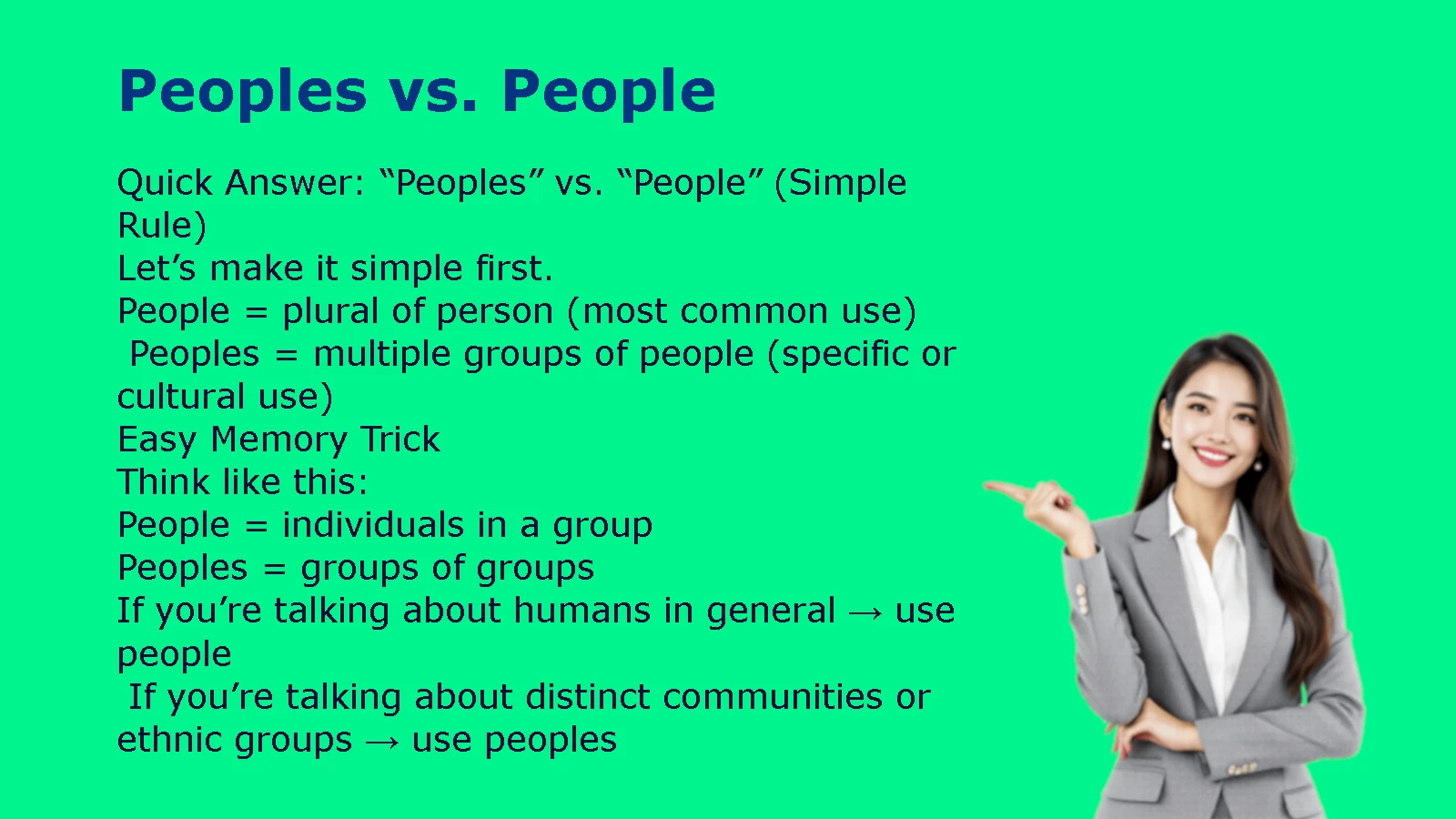
Quick Answer: “Peoples” vs. “People” (Simple Rule)
Let’s make it simple first.
People = plural of person (most common use)
Peoples = multiple groups of people (specific or cultural use)
Easy Memory Trick
Think like this:
- People = individuals in a group
- Peoples = groups of groups
If you’re talking about humans in general → use people
If you’re talking about distinct communities or ethnic groups → use peoples
The Core Meaning of “People” (Everyday Use)
In most situations, “people” is the correct word.
Standard Meaning
“People” = more than one person
Examples
- The people are waiting outside.
- Many people love music.
- People don’t always agree on this topic.
Key Insight
In modern English, “people” already works as a plural form, so you don’t add “s” in normal contexts.
In fact, saying “peoples” in everyday conversation often sounds incorrect.
The Meaning of “Peoples” (Special Use Only)
Now here’s where things change.
“Peoples” is correct—but only in specific contexts.
When It Means Multiple Ethnic or Cultural Groups
Example:
- The indigenous peoples of Canada
- The native peoples of South America
- The ancient peoples of Mesopotamia
What It Really Means
Not multiple individuals—but distinct communities or nations
Academic Connection
In fields like Linguistics, “peoples” is used to emphasize cultural or ethnic diversity rather than just quantity.
Why “Peoples” Sounds Strange Sometimes
Here’s the issue:
Modern English simplifies things. So:
- “People” = default plural
- “Peoples” = specialized academic or historical usage
Common Confusion
People mistakenly say:
- ❌ “There are many peoples in the room” (wrong in most cases)
Instead of:
- ✅ “There are many people in the room”
Why It Happens
English borrows meaning from context, not just grammar rules.
The Simple Grammar Rule Behind It
Let’s break it down clearly:
1. “Person” → “People”
This is the normal plural form.
2. “People” → “Peoples”
Only when referring to separate cultural/national groups
Side-by-Side Comparison Table
| Word | Meaning | Usage Type | Example |
| People | Multiple individuals | Everyday English | People are kind |
| Peoples | Multiple ethnic/cultural groups | Academic / cultural | Indigenous peoples |
Real-Life Examples of “People”
Use “people” in almost all daily situations:
- People are talking in the hall.
- I met new people today.
- People like different foods.
Simple Rule
If you can replace it with “they,” use people.
Real-Life Examples of “Peoples”
Use “peoples” only when discussing distinct groups:
- The museum showcases the cultures of many indigenous peoples.
- Ancient peoples built these structures.
- The rights of different peoples must be respected.
Key Idea
It’s about diversity of groups, not just number of individuals.
The Biggest Mistake People Make
Here’s the real problem:
People assume “peoples” is just a fancy plural of “people.”
What Goes Wrong
- Overusing “peoples” in casual writing
- Thinking it means “many people”
- Mixing academic and everyday English
Result
Sentences sound unnatural or incorrect.
Regional and Context Differences
In Everyday English
- “People” dominates
- “Peoples” is rare
Academic Writing
- “Peoples” is common in anthropology, history, and cultural studies
Global Communication
Misuse can make writing sound unclear or overly formal.
How to Never Get Confused Again
Use this simple checklist:
Step 1: Are you talking about individuals?
→ Use people
Step 2: Are you talking about cultural or ethnic groups?
→ Use peoples
Step 3: Still unsure?
→ Use people (safer choice)
Better Alternatives (Clear Writing Tips)
Instead of guessing, you can rephrase:
- “different communities” instead of “different peoples”
- “groups of people” instead of “peoples”
- “various populations” for academic tone
Why This Helps
It avoids confusion completely.
Quick Decision Guide
- Everyday humans → people
- Cultural or ethnic groups → peoples
- Not sure → people
Simple. Safe. Correct.
FAQ: “Peoples” vs. “People”
Is “peoples” grammatically correct?
Yes, but only in specific cultural or academic contexts.
Can I say “many peoples” meaning many individuals?
No. That is incorrect in standard English.
Why does “peoples” exist at all?
To describe multiple distinct cultural or ethnic groups.
Which is more common?
“People” is far more common in everyday English.
Final Takeaway: The One Rule That Never Fails
Here’s the simplest truth:
- People = normal plural of person
- Peoples = special word for multiple cultural groups
In 95% of situations, you’ll only need people.
So when in doubt, don’t overthink it. English rewards clarity more than complexity.