Have you ever wondered whether “stadiums vs. stadia” is just a spelling difference or if both words actually mean the same thing? This is a common confusion in English vocabulary, especially among learners, writers, and sports enthusiasts who come across both terms in reading, writing, and formal contexts.
In simple terms, both stadiums and stadia refer to large venues designed for sports events, concerts, and public gatherings. However, the difference lies mainly in usage and language style—stadiums is the modern and widely accepted plural form in everyday English, while stadia is the traditional Latin-derived plural that appears more often in formal, academic, or historical writing.
This confusion often shows up in searches like stadium vs stadia meaning, difference between stadiums and stadia, and which is correct: stadiums or stadia, especially among learners trying to improve their grammar, vocabulary, and English usage accuracy.
If you’ve ever hesitated while writing a sentence like “the stadiums were full” or seen the word “stadia” in formal texts, you’re not alone—this is one of those word pairs where usage depends more on style than strict grammar rules.
In this guide, you’ll learn the clear difference between stadiums and stadia, their meanings, correct usage in modern English, and simple examples to help you use them confidently in writing and conversation.
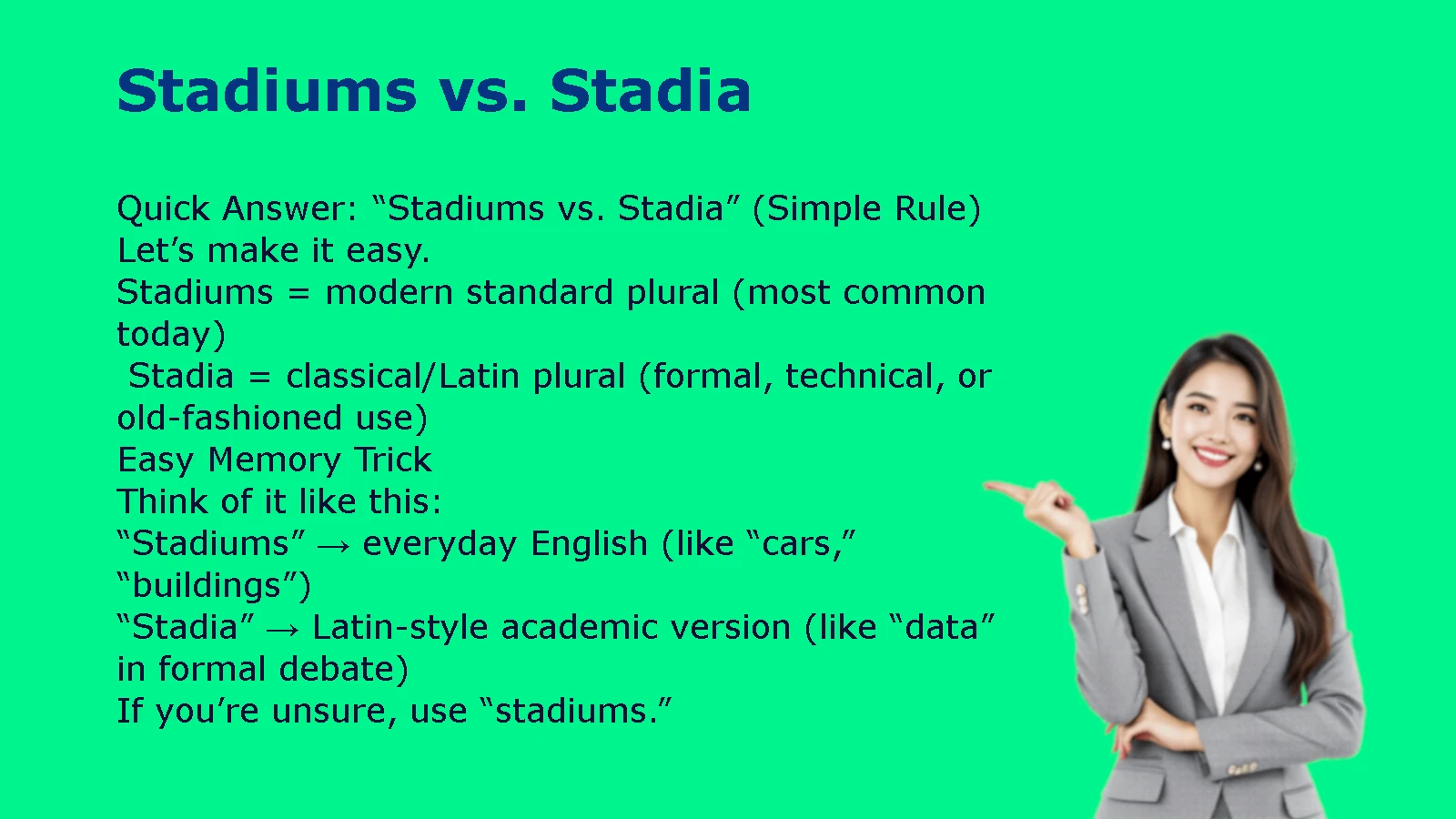
Quick Answer: “Stadiums vs. Stadia” (Simple Rule)
Let’s make it easy.
Stadiums = modern standard plural (most common today)
Stadia = classical/Latin plural (formal, technical, or old-fashioned use)
Easy Memory Trick
Think of it like this:
- “Stadiums” → everyday English (like “cars,” “buildings”)
- “Stadia” → Latin-style academic version (like “data” in formal debate)
If you’re unsure, use “stadiums.”
The Core Difference Between “Stadiums” and “Stadia”
Here’s where the confusion comes from.
“Stadiums”
This is the standard English plural used in:
- News articles
- Sports commentary
- Everyday conversation
- Modern writing
Example:
- “The city is building three new stadiums.”
- “Fans filled all the stadiums across the league.”
“Stadia”
This is the Latin-derived plural form of “stadium.”
It appears in:
- Academic writing
- Architecture discussions
- Historical or classical references
- Some British English contexts
Example:
- “Ancient Roman stadia were used for athletic competitions.”
- “The study compares modern stadia across Europe.”
Why Do Two Plurals Exist?
English borrows words from Latin and Greek, and sometimes keeps the original plural form.
Word Origin Breakdown
- Stadium → Latin/Greek origin
- Original plural → “stadia”
- Modern English adaptation → “stadiums”
Over time, English simplified many classical plurals to make them easier and more natural.
That’s why we now say:
- octopuses (not octopi in strict English use)
- stadiums (not stadia in everyday use)
“Stadiums” vs. “Stadia” in Real Usage
Here’s how language actually behaves today.
In Modern Sports Media
Almost always:
- “stadiums” is used
Example:
- “World Cup stadiums were upgraded before the tournament.”
In Academic or Technical Writing
Sometimes:
- “stadia” is used for precision or stylistic reasons
Example:
- “The research evaluates stadia design efficiency.”
In Everyday Conversation
Always:
- “stadiums”
Nobody naturally says:
- “We visited three stadia last summer” ❌
The Biggest Mistake People Make
Here’s the real confusion point.
People assume:
“Stadia sounds more correct, so it must be better English.”
That’s not true.
What Actually Happens
- “Stadia” sounds formal → people overuse it
- “Stadiums” sounds natural → used in real communication
Result
Writing becomes:
- overly academic
- or incorrectly formal
Side-by-Side Comparison Table
| Word | Type | Usage Level | Best Context |
| Stadiums | Modern English | Standard everyday | News, sports, conversation |
| Stadia | Classical plural | Formal/academic | Research, architecture, history |
Real-Life Examples of “Stadiums”
Let’s ground it in reality.
Common Usage
- “The city has five football stadiums.”
- “Concerts are held in large stadiums.”
- “New stadiums are being built for the league.”
What It Means
Always refers to modern venues in everyday English.
Real-Life Examples of “Stadia”
Now the rarer form.
Common Usage
- “Roman stadia were used for athletic games.”
- “The study compares ancient stadia layouts.”
- “Architects analyzed stadium vs. stadia design.”
What It Means
Often historical or technical plural form.
Regional and Writing Style Differences
American English
- Strong preference: stadiums
- “stadia” is rare
British English
- “stadia” appears slightly more in formal writing
- still not common in speech
Academic Writing
- “stadia” may appear in:
- architecture journals
- classical studies
- technical comparisons
How to Choose the Right Word Every Time
Use this simple decision rule:
Step 1: Is it everyday writing?
→ Use stadiums
Step 2: Is it academic, historical, or technical?
→ “stadia” is acceptable
Step 3: Still unsure?
→ Always default to stadiums
What to Say Instead (Clear Alternatives)
If you want safe, natural English:
- “sports venues” instead of either word
- “arenas” (if indoor)
- “football grounds” (UK usage)
- “athletic facilities”
Example:
- “The city has several sports venues.”
FAQ: “Stadiums” vs. “Stadia”
Is “stadia” wrong?
No. It’s grammatically valid, but rarely used in modern English.
Which one is correct?
Both are correct, but “stadiums” is standard.
Why do some people use “stadia”?
Because of Latin origin or academic writing style.
Should I use “stadia” in SEO writing?
No. “Stadiums” performs better in search and readability.
Case Study: Writing Confusion in Sports Journalism
A sports blog published an article about football infrastructure.
What happened:
- Title used “stadia”
- Readers searched “stadiums”
- Traffic dropped due to keyword mismatch
Fix:
They changed:
- “stadia” → “stadiums”
Result:
- Better ranking
- Higher engagement
- Improved readability
Key Facts You Should Remember
- “Stadiums” = modern, standard plural
- “Stadia” = Latin, formal, academic plural
- Real-world usage strongly favors “stadiums”
- SEO and readability prefer “stadiums”
- Context decides correctness
Final Takeaway: The One Rule That Never Fails
Here’s the simplest truth.
Language evolves toward simplicity. And English already made its choice.
So remember:
If you’re writing for people → stadiums
If you’re writing for academia → stadia (rarely needed)
If you’re unsure → always choose stadiums
Because in real communication, clarity always beats tradition.
And when it comes to “stadiums” vs. “stadia,” the modern world has already voted.