Have you ever wondered whether Dialog vs. Dialogue is the correct spelling? You’re not alone. This common English grammar and spelling question often confuses students, writers, editors, and English learners because both words appear in books, screenplays, business writing, and everyday communication. The correct choice depends on the context, writing style, and whether you’re following American English or British English conventions.
If you’ve ever paused while writing an essay, novel, script, email, or blog post, wondering whether to use dialog or dialogue, you’re facing one of the most frequently confused words in the English language. Although the two spellings share the same meaning, one is more common in general writing, while the other is often preferred in specific fields such as computer programming, user interface (UI) design, and software development. Choosing the wrong spelling may not always be grammatically incorrect, but it can make your writing seem inconsistent or unfamiliar to your audience.
The good news? The difference between dialog and dialogue is easier to understand than you might think.
In this guide, you’ll learn the meaning of Dialog vs. Dialogue, discover which spelling is correct in different situations, explore the differences between American English and British English, and understand how each word is used in literature, creative writing, screenwriting, technical documentation, and digital interfaces. You’ll also find practical examples, common grammar mistakes to avoid, and simple tips to improve your vocabulary and choose the right word with confidence.
So, if you’re ready to master Dialog or Dialogue once and for all, let’s dive in.
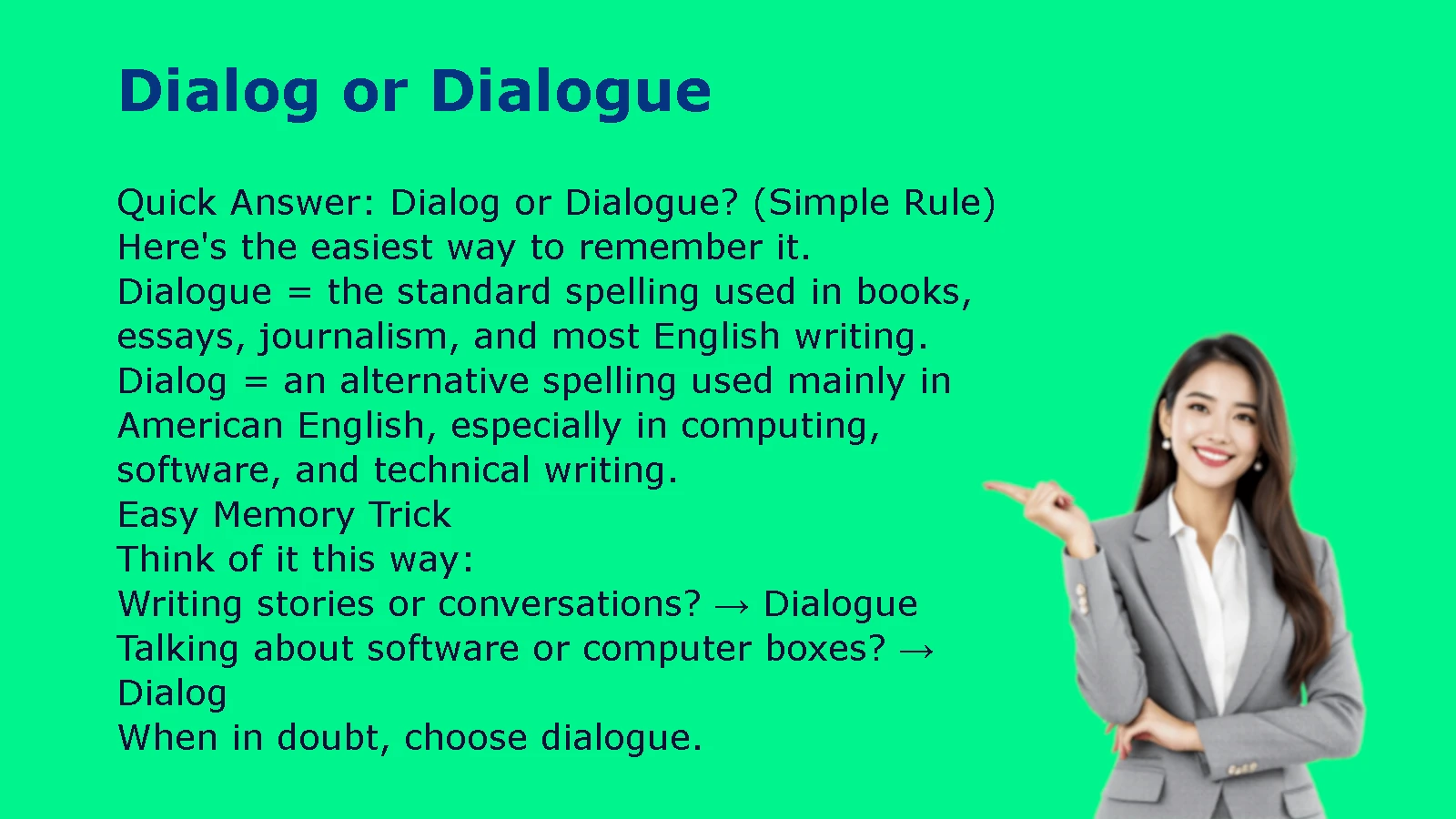
Quick Answer: Dialog or Dialogue? (Simple Rule)
Here’s the easiest way to remember it.
Dialogue = the standard spelling used in books, essays, journalism, and most English writing.
Dialog = an alternative spelling used mainly in American English, especially in computing, software, and technical writing.
Easy Memory Trick
Think of it this way:
Writing stories or conversations? → Dialogue
Talking about software or computer boxes? → Dialog
When in doubt, choose dialogue.
How People Actually Use “Dialog” and “Dialogue”
This is where many writers become uncertain.
Although both words refer to conversation, they aren’t equally common in every context.
In Everyday Writing
Most people write dialogue.
You’ll see it in:
- Novels
- Newspapers
- School assignments
- Blogs
- Magazines
In Technology
Software developers often use dialog.
Examples include:
- Dialog box
- Dialog window
- Dialog editor
Why This Happens
Language changes based on industry.
Writers prefer the traditional spelling.
Programmers often prefer the shorter version.
The Difference Between Dialog and Dialogue
Understanding the difference is surprisingly simple.
Dialogue
Dialogue is the traditional English spelling.
It refers to:
- A conversation between two or more people
- Spoken exchanges in books or movies
- Discussions between groups
Example:
“The dialogue between the two characters felt natural.”
Dialog
Dialog is simply a shortened spelling.
It appears mostly in:
- Computer terminology
- User interface design
- Programming documentation
Example:
“Click OK to close the dialog.”
Key Insight
Both words share the same meaning, but dialogue is standard English, while dialog is specialized.
“Dialogue” Explained Clearly
In almost every writing situation, dialogue is the correct choice.
Standard Meaning
Dialogue means a conversation between people.
Examples:
- Dialogue in a novel
- Political dialogue
- Classroom dialogue
- Movie dialogue
Where You’ll See It
- Fiction
- Nonfiction
- Academic writing
- Business communication
- Journalism
Key Takeaway
If your writing isn’t related to computers or software, choose dialogue.
“Dialog” Explained Clearly
Now let’s look at the less common spelling.
Standard Meaning
Dialog is mainly a technical spelling.
Software developers use it to describe interface windows.
Examples:
- Open the settings dialog.
- The dialog appears after clicking Save.
- Create a custom dialog box.
Modern Usage
Some American dictionaries recognize dialog as an acceptable alternative spelling.
However, many style guides still recommend dialogue for general writing.
Key Insight
Use dialog only when your audience expects technical language.
The Biggest Mistake People Make
The most common mistake is assuming both spellings work everywhere.
What Goes Wrong
Someone writes:
“The novel contains realistic dialog.”
Many editors will change it to:
“The novel contains realistic dialogue.”
Why?
Because dialogue is the accepted spelling in literary writing.
Side-by-Side Comparison Table
| Word | Standard Meaning | Best Use Case | Risk of Confusion |
| Dialogue | Conversation between people | Books, articles, essays, everyday writing | Low |
| Dialog | Alternative spelling, mainly technical | Software, programming, UI design | Medium |
Real-Life Examples of “Dialogue”
Let’s see it in action.
Common Examples
“The dialogue in the movie sounded authentic.”
“The teacher encouraged open dialogue among students.”
“Good dialogue makes stories more believable.”
“The peace dialogue continued for several hours.”
Mini Scenario
You’re writing a novel.
Correct:
“The dialogue between the detective and the suspect created suspense.”
Not:
“The dialog between the detective and the suspect created suspense.”
Real-Life Examples of “Dialog”
Now compare.
Common Examples
“Open the dialog box.”
“The error dialog appeared after installation.”
“Close the dialog before continuing.”
“The application displays a login dialog.”
Mini Scenario
You’re writing software documentation.
Correct:
“Select the dialog from the Tools menu.”
Here, dialog sounds natural because it’s technical terminology.
British vs. American English
Regional spelling also plays a role.
In British English
Dialogue is almost always used.
Dialog is rarely seen outside technical documentation.
In American English
Dialogue is still the preferred spelling.
However, dialog appears much more often in software and computing.
In International Writing
If your audience is global, dialogue is usually the safest choice.
How to Avoid Confusion Every Time
Want to choose the correct spelling instantly?
Follow these simple rules.
If You’re Writing About Conversations
Use:
Dialogue
If You’re Writing About Software
Use:
Dialog
When Unsure
Choose dialogue.
It works in nearly every situation.
What to Say Instead (Clear Alternatives)
Sometimes another word fits better.
Alternatives
- Conversation
- Discussion
- Exchange
- Talk
- Communication
- Debate
- Interaction
When to Use Them
Instead of repeating “dialogue” several times, vary your vocabulary naturally.
Quick Decision Guide (Use This Instantly)
When choosing between the two:
Writing a story? → Dialogue
Writing an essay? → Dialogue
Writing software documentation? → Dialog
Still unsure? → Dialogue
Simple. Reliable. Done.
FAQ: Dialog or Dialogue
Is “dialog” a real word?
Yes. It’s a recognized alternative spelling, especially in computing and software documentation.
Which spelling is more common?
Dialogue is far more common in books, newspapers, education, and everyday English.
Can I use “dialog” in a novel?
It’s generally not recommended. Most editors prefer dialogue.
Why do programmers write “dialog”?
Many programming languages, software libraries, and user interface guidelines adopted the shorter spelling.
Which spelling should students use?
Students should almost always use dialogue unless instructed otherwise.
Case Study: A Simple Editing Mistake
A university student submitted a literature essay discussing character conversations.
Throughout the paper, they wrote:
“The dialog between the main characters reveals their personalities.”
What Happened
The instructor corrected every instance to dialogue.
Why?
The essay wasn’t about software or computing.
It followed standard academic English, where dialogue is preferred.
Lesson
Know your audience before choosing the spelling.
Key Facts You Should Remember
- Dialogue is the standard English spelling.
- Dialog is mainly used in software and technical writing.
- Both words refer to conversation.
- Most editors recommend dialogue for general writing.
- When uncertain, choose dialogue.
Final Takeaway: The One Rule That Never Fails
Here’s the simple truth.
Both dialog and dialogue are recognized spellings, but they aren’t interchangeable in every situation.
For novels, essays, articles, classrooms, and everyday communication, dialogue is the clear winner. It’s the traditional spelling, widely accepted across English-speaking countries, and preferred by most style guides.
Reserve dialog for software, programming, and technical documentation where it’s already established.
If you’re ever in doubt, remember this rule:
General writing → Dialogue
Technical writing → Dialog
Choosing the right spelling isn’t just about correctness—it’s about matching your audience and writing with clarity and confidence.