Sole vs Soul is one of those confusing English pairs that sound the same but mean completely different things. First of all, Sole and Soul are homophones, which means they share pronunciation but not meaning. Because of this, learners often mix them up in speech and writing.
To begin with, Sole usually refers to something physical or specific. For example, it can mean the bottom part of a shoe or the foot, and it can also mean something that is the only one or single. On the other hand, Soul is used in a completely different sense, often connected to a person’s inner self, emotions, or spiritual identity. In contrast to Sole, it is not physical.
Furthermore, the real challenge comes from everyday usage. Since both Sole and Soul appear in common conversations, it is important to pause and think about context before choosing the correct word. Over time, understanding their difference becomes easier with practice and attention.
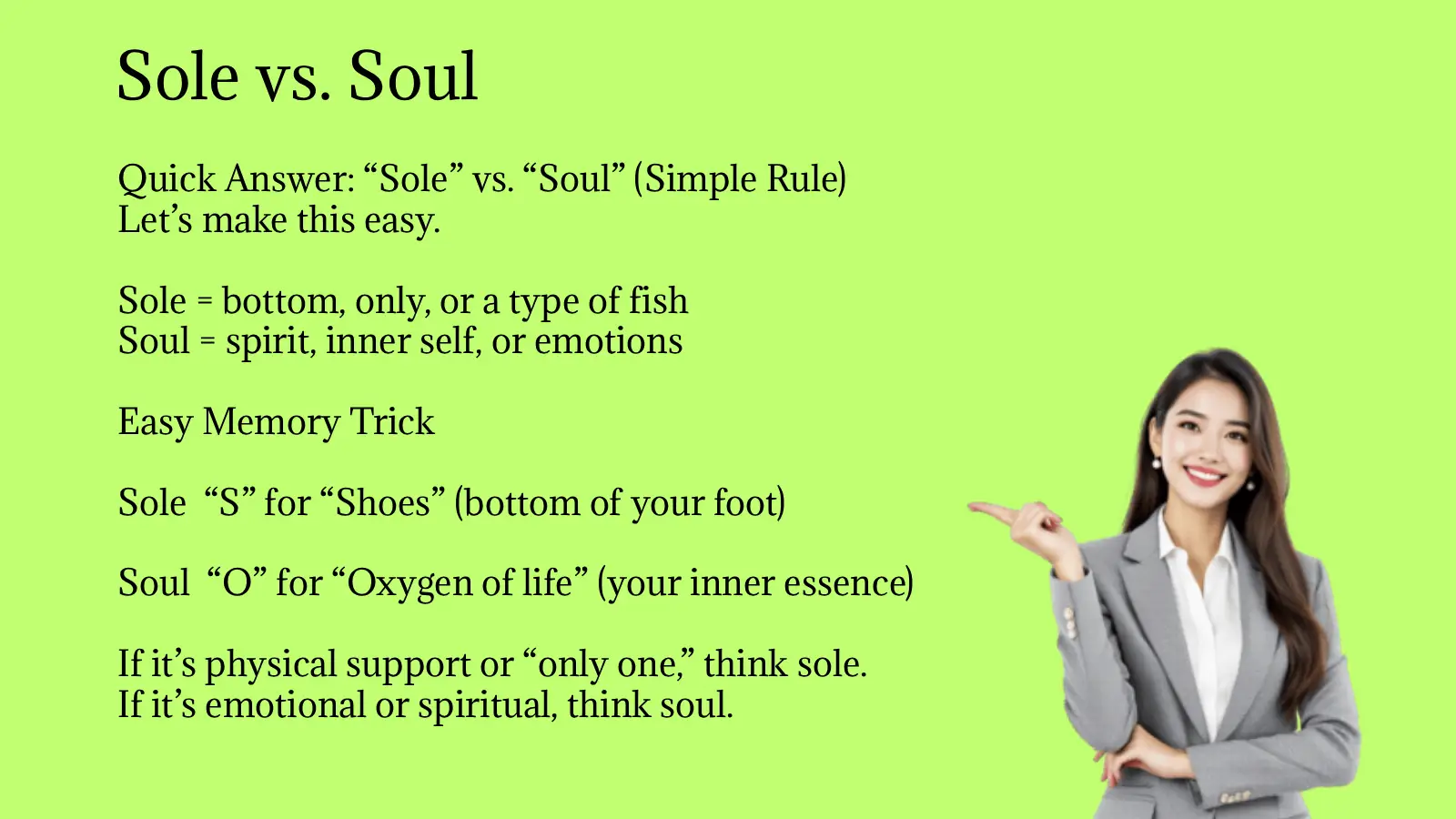
Quick Answer: “Sole” vs. “Soul” (Simple Rule)
Let’s make this easy.
Sole = bottom, only, or a type of fish
Soul = spirit, inner self, or emotions
Easy Memory Trick
- Sole → “S” for “Shoes” (bottom of your foot)
- Soul → “O” for “Oxygen of life” (your inner essence)
If it’s physical support or “only one,” think sole.
If it’s emotional or spiritual, think soul.
Why People Confuse “Sole” and “Soul”
The confusion happens for one simple reason: they sound exactly the same.
English has many of these “homophones,” words that sound identical but mean completely different things.
The brain relies on context, not spelling, so in fast writing or speech, mistakes happen easily.
“Sole” Explained Clearly (With Real Meaning)
“Sole” is a physical or factual word. It never deals with emotions or spirit.
1. Sole = Bottom of the Foot or Shoe
This is the most common meaning.
Example:
- “The sole of my shoe is worn out.”
It refers to the underside that touches the ground.
2. Sole = Only or Single
“Sole” can also mean “only one.”
Example:
- “She is the sole survivor of the accident.”
- “He is the sole owner of the company.”
This usage is common in legal and formal writing.
3. Sole = A Type of Fish
Yes, it’s also a fish.
Example:
- “We had grilled sole for dinner.”
Key Idea for “Sole”
Think: something physical, single, or structural.
“Soul” Explained Clearly (With Emotional Meaning)
“Soul” is abstract. It belongs to feelings, identity, and spirituality.
1. Soul = Inner Self or Spirit
Example:
- “She has a kind soul.”
- “Music touches the soul.”
This refers to emotional depth or personality.
2. Soul = Emotional Energy or Essence
Example:
- “He put his soul into the performance.”
It means deep emotional effort.
3. Soul in Cultural or Spiritual Context
Example:
- “Many traditions believe the soul lives after death.”
Used in religion, philosophy, and spirituality.
Key Idea for “Soul”
Think: feelings, identity, life energy.
Side-by-Side Comparison Table
| Word | Meaning | Type | Example |
|---|---|---|---|
| Sole | Bottom of foot/shoe | Physical | Sole of the shoe |
| Sole | Only one | Factual | Sole survivor |
| Sole | Fish | Object | Grilled sole |
| Soul | Inner spirit | Emotional | Kind soul |
| Soul | Emotional depth | Abstract | Music touches the soul |
| Soul | Spiritual essence | Religious | Soul after death |
The Biggest Mistake People Make
Here’s the real problem:
People try to guess based on sound instead of meaning.
What Goes Wrong
- “He sold his sole to the devil” ❌
- “She has a beautiful sole” ❌ (unless talking about feet or fish)
What Should Happen
- “He sold his soul to the devil” ✔
- “The sole of her shoe is damaged” ✔
Real-Life Examples of “Sole”
Everyday Usage
- “This is my sole focus right now.”
- “He is the sole reason we succeeded.”
- “The shoe has a rubber sole.”
Workplace Example
- “She is the sole decision-maker for this project.”
Real-Life Examples of “Soul”
Emotional Usage
- “That song speaks to my soul.”
- “He is a gentle soul.”
- “She poured her soul into the artwork.”
Storytelling Example
- “The hero risked everything to save his soul.”
Quick Memory Trick That Always Works
Use this simple mental shortcut:
- Sole = Shoes (on the ground)
- Soul = Spirit (beyond the body)
Or even simpler:
- Sole = Physical
- Soul = Emotional
If you can touch it → sole
If you can feel it → soul
Common Confusion Scenarios
Scenario 1: Writing Mistake
❌ “He has a kind sole.”
✔ “He has a kind soul.”
Scenario 2: Job Description
❌ “She is the soul owner of the company.”
✔ “She is the sole owner of the company.”
Scenario 3: Emotional Expression
❌ “Music touches my sole.”
✔ “Music touches my soul.”
Pro Tip: How to Never Mix Them Again
Before writing, ask:
- Am I talking about emotion or identity? → soul
- Am I talking about only one or something physical? → sole
This 2-second check eliminates 99% of mistakes.
Quick Decision Guide
If you’re unsure:
- Bottom of shoe → sole
- Only one → sole
- Fish → sole
- Feelings/spirit → soul
Still confused? Replace it in your mind:
- “Only” → sole
- “Spirit” → soul
FAQ: Sole vs Soul
Is “sole” ever related to feelings?
No. “Sole” is physical or factual only.
Can “soul” be plural?
Yes → “souls” (e.g., “lost souls”).
Why do they sound the same?
They are homophones in English, meaning same pronunciation but different spelling and meaning.
Which one is more common?
“Soul” is more common in emotional and everyday language, while “sole” is more technical or specific.
Final Takeaway: The One Rule That Never Fails
Here’s the simplest truth:
Sole = something physical or singular
Soul = something emotional or spiritual
Think of it like this:
You stand on your sole, but you feel with your soul.
And once you lock that difference in, you’ll never confuse them again.