This Is She vs This Is Her is a common area of confusion for many English learners, especially when they first encounter it in real conversations. Many people get stuck between This is she and This is her, because both sound possible in everyday speech. However, the difference comes from older grammatical rules and how modern English learners actually use language in real situations like phone calls and introductions.
To understand it better, it helps to focus on subject pronoun and object pronoun usage. Traditionally, “This is she” follows the rule of using a subject form after a linking verb, which is why it is considered grammatically correct in formal explanations. On the other hand, “This is her” uses the object form, which sounds more natural in casual English and especially in American conversations. Transitioning from strict grammar to natural speech is why many native speakers prefer the second form today.
In real-life communication, especially during phone introductions and informal speaking, people often prioritize fluency over strict grammar rules. That is why This is her is more commonly heard in daily use, while This is she remains more formal or traditional. Ultimately, understanding both forms helps improve grammar accuracy, speaking confidence, and overall communication skills, allowing learners to adapt to both formal and informal English contexts.
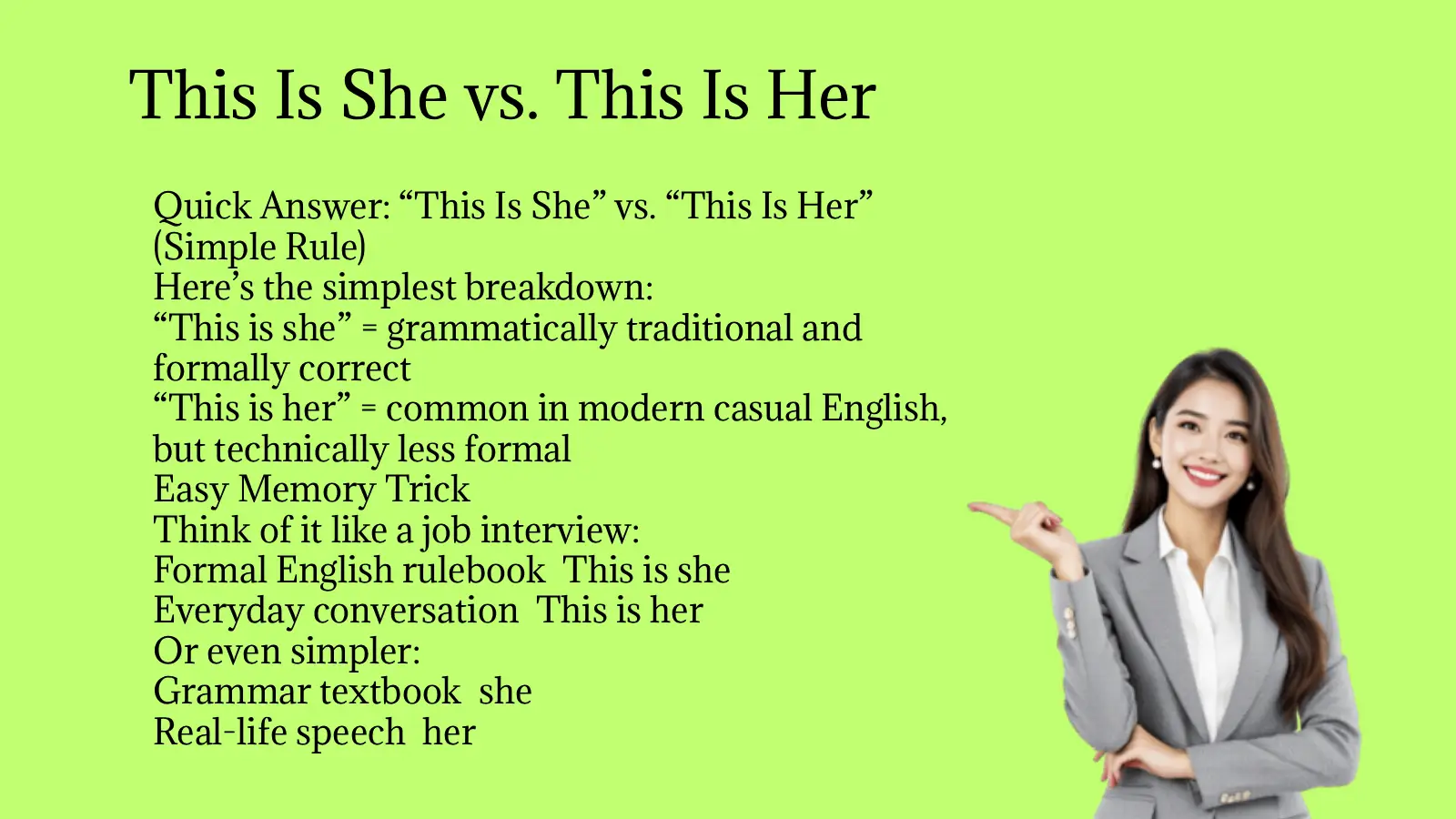
Quick Answer: “This Is She” vs. “This Is Her” (Simple Rule)
Here’s the simplest breakdown:
- “This is she” = grammatically traditional and formally correct
- “This is her” = common in modern casual English, but technically less formal
Easy Memory Trick
Think of it like a job interview:
- Formal English rulebook → This is she
- Everyday conversation → This is her
Or even simpler:
- Grammar textbook → she
- Real-life speech → her
Do “This Is She” and “This Is Her” Mean the Same Thing?
Yes. The meaning is identical.
Both phrases confirm:
“You are speaking to the person you asked for.”
However, the structure changes how “correct” it sounds depending on grammar tradition.
Why Is There Confusion?
This is where English gets tricky.
The Grammar Rule Behind It
In traditional grammar:
- After linking verbs like “is,” the subject complement should match subject form.
- So, “she” is technically correct, not “her.”
That’s why:
- “This is she” follows strict grammar logic
But Here’s the Reality
Modern English speakers:
- Prioritize natural speech
- Avoid formal-sounding structures
- Often use object pronouns in conversation
So:
- “This is her” became widely accepted in casual use
“This Is She” Explained Clearly
At first, this phrase might sound unusual. But it’s the grammatically traditional response in formal settings.
When You Should Use “This Is She”
Use it when:
- Answering formal phone calls
- Speaking in professional settings
- You want strict grammatical correctness
Example Conversations
Caller: “May I speak to Sarah?”
You: “This is she.”
Caller: “Is this Ms. Johnson?”
You: “Yes, this is she.”
How It Feels
“This is she” sounds:
- Formal
- Slightly old-fashioned
- Precise
It’s the kind of English you’ll hear in scripted professional dialogue.
“This Is Her” Explained Clearly
Now let’s switch to the version most people actually say.
“This is her” feels natural in modern conversation. It flows easily and avoids grammatical stiffness.
When You Should Use “This Is Her”
Use it when:
- Speaking casually
- Answering friends or informal calls
- You want natural-sounding speech
Example Conversations
Caller: “Is this Emily?”
You: “Yes, this is her.”
Caller: “Can I speak to Anna?”
You: “This is her.”
How It Feels
“This is her” sounds:
- Relaxed
- Modern
- Conversational
It fits how people actually talk today.
The Biggest Mistake People Make
Here’s where things get interesting.
People assume only one version is correct everywhere.
That’s not true.
What Goes Wrong
- Learners memorize grammar rules without context
- Native speakers prioritize natural flow
- Both sides judge each other incorrectly
Real-Life Confusion Example
In a formal office:
Caller: “Is this the manager?”
Employee: “This is her.”
Grammatically debated? Yes.
Still completely understood? Also yes.
Side-by-Side Comparison Table
Here’s a quick breakdown you can scan anytime:
| Phrase | Grammar Status | Usage Style | Tone |
|---|---|---|---|
| This is she | Traditionally correct | Formal speech | Polished, strict |
| This is her | Common modern usage | Everyday speech | Natural, relaxed |
Real-Life Examples of “This Is She”
Let’s ground it in real situations.
Common Scenarios
- “This is she speaking.”
- “Yes, this is she.”
- “You’ve reached her office. This is she.”
Mini Scenario
A receptionist answers a corporate call:
Caller: “Is this Dr. Khan?”
Receptionist: “Yes, this is she.”
It sounds structured and professional.
Real-Life Examples of “This Is Her”
Now compare natural usage.
Common Scenarios
- “Yes, this is her.”
- “You’re speaking with her now.”
- “This is her, can I help you?”
Mini Scenario
A friend picks up a call:
Caller: “Is this Sara?”
Sara: “Yeah, this is her.”
It feels effortless and real.
Why Native Speakers Use “This Is Her” More Often
Language evolves. Grammar rules don’t always keep up.
The Shift in English
People naturally prefer:
- Simpler phrasing
- Faster responses
- Less formal structure
So “this is her” became dominant in speech.
But Here’s the Catch
In strict grammar teaching:
- “This is she” is still considered correct
So both coexist.
Regional Differences
Language style changes depending on where you are.
In the United States
- “This is her” is far more common
- “This is she” appears in formal or scripted settings
UK
- Both are understood
- “This is she” appears slightly more in formal English
Global English
- Informal communication favors “this is her”
- Formal writing or exams may prefer “this is she”
How to Choose the Right Phrase Every Time
You don’t need to overthink it.
Step 1: Identify the Setting
- Formal or professional → “this is she”
- Casual or everyday → “this is her”
2: Think About Your Audience
- Business call → lean formal
- Friends or family → go natural
3: Stay Consistent
Don’t switch mid-conversation. It can feel awkward.
What to Say Instead (Clear Alternatives)
If both options feel confusing, use these:
- “Speaking.”
- “Yes, you’re speaking with her.”
- “This is [name].”
- “Yes, I am.”
These often sound more natural and avoid grammar debates entirely.
Quick Decision Guide (Use This Instantly)
Still unsure? Follow this:
- Formal situation → This is she
- Casual conversation → This is her
- Want zero confusion → Use your name instead
Simple. Clean. No stress.
FAQ: “This Is She” vs. “This Is Her”
Is “this is she” grammatically correct?
Yes. It follows traditional English grammar rules.
Why do people say “this is her”?
Because modern English favors natural, conversational speech.
Which one should I use in real life?
Use “this is her” for everyday speech. Use “this is she” in formal contexts.
Will people misunderstand either version?
No. Both are understood instantly.
Case Study: Formal vs. Natural Speech
A customer service trainee used “this is she” during training.
It was marked as correct.
Later, while answering real customer calls, she switched to “this is her.”
What Changed?
- Tone felt more natural
- Conversations flowed better
- No confusion occurred
Lesson
Context matters more than strict grammar perfection.
Key Facts You Should Remember
- Both phrases mean the same thing
- “This is she” is grammatically traditional
- “This is her” is widely used in modern speech
- Context decides which sounds better
- Clarity matters more than strict rules
Final Takeaway: The One Rule That Never Fails
Here’s the simple truth.
English is flexible. Real people prioritize flow over perfection.
So use this rule:
Formal setting → This is she
Natural conversation → This is her
Still unsure → Say your name directly
Think of it like clothing again. One is a suit. One is everyday wear. Both are fine—just worn in different places.
And once you understand the context, the confusion disappears completely,