Categorize vs categorise is a spelling difference between two forms of the same English verb. Categorize is the standard spelling in American English, while categorise is common in British English. Both words mean to place people, objects, ideas, or information into groups based on shared characteristics.
The difference goes beyond spelling conventions. Understanding categorise meaning, categorize pronunciation, and categorize synonyms helps you choose the right word for business reports, academic writing, websites, and everyday communication. You’ll also learn how to use related forms such as categorization, categorised, and recategorize, along with the differences between categorizing, classifying, sorting, and organizing.
Categorize vs Categorise: The Main Difference
Categorize and categorise have the same meaning, grammatical function, and pronunciation in most varieties of English. The main difference is regional spelling preference: American English uses categorize, while British English commonly uses categorise. However, British English also accepts the -ize spelling in many contexts.
| Feature | Categorize | Categorise |
| Common usage | American English | British English |
| Meaning | To place something into a category | To place something into a category |
| Part of speech | Verb | Verb |
| Pronunciation | Generally the same | Generally the same |
| Present tense | Categorizes | Categorises |
| Past tense | Categorized | Categorised |
| Present participle | Categorizing | Categorising |
| Noun form | Categorization | Categorisation |
For example, an American office manager might write, “We need to categorize these invoices by department.” A British office manager could write, “We need to categorise these invoices by department.”
Both sentences are correct. The writer simply follows a different spelling convention.
Is Categorize or Categorise Correct?
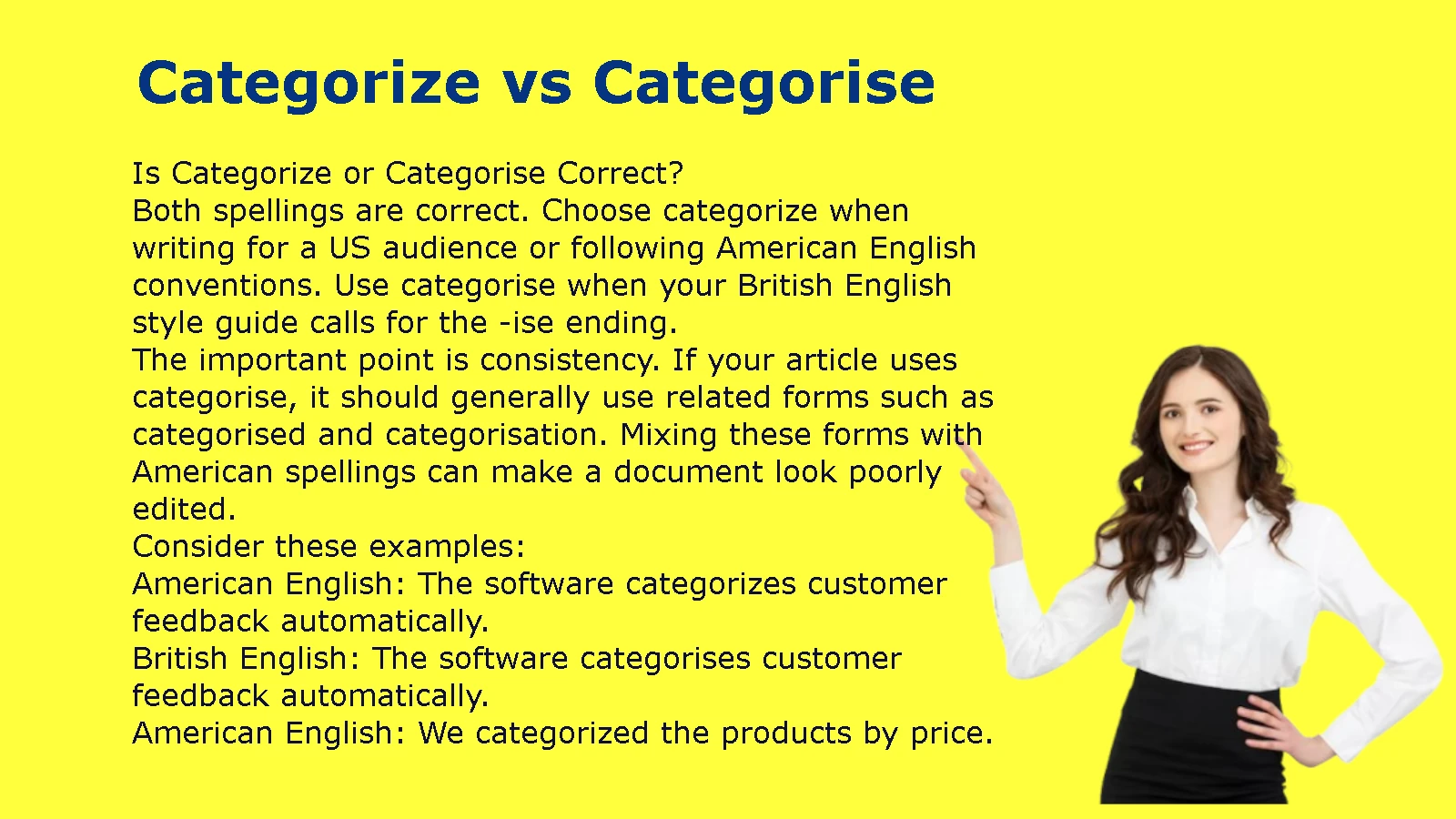
Both spellings are correct. Choose categorize when writing for a US audience or following American English conventions. Use categorise when your British English style guide calls for the -ise ending.
The important point is consistency. If your article uses categorise, it should generally use related forms such as categorised and categorisation. Mixing these forms with American spellings can make a document look poorly edited.
Consider these examples:
- American English: The software categorizes customer feedback automatically.
- British English: The software categorises customer feedback automatically.
- American English: We categorized the products by price.
- British English: We categorised the products by price.
The meaning remains unchanged in every example.
One detail often causes confusion: British English does not universally reject words ending in -ize. Some British dictionaries, publishers, and academic style guides prefer -ise, while others accept or prefer -ize. Therefore, the intended audience and the relevant style guide matter more than a blanket rule about British spelling.
Categorize vs Categorise in US, UK, Canadian, and Australian English
English spelling varies across countries, but national boundaries do not always determine a single correct form. Editorial conventions, institutional policies, and individual preferences can also affect spelling.
| English variety | Common spelling pattern | Practical guidance |
| American English | Categorize | Use the -ize form. |
| British English | Categorise or categorize | Follow the publication’s preferred style. |
| Canadian English | Both patterns occur | Check the organization’s spelling policy. |
| Australian English | Categorise is common | Follow Australian English conventions and the relevant style guide. |
For US-focused websites, categorize is the natural default. For a British audience, categorise is a sensible choice when the rest of the site uses -ise spellings.
Canadian English can combine British and American spelling traditions, so it helps to check the style used by the publication or organization. Australian English commonly uses forms such as categorise, organise, and recognise.
The same principle applies to other spelling pairs, including prioritize/prioritise, organize/organise, and recognize/recognise. Choose the convention that suits your readers and use it consistently across the page.
Categorise Meaning and Definition
Categorise means to put people, objects, ideas, or information into groups according to their shared features. The American spelling, categorize, has exactly the same meaning. People use the verb when they sort information, classify products, organize records, or identify the type of something.
For example, a teacher might categorise books by reading level, while a company might categorize expenses by department. In both cases, the action creates a useful structure that makes information easier to understand or manage.
Categorize Meaning With Examples
The verb categorize describes the act of assigning something to a group or class. The categories usually depend on a purpose, such as finding information quickly, comparing similar items, or analyzing a collection of data.
Here are examples from different situations:
Everyday life
- I categorize my photos by year and event.
- She categorised the kitchen supplies according to their purpose.
- We need to categorize these clothes before donating them.
Business and finance
- The accountant categorized each expense as travel, equipment, or office supplies.
- The company categorises customer complaints by urgency.
- Our team categorized the invoices by department before preparing the monthly report.
Education
- Students categorized the animals according to their habitats.
- The teacher asked the class to categorize the words by part of speech.
- Researchers categorised the survey responses into several themes.
Technology and data management
- The application categorizes incoming emails by topic.
- The database categorises products by price, brand, and availability.
- The team categorized thousands of support tickets to identify recurring problems.
These examples show that categorizing usually involves a decision about which group best fits an item. The usefulness of the result depends on choosing categories that match the task.
How to Use Categorize in a Sentence
You can use categorize with a direct object, followed by a phrase that explains the basis for classification.
Common sentence patterns include:
- Categorize something by a feature: We categorized the books by genre.
- Categorize something into groups: The researcher categorized the participants into three groups.
- Categorize something as a type: The accountant categorized the purchase as a business expense.
- Categorize something according to a rule: The system categorizes messages according to their content.
The preposition often depends on what you want to emphasize. Use by to identify the organizing feature, into to emphasize the resulting groups, and as to identify the category assigned to an item.
Compare these sentences:
“The store categorized its products by price.”
This sentence explains the method used to organize the products.
“The store categorized its products into three price ranges.”
This version emphasizes the resulting groups.
“The store categorized the damaged item as unsellable.”
Here, the sentence assigns a particular status to one item.
All three constructions are natural. Choose the one that expresses your intended meaning most clearly.
Is Categorize a Verb, Noun, or Adjective?
Categorize is a verb, not a noun or an adjective. Its related forms include category, categorization, and categorical, but each word performs a different grammatical role.
| Word | Part of speech | Meaning | Example |
| Categorize | Verb | Place something in a category | Categorize the files by date. |
| Category | Noun | A group or class | Choose the correct category. |
| Categorization | Noun | The act or result of assigning categories | The categorization took several hours. |
| Categorical | Adjective | Absolute, definite, or relating to categories | She gave a categorical denial. |
| Categorized | Verb form or adjective | Placed in a category | The categorized records are ready. |
| Categorizing | Verb form or gerund | The act of assigning categories | Categorizing the records takes time. |
The adjective categorical deserves special attention. It can describe something related to categories, but it also means definite or unconditional, as in “a categorical refusal.” It is not simply another form of the verb categorize.
Likewise, category names the group itself, while categorization names the process or result of placing something into a group.
How to Pronounce Categorize
Categorize is commonly pronounced /ˈkæt.ə.ɡə.raɪz/ in American English, with some variation in how speakers pronounce the unstressed vowels. The word has four syllables in this transcription, and the primary stress falls on the first syllable. The British spelling categorise generally uses the same pronunciation.
The final sound is a voiced /z/, not an /s/. This matches the ending in words such as organize and recognize.
Categorize Pronunciation in American and British English
The spelling difference between categorize and categorise does not normally create a pronunciation difference. Speakers in both the United States and the United Kingdom use broadly similar pronunciations, although accents can affect vowel quality and the rhythm of unstressed syllables.
A useful way to learn the word is to break it into smaller parts:
- Start with cat, using the vowel sound found in cat in many American accents.
- Move through the shorter, unstressed middle syllables.
- Finish with -ize, pronounced with a long i sound followed by a voiced z.
Avoid pronouncing the ending as though it rhymes with ice. The final consonant is voiced, so the ending sounds like the one in rise rather than rice.
Try this practice sentence:
“Please categorize the customer comments before the meeting.”
Say the sentence slowly first. Then repeat it at a normal speaking pace, keeping the first syllable stressed.
How to Remember the Pronunciation
The easiest way to remember the pronunciation is to focus on the first-syllable stress and the final -ize sound.
Use this short practice routine:
- Say the first syllable clearly.
- Relax the middle syllables instead of giving each one equal emphasis.
- Finish with a voiced z sound.
- Repeat the word in a complete sentence.
You can also compare categorize with organize, recognize, and prioritize. These words share a similar ending, which makes them useful for pronunciation practice.
Remember that the spelling ending -ise in categorise does not mean you should automatically pronounce the last sound as /s/. In standard pronunciations of this word, the ending is voiced.
Categorize Synonyms and Alternative Words
Categorize synonyms include classify, sort, group, organize, label, and arrange. However, these words are not always interchangeable. Classify often emphasizes a formal system, sort emphasizes separating or arranging items, and label focuses on assigning a name or tag.
The best alternative depends on what you are doing and how precise you need to be.
| Synonym | Main emphasis | Example |
| Classify | Assigning something to a defined class | Scientists classify the specimens by species. |
| Sort | Separating or arranging items | Sort the receipts by date. |
| Group | Putting related things together | Group the comments by topic. |
| Organize | Creating an orderly arrangement | Organize the documents into folders. |
| Label | Assigning a descriptive name or tag | Label each box with its contents. |
| Arrange | Putting things in a particular order | Arrange the files by size. |
| Segment | Dividing something into distinct sections | The company segments its customers by purchasing behavior. |
| Class | Assigning something to a class, often in technical contexts | The model classes each image by content. |
Use these alternatives when you want to avoid repetition or express a more specific action. Replacing every occurrence of categorize with organize, for example, may change the meaning of a sentence.
Categorize vs Classify
Categorize and classify both mean placing something into a group, but classify can suggest a more formal or systematic process. It often appears in science, research, education, and technical work.
For example:
- “We categorized the customer comments by topic.”
- “Researchers classified the organisms according to their biological characteristics.”
The first sentence describes a practical way to organize comments. The second suggests a defined classification system based on specific characteristics.
Still, the words overlap considerably. You can classify customer feedback or categorize biological specimens. The best choice depends on the level of formality and the system being used.
Categorize vs Organize
Categorize means assigning items to groups, while organize has a broader meaning. Organizing may involve categorizing, arranging, prioritizing, labeling, or restructuring information.
Imagine that you have 200 digital files.
If you categorize them, you might assign them to groups such as invoices, contracts, reports, and photographs.
If you organize them, you might also rename the files, remove duplicates, sort them by date, and place them into folders.
Categorization can be one step in organization, but organization involves more than creating categories.
Choose categorize when the grouping decision matters. Choose organize when you mean the wider task of making something orderly or easier to use.
Categorize vs Group
Group emphasizes putting related things together. Categorize emphasizes assigning items to defined categories, which may follow a specific set of rules.
For example, a teacher might group students for a classroom activity based on their interests. A researcher might categorize survey participants according to age ranges, education levels, or responses.
The distinction is not absolute. Grouping can be systematic, and categorization can be informal. However, categorize often suits situations where the categories themselves matter.
Compare these examples:
- “Group the chairs near the windows.” This focuses on physical placement.
- “Categorize the chairs by design.” This focuses on assigning them to types.
- “Group the comments that express similar concerns.” This emphasizes similarity.
- “Categorize each comment as positive, negative, or neutral.” This specifies a classification system.
Categorise or Categorize in UK English?
Categorise is a common British English spelling, but categorize is also accepted in many British English contexts. The choice depends on the spelling convention followed by the writer, publisher, institution, or organization.
If you are writing for a UK audience, categorise is a sensible option when your content uses other -ise forms. However, do not assume that every British publication requires it.
Why Do British Words End in -ise or -ize?
English contains many words with alternative -ise and -ize endings. These variations developed through the history of English spelling and different editorial traditions.
Both endings appear in British English, although many UK publications favor -ise. The -ize form also has a long history in British writing and remains acceptable under several style conventions.
Examples include:
| Common British-style form | Alternative form |
| Categorise | Categorize |
| Organise | Organize |
| Recognise | Recognize |
| Prioritise | Prioritize |
| Standardise | Standardize |
| Specialise | Specialize |
| Modernise | Modernize |
The key is to distinguish a spelling preference from a universal rule. Some words have more complicated histories or different accepted forms, so you should not assume that every word ending in -ise follows exactly the same pattern.
For a website, select a spelling convention and apply it throughout your content. Readers are more likely to notice inconsistent editing than a legitimate regional spelling choice.
Should You Use Categorise or Categorize in Academic and Professional Writing?
In academic and professional writing, follow the required style guide first. A university, journal, government department, or company may specify British English, American English, or a particular editorial convention.
Use this checklist before submitting your work:
- Check the style guide. Follow the rules provided by your employer, instructor, journal, or publisher.
- Match your audience. Use the spelling familiar to the readers you want to reach.
- Keep related forms consistent. If you choose categorise, review categorised, categorising, and categorisation as well.
- Check automated tools. Set your word processor’s language to the appropriate English variety.
- Review the whole document. Search for both spelling patterns to catch accidental mixing.
For example, a US business report might use categorize, organize, and prioritize. A British report following an -ise convention might use categorise, organise, and prioritise.
Neither pattern makes the report more accurate by itself. Consistency and compliance with the relevant style guide matter most.
Categorize and Its Related Word Forms
The spelling difference affects several related words. Knowing these forms helps you write accurately in different tenses and grammatical structures.
American English commonly uses categorization, categorized, and categorizing. Writers who follow an -ise convention commonly use categorisation, categorised, and categorising.
| American spelling | Common British -ise spelling | Grammatical role |
| Categorize | Categorise | Base verb |
| Categorizes | Categorises | Third-person singular |
| Categorized | Categorised | Past tense or past participle |
| Categorizing | Categorising | Present participle or gerund |
| Categorization | Categorisation | Noun |
| Recategorize | Recategorise | Related verb meaning to categorize again |
Categorization vs Categorisation
Categorization and categorisation are nouns that describe the act or result of assigning things to categories. The difference is spelling, not meaning.
Examples:
- American English: The categorization of the survey responses took two days.
- British English: The categorisation of the survey responses took two days.
The noun often appears in research, data management, education, and business writing. It can refer to the process of creating groups or to the way items have been grouped.
For instance, a researcher might discuss the categorization of interview responses. A software team might review its categorization rules to ensure that similar support tickets receive the same label.
In both examples, the noun describes a process or system rather than a single act of placing an item into a category.
Categorized vs Categorised
Categorized is the American spelling of the past tense and past participle, while categorised is common in British English. Both forms describe an action that took place in the past or a result that exists now.
Examples:
- American English: The manager categorized the receipts by department.
- British English: The manager categorised the receipts by department.
- American English: All the files have been categorized.
- British English: All the files have been categorised.
The form can appear in different grammatical constructions.
As a simple past-tense verb, it describes a completed action: “The team categorized the products yesterday.”
As a past participle, it can appear with have: “The team has categorized the products.”
It can also describe a resulting state: “The categorized products are ready for review.”
Recategorize vs Recategorise
Recategorize means to assign something to a category again, usually because the original category no longer fits or a classification system has changed. Recategorise is the corresponding spelling commonly used in British English.
The prefix re- conveys the idea of doing something again. In this case, the action involves reviewing or changing an existing classification.
Examples include:
- The accountant recategorized the purchase from office supplies to equipment.
- The store recategorised several products after changing its inventory system.
- The research team recategorized the survey responses after identifying a new theme.
- The website administrator recategorised the articles to make the navigation clearer.
Recategorization can be useful when information changes or the original classification proves inaccurate.
Business example: A company initially records a software subscription as a general office expense. During a financial review, the accounting team determines that the subscription belongs in a separate software-expense category. The team recategorizes the transaction so its reports reflect the correct classification.
This example also shows why recategorizing differs from simply organizing something. The action changes the category assigned to an item rather than merely moving it into a more convenient position.
Categorizing vs Categorising
Categorizing and categorising are the present participle and gerund forms of the verb. Both describe the ongoing action of placing items into groups or can function as nouns within a sentence.
Examples:
- American English: Categorizing the files takes less time with the new software.
- British English: Categorising the files takes less time with the new software.
- American English: We are categorizing the customer feedback now.
- British English: We are categorising the customer feedback now.
The -ing form works in several contexts.
As part of a continuous verb phrase, it describes an action in progress: “The team is categorizing the records.”
As a gerund, it names the activity: “Categorizing the records requires attention to detail.”
Choose the spelling based on the same convention you use for the base verb. Avoid switching between categorizing and categorising in the same document unless you are discussing the variants themselves.
Categorize Crossword Clue and Word Puzzle Help
A categorize crossword clue usually points to a word meaning to classify, sort, group, or arrange something. The correct answer depends on the clue’s exact wording, the number of letters, and the crossing answers already filled in.
If the clue is simply “categorize,” possible answers include classify, sort, and group. These are candidates rather than guaranteed solutions because crossword clues often rely on a particular grammatical form or a specific number of letters.
Common Answers for Categorize Crossword Clues
Use the clue’s letter count to narrow down the answer.
| Possible answer | Letters | When it may fit |
| Sort | 4 | When the clue means to separate or arrange items |
| Group | 5 | When the clue means to put similar things together |
| Classify | 8 | When the clue calls for assigning something to a class |
| Organize | 8 | When the clue emphasizes arranging things systematically |
The exact answer depends on the puzzle. For example, a four-letter answer may be sort, while an eight-letter answer could be classify or organize.
To solve the clue efficiently:
- Count the available spaces.
- Check whether the clue requires a verb or a noun.
- Use crossing letters to eliminate incompatible answers.
- Consider whether the clue suggests formal classification or general sorting.
If the puzzle uses British spelling, the clue may also relate to categorise. However, crossword answers usually depend more on the clue and grid than on the spelling distinction itself.
Common Mistakes When Using Categorize or Categorise
The most common mistake is assuming that one spelling is always correct and the other is always wrong. In reality, both forms are established English spellings, and regional conventions determine which one fits a particular document.
Other mistakes involve inconsistent spelling, incorrect word forms, and choosing a synonym that changes the intended meaning.
Watch out for these problems:
- Mixing spelling conventions: Writing categorize, categorised, and categorisation in the same article can create an inconsistent style.
- Confusing the verb with the noun: Categorize describes an action, while category names a group.
- Misusing categorical: The word can mean definite or unconditional, as in “a categorical denial.” It does not simply mean “related to categorization” in every context.
- Treating organizing and categorizing as identical: Organizing may include several actions beyond assigning categories.
- Assuming every British writer uses -ise: British English includes both -ise and -ize conventions.
How to Choose the Right Spelling for Your Website
Your website should use the spelling that matches its intended audience and editorial policy. Search intent and keyword targeting may also influence the exact wording of a page, but they should not override readability or spelling accuracy.
For a US-focused website, use categorize as the main spelling and include categorise where it helps explain the difference. For a UK-focused website following -ise conventions, use categorise consistently while mentioning the alternative spelling naturally.
A practical editing workflow looks like this:
Step 1: Choose your English variety. Decide whether the site follows US English, British English, or another established convention.
Step 2: Set your language tools. Configure your spell-checker and grammar tools to match the chosen variety.
Step 3: Review related forms. Check the base verb, past tense, -ing form, and noun form together.
Step 4: Check your SEO elements. Make sure the title, headings, URL slug, and body text use the spelling that best matches the page’s target audience. Mention legitimate variants where useful.
Step 5: Maintain consistency across internal links. If you have related pages about prioritize vs prioritise or organize vs organise, use clear anchor text and consistent editorial conventions.
For example, a US English article might link to a page about prioritize vs prioritise using the American spelling in its main prose. A British English article can use prioritise while explaining the alternative form for readers who search for it.
The goal is to make the content easy to read, accurate, and relevant to the intended audience. You do not need to repeat every spelling variant throughout the page to rank for the comparison.
Frequently Asked Questions
Is It Categorize or Categorise?
Both spellings are correct. Categorize is standard in American English, while categorise is common in British English. Some British style guides also accept or prefer categorize. Follow the spelling convention used by your audience, publisher, or organization.
What Does Categorise Mean?
Categorise means to place people, objects, ideas, or information into groups based on shared features. For example, a company might categorise expenses by department, while a teacher might categorise words according to their parts of speech. The American spelling is categorize.
How Do You Pronounce Categorize?
Categorize is commonly pronounced /ˈkæt.ə.ɡə.raɪz/ in American English, with the primary stress on the first syllable. The final sound is a voiced /z/. The spelling categorise generally has the same pronunciation.
What Is a Synonym for Categorize?
Common synonyms include classify, sort, group, organize, and label. Choose classify for assigning items to defined classes, sort for separating or arranging them, and label when the main action involves giving something a descriptive name or tag.
Is Categorize American or British English?
Categorize is the standard American English spelling. British English commonly uses categorise, although categorize is also accepted in many British contexts. The correct choice depends on the style convention being followed rather than a universal US-versus-UK rule.
What Is the Difference Between Categorize and Recategorize?
Categorize means assigning something to a category. Recategorize means reviewing or changing an existing category assignment. For example, a retailer might categorize a product as home equipment and later recategorize it as garden equipment after reviewing how the store organizes its inventory.
Conclusion: Categorize vs Categorise
The difference between categorize vs categorise comes down to spelling convention, not meaning. American English uses categorize, while British English commonly uses categorise. Both forms describe the same action: placing something into a group based on shared characteristics.
To choose the right spelling, consider your audience and follow the relevant style guide. Keep related forms consistent, including categorized/categorised, categorizing/categorising, and categorization/categorisation.