A succubus is a female demon in folklore and mythology, traditionally described as visiting people in their sleep, while succubi is the plural form of succubus. If you’ve come across the terms “succubus” and “succubi” and wondered which one to use, the difference comes down to singular and plural agreement, word formation, and context. These terms are closely connected to mythology, demons, supernatural beings, folklore, legends, and fantasy literature.
The succubus vs succubi distinction is simple: “succubus” refers to one supernatural being, while “succubi” refers to two or more. For example, you might write, “A succubus appears in the legend,” but “Several succubi appear in the story.” The verb must also agree with the noun: use “a succubus is” for the singular and “succubi are” for the plural. Understanding this singular and plural agreement helps you avoid common grammar mistakes when using these terms.
In this guide, you’ll learn the difference between succubus and succubi, how to use each word in sentences, how singular and plural agreement works, and why “succubi” is the traditional plural form. You’ll also see clear examples and comparisons to help you understand the correct usage of both terms.
By the end, you’ll know exactly when to use succubus or succubi and how to match each form with the correct verbs and sentence structure.
Succubus vs Succubi: What Is the Difference?
Succubus is the singular noun for one supernatural being in traditional folklore, while succubi is its traditional Latin-derived plural for two or more beings. For example, a story may feature one succubus as its main antagonist and several succubi as members of a supernatural group. The alternative plural succubuses is also acceptable in English.
The main difference is grammatical rather than a difference in the type of creature described. Both forms refer to the same kind of supernatural being. The number of beings determines which word you should use.
| Feature | Succubus | Succubi |
| Grammatical number | Singular | Plural |
| Meaning | One supernatural being | Two or more supernatural beings |
| Word origin | Latin-derived | Latin plural form |
| Typical context | One character or creature | A group of creatures |
| Example | A succubus entered the dream. | Three succubi appeared in the legend. |
The easiest rule to remember is one succubus, two or more succubi. Although English permits the regular plural succubuses, succubi remains a familiar choice in mythology, literature, and fantasy gaming.
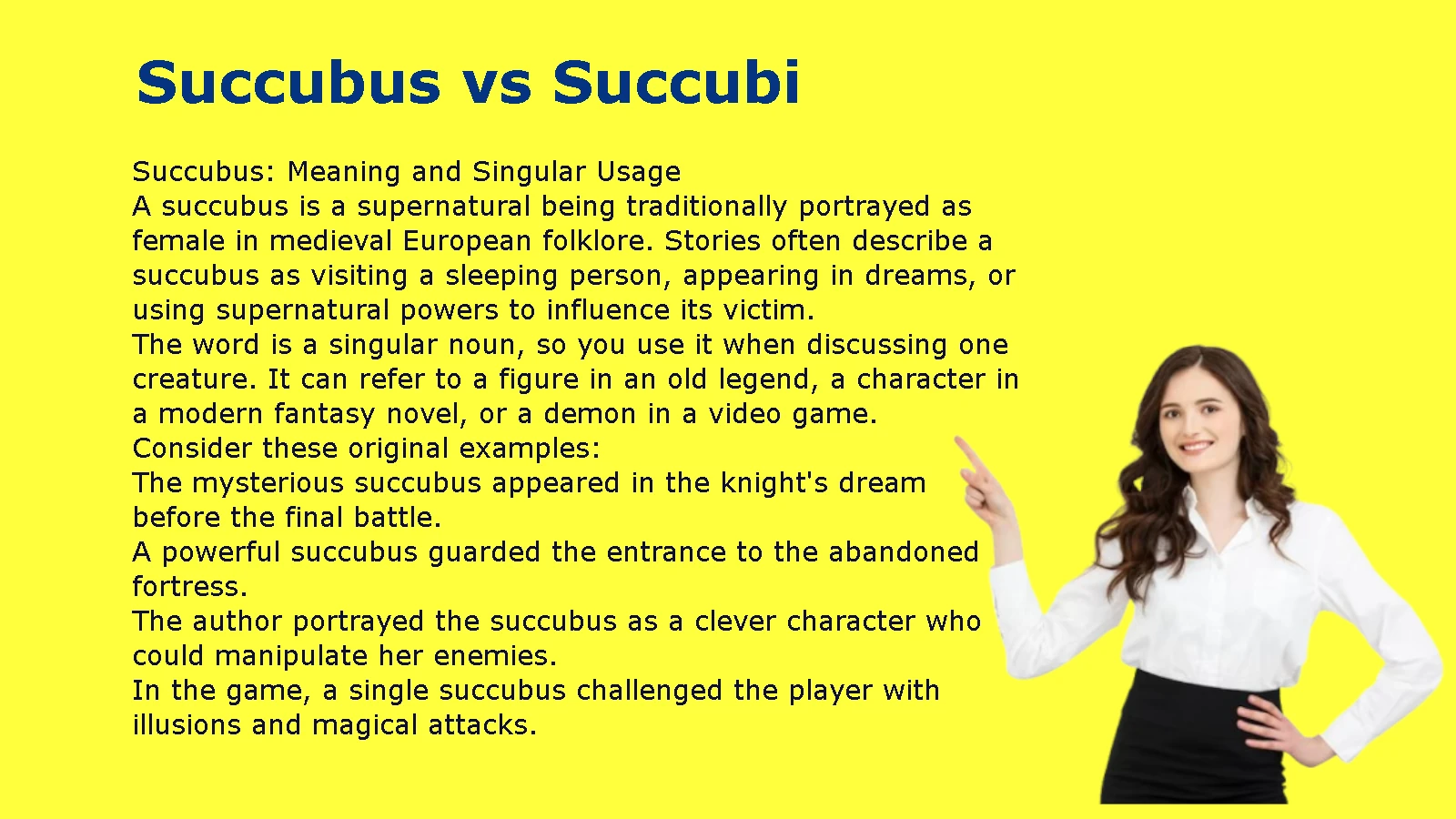
Succubus: Meaning and Singular Usage
A succubus is a supernatural being traditionally portrayed as female in medieval European folklore. Stories often describe a succubus as visiting a sleeping person, appearing in dreams, or using supernatural powers to influence its victim.
The word is a singular noun, so you use it when discussing one creature. It can refer to a figure in an old legend, a character in a modern fantasy novel, or a demon in a video game.
Consider these original examples:
- The mysterious succubus appeared in the knight’s dream before the final battle.
- A powerful succubus guarded the entrance to the abandoned fortress.
- The author portrayed the succubus as a clever character who could manipulate her enemies.
- In the game, a single succubus challenged the player with illusions and magical attacks.
Each sentence describes one individual. Therefore, succubus is the appropriate form.
How to use succubus correctly: Use the singular form after words such as a, an, one, or each when you are referring to a single creature.
For example, “A succubus appeared beside the ancient altar” is grammatically correct. By contrast, “A succubi appeared beside the ancient altar” is incorrect because succubi is plural.
Succubi: Meaning and Plural Usage
Succubi is the traditional plural form of succubus. It describes two or more supernatural beings of the same type. The word appears frequently in fantasy stories, role-playing games, mythology discussions, and descriptions of supernatural groups.
For example, a writer might describe a single succubus guarding a tower. If several creatures guard the same tower, the writer can describe them as succubi.
Here are more examples:
- The old manuscript described a group of succubi gathering beneath a ruined cathedral.
- Several succubi appeared as enemies during the final stage of the fantasy game.
- The novelist created three distinct succubi, each with different abilities and motives.
- According to the fictional legend, the succubi could enter dreams and create convincing illusions.
Notice that the word itself communicates plurality. You do not need to add an s to succubi to make it plural.
For instance:
- Correct: The succubi guarded the entrance.
- Incorrect: The succubis guarded the entrance.
The ending -i already marks the traditional plural form.
A useful writing tip: If your article discusses one creature and then introduces a group, make the transition clear. You might write, “The first succubus lived in the ruined castle. Later, the hero discovered that several succubi protected the surrounding forest.”
This approach helps readers understand both the grammar and the story.
Succubi vs. Succubuses: Which Plural Is Correct?
Both succubi and succubuses can be correct plural forms in English. However, they have slightly different stylistic associations. Succubi follows the traditional Latin-derived pattern and is especially common in fantasy and mythological contexts. Succubuses follows the regular English plural pattern.
English has borrowed words from many languages. Some borrowed nouns retain their original plural forms, while others adopt the usual English ending -s or -es. This is why more than one plural can exist for certain words.
Compare the two forms:
| Plural form | Status | Best use |
| Succubi | Traditional plural | Mythology, fantasy literature, gaming, formal descriptions |
| Succubuses | Accepted English plural | General English writing when a regular plural feels more natural |
Examples using succubi:
- The legends describe succubi as mysterious supernatural visitors.
- The game’s bestiary includes several succubi with different magical abilities.
Examples using succubuses:
- The author introduced two succubuses in the second chapter.
- The fictional museum displayed paintings of succubuses from different regions.
Neither example changes the basic meaning. The difference lies in the plural form and the style the writer prefers.
For an article focused on folklore, mythology, or fantasy gaming, succubi is usually the better default because readers are likely to recognize it immediately. For general writing, succubuses can also work.
The most important rule is consistency. If you choose succubi in one section, avoid switching to succubuses later unless you have a clear reason.
What Does Succubus Mean? Definition and Latin Origins
A succubus is a supernatural figure traditionally associated with medieval European beliefs about demons, dreams, and nighttime encounters. The word has Latin roots and a long history in supernatural folklore. Its linguistic background helps explain both its meaning and its unusual plural form, succubi.
The term has evolved over time. In historical accounts, succubi were associated with frightening or troubling experiences during sleep. In modern fiction, they may appear as demons, magical beings, antagonists, or more complex characters.
Understanding the word requires looking at both its linguistic roots and the cultural beliefs that shaped its use.
The Latin Roots Behind Succubus
The word succubus is connected to Late Latin succuba, a term associated with a female bedfellow, and to the Latin verb succumbere, meaning to lie beneath or yield. The verb combines elements associated with sub- (“under”) and cubare (“to lie down”).
These roots relate to the traditional image of a succubus as a supernatural being that visits a sleeping person.
The related word incubus comes from Latin incubare, meaning to lie upon or lie over. This linguistic relationship helps explain why the two terms are often discussed together.
The historical development of these words is more complex than a simple word-for-word translation. Still, the underlying idea of lying down connects the vocabulary to the folklore surrounding sleep and nighttime encounters.
The word’s history also explains why its plural does not follow the most familiar English pattern. Rather than simply adding -es, the traditional form reflects an older Latin grammatical structure.
Here is a quick breakdown:
| Word or element | Meaning or role |
| Succubus | Singular name for the supernatural figure |
| Succubi | Traditional plural of succubus |
| Succuba | Late Latin word associated with a female bedfellow |
| Succumbere | Latin verb meaning to lie beneath or yield |
| Sub- | Latin element meaning under |
| Cubare | Latin verb meaning to lie down |
| Incubus | Related supernatural term traditionally associated with a male figure |
The etymology offers useful context, but the modern meaning depends on how the word is used. In a mythology article, it may describe a figure from historical belief. In a fantasy novel, it may refer to a fictional species or individual character.
Why Does Succubus Become Succubi?
The plural succubi follows a traditional Latin pattern. Many Latin masculine nouns ending in -us form their nominative plural by changing that ending to -i. When English borrows such a noun, it may retain the original plural form.
The pattern can be seen in familiar examples:
| Singular | Traditional plural |
| Succubus | Succubi |
| Incubus | Incubi |
| Fungus | Fungi |
| Alumnus | Alumni |
These examples illustrate why succubi is a natural plural in traditional usage. The word follows a recognizable pattern rather than an arbitrary spelling change.
However, not every English word ending in -us changes to -i. English includes words from different languages, and their plural forms depend on their histories and established usage.
For example, bus becomes buses, not bui. The word virus usually becomes viruses in standard modern English rather than viri.
The lesson is simple: do not apply one plural rule to every word that ends in the same letters. Learn the accepted forms of individual words.
For succubus, remember these options:
- Succubus: One creature.
- Succubi: The traditional plural.
- Succubuses: An accepted regular English plural.
This distinction is useful for students, editors, creative writers, and anyone producing content about fantasy or mythology.
Succubus vs. Incubus: Key Differences
A succubus and an incubus are related supernatural figures in traditional European folklore. A succubus is generally portrayed as female, while an incubus is generally portrayed as male. Their traditional stories involve nighttime encounters and sleeping victims, although details vary across historical traditions and modern fictional works.
The two terms are related in meaning and folklore, but they are not interchangeable in traditional usage. They also have different plural forms.
Succubus and Incubus Compared
The following table summarizes the main differences.
| Feature | Succubus | Incubus |
| Traditional gender | Female | Male |
| Singular form | Succubus | Incubus |
| Traditional plural | Succubi | Incubi |
| Linguistic association | Latin succuba and succumbere | Latin incubare |
| Traditional folklore | Associated with visits to sleeping men | Associated with visits to sleeping women |
| Common modern role | Demon, magical being, or fantasy character | Demon, supernatural antagonist, or fantasy character |
In traditional accounts, the distinction often involves the gender of the supernatural figure and the person it visits. These descriptions reflect historical folklore, not scientific evidence of real supernatural beings.
Modern fantasy writers sometimes change these conventions. A game may give a succubus magical combat abilities, while a novel may portray an incubus as a conflicted character. These creative choices do not change the conventional meanings of the words.
Remember the two pairs:
- One succubus, multiple succubi.
- One incubus, multiple incubi.
The matching plural endings make the terms easier to remember.
Are Succubus and Incubus the Same Type of Demon?
Succubi and incubi belong to related traditions of supernatural folklore, but their names traditionally identify different figures. Historical stories often connect both with sleep, dreams, temptation, and unexplained nighttime experiences.
The distinction became part of the way these beings were described in European supernatural traditions. Some accounts treated them as separate types of demons, while other stories explored connections between them.
Modern fantasy has expanded these ideas in different directions. For example, a role-playing game might classify both as members of a broader demon category. A fantasy author might give them related magical abilities but different personalities or social roles.
Consider this fictional example:
The villagers feared the succubus that haunted the watchman’s dreams, but the old legend also warned of an incubus that visited travelers who slept near the forest.
The sentence uses the two terms according to their traditional distinction. It also shows how a writer can introduce both figures without confusing the reader.
When discussing folklore, it is useful to separate three things:
- Traditional meaning: How the terms were generally used in historical supernatural stories.
- Cultural interpretation: How communities understood the beings within their belief systems.
- Modern fiction: How authors and game designers adapt the figures for entertainment.
This separation makes mythology writing clearer and prevents fictional descriptions from being mistaken for historical facts.
Succubi in Modern Fantasy, Books, and Video Games
In modern entertainment, succubi often appear as recognizable fantasy creatures rather than only as frightening figures from medieval folklore. Video games, role-playing systems, novels, and fantasy television have adapted the concept for different audiences.
These portrayals may emphasize magic, temptation, combat, deception, supernatural beauty, or complex character motivations. As a result, readers may encounter the plural succubi more often in fictional settings than in everyday conversation.
The original grammatical distinction remains the same, even when the fictional interpretation changes.
How Games Use the Word Succubi
Fantasy games frequently classify supernatural beings into named groups or creature types. This structure makes the plural succubi useful when a player encounters multiple creatures of the same kind.
For example, games such as Dungeons & Dragons, World of Warcraft, and Diablo draw on fantasy and demon-related imagery, although each franchise has its own fictional setting, terminology, and rules.
In gaming discussions, you might see sentences such as:
- The party prepared for a difficult encounter with several succubi.
- The dungeon contained a succubus that used magic to mislead the heroes.
- Players compared the abilities of different succubi before choosing a strategy.
- The game introduced a new succubus character with a different role from earlier versions.
These examples show why the plural form matters in gaming guides, character descriptions, and walkthroughs.
A writer explaining a single enemy should use succubus. A writer discussing several enemies should normally use succubi or, where appropriate, succubuses.
The distinction also helps with search optimization. Someone searching for succubus meaning may want a definition, while someone searching for succubi in fantasy games may want information about multiple creatures or their roles in a particular game.
Content creators should answer the reader’s actual question instead of treating every search involving the word as a request for mythology alone.
How Modern Fiction Reimagines Succubi
Modern fiction does not always portray succubi as purely evil beings. Some stories retain the traditional image of a dangerous supernatural visitor, while others explore characters with personal goals, conflicting loyalties, or complicated relationships with humans.
A succubus in one novel might be a villain who deceives the protagonist. In another story, she might be a reluctant ally who struggles against the expectations of her supernatural world.
These different portrayals show how folklore can change when writers adapt it for new audiences.
For example, imagine a fantasy novel in which a young scholar discovers that the mysterious woman helping him translate an ancient manuscript is a succubus. Rather than attacking him, she wants to prevent a powerful demon from escaping. Later, the scholar discovers that she belongs to a group of succubi who protect forbidden knowledge.
In this fictional scenario, succubus describes the individual character, while succubi refers to the group.
The example also illustrates an important point: a fictional character’s personality does not determine whether the singular or plural form is correct. Grammar depends on the number of beings, not whether the character is good, evil, friendly, or dangerous.
When writing about modern fantasy, keep the language clear and distinguish the author’s interpretation from traditional folklore.
How to Use Succubus and Succubi Correctly
The easiest way to use succubus and succubi correctly is to identify how many beings you mean before writing the sentence. Use succubus for one and succubi for multiple beings when following the traditional plural pattern.
The same principle applies to descriptions, dialogue, gaming guides, and mythology articles.
Singular and Plural Examples
Use this table as a quick reference when editing your writing.
| Example sentence | Correct form | Reason |
| A powerful ___ appeared in the dream. | Succubus | The sentence refers to one being. |
| Two ___ guarded the palace entrance. | Succubi | The sentence refers to more than one. |
| The hero fought a dangerous ___. | Succubus | Only one creature is mentioned. |
| The story describes a group of ___. | Succubi | A group contains multiple beings. |
| Several ___ appeared in the final chapter. | Succubi | The noun must be plural. |
| The writer created three ___. | Succubi or succubuses | Both plural forms are accepted. |
Here are a few longer examples that demonstrate the words in context:
Example 1: A fantasy novel
The protagonist believed that a succubus had been following him through his dreams. Later, he learned that several succubi had been guarding the ancient gateway for centuries.
The first sentence uses succubus because it describes one being. The second uses succubi because it refers to several.
Example 2: A gaming guide
A succubus can be a challenging enemy when the player first enters the dungeon. Later levels may introduce stronger succubi with different abilities.
Again, the singular and plural forms reflect the number of creatures.
Example 3: A mythology article
The legend tells of one succubus who visited a sleeping traveler. Other versions of the story describe succubi appearing in different locations.
This example also shows how writers can discuss variations in folklore without changing the basic grammar.
Common Mistakes to Avoid
Even writers who understand the definition can make mistakes with the spelling or grammatical number. The following errors are easy to avoid.
Using succubi for one creature
Incorrect: A succubi appeared beside the window.
Correct: A succubus appeared beside the window.
Why? Succubi is plural, so it does not work with the singular article a.
Adding an unnecessary plural ending
Incorrect: The succubis guarded the tower.
Correct: The succubi guarded the tower.
Why? The traditional plural already ends in -i. It does not need another s.
Assuming succubuses is always wrong
Incorrect explanation: Succubuses is never a correct English plural.
Better explanation: Succubi is the traditional Latin-derived plural, while succubuses is also accepted in English.
Why? Borrowed words can have more than one established plural form.
Confusing succubus with incubus
Incorrect: The male succubus in the traditional legend visited the sleeping woman.
Better: The incubus in the traditional legend visited the sleeping woman.
Why? Traditional folklore generally uses incubus for the male figure and succubus for the female figure. Modern fictional works may reinterpret these conventions.
Applying the Latin rule to every word ending in -us
Incorrect: Every noun ending in -us must become -i in the plural.
Better: Some Latin-derived nouns retain the -us to -i pattern, but English pluralization varies by word.
Why? English borrows vocabulary from several languages and does not apply one universal rule to all borrowed nouns.
A Simple Editing Checklist
Before publishing an article or story that includes these words, check the following:
- Does succubus refer to one being?
- Does succubi refer to two or more beings?
- If you use succubuses, are you using that accepted plural consistently?
- Have you distinguished succubus from incubus where the traditional meanings matter?
- Does the surrounding sentence make the intended number clear?
- Are you distinguishing historical folklore from a modern fictional interpretation?
This short checklist can prevent common grammar mistakes without making the writing sound stiff or unnatural.
Frequently Asked Questions About Succubus vs Succubi
Is Succubi Singular or Plural?
Succubi is plural. It is the traditional plural form of succubus and refers to two or more supernatural beings. For example, “The succubi appeared in the castle” describes multiple creatures. Use succubus when referring to one.
Is Succubuses Grammatically Correct?
Yes, succubuses is an accepted English plural. However, succubi is the traditional Latin-derived form and is common in mythology, fantasy literature, and gaming. Both forms can be used, but choosing one and using it consistently improves readability.
Can a Succubus Be Male?
In traditional folklore, a succubus is generally portrayed as female, while an incubus is the male counterpart. Modern fantasy may change or expand these conventions. When describing traditional mythology, use the established distinction; when discussing a fictional setting, follow that setting’s own terminology.
What Is the Difference Between Succubi and Incubi?
A succubus is traditionally a female supernatural being associated with nighttime encounters, while an incubus is traditionally male. Their plural forms are succubi and incubi, respectively. Both figures appear in European supernatural folklore and have been adapted in modern fantasy.
What Is the Adjective Form of Succubus?
Succubus-like is a clear and natural adjective when describing something resembling a succubus. For example, “The story featured a succubus-like creature with supernatural powers.” The expression succubaan is uncommon and should not be presented as the standard adjective in ordinary English.
Why Is the Plural of Succubus Succubi?
The traditional plural succubi reflects a Latin grammatical pattern in which many masculine nouns ending in -us change to -i in the plural. English has retained this form for succubus. The regular English plural succubuses is also accepted.
Final Thoughts on Succubus vs Succubi
The difference between Succubus vs Succubi is straightforward once you understand the plural rule. Succubus refers to one supernatural being, while succubi is the traditional plural used for two or more. The alternative succubuses is also acceptable in English, although succubi is often preferred in mythology and fantasy writing.
The words have a rich linguistic and cultural background. Their Latin connections explain the unusual plural, while their association with medieval European folklore explains why they remain familiar in books, games, and supernatural stories. The related term incubus adds another useful distinction, especially when discussing traditional folklore.
Keep these three points in mind:
- One: Succubus.
- More than one: Succubi.
- Alternative English plural: Succubuses.
If you are writing a mythology article, fantasy story, or gaming guide, choose the form that fits your sentence and use it consistently. Apply the same care to related terms such as incubus and incubi to make your writing accurate, clear, and easy to follow.
Next step: Review your draft for singular and plural agreement, then use the examples and tables in this guide to check any sentence where succubus or succubi appears.