Tuckered out is a casual expression that means very tired, exhausted, or completely worn out, usually after physical activity, hard work, or a busy day. If you’ve come across the phrase “tuckered out” and wondered what it means, how it is used, or why someone might say they are tuckered out, the expression is closely connected to tiredness, exhaustion, fatigue, physical effort, rest, and being worn out.
The tuckered out meaning refers to being extremely tired or exhausted, often to the point where you need to stop and rest. It is an informal expression commonly used in everyday American English, especially when talking about people, children, pets, or someone who has been active for a long time. Related expressions such as worn out, exhausted, beat, drained, pooped, spent, and dog-tired have similar meanings but can differ in tone and usage.
In this guide, you’ll learn what “tuckered out” means, where the phrase comes from, how it is used in sentences, and how “tuckered out” differs from related expressions such as “tired,” “worn out,” and “exhausted.” You’ll also see clear examples to make the meaning easy to understand.
By the end, you’ll know exactly what tuckered out means and how to use this informal expression naturally and correctly.
Quick Answer: What Does “Tuckered Out” Mean?
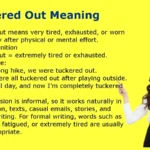
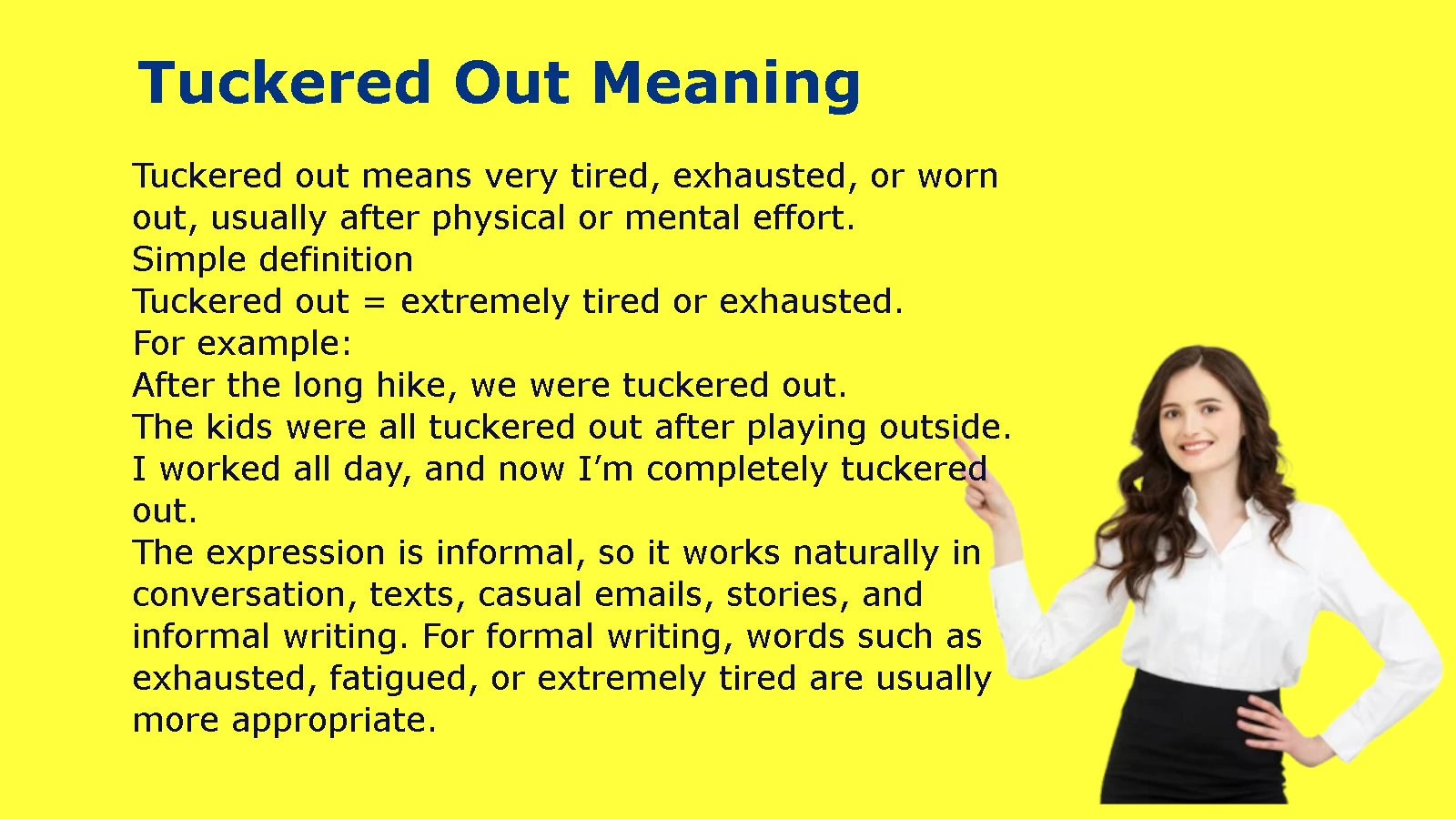
Tuckered out means very tired, exhausted, or worn out, usually after physical or mental effort.
Simple definition
Tuckered out = extremely tired or exhausted.
For example:
- After the long hike, we were tuckered out.
- The kids were all tuckered out after playing outside.
- I worked all day, and now I’m completely tuckered out.
The expression is informal, so it works naturally in conversation, texts, casual emails, stories, and informal writing. For formal writing, words such as exhausted, fatigued, or extremely tired are usually more appropriate.
Tuckered out at a glance
| Feature | Details |
| Meaning | Extremely tired or exhausted |
| Part of speech | Adjective / past participle used adjectivally |
| Register | Informal |
| Main variety | American English |
| Common use | Casual speech and writing |
| Typical context | Physical activity, work, travel, busy days |
| Similar words | Exhausted, worn out, spent, drained |
| Common variation | All tuckered out |
| Intensified variation | Plum/plumb tuckered out |
What Does “Tuckered Out” Mean?
The tuckered out meaning is straightforward: a person or animal is very tired because of exertion, activity, or prolonged effort.
The expression generally suggests more than ordinary tiredness. If someone says, “I’m tired,” they could simply need a short break. If they say, “I’m tuckered out,” the implication is that they are really worn out.
Cambridge gives the core meaning as “extremely tired,” while Collins defines it as extremely tired or exhausted.
What does tuckered out imply?
Depending on context, it can communicate:
- Physical exhaustion
- General fatigue
- Low energy after a busy day
- Weariness after travel
- Tiredness after exercise
- Exhaustion after work or chores
- A need for rest or sleep
For example:
“We walked around the city for eight hours, and by the time we got back to the hotel, we were tuckered out.”
The speaker isn’t merely saying that the walk made them slightly tired. The phrase emphasizes that the activity used up a substantial amount of their energy.
Tuckered out vs. simply tired
Consider these two sentences:
I was tired after work.
I was tuckered out after work.
The first statement is neutral. The second sounds more conversational and emphasizes a greater degree of tiredness.
That difference makes tuckered out particularly common in informal storytelling.
Is “Tuckered Out” an Idiom?
Yes. Tuckered out is an established informal idiomatic expression meaning very tired or exhausted.
Its meaning cannot be understood simply by interpreting tuckered and out as unrelated ordinary words. The expression has developed a specific meaning associated with being worn out.
Dictionary.com classifies tuckered out as an idiom and dates the colloquial expression to the 1820s.
It is also useful to understand that tucker can function as a verb.
Tucker as a verb
In the relevant sense:
to tucker someone out = to make someone very tired
For example:
- That workout really tuckered me out.
- The long journey tuckered everyone out.
- Running after the puppy tuckered him out.
The related form:
be tuckered out = be extremely tired
For example:
- I’m tuckered out.
- She was tuckered out.
- They were completely tuckered out.
This gives the expression a useful grammatical pattern:
tucker someone out → someone becomes tuckered out
Tuckered Out Meaning in Different Contexts
The phrase works in many everyday situations, but its basic meaning remains the same: very tired or exhausted.
Tuckered Out After Physical Activity
This is one of the most natural contexts for the expression.
You might describe someone as tuckered out after:
- Hiking
- Running
- Cycling
- Swimming
- Playing sports
- Gardening
- Moving furniture
- Cleaning
- Working outdoors
- Walking long distances
For example:
After climbing the mountain, everyone was tuckered out.
The phrase fits particularly well because the tiredness results directly from physical exertion.
Tuckered Out After a Busy Day
You don’t have to perform strenuous exercise to become tuckered out.
A demanding schedule can leave someone exhausted:
After eight hours at work, grocery shopping, and taking care of the kids, Maria was tuckered out.
Here, the expression describes overall exhaustion rather than one specific physical activity.
Tuckered Out in Casual Conversation
Tuckered out has a friendly, conversational quality.
Someone might say:
I’m pretty tuckered out tonight. I think I’ll just stay home.
That sounds relaxed and natural.
By contrast:
I am experiencing substantial fatigue this evening.
The second sentence is grammatically correct but far too formal for ordinary conversation.
Tuckered Out After Travel
Long journeys often provide another natural context:
After the twelve-hour flight and three-hour drive, we were completely tuckered out.
Travel can involve walking, waiting, changing transportation, carrying luggage, adjusting to time differences, and staying awake for long periods. The phrase captures that accumulated exhaustion without sounding overly serious.
What Does “Plum Tuckered Out” Mean?
Plum tuckered out means completely or extremely exhausted.
You may also see the spelling plumb tuckered out.
Here, plum/plumb acts as an intensifier. It does not refer to the fruit.
Dictionary sources recognize plum as an informal intensifier meaning completely, as in “plum tuckered out.”
Tuckered out vs. plum tuckered out
| Expression | Meaning | Tone |
| Tuckered out | Very tired | Informal |
| All tuckered out | Very tired | Informal, emphatic |
| Plum tuckered out | Completely exhausted | Informal, emphatic |
| Plumb tuckered out | Completely exhausted | Informal, emphatic |
For example:
After working in the heat all afternoon, he was plum tuckered out.
The word plum strengthens the expression.
Is “plum” or “plumb” correct?
Both forms occur in informal usage when this intensifying expression is meant.
Plumb has a separate literal meaning connected with vertical alignment and historically with a plumb line. In expressions such as plumb exhausted or plumb tuckered out, however, it functions as an intensifier.
Plum is also established as an intensifier in informal expressions.
The important point is that plum tuckered out does not mean “tired from eating plums.”
Tuckered Out Synonyms
There are many words and phrases that can replace tuckered out, but they differ slightly in tone and strength.
Common synonyms
- Exhausted
- Worn out
- Tired out
- Spent
- Drained
- Weary
- Fatigued
- Beat
- Dog-tired
- Dead tired
Comparison of tuckered out synonyms
| Expression | Approximate meaning | Tone | Common context |
| Tired | Low on energy | Neutral | General |
| Weary | Tired, often after prolonged effort | Neutral/literary | Writing and speech |
| Fatigued | Tired or lacking energy | Formal/neutral | Medical, professional, formal |
| Worn out | Very tired | Informal | Everyday conversation |
| Spent | Completely used up energetically | Neutral | Physical or mental effort |
| Drained | Energy depleted | Neutral | Physical or emotional |
| Exhausted | Extremely tired | Neutral | Broad use |
| Tuckered out | Very tired | Informal | Casual conversation |
| Dog-tired | Extremely tired | Informal | Casual speech |
| Dead tired | Extremely tired | Informal | Casual speech |
Tuckered out is especially close to worn out, tired out, and exhausted.
However, tuckered out often sounds lighter and more folksy than exhausted.
Tuckered Out vs. Tired vs. Exhausted
These expressions overlap, but they aren’t identical in tone.
Tired
Tired is the broadest and most neutral term.
I’m tired after work.
This doesn’t necessarily suggest severe exhaustion.
Tuckered out
Tuckered out usually suggests that someone is very tired.
I’m tuckered out after that workout.
It is more expressive and informal.
Exhausted
Exhausted generally communicates a very high degree of tiredness.
After running the marathon, she was exhausted.
It works in both everyday and formal contexts.
A useful scale
A rough conversational progression might look like this:
tired → very tired → tuckered out / worn out → exhausted
This isn’t a strict grammatical scale, because context determines intensity. Still, it helps explain why tuckered out usually feels stronger than simply tired.
Is “Tuckered Out” Formal or Informal?
Tuckered out is informal.
Cambridge explicitly labels it US informal, and Collins describes it as mainly US and informal.
That means it is perfectly acceptable in casual communication but isn’t normally the first choice for highly formal documents.
Good contexts for tuckered out
You can comfortably use it in:
- Conversations
- Text messages
- Social media posts
- Personal emails
- Casual blogs
- Informal stories
- Dialogue in fiction
- Friendly workplace conversations
Better alternatives for formal writing
For formal contexts, consider:
- Extremely tired
- Exhausted
- Fatigued
- Physically exhausted
- Severely fatigued
- Experiencing significant fatigue
For example:
Casual:
The hikers were tuckered out after the climb.
More formal:
The hikers were extremely fatigued after the climb.
Both communicate essentially the same idea, but the register is different.
How to Use “Tuckered Out” in a Sentence
Tuckered out normally appears after a form of be, especially when describing someone’s condition.
Common sentence patterns
Subject + be + tuckered out
I was tuckered out.
She is tuckered out.
They were tuckered out.
You can add an intensifier:
I was completely tuckered out.
The children were all tuckered out.
You can also identify the activity that caused the exhaustion:
We were tuckered out after the hike.
Tuckered out with “after”
The preposition after is particularly useful when explaining the cause or timing of the tiredness.
He was tuckered out after working in the yard.
They were tuckered out after playing soccer.
I was tuckered out after traveling all day.
Tuckered out with “from”
You can also use from:
She was tuckered out from all the walking.
The dog was tuckered out from chasing the ball.
Tuckered Out in a Sentence: Real Examples
Here are natural examples covering different contexts.
Physical activity
After hiking for six hours, we were completely tuckered out.
Exercise
The workout was harder than I expected, and I was tuckered out afterward.
Children
The kids were all tuckered out after spending the afternoon at the park.
Work
I was tuckered out after a long day at the construction site.
Travel
After the overnight flight, everyone was tuckered out.
Household chores
She cleaned the entire house and was tuckered out by dinner.
Animals
The puppy was tuckered out after chasing the ball around the yard.
Casual conversation
I’m pretty tuckered out tonight, so I’m going to bed early.
Longer sentence
By the time we finished moving the furniture, carrying boxes upstairs, and cleaning the apartment, we were all tuckered out.
Notice that the phrase remains informal in every example.
Where Does “Tuckered Out” Come From?
The history of tuckered out is more complicated than the modern meaning suggests.
Etymological sources trace tucker as a verb meaning “to tire, weary” to American usage in the early 19th century, particularly New England colloquial speech. Etymonline dates this verb sense to 1833 and says its precise origin is uncertain.
The important point is that the modern phrase did not simply arise because someone was literally tucking something.
Early American usage
Historical evidence shows the expression in print during the 1830s.
Phrases.org.uk identifies an early printed example from the Wisconsin Enquirer in April 1839, while other historical research points to examples from 1836.
One 1836 example describes someone as being “prodigiously tuckered out.” Another contemporary example uses tuckered out to describe a horse becoming exhausted.
That evidence matters because it shows that the phrase is not a recent piece of internet slang. It has been used in American English for nearly two centuries.
Where did “tucker” come from?
The precise origin of the fatigue-related verb tucker remains uncertain.
Etymonline suggests a possible connection to tucked, including an older slang use associated with exhausted or underfed dogs, but it explicitly treats the origin as uncertain.
Grammarphobia also discusses a possible historical connection between tuck and older descriptions of tired or poorly nourished animals, while distinguishing that history from the later American verb tucker, meaning to tire or weary.
So it is better to say:
The exact etymology of the fatigue-related “tucker” is uncertain, but the verb was established in American English by the 1830s.
That is more accurate than claiming a single definite origin.
Tuckered Out vs. Tucked Out
One of the most common spelling questions is whether the expression should be tuckered out or tucked out.
For the meaning “very tired,” the established expression is:
tuckered out
Not:
tucked out
Why the confusion happens
The words tuck, tucked, and tuckered look closely related.
English also contains familiar expressions such as:
- tucked in
- tucked away
- tucked under
- tucked into bed
That makes tucked out look plausible.
But tuckered out is the established expression for being exhausted. Cambridge and Collins both list it with the meaning extremely tired.
Compare the forms
| Form | Meaning |
| Tuckered out | Extremely tired |
| Tucked in | Placed securely inside or made comfortable in bed |
| Tucked away | Put or stored in a safe or hidden place |
| Tucked out | Not the standard expression for being exhausted |
So if you want to say that someone is very tired, write:
“I’m tuckered out.”
Common Mistakes With “Tuckered Out”
Writing “tucked out”
This is the biggest spelling mistake.
Incorrect for the intended meaning:
I was tucked out after the hike.
Correct:
I was tuckered out after the hike.
Treating it as a formal synonym
Although tuckered out is a legitimate English expression, it is informal.
A scientific report would generally say:
The participants reported significant fatigue.
rather than:
The participants were tuckered out.
Assuming it means only physically tired
Physical exhaustion is a very common use, but everyday speakers can use tuckered out more broadly for being generally worn out.
For example:
After dealing with emails and meetings all day, I was completely tuckered out.
The exhaustion here isn’t necessarily caused by physical activity.
Assuming it is modern slang
It isn’t a newly invented internet expression. Historical examples date back to the 1830s, and dictionary sources describe it as an established informal expression.
Tuckered Out vs. Similar Expressions
Tuckered Out vs. Worn Out
Both mean very tired.
I was tuckered out after the game.
I was worn out after the game.
The main difference is tone. Tuckered out has a distinctly informal, conversational feel.
Tuckered Out vs. Beat
Beat can mean very tired in informal American English.
I’m beat after work.
I’m tuckered out after work.
Both are casual. Beat is shorter and very common in everyday speech.
Tuckered Out vs. Dog-Tired
Dog-tired means extremely tired.
After the marathon, she was dog-tired.
It is also informal and expressive.
Tuckered Out vs. Exhausted
Exhausted is more neutral and works in formal writing.
The workers were exhausted after the shift.
Tuckered out sounds more casual:
The workers were tuckered out after the shift.
The underlying idea is similar, but the register differs.
Can “Tuckered Out” Describe Mental Exhaustion?
Yes, especially in casual conversation.
The phrase commonly refers to physical tiredness, but speakers can use it for general exhaustion, including tiredness caused by a demanding schedule.
For example:
I’ve been answering customer complaints all day, and I’m completely tuckered out.
The speaker doesn’t necessarily mean physical exhaustion. They mean that the day’s effort has left them very tired.
Still, if you need to make a precise distinction, terms such as mentally exhausted, mentally drained, or cognitively fatigued may communicate the intended meaning more clearly.
Is “Tuckered Out” Positive, Negative, or Neutral?
The expression itself is generally neutral. It describes a state of extreme tiredness.
However, its informal wording can give the sentence a lighthearted, friendly, or humorous tone.
Compare:
The children were exhausted.
with:
The children were all tuckered out.
The second sentence can sound warmer and more playful, particularly when talking about children or animals.
For example:
After their afternoon at the beach, the kids were all tuckered out and asleep before dinner.
The phrase describes tiredness, but the overall sentence can feel affectionate rather than negative.
Grammar of “Tuckered Out”
Tuckered out can function as an adjective describing a state.
After “be”
I am tuckered out.
She was tuckered out.
They are completely tuckered out.
With an intensifier
Common intensifiers include:
- All
- Completely
- Totally
- Pretty
- Really
- Absolutely
Examples:
We were all tuckered out.
He was completely tuckered out.
I’m pretty tuckered out after that trip.
The related verb “tucker out”
The verb form has a different construction:
The long hike tuckered me out.
Here, the hike causes the tiredness.
Compare:
The hike tuckered me out.
with:
I was tuckered out after the hike.
The first emphasizes the cause. The second emphasizes the resulting state.
Is “Tuckered Out” Used Only for People?
No.
It can describe animals as well.
For example:
The dog was tuckered out after chasing squirrels all afternoon.
The puppy was completely tuckered out after playing with the other dogs.
Dictionary examples also use the expression for animals, including dogs and mice.
This makes sense because the underlying idea is simply being exhausted after exertion.
Tuckered Out Pronunciation
The phrase is pronounced differently depending on the variety of English.
Cambridge gives the US pronunciation as approximately:
/ˌtʌk.ɚd ˈaʊt/
and the UK pronunciation as approximately:
/ˌtʌk.əd ˈaʊt/
The main stress falls on out in the phrase.
The first word comes from tucker, so be careful not to reduce it to tucked when speaking.
Real-World Usage: What the Phrase Sounds Like
A useful way to understand tuckered out is to hear how it functions in natural situations.
After a hike
“How was the trail?”
“Beautiful, but we’re absolutely tuckered out.”
The phrase fits because the speakers are having a casual conversation about physical exertion.
After work
“Want to go out tonight?”
“Not tonight. I’m tuckered out.”
Here, the phrase gives a simple reason for declining an activity.
Talking about children
“The kids had a great time at the park.”
“They look tuckered out.”
This sounds natural and conversational.
Talking about a pet
“Why is the dog sleeping already?”
“He’s tuckered out from running around all afternoon.”
Again, the phrase emphasizes exhaustion after activity.
A Short Case Study: Choosing the Right Expression
Imagine three hikers have just completed a difficult trail.
One says:
“I’m tired.”
This is accurate but general.
Another says:
“I’m tuckered out.”
This communicates stronger tiredness while maintaining a relaxed, conversational tone.
A third says:
“I’m exhausted.”
This is stronger and more neutral in register.
All three can be correct. The best choice depends on tone and intensity, not simply on grammar.
| Statement | Main effect |
| I’m tired. | Neutral statement of fatigue |
| I’m tuckered out. | Strong fatigue, casual tone |
| I’m exhausted. | Strong fatigue, neutral/formal-friendly tone |
| I’m plum tuckered out. | Very strong fatigue, strongly informal/emphatic |
This is why tuckered out is particularly useful in dialogue and informal writing.
Facts to Remember About “Tuckered Out”
Here are the key facts worth remembering:
- Tuckered out means extremely tired or exhausted.
- It is an informal expression.
- It is especially associated with US English.
- The phrase has been documented in American English since the 1830s.
- The exact origin of the fatigue-related verb tucker is uncertain.
- All tuckered out is a common emphatic form.
- Plum tuckered out and plumb tuckered out intensify the expression.
- Tuckered out is different from tucked out.
- Exhausted, worn out, spent, and drained are useful synonyms.
- The expression can describe people or animals.
- It works particularly well in casual speech, dialogue, texting, and informal writing.
- For formal writing, exhausted or fatigued is generally more suitable.
FAQs About Tuckered Out Meaning
What does tuckered out mean in English?
Tuckered out means extremely tired, exhausted, or worn out. It is an informal expression, especially associated with American English.
What does tuckered out mean in texting?
In texting, tuckered out simply means very tired.
For example:
“I’m tuckered out. Going to bed early tonight.”
It is casual and perfectly understandable in an informal message.
Is tuckered out a slang term?
It is best described as an informal idiomatic expression rather than modern internet slang. Historical examples date to the 1830s, and major dictionaries classify it as informal.
Is tuckered out an idiom?
Yes. Tuckered out is an established idiomatic expression meaning extremely tired or exhausted.
What is another word for tuckered out?
Common alternatives include exhausted, worn out, tired out, spent, drained, weary, fatigued, beat, and dog-tired.
The best synonym depends on the desired tone.
What does plum tuckered out mean?
Plum tuckered out means completely or extremely exhausted. Here, plum functions as an informal intensifier rather than referring to the fruit.
Is tuckered out American slang?
It is strongly associated with informal American English. Cambridge labels it “US informal,” while Collins describes it as mainly US and informal.
What is the difference between tuckered out and exhausted?
Both mean very tired, but tuckered out is more informal and conversational. Exhausted is more neutral and is suitable for both everyday and formal contexts.
Is tucked out the same as tuckered out?
No. Tuckered out is the established expression meaning very tired or exhausted. Tucked out is not the standard expression for that meaning.
How do you use tuckered out in a sentence?
You can say:
“After the long hike, we were completely tuckered out.”
Another common pattern is:
“The workout tuckered me out.”
The first describes the resulting state, while the second uses tucker out as a verb meaning to make someone very tired.
How do you pronounce tuckered out?
Cambridge gives the US pronunciation as /ˌtʌk.ɚd ˈaʊt/.
Conclusion: What Does “Tuckered Out” Mean?
The tuckered out meaning is simple: extremely tired, exhausted, or worn out.
It is an established informal expression, particularly associated with American English. You can use it after exercise, work, travel, chores, sports, or any demanding activity that leaves someone with little energy.
The phrase has a long history in American English, with documented printed examples from the 1830s. Its precise etymological origin is uncertain, so claims about a single definitive source should be treated cautiously.
Remember the key distinction:
Tuckered out = very tired.
And if you want to make the expression more emphatic, you may encounter:
all tuckered out
plum tuckered out
plumb tuckered out
Most importantly, don’t confuse tuckered out with tucked out. When you mean exhausted, tuckered out is the established form.