Have you ever seen the word vaporing and wondered what it means? If you’re searching for vaporing meaning, what does vaporing mean, or vaporing definition, the word can be confusing because it has more than one possible use depending on the context.
Vaporing generally refers to producing or giving off vapor, especially when a liquid changes into a gaseous form. In older or figurative usage, vaporing can also describe boasting, bragging, or making grand claims without much substance.
Examples:
- The vaporing liquid began to disappear as the temperature increased.
- His constant vaporing about his achievements annoyed everyone in the room.
The confusion is understandable. People often search for vaporing meaning in English, what is the meaning of vaporing, vaporing synonyms, vaporing antonyms, or how to use vaporing in a sentence because the word can have a literal connection to vapor as well as an older figurative sense related to boastful talk. The exact meaning becomes much clearer when you look at the sentence and context in which vaporing appears.
In this guide, you’ll learn the complete vaporing meaning, including its definition, pronunciation, origin, synonyms, antonyms, and usage. You’ll also see clear examples of vaporing in a sentence and learn how to understand and use the word correctly in different contexts.
What Does Vaporing Mean?
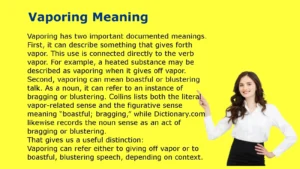
Vaporing has two important documented meanings.
First, it can describe something that gives forth vapor. This use is connected directly to the verb vapor. For example, a heated substance may be described as vaporing when it gives off vapor.
Second, vaporing can mean boastful or blustering talk. As a noun, it can refer to an instance of bragging or blustering. Collins lists both the literal vapor-related sense and the figurative sense meaning “boastful; bragging,” while Dictionary.com likewise records the noun sense as an act of bragging or blustering.
That gives us a useful distinction:
Vaporing can refer either to giving off vapor or to boastful, blustering speech, depending on context.
The figurative sense is particularly important if you encounter the word in older literature, historical writing, or formal prose. Modern speakers are much more likely to say bragging, boasting, or blustering.
Vaporing Meaning in Simple Words
In simple English, vaporing can mean one of two things:
- Giving off vapor: Something is producing or emitting vapor.
- Boastful talking: Someone is bragging, boasting, or making grand claims.
Consider these two sentences:
Literal:
The heated liquid was vaporing rapidly.
Here, vaporing relates to vapor.
Figurative:
His speech was nothing but vaporing.
Here, vaporing means boastful or empty talk.
The surrounding words make the intended meaning clear. If the sentence discusses heat, liquid, fumes, or vapor, the literal meaning is likely. If it discusses a person’s claims, speech, promises, or self-praise, the figurative meaning is more likely.
Vaporing as a Form of Boastful Talk
One of the most distinctive meanings of vaporing is boastful, bombastic, or blustering speech.
Someone who is vaporing in this sense is not simply talking. The person is making grand claims, boasting about achievements, or speaking in a way that seems designed to impress others.
For example:
His constant vaporing about his achievements became tiresome.
This does not mean the person was producing physical vapor. It means he was boasting repeatedly.
Another example is:
The politician’s speech was dismissed as empty vaporing.
Here, vaporing suggests grandiose or boastful talk without enough substance behind it.
Dictionary.com provides historical examples in which vaporing describes speech about someone’s supposed importance or achievements. Collins also defines the adjective as “boastful; bragging” and the noun as an instance of “bragging or blustering.”
What Does Vaporing Mean When Describing a Person?
When vaporing is connected to a person, speech, claims, or behavior, it usually carries the idea of boasting or blustering.
For instance:
He spent the evening vaporing about his business success.
The sentence presents the person’s talk as self-important boasting.
The word can also suggest that the speaker’s claims are exaggerated or lacking substance. That is why vaporing can have a more dismissive tone than the neutral verb speaking.
Some close modern alternatives include:
- boasting
- bragging
- blustering
- grandstanding
- vaunting
- making grand claims
- talking oneself up
However, these words are not perfect synonyms in every situation. Vaporing has a distinctly old-fashioned or literary flavor in its figurative sense.
Vaporing as Giving Off Vapor
The other major meaning of vaporing is literal.
In this use, vaporing means giving off vapor or being in the process of emitting vapor. This meaning comes directly from the verb vapor.
Dictionary.com lists vaporing as the present participle of vapor, while Collins gives “that gives forth vapor” as one of its adjective definitions.
For example:
The vaporing liquid released a visible mist.
Here, vaporing describes what the liquid is doing.
Another example:
The chamber contained a vaporing substance.
The surrounding context indicates that vaporing concerns the emission of vapor rather than bragging.
Vaporing and Physical Vapor
The literal use is closely connected to the noun vapor.
A vapor is a gaseous form of a substance that is normally solid or liquid under ordinary conditions. The verb vapor can describe the process of becoming or emitting vapor. Dictionary.com lists the verb’s present participle as vaporing and gives meanings related to rising or passing off as vapor and emitting vapor or exhalations.
This gives the basic grammatical relationship:
vapor → vapored → vaporing
For example:
- The liquid vapors quickly.
- The liquid vapored under the heat.
- The liquid is vaporing under the heat.
The exact wording you choose depends on tense and context.
Vaporing as the Present Participle of “Vapor”
From a grammar perspective, vaporing is the present participle of the verb vapor.
Collins’ verb conjugation table explicitly lists vaporing as the present participle of vapor.
The basic forms are:
| Verb Form | Example |
| Vapor | The substance may vapor. |
| Vapors | The substance vapors quickly. |
| Vapored | The substance vapored under heat. |
| Vaporing | The substance is vaporing. |
The -ing form can also function as a gerund or participial adjective, depending on the sentence.
For example:
The machine is vaporing.
Here, vaporing forms part of the progressive verb construction.
In:
The vaporing liquid filled the chamber with fumes.
Vaporing functions adjectivally to describe the liquid.
This grammatical point matters because not every occurrence of vaporing represents the separate noun meaning “boastful talk.”
Vaporing vs. Vapouring
One of the most useful spelling distinctions is vaporing vs. vapouring.
The difference follows the broader American-English and British-English spellings:
- vapor → American English
- vapour → British English
- vaporing → American form
- vapouring → British form
Wiktionary identifies vaporing as the present participle and gerund of American-English vapor and also records it as an alternative form of vapouring. WordWeb similarly lists vapouring as British/Canadian and vaporing as the US form.
| American English | British English |
| vapor | vapour |
| vaporing | vapouring |
| vapored | vapoured |
This follows the familiar pattern seen in words such as:
- color / colour
- favor / favour
- honor / honour
- vapor / vapour
The spelling difference does not automatically create a difference in meaning.
Vaporing Pronunciation
Vaporing is pronounced approximately:
VAY-per-ing
Its phonetic transcription is /ˈveɪpərɪŋ/. Collins and Dictionary.com both provide this pronunciation.
Break it into three parts:
vay + per + ing
The primary stress falls on the first syllable:
VAY-per-ing
It is important not to assume that the pronunciation changes because the word has an unusual figurative meaning. The literal and figurative uses have the same basic pronunciation.
Vaporing Examples in Sentences
Understanding the word becomes easier when you see its different uses in context.
Examples of “Vaporing” Meaning Boastful Talk
Here are several original examples:
His speech was full of vaporing about his supposed achievements.
The manager dismissed the proposal as nothing more than vaporing.
After winning one small competition, he began vaporing about becoming the world’s greatest athlete.
Her constant vaporing made it difficult to tell which of her claims were serious.
The letter contained more vaporing than useful information.
In each example, vaporing relates to boasting, grand claims, or blustering speech.
Examples of “Vaporing” Meaning Giving Off Vapor
The literal meaning works differently:
The heated liquid was vaporing inside the container.
The machine was vaporing near the outlet.
The substance began vaporing as the temperature increased.
A vaporing solution produced visible fumes.
These sentences use the word in connection with vapor or emission, not bragging.
How Context Determines the Meaning
Compare:
He was vaporing about his achievements.
with:
The liquid was vaporing in the container.
The first sentence clearly concerns boasting.
The second concerns vapor emission.
That distinction is one of the most important things to remember when interpreting the word.
Vaporing Synonyms
The best synonym depends on which meaning you intend.
Synonyms for Vaporing Meaning Boastful Talk
Common alternatives include:
- boasting
- bragging
- blustering
- vaunting
- grandstanding
- bombast
- self-praise
These words have slightly different shades of meaning.
| Word | Meaning | Tone |
| Bragging | Talking proudly about one’s achievements | Common, informal |
| Boasting | Expressing excessive pride in oneself | Common, neutral |
| Blustering | Speaking aggressively or confidently without much substance | Stronger |
| Vaunting | Praising one’s own achievements | Formal/literary |
| Grandstanding | Acting or speaking to attract attention or admiration | Modern |
| Bombast | Inflated, grandiose language | Formal |
| Vaporing | Boastful or blustering talk | Old-fashioned/literary |
If you are writing for a modern general audience, boasting or bragging will usually be easier to understand than vaporing.
Synonyms for Vaporing Meaning Giving Off Vapor
Depending on the scientific or descriptive context, possible alternatives include:
- vaporizing
- evaporating
- steaming
- emitting vapor
- giving off vapor
- releasing fumes
These words should not be treated as exact replacements in every technical context.
For example, evaporating describes a particular physical process, while emitting vapor focuses on the release of vapor. Vaporing can be broader and is less common in modern technical prose.
Vaporing vs. Bragging vs. Boasting
The figurative meaning of vaporing overlaps strongly with bragging and boasting, but the words differ in style.
Bragging is the most natural everyday word:
He kept bragging about his new car.
Boasting is also common and can work in both everyday and formal writing:
She was boasting about her accomplishments.
Vaporing sounds much more literary:
He was vaporing about his accomplishments.
The third sentence is grammatically possible, but many modern readers would find it unusual. That’s because the figurative use has an older literary flavor.
The historical character of the word is reflected in dictionary examples. Dictionary.com includes examples from literary works in which vaporing describes boastful or inflated speech.
Vaporing vs. Vaping: Are They the Same?
No. Vaporing and vaping should not automatically be treated as the same word.
This is probably the most important spelling confusion for modern readers.
What Does Vaping Mean?
Vaping is the modern term commonly used for using an electronic cigarette or similar device to inhale an aerosol produced by heating a liquid.
In medical and public-health literature, electronic smoking devices are commonly described as devices that heat a liquid to create an aerosol or vapor that the user inhales. Memorial Sloan Kettering notes that electronic smoking is also referred to as vaping, vaporing, juuling, or e-smoking in its patient education material.
So there is some modern usage in which vaporing can refer to electronic smoking.
However, that does not erase the established dictionary meanings of vaporing.
Why the Confusion Happens
The confusion comes from the similarity between:
vapor → vaporing
and:
vape → vaping
They look similar, but they are formed from different verbs.
| Word | Base Verb | Common Meaning |
| vaporing | vapor | Giving off vapor; also boastful talk |
| vaping | vape | Using a vape/e-cigarette device |
This distinction is especially useful when you’re reading older texts. A nineteenth- or early twentieth-century reference to vaporing may have nothing to do with electronic cigarettes, which are a much more recent technology.
Is “Vaporing” a Real Word?
Yes. Vaporing is a real English word.
It is not merely a typo for vaping. Established dictionaries record it as an English word with multiple grammatical and semantic uses.
Collins lists vaporing as an adjective meaning that something gives forth vapor, as well as an adjective meaning boastful or bragging. It also lists the noun sense for an act of bragging or blustering.
Dictionary.com likewise identifies it as the present participle of vapor and records both adjective meanings and the noun meaning.
The word’s recorded history also goes back several centuries. Collins and Dictionary.com date its first recorded use to 1620–30.
So calling vaporing a misspelling would be incorrect.
The better question is which meaning the writer intended.
Is Vaporing an Old-Fashioned Word?
The answer depends on the meaning.
The literal grammatical use of vaporing follows naturally from the verb vapor. However, the boastful-talk sense has a distinctly old-fashioned or literary feel in modern English.
Most people today would say:
- bragging
- boasting
- blustering
- grandstanding
- talking big
rather than:
- vaporing
That does not make the word incorrect. It simply means that modern frequency and dictionary validity are different things.
A word can be established and perfectly legitimate while still sounding unusual in everyday conversation.
This is particularly useful when reading older literature. If you encounter:
He spent the evening vaporing about his accomplishments.
you should not assume that the writer means the person was producing vapor. The context of speech and self-praise points to the figurative sense.
How “Vaporing” Is Used in Context
Context is the key to interpreting this unusual word.
Vaporing in Literature
The figurative meaning appears in literary and historical writing.
Dictionary.com provides examples from works in which vaporing describes people talking about their supposed importance, achievements, or future actions.
This makes the word particularly useful when reading older prose.
A modern writer might replace:
His vaporing annoyed the audience.
with:
His boasting annoyed the audience.
Both communicate the basic idea, but the second sounds more natural to most contemporary readers.
Vaporing in Descriptive Writing
The literal sense can describe something producing vapor:
The vaporing liquid created a mist around the apparatus.
Here, the word is connected to a physical process.
In technical writing, however, a more precise term such as evaporating, vaporizing, or emitting vapor may be preferable when the exact physical process matters.
Vaporing in Modern Writing
Modern writers should consider their audience.
If the purpose is clarity, boasting will usually be clearer than vaporing.
If the purpose is literary effect, historical flavor, or close interpretation of an older text, vaporing may be exactly the right word.
The word therefore has value, but it is not a universal substitute for bragging.
Common Mistakes With “Vaporing”
Confusing Vaporing With Vaping
This is the most obvious modern confusion.
Vaporing comes from vapor, while vaping comes from vape.
They may overlap in some modern contexts involving electronic smoking, but they are not simply interchangeable spellings.
Assuming Vaporing Always Means Bragging
The figurative meaning is real, but it is not the only meaning.
Vaporing can also be related directly to vapor emission. Collins and Dictionary.com both document this literal sense.
Assuming Vaporing Always Means Producing Vapor
The opposite mistake is also possible.
If someone says:
His speech was full of vaporing.
the subject is not producing physical vapor. The sentence describes boastful or blustering talk.
Treating Vaporing as Modern Slang
The word should not automatically be labeled modern slang.
Its documented history extends back to the 1620s or 1630s, and dictionaries record its literary and grammatical uses.
Its figurative sense is better understood as old-fashioned or literary in contemporary general usage.
Assuming Unusual Means Incorrect
A word can sound unfamiliar without being wrong.
This is especially important with dictionary words that survive more often in literature than in everyday conversation. Vaporing is a good example: its documented meanings are legitimate, but the figurative sense is not something most people use frequently today.
Vaporing Word Forms and Related Words
Because vaporing comes from vapor, it belongs to a wider word family.
| Word | Part of Speech | Meaning |
| vapor | Noun | A gaseous form of a substance |
| vapor | Verb | To emit or become vapor; also to speak boastfully |
| vapors | Verb | Third-person singular present |
| vapored | Verb | Past tense/past participle |
| vaporing | Verb/adjective/noun | Present participle and related uses |
| vaporingly | Adverb | In a vaporing manner |
| vapour | Noun/verb | British spelling/form |
Collins records vaporingly as a derived adverb, while its conjugation table identifies vaporing as the present participle of vapor.
This word family helps explain why vaporing should not automatically be interpreted as a variation of vaping.
Vaporing Etymology and Word Origin
The word vaporing is formed from vapor + -ing.
The -ing ending creates the present participle of the verb and can also produce nouns and participial adjectives.
Collins and Dictionary.com date the first recorded use of vaporing to approximately 1620–30.
The structure is straightforward:
vapor + ing = vaporing
The suffix does not create an entirely unrelated word. It creates the form associated with the action or state described by the verb.
The figurative meaning is especially interesting because vapor itself has a long history of figurative use. Dictionary.com records vapor as a verb that can also mean to talk or act grandiloquently, pompously, or boastfully; bluster.
That helps explain the connection between the literal idea of vapor and the figurative idea of empty or inflated speech.
A Practical Way to Understand “Vaporing”
When you encounter vaporing, use the words around it to determine its meaning.
Ask three questions:
Is the sentence about a physical substance?
If yes, vaporing probably relates to giving off vapor.
Is the sentence about someone’s speech or claims?
If yes, it probably means boasting or blustering.
Is the text modern and about electronic cigarettes?
If yes, check the surrounding context carefully because some modern sources use vaporing in connection with electronic smoking, although vaping is the much more familiar modern term.
Context Clues
| Context | Likely Meaning |
| Liquid, heat, fumes | Giving off vapor |
| Machine, chamber, substance | Producing/emitting vapor |
| Speech, claims, achievements | Boasting or blustering |
| Historical literature | Often boastful or blustering talk |
| Electronic cigarettes | May refer to vaping in some modern usage |
This approach is more reliable than assuming every occurrence has the same definition.
Vaporing Meaning: Key Facts to Remember
Here are the most important facts in one place:
- Vaporing is a real English word.
- It is the present participle of vapor.
- It can mean giving off vapor.
- It can mean boastful or bragging when used figuratively.
- As a noun, it can mean an instance of bragging or blustering.
- Its documented history goes back to approximately 1620–30.
- Vapouring is the British form associated with American vaporing.
- Vaporing is not simply another spelling of vaping.
- The boastful sense is uncommon and literary-sounding in contemporary everyday English.
- Modern alternatives such as bragging, boasting, and blustering are generally easier for today’s readers to understand.
FAQs About Vaporing Meaning
What does vaporing mean in simple English?
Vaporing can mean giving off vapor, or it can mean boasting, bragging, or speaking in a blustering way. The correct meaning depends on the context.
What does vaporing mean when describing a person?
When vaporing describes a person’s speech or behavior, it usually means boasting, bragging, or making grandiose claims. This figurative sense is relatively old-fashioned today.
Is vaporing the same as vaping?
No. Vaporing comes from vapor, while vaping comes from vape. In some modern health-related sources, vaporing can be used as another term for electronic smoking, but the established dictionary word vaporing also has older meanings unrelated to electronic cigarettes.
Is vaporing a real English word?
Yes. Collins and Dictionary.com both list vaporing as an established English word. It is recorded as an adjective, noun, and present participle of vapor.
Is vaporing an old-fashioned word?
The boastful-talk sense is old-fashioned or literary in modern usage. Contemporary speakers are much more likely to say boasting, bragging, or blustering.
What is the difference between vaporing and vapouring?
Vaporing is the American spelling, while vapouring is the British form associated with vapour. The underlying meaning is generally the same.
What are the synonyms of vaporing?
When it means boastful talk, synonyms include boasting, bragging, blustering, vaunting, bombast, and grandstanding. When it refers to producing vapor, possible alternatives include vaporizing, evaporating, steaming, and emitting vapor, depending on the context.
What is the noun form of vaporing?
Vaporing itself can function as a noun. In this use, it means an act or instance of bragging or blustering. Collins and Dictionary.com both record this noun sense.
How do you pronounce vaporing?
Vaporing is pronounced approximately VAY-per-ing, with the main stress on the first syllable. Its dictionary pronunciation is /ˈveɪpərɪŋ/.
Conclusion: What Does Vaporing Mean?
Vaporing is a genuine English word with more than one documented meaning.
In its literal sense, it relates to giving off or emitting vapor and functions naturally as the present participle of the verb vapor. In its figurative sense, it describes boastful, bragging, or blustering talk. As a noun, vaporing can refer specifically to an instance of such boastful speech.
The easiest way to understand the word is to examine its context. A sentence about a liquid, substance, heat, or fumes probably uses vaporing in its literal sense. A sentence about someone’s speech, achievements, promises, or claims is more likely using the word to mean boasting or blustering.
Don’t confuse vaporing with vaping, either. Although some modern sources use vaporing in connection with electronic smoking, the two words have different origins, and vaporing has a much older dictionary history.
Finally, remember the spelling distinction: vaporing is the American form, while vapouring is the British form associated with vapour.
In short, vaporing can mean giving off vapor or engaging in boastful, blustering talk. Context tells you which meaning the writer intends.