Have you ever come across the word pooped and wondered what it means? Pooped is a common informal word that can describe being very tired or exhausted, but its meaning can also depend on the context in which it appears.
Pooped usually means extremely tired, worn out, or lacking energy. It is the past tense and past participle of the informal verb poop, which can mean to make someone very tired or to become exhausted. For example, if someone says, “I’m pooped after that long hike,” they mean they are completely worn out.
Examples:
- I was pooped after working all day.
- We were completely pooped after the long trip.
The confusion is understandable. People often search for pooped meaning, what does pooped mean, pooped definition, or pooped meaning in English because the word can sound humorous or confusing, especially when you know that poop also has another informal meaning related to feces. In everyday conversation, however, pooped often means very tired when the context involves energy, work, exercise, or physical activity.
In this guide, you’ll learn the complete pooped meaning, including its definition, pronunciation, origin, part of speech, and usage. You’ll also see clear examples that show how pooped is used in everyday English and how to understand its meaning from context.
Pooped Meaning
Pooped usually means very tired, exhausted, or worn out in informal American English. Cambridge Dictionary lists pooped as an informal adjective meaning “very tired,” especially after a lot of work or physical activity.
For example:
I’m pooped after walking around the city all day.
Here, pooped has nothing to do with using the bathroom. It simply means extremely tired.
The word often suggests more than ordinary tiredness. If you say I’m tired, you may still have enough energy to keep going. If you say I’m pooped, you’re emphasizing that you feel worn out and ready to rest.
Simple definition of pooped
Pooped: very tired, exhausted, or lacking energy; informal.
A few natural examples include:
- I’m pooped after work.
- We were pooped after the hike.
- She looked pooped after the long flight.
- The kids were completely pooped after playing outside.
- I’m too pooped to cook tonight.
In this sense, pooped is especially common in relaxed conversation.
What Does Pooped Mean in Slang?
In informal American English, pooped means very tired or exhausted.
Cambridge specifically labels this use as informal, while Merriam-Webster also recognizes poop as an informal verb meaning to become exhausted.
That makes pooped a casual expression rather than a formal synonym for fatigued.
Compare these sentences:
| Casual expression | More neutral expression |
| I’m pooped. | I’m very tired. |
| She’s completely pooped. | She’s completely exhausted. |
| We were pooped after the hike. | We were exhausted after the hike. |
| He looks pooped. | He looks worn out. |
The meaning stays similar, but the tone changes.
If you’re chatting with a friend, I’m pooped sounds perfectly natural. In a formal report, however, I’m exhausted or I’m fatigued would usually fit better.
What Does “I’m Pooped” Mean?
“I’m pooped” means “I’m very tired” or “I’m exhausted.”
It’s one of the most common ways to use the word.
For example:
I’m pooped. I think I’m going straight to bed.
The speaker isn’t talking about a bowel movement. The sentence describes a state of extreme tiredness.
You can use I’m pooped after many kinds of activities:
- A long day at work
- A difficult workout
- A long hike
- A busy shopping trip
- Traveling
- Cleaning the house
- Taking care of children
- Studying for hours
- Attending a long event
The expression works because pooped communicates the idea of having very little energy left.
Examples of “I’m pooped”
- I’m pooped after that three-hour meeting.
- I’m pooped from moving all those boxes.
- I’m pooped, so I’m going to relax for a while.
- I’m completely pooped after traveling all day.
- I’m too pooped to go out tonight.
The expression is casual, friendly, and easy to understand in American English.
Pooped Also Means Had a Bowel Movement
There is another completely legitimate pooped meaning.
Pooped can also be the past tense and past participle of the informal verb poop, meaning to pass solid waste from the body.
Cambridge Dictionary defines poop as an informal US verb meaning to pass solid waste. Merriam-Webster likewise defines poop as an informal verb meaning to defecate.
For example:
The dog pooped in the backyard.
Here, pooped means the dog had a bowel movement.
Another example:
The baby pooped during the diaper change.
Again, the word refers to a bodily function rather than tiredness.
This sense is also informal. People commonly use it in everyday conversation, particularly when talking about babies, children, pets, or animals.
How Context Changes the Pooped Meaning
The surrounding words usually tell you which meaning of pooped the speaker intends.
Consider these two sentences:
I was pooped after the marathon.
The dog pooped after the marathon.
The first sentence means I was exhausted.
The second means the dog had a bowel movement.
The spelling is identical. The grammatical role and context make the difference.
| Sentence | Meaning of pooped |
| I’m pooped after work. | Very tired |
| She was pooped after the hike. | Very tired |
| The puppy pooped outside. | Had a bowel movement |
| The baby pooped in the diaper. | Had a bowel movement |
| We were pooped after traveling. | Very tired |
| The dog pooped in the yard. | Had a bowel movement |
A useful shortcut is to look at the whole sentence instead of the word alone.
When pooped describes someone’s condition after an activity, it usually means exhausted.
When pooped describes an action involving a person, child, pet, or animal, it may mean had a bowel movement.
Pooped Meaning in a Sentence
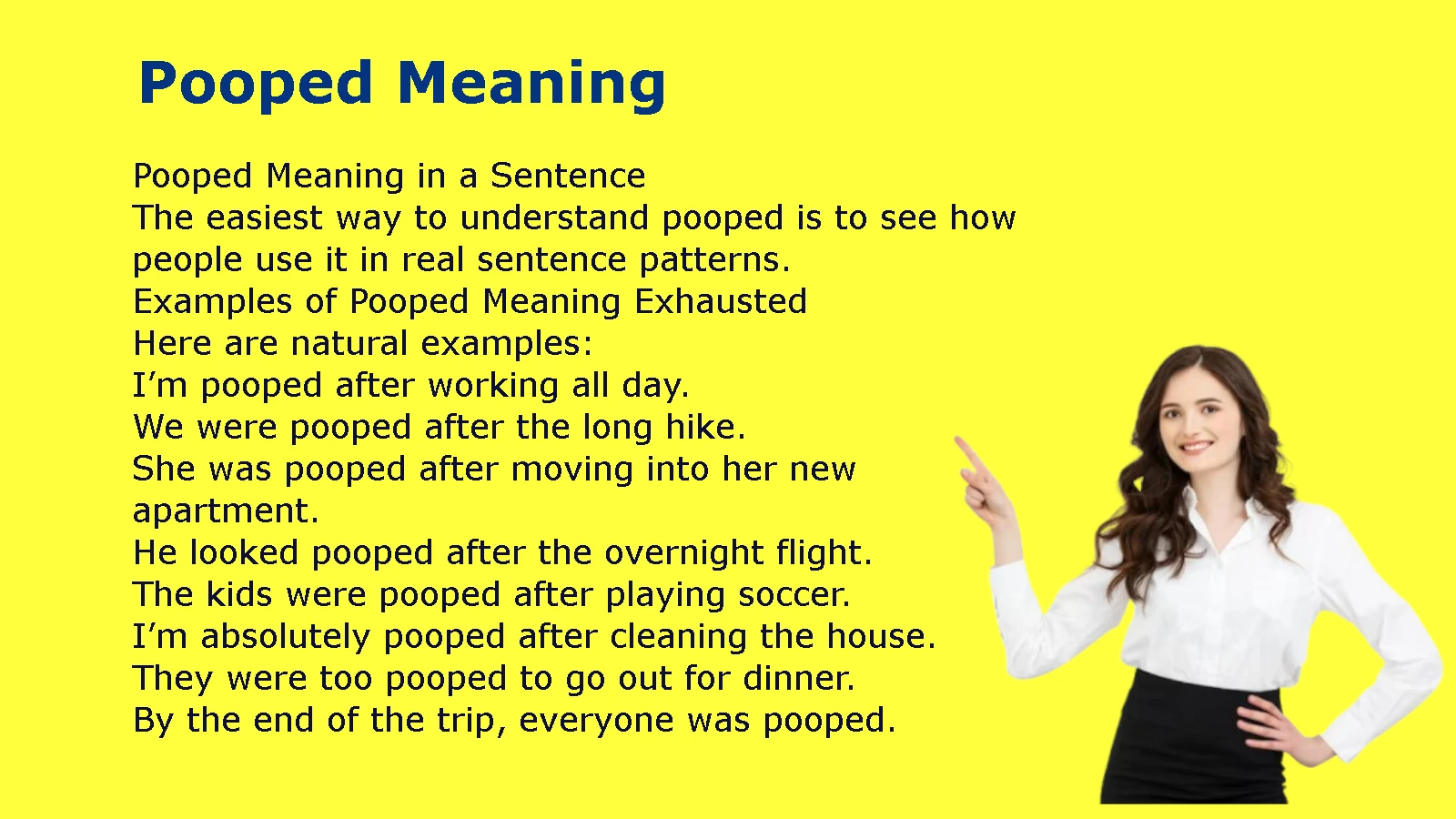
The easiest way to understand pooped is to see how people use it in real sentence patterns.
Examples of Pooped Meaning Exhausted
Here are natural examples:
- I’m pooped after working all day.
- We were pooped after the long hike.
- She was pooped after moving into her new apartment.
- He looked pooped after the overnight flight.
- The kids were pooped after playing soccer.
- I’m absolutely pooped after cleaning the house.
- They were too pooped to go out for dinner.
- By the end of the trip, everyone was pooped.
- She gets pooped when she works long shifts.
- I was so pooped that I fell asleep on the couch.
Notice how activities such as working, hiking, traveling, cleaning, and exercising provide clues about the meaning.
Examples of Pooped Meaning Had a Bowel Movement
Now compare those sentences with the other use:
- The puppy pooped in the kitchen.
- The baby pooped during the car ride.
- My dog pooped in the backyard.
- The toddler pooped in his diaper.
- The puppy finally pooped outside.
- The cat pooped outside the litter box.
In these examples, the word refers to defecation.
The context makes the intended meaning clear without needing an explanation.
Pooped Grammar and Word Forms
Pooped comes from the verb poop. It can appear as a past-tense verb, a past participle, or an adjective-like form describing a person’s condition.
Here are the main forms:
| Word | Grammatical form | Example |
| poop | Base verb | The dog may poop outside. |
| poops | Third-person singular present | The puppy poops outside. |
| pooped | Simple past | The dog pooped outside. |
| pooped | Past participle | The dog has pooped outside. |
| pooping | Present participle/gerund | The dog is pooping outside. |
The tiredness sense works somewhat differently.
For example:
I’m pooped.
Here, pooped describes the speaker’s condition.
You can also see it after linking verbs:
- She was pooped.
- They looked pooped.
- He seemed pooped.
- We were completely pooped.
Cambridge lists pooped as an adjective in this tiredness sense.
Is Pooped an Adjective or a Verb?
It can be either, depending on the sentence.
Consider:
The dog pooped outside.
Here, pooped is a verb. It describes an action the dog performed.
Now consider:
The dog was pooped after the long walk.
Here, pooped describes a condition, meaning the dog was very tired.
The same spelling can therefore perform different grammatical jobs.
| Example | Role of “pooped” | Meaning |
| The dog pooped outside. | Verb | Had a bowel movement |
| I’m pooped. | Adjective-like complement | Very tired |
| She was pooped after work. | Adjective-like complement | Very tired |
| The puppy has pooped. | Past participle | Has had a bowel movement |
This distinction matters because it helps explain why the word can look confusing in dictionary searches.
Pooped Pronunciation
Pooped is pronounced /puːpt/.
The word has one syllable and rhymes with words such as looped and scooped.
The final -ed is pronounced as a /t/ sound rather than an extra syllable. That’s why pooped sounds like “poopt”, not “poo-ped.”
The pronunciation is the same for the two common meanings.
Pooped pronunciation at a glance
| Feature | Details |
| Word | pooped |
| IPA | /puːpt/ |
| Syllables | 1 |
| Main vowel | Long /uː/ |
| Final sound | /t/ |
Cambridge and Collins both give the pronunciation as /puːpt/.
Pooped Synonyms
The best synonym depends on which pooped meaning you have in mind.
If you’re talking about tiredness, you have plenty of alternatives.
Synonyms for Pooped Meaning Tired
Common choices include:
- tired
- exhausted
- worn out
- drained
- spent
- fatigued
- weary
- worn down
- beat
- tuckered out
These words don’t always have exactly the same tone.
Exhausted sounds stronger and more neutral.
Tuckered out is also informal and conversational.
Fatigued sounds more formal and is common in medical, technical, or professional contexts.
Pooped vs. Tired
The difference is mostly about degree and tone.
I’m tired.
This tells you that the person needs rest.
I’m pooped.
This suggests that the person is really worn out.
For example, after a short walk, someone might simply say:
I’m tired.
After a 20-mile hike, they might say:
I’m completely pooped.
The second expression paints a stronger picture of exhaustion.
Pooped vs. Exhausted
Exhausted is more neutral and works in formal writing.
Pooped is more casual.
| Word | Meaning | Tone |
| pooped | Very tired | Informal |
| tired | Needing rest | Neutral |
| worn out | Very tired from effort | Informal/neutral |
| drained | Lacking physical or mental energy | Neutral |
| exhausted | Extremely tired | Neutral/formal |
| fatigued | Tired or lacking energy | Formal/technical |
So, if you’re writing an email to a friend, I’m pooped sounds natural.
If you’re writing a formal report, exhausted or fatigued will usually fit better.
Pooped vs. Pooped Out
You may also encounter pooped out.
Pooped out is an informal expression meaning very tired or exhausted. Cambridge lists pooped out as an alternative form connected with pooped.
For example:
I was too pooped out to finish the movie.
The meaning is essentially:
I was too tired to finish the movie.
Both forms are common in casual English:
- I’m pooped.
- I’m pooped out.
The second can sound slightly more emphatic because out reinforces the idea that the person’s energy has been used up.
Is Pooped a Bad Word?
Pooped is generally not considered a swear word.
However, it is definitely informal.
The word poop refers to a bodily function, so some formal settings may call for more neutral vocabulary. Still, pooped in the sense of being tired is generally mild and harmless in everyday conversation.
For example:
I’m pooped after that workout.
There’s nothing offensive about this sentence in normal casual conversation.
You may want a more formal alternative in professional writing:
- I’m very tired.
- I’m exhausted.
- I’m fatigued.
- I’m physically drained.
The right choice depends on your audience.
Is Pooped a Slang Word?
Yes, the tiredness sense is informal and is often described as slang.
Merriam-Webster identifies the verb poop meaning “to become exhausted” as slang, while American Heritage also labels the fatigue-related verb as slang.
At the same time, major dictionaries recognize pooped as an established English word. It isn’t an invented internet expression or a temporary social-media trend.
That distinction matters.
A word can be informal without being incorrect.
For instance, I’m pooped is perfectly natural in casual American English. It simply isn’t the kind of expression you would normally choose for a formal academic paper.
Is “I’m Pooped” Correct?
Yes. “I’m pooped” is a correct and natural informal expression.
It means:
I’m very tired.
The construction follows a normal English pattern in which a linking verb such as am connects the subject with a word describing its condition.
Examples include:
- I’m tired.
- I’m exhausted.
- I’m worn out.
- I’m pooped.
The difference is mainly one of style and intensity.
If you’re speaking casually, I’m pooped sounds friendly and natural.
Common Expressions With Pooped
Several common expressions build on the tiredness sense.
I’m Pooped
This is the simplest form.
I’m pooped after work.
Meaning: I’m very tired after work.
Completely Pooped
Adding completely emphasizes the degree of exhaustion.
I was completely pooped after moving all those boxes.
The speaker isn’t merely tired. They feel thoroughly worn out.
Absolutely Pooped
Absolutely works as another informal intensifier.
We were absolutely pooped after the road trip.
The expression remains casual and conversational.
Too Pooped to…
The structure too pooped to + verb is especially useful.
I’m too pooped to cook dinner.
She was too pooped to go shopping.
They were too pooped to keep walking.
This construction means that someone is so tired that they don’t have enough energy to do another activity.
Pooped Out
As mentioned earlier, pooped out also means exhausted.
I was completely pooped out after the tournament.
This expression is informal and often appears in relaxed speech.
Is Pooped Formal or Informal?
Pooped is informal.
Major dictionaries consistently mark the tiredness sense as informal or slang. Cambridge labels it US informal, while Collins describes it as informal and gives the meaning “fatigued; exhausted.”
That doesn’t make the word wrong. It simply means you should match it to the situation.
Casual setting
I’m pooped after that meeting.
Natural.
Neutral setting
I’m really tired after that meeting.
Natural.
Formal setting
I’m exhausted after the extended meeting.
More appropriate.
A good rule is simple: use pooped when the conversation is relaxed and conversational.
The History and Origin of Pooped
The tiredness sense of pooped has an interesting history.
Merriam-Webster dates the first known use of the fatigue-related verb poop to 1927.
Etymonline dates the adjective pooped meaning “tired” to 1931 and says its origin is unknown. It notes that poop and poop out were already used in the 1920s in aviation for an engine that stopped working.
Collins gives the origin of the tiredness adjective as American and dates it to roughly 1930–35.
So, the modern tiredness sense isn’t centuries old. It emerged in American English during the early 20th century.
The origin isn’t completely settled
It’s tempting to claim that pooped definitely comes from one particular source, but the historical record doesn’t support that level of certainty.
Etymonline explicitly describes the origin of the tiredness sense as unknown. One possibility it discusses is a connection with the sound of heavy breathing during exhaustion. Another historical association involves the verb poop and engines that stopped functioning.
That uncertainty is worth preserving rather than turning an interesting possibility into a fact.
The bodily-function sense has a different history
The poop meaning related to excrement also has a separate history.
Etymonline dates the noun poop meaning excrement to around 1744 and describes it as a children’s euphemism, probably of imitative origin. The verb in that sense is recorded from the early 20th century.
In other words, the two modern meanings shouldn’t automatically be treated as if they developed from exactly the same source.
Pooped in American English
The tiredness sense is strongly associated with American informal English.
Cambridge marks pooped as US informal and gives examples involving work, physical activity, travel, and everyday exhaustion.
The bodily-function verb is also especially common in informal American English. In British English, poo is often preferred for the bodily-function sense, although English varieties overlap and usage varies by speaker and context. Cambridge specifically notes poo as the UK equivalent for this sense.
That distinction can help explain why learners sometimes encounter slightly different versions of the word depending on the country.
Real-Life Context: How to Choose the Correct Meaning
Imagine someone says:
“After hiking for six hours, I was pooped.”
The context contains hiking for six hours. That’s a strong clue that pooped means exhausted.
Now imagine:
“After the walk, the puppy pooped in the yard.”
The phrase in the yard and the subject puppy point toward the bodily-function meaning.
Here’s a practical decision guide:
| If the sentence talks about… | Pooped probably means… |
| Work | Exhausted |
| Exercise | Exhausted |
| Hiking | Exhausted |
| Travel | Exhausted |
| Studying | Exhausted |
| Cleaning | Exhausted |
| Playing | Exhausted |
| A baby and a diaper | Had a bowel movement |
| A dog and the yard | Had a bowel movement |
| A cat and a litter box | Had a bowel movement |
| A puppy and the floor | Had a bowel movement |
Context isn’t just helpful here. It’s the key to understanding the word correctly.
Pooped in Everyday Conversation
The tiredness sense works especially well when someone wants to describe exhaustion without sounding overly serious.
Compare:
I am extremely fatigued after today’s activities.
with:
I’m totally pooped.
The first sounds clinical or formal.
The second sounds like something you’d naturally say to a friend while dropping onto the couch.
That’s one reason informal vocabulary remains useful. It carries tone, not just dictionary meaning.
Words such as pooped, worn out, beat, and tuckered out allow speakers to express tiredness in a more relaxed and colorful way.
When Not to Use Pooped
Although pooped is perfectly acceptable in casual English, it isn’t the best choice everywhere.
Avoid it when you need a highly formal tone, such as:
- Academic research
- Formal business reports
- Legal documents
- Professional medical writing
- Official correspondence
Instead, consider:
- fatigued
- exhausted
- physically tired
- mentally drained
- physically and mentally exhausted
For example, replace:
The employees were pooped after the shift.
with:
The employees were physically exhausted after the shift.
The second sentence better suits formal writing.
Pooped Meaning: Quick Comparison
The two major meanings can be summarized like this:
| Meaning | Part of speech | Example | Register |
| Very tired or exhausted | Adjective-like use | I’m pooped. | US informal |
| Had a bowel movement | Verb, past tense | The dog pooped outside. | Informal |
The difference is straightforward once you look at the sentence around the word.
Frequently Asked Questions About Pooped Meaning
What does pooped mean in slang?
In informal English, pooped commonly means very tired or exhausted. For example, I’m pooped after work means I’m extremely tired after work.
What does “I’m pooped” mean?
“I’m pooped” means “I’m very tired.” It is a casual American English expression used to describe exhaustion.
Does pooped mean tired?
Yes. Pooped can mean very tired or exhausted, especially after physical activity, work, travel, or a busy day.
Is pooped a real word?
Yes. Pooped is a standard dictionary-listed form. It can be the past tense or past participle of poop, and it also functions as an informal adjective-like form meaning very tired.
Is pooped a bad word?
No, not generally. It is an informal word rather than a swear word. However, the word is casual and may not suit formal writing.
Is pooped a slang word?
The tiredness sense is commonly classified as informal or slang. Major dictionaries use labels such as “US informal” and “slang” for related forms.
What is another word for pooped?
If pooped means tired, useful alternatives include exhausted, worn out, drained, spent, weary, fatigued, and tuckered out.
What is the opposite of pooped?
When pooped means exhausted, possible opposites include:
- rested
- refreshed
- energetic
- lively
- full of energy
There isn’t one simple opposite when pooped means having a bowel movement because that sense describes an action rather than a state of tiredness.
What does pooped out mean?
Pooped out means very tired or exhausted. It is an informal expression closely related to pooped.
Is “I’m too pooped to go” correct?
Yes. “I’m too pooped to go” is grammatically natural informal English. It means the speaker is too tired to go.
Is pooped the same as exhausted?
Not exactly in tone. Both can describe severe tiredness, but pooped is informal while exhausted is more neutral and works in formal contexts.
Does pooped always mean tired?
No. Pooped can also be the past tense of poop, meaning had a bowel movement. Context determines which meaning applies.
Final Takeaway: What Does Pooped Mean?
The most common pooped meaning in casual American English is very tired or exhausted.
When someone says:
“I’m pooped.”
they mean:
“I’m really tired.”
However, pooped can also mean had a bowel movement when it functions as the past tense of the informal verb poop.
The easiest way to tell the difference is to examine the context:
- I’m pooped after the workout. → I’m exhausted.
- The dog pooped in the yard. → The dog had a bowel movement.
The word is informal in both senses. Its tiredness meaning has been established in American English since the early 20th century, with dictionary sources dating the adjective pooped to around 1930–35 and the related fatigue verb to the 1920s or 1930s.
So, when you see pooped in a sentence, don’t assume it always refers to the bathroom. Sometimes it simply means someone has run out of energy.
In short: “pooped” can mean exhausted or, in another informal use, had a bowel movement. The sentence tells you which meaning the speaker intends.