Have you ever wondered whether you should write stationary or stationery when talking about paper, envelopes, or office supplies? These two words sound almost identical, but their meanings are completely different. Understanding the difference between stationary vs stationery can help you avoid a common spelling mistake in everyday writing.
Stationary is an adjective that means not moving or staying in one place, while stationery is a noun that refers to writing materials, such as paper, envelopes, letterheads, and pens.
Examples:
- The car remained stationary at the traffic light.
- She ordered new stationery for her office.
The confusion is understandable. People often search for stationary vs stationery, stationery meaning, stationary meaning, or stationary or stationery which is correct because these words have nearly the same pronunciation. And here’s the kicker: one letter can completely change the meaning of the sentence.
In this guide, you’ll learn the complete difference between stationary and stationery, including their meanings, definitions, pronunciation, correct usage, and examples in sentences. You’ll also discover an easy way to remember stationary vs stationery, so you can choose the right word with confidence.
Stationary vs Stationery: Quick Difference
The easiest way to separate the two words is to focus on what you’re talking about.
| Word | Part of speech | Meaning | Example |
| Stationary | Adjective | Not moving or not changing | The truck remained stationary. |
| Stationery | Noun | Writing materials, including paper, pens, and envelopes | She bought new stationery. |
The simplest rule
Stationary = still or unchanged.
Stationery = writing materials.
If a bicycle stays in one place, it’s stationary.
If you buy paper and envelopes for writing, you’ve bought stationery.
Merriam Webster defines stationary as fixed or immobile and also gives an extended sense involving something that remains unchanged. It defines stationery as writing materials and, more specifically, letter paper often supplied with matching envelopes.
What Does “Stationary” Mean?
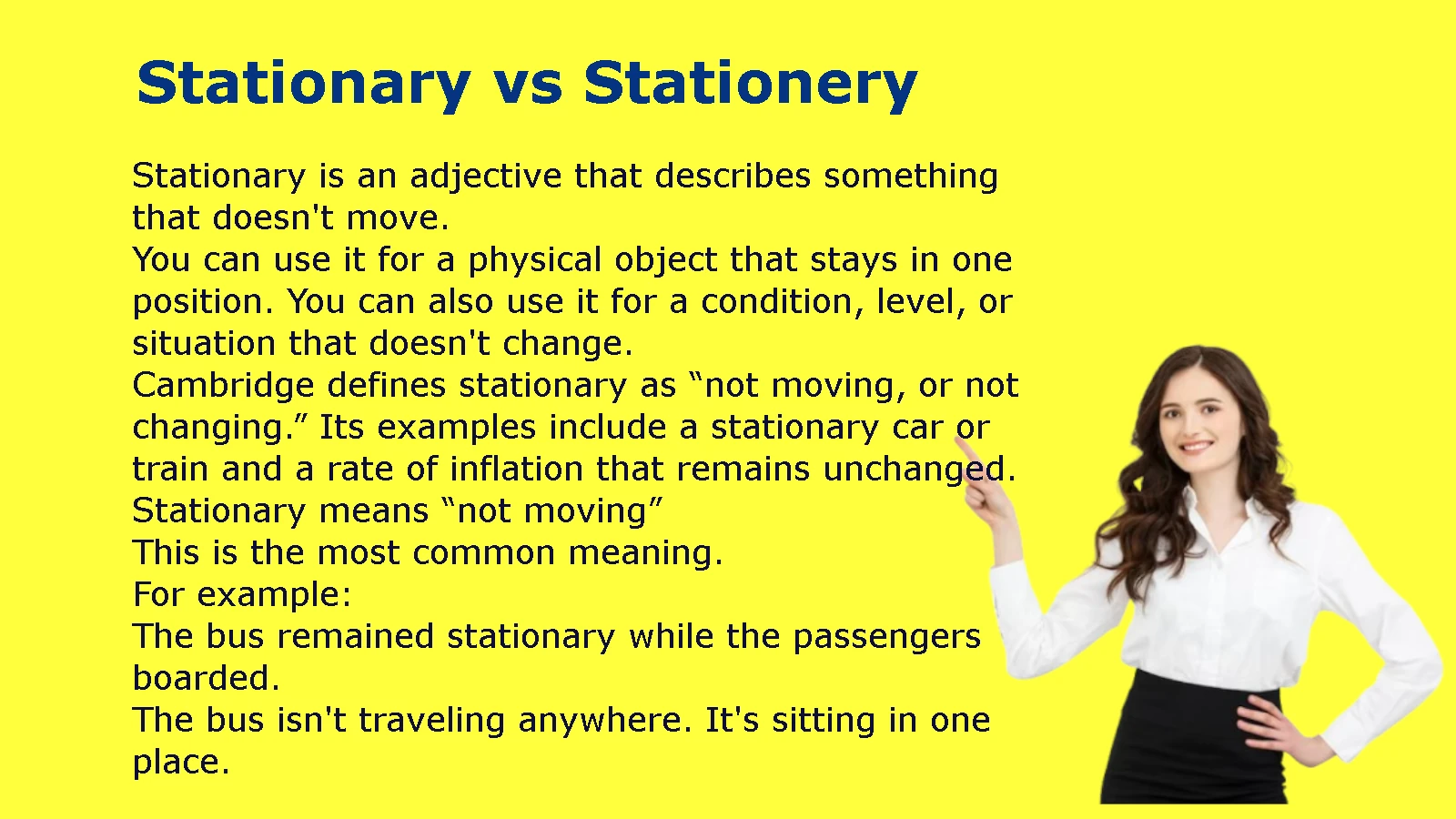
Stationary is an adjective that describes something that doesn’t move.
You can use it for a physical object that stays in one position. You can also use it for a condition, level, or situation that doesn’t change.
Cambridge defines stationary as “not moving, or not changing.” Its examples include a stationary car or train and a rate of inflation that remains unchanged.
Stationary means “not moving”
This is the most common meaning.
For example:
The bus remained stationary while the passengers boarded.
The bus isn’t traveling anywhere. It’s sitting in one place.
Likewise:
- The car was stationary at the intersection.
- The train remained stationary for several minutes.
- Keep the camera stationary during the exposure.
- The cyclist stopped and stood stationary.
- The object appeared stationary from a distance.
In each sentence, stationary describes the position or movement of something.
Stationary can also mean “unchanging”
The word doesn’t always describe physical movement.
It can also describe something that remains at the same level or in the same condition. Merriam Webster lists “unchanging in condition” as a sense of stationary.
For example:
The population remained stationary for several years.
Here, stationary doesn’t mean the population literally stood still. It means the population didn’t change significantly.
You might also encounter sentences such as:
- Prices remained stationary throughout the period.
- The rate stayed stationary for several months.
- The patient’s condition remained stationary.
- The system reached a stationary state.
The central idea remains the same: no movement or no change.
Common phrases with “stationary”
You’ll often see stationary in combinations such as:
- stationary bike
- stationary bicycle
- stationary vehicle
- stationary object
- stationary position
- stationary train
- stationary car
- stationary camera
- stationary traffic
- remain stationary
These phrases all involve something staying in place or remaining unchanged.
What Does “Stationery” Mean?
Stationery is a noun that refers to materials used for writing or office work.
Depending on context, it can include paper, envelopes, pens, pencils, ink, and other writing supplies. Cambridge specifically defines stationery as things needed for writing, such as paper, pens, pencils, and envelopes.
Oxford likewise defines stationery as materials used for writing and office work and includes special paper for writing letters as another sense.
Stationery can mean writing supplies
In a broad sense, stationery covers the things you use to write or handle written communication.
For example:
- paper
- envelopes
- pens
- pencils
- writing pads
- letterheads
- notebooks
- office writing supplies
Consider this sentence:
The office needs more stationery.
The sentence could refer to a collection of writing and office supplies rather than one specific item.
Stationery can mean special writing paper
The word can also have a narrower meaning.
Stationery may refer specifically to attractive, personalized, or formal writing paper, often accompanied by matching envelopes. Merriam Webster and Oxford both recognize this sense.
For example:
She wrote the thank you note on personalized stationery.
Here, stationery doesn’t mean every writing supply in the room. It refers to the particular paper used for the letter.
You’ll see this meaning in phrases such as:
- personal stationery
- business stationery
- wedding stationery
- custom stationery
- letter stationery
- branded stationery
Stationary vs Stationery: The Main Differences
The difference becomes much easier once you compare the words by meaning, grammar, spelling, and sentence function.
| Feature | Stationary | Stationery |
| Meaning | Not moving or not changing | Writing materials |
| Part of speech | Adjective | Noun |
| Typical context | Movement, position, stability | Writing, paper, office supplies |
| Example | The vehicle was stationary. | I ordered new stationery. |
| Memory clue | A = at rest | E = envelope |
Difference in meaning
The most important distinction is simple:
Stationary describes a state.
Stationery names materials.
Compare:
The camera remained stationary.
The word describes what the camera did.
Now compare:
The photographer bought new stationery.
The word identifies what the photographer bought.
Difference in part of speech
Grammar provides another useful clue.
Stationary is an adjective. It describes a noun.
Stationery is a noun. It names a category of materials.
some stationery
office stationery
personalized stationery
This difference helps when you’re unsure which spelling belongs in a sentence.
Difference in spelling
Only one letter separates them:
- stationary → a
- stationery → e
Unfortunately, that one letter carries the whole meaning.
That’s why spelling the word from memory can be tricky. Both words sound alike, so you need to connect the spelling to the meaning rather than relying on pronunciation.
Are “Stationary” and “Stationery” Homophones?
Yes. Stationary and stationery are homophones because they have the same pronunciation in standard English but different spellings and meanings.
Cambridge lists matching pronunciations for the American English forms of both words.
That explains why people frequently confuse them.
When someone says:
“I need some stationery.”
you can’t determine the spelling simply by hearing the sentence. You need to understand what the speaker means.
If the sentence means writing supplies, the spelling is stationery.
If someone says:
“Please remain stationary.”
the meaning is clear: don’t move.
Why pronunciation causes problems
English contains many homophones:
- there / their / they’re
- to / too / two
- brake / break
- principal / principle
- stationary / stationery
In each case, sound alone doesn’t tell you which spelling to choose.
The same thing happens here. When you’re writing, stop and ask:
What does the word mean in this sentence?
That question usually solves the problem immediately.
Stationary or Stationery: Which One Should You Use?
Use this quick decision test.
Use “stationary” for something that stays still
If you can replace the word with still, fixed, motionless, or unchanging, choose stationary.
The vehicle remained stationary.
You could say:
The vehicle remained still.
So stationary is correct.
Use “stationery” for writing materials
If you’re talking about paper, envelopes, pens, pencils, or other writing supplies, choose stationery.
I bought some new stationery.
You could replace it with:
I bought some new writing materials.
So stationery is correct.
A fast two question test
When you’re stuck, ask:
Is something staying still or unchanged?
→ stationary
Am I talking about writing materials?
→ stationery
That’s all you need in most everyday situations.
How to Remember the Difference Between Stationary and Stationery
A good memory trick turns the spelling into something meaningful.
Stationery = E for Envelope
The e in stationery can remind you of envelope.
An envelope belongs with letters and other writing materials.
So:
stationery → E → envelope
This is a practical mnemonic because it connects the unusual spelling to an actual object associated with stationery.
Stationary = A for At Rest
For stationary, let the a remind you of at rest.
stationary → A → at rest
If something is stationary, it isn’t moving.
Use “paper” as your spelling clue
Merriam Webster recommends another useful connection: paper and stationery both contain the letters er toward the end.
Think:
paper → stationery
This works particularly well if you associate stationery with paper and letters.
Use “stationer” to remember stationery
There’s also a historical connection.
A stationer is a person or business that sells writing materials. Merriam Webster notes that stationer was once associated with booksellers and publishers before becoming associated with sellers of paper, pens, and office goods.
So you can remember:
stationer → stationery
That connection gives the e spelling a logical reason to exist rather than making it a random spelling rule.
Stationary vs Stationery Examples in Sentences
Examples make this distinction much easier to see in action.
Examples with “stationary”
- The car remained stationary at the red light.
- The train was stationary for several minutes.
- Please keep the camera stationary.
- The cyclist stood stationary near the entrance.
- The truck hit a stationary vehicle.
- The machine remained stationary during the test.
- The object looked stationary from across the room.
- The traffic became completely stationary.
- The patient remained in a stationary position.
- The inflation rate stayed stationary for several months.
Notice how each example involves either lack of movement or lack of change.
Examples with “stationery”
- She bought new stationery for her desk.
- The company ordered branded stationery.
- He wrote the letter on personalized stationery.
- The office needs more stationery.
- The store sells pens, notebooks, and other stationery.
- She chose elegant wedding stationery.
- The business printed its logo on official stationery.
- He keeps his stationery in the top drawer.
- The school ordered additional stationery for its classrooms.
- She used handmade stationery for her thank you notes.
Every example refers to writing materials or special writing paper.
Examples using both words
These sentences put the two words side by side, which makes the contrast especially clear.
The car remained stationary while I bought stationery.
The stationary printer sat beside a box of stationery.
She stayed stationary at her desk while organizing her stationery.
The vehicle was stationary outside the stationery store.
Once the train became stationary, he pulled out his stationery and wrote a note.
These examples demonstrate why context matters. The words can appear in the same sentence while performing completely different jobs.
Common Mistakes With Stationary and Stationery
Because the words sound alike, even experienced writers can occasionally choose the wrong spelling.
Mistake: Using “stationary” for writing supplies
Incorrect:
I bought new stationary for the office.
Correct:
I bought new stationery for the office.
The office needs writing materials, so stationery is the correct noun.
Mistake: Using “stationery” for something that isn’t moving
Incorrect:
The car remained stationery at the intersection.
Correct:
The car remained stationary at the intersection.
The car isn’t moving, so you need the adjective stationary.
Mistake: Writing “stationery bike”
Incorrect:
I exercise on a stationery bike.
Correct:
I exercise on a stationary bike.
A stationary bike stays in place while you pedal. The word has nothing to do with paper or writing.
Cambridge specifically lists stationary bike and stationary bicycle among the expressions associated with stationary.
Mistake: Writing “stationary store”
Incorrect:
She went to the stationary store.
Correct:
She went to the stationery store.
A stationery store sells writing materials.
Mistake: Choosing based on sound
This is the root of many errors.
Both words sound alike, so trying to “hear” the correct spelling won’t work.
Instead, identify the meaning first.
Still or unchanged? → stationary
Writing materials? → stationery
Is “Stationery” Countable or Uncountable?
Stationery is generally an uncountable noun when it refers to writing materials as a category.
Oxford labels stationery as uncountable, while Cambridge also marks it as an uncountable noun.
That means you normally say:
- some stationery
- a lot of stationery
- office stationery
- new stationery
- more stationery
You generally don’t say:
- ❌ a stationery
- ❌ two stationeries
when you’re referring to writing materials as a general category.
How do you count stationery?
When you need to identify individual items, name the items themselves.
For example:
I bought three notebooks and five pens.
Or use a suitable quantity phrase:
We ordered a box of stationery.
She purchased a set of stationery.
The office received several packs of paper.
The word stationery describes the broader category. Individual products can be counted separately.
What about “a piece of stationery”?
A piece of stationery can be correct when you mean one piece of writing paper.
For example:
She wrote the address on a piece of stationery.
The countable noun piece allows you to refer to one item while stationery remains uncountable.
Stationary vs Stationery in American English
The distinction is the same in US English:
- stationary = not moving or not changing
- stationery = writing materials
Cambridge’s American Dictionary entries support these meanings and identifies stationary as an adjective and stationery as an uncountable noun.
Common American expressions include:
- stationary bike
- stationary vehicle
- stationary object
- office stationery
- personal stationery
- business stationery
- stationery store
There isn’t a separate American spelling such as stationary for writing supplies. Stationery remains the correct spelling.
Stationer, Stationery, and Stationary: Are They Related?
The words stationer, stationery, and stationary look closely related, but they don’t all share the same modern meaning.
What is a stationer?
A stationer is a person or business that sells writing materials.
Historically, the word had a broader connection to booksellers and publishers. Merriam Webster explains that the word eventually came to describe sellers of paper, pens, and office goods.
That history helps explain the spelling of stationery.
Where does “stationery” come from?
The noun stationery developed from stationer, referring to the goods associated with that trade.
Merriam Webster gives the first known use of stationery in the relevant sense as 1727.
So the relationship is straightforward:
stationer → stationery
That’s why the spelling uses e, not a.
Where does “stationary” come from?
Stationary has a different history connected with station and the idea of being fixed in a particular place.
Merriam Webster records its first known use in the 15th century and defines its core sense around being fixed or immobile.
The two words therefore developed into different terms even though their spellings and pronunciations became remarkably close.
Stationary vs Stationery in Common Phrases
Recognizing common word combinations can make the distinction automatic.
| Correct phrase | Meaning |
| stationary bike | A bike designed to remain in place |
| stationary bicycle | Same basic meaning as stationary bike |
| stationary vehicle | A vehicle that isn’t moving |
| stationary object | An object that remains still |
| stationary camera | A camera kept in a fixed position |
| stationary traffic | Traffic that has stopped moving |
| office stationery | Writing and office materials |
| business stationery | Writing materials carrying business information or branding |
| personal stationery | Personalized writing paper and related materials |
| wedding stationery | Printed materials used for wedding correspondence and events |
| stationery store | A store that sells stationery |
| stationery supplies | Materials used for writing or office work |
“Stationary bike” deserves special attention
Stationary bike is one of the most common places people use the wrong spelling.
The bike doesn’t travel down the road. It stays fixed in place while the pedals and wheel mechanism operate.
So:
stationary bike ✅
Not:
stationery bike ❌
The second version would suggest a bike somehow associated with paper and envelopes.
A Real World Case Study: One Letter Changes the Meaning
Imagine an office manager writing an order:
“Please send 50 boxes of stationary.”
The intended meaning is probably writing supplies. However, stationary doesn’t mean writing supplies. It means something that remains still or unchanged.
The corrected sentence is:
“Please send 50 boxes of stationery.”
Now the meaning is clear.
Consider a different situation. A traffic report says:
“Several vehicles remained stationery during the accident.”
That spelling changes the meaning again. The writer wants to describe vehicles that weren’t moving.
The correct sentence is:
“Several vehicles remained stationary during the accident.”
This is why spelling isn’t merely cosmetic. One letter can change the meaning of an entire sentence.
Stationary vs Stationery: A Quick Comparison Test
Try these sentences without looking at the answers.
Fill in the blank
- The train remained ______ while repairs were completed.
- I ordered new ______ for my office.
- The camera must remain ______ during the shot.
- She used elegant ______ for the invitation.
- The traffic became completely ______.
- The company needs more office ______.
- He rides a ______ bike every morning.
- She keeps her pens and paper with the rest of her ______.
Answers
- stationary
- stationery
- stationary
- stationery
- stationary
- stationery
- stationary
- stationery
The pattern is consistent:
Movement or change → stationary
Writing materials → stationery
Frequently Asked Questions About Stationary vs Stationery
Is it “stationary” or “stationery” for paper?
Use stationery.
She bought new stationery for writing letters.
Stationery can refer to paper specifically or to a broader collection of writing materials.
Is a stationary bike spelled with an A or E?
It’s spelled stationary bike with an a.
The bike remains fixed in one place, so stationary is the correct adjective.
What is the easiest way to remember “stationery”?
Think of the E in stationery as E for envelope.
You can also connect stationery with paper and letter, which share the er ending highlighted by Merriam Webster’s spelling mnemonic.
Is stationery a noun or an adjective?
Stationery is a noun.
It names writing materials such as paper, pens, pencils, and envelopes.
Is stationary a noun or an adjective?
Stationary is primarily an adjective.
It describes something that isn’t moving or isn’t changing.
The vehicle was stationary.
Are stationary and stationery pronounced the same?
Yes. They are commonly pronounced alike in English, which makes them homophones.
Their spelling and meaning are different even though their pronunciation is essentially the same. Cambridge lists matching American English pronunciations for the two words.
Can stationery be plural?
When stationery means writing materials as a general category, it’s normally uncountable.
Say:
We need more stationery.
rather than:
We need more stationeries.
Oxford explicitly labels the noun stationery as uncountable.
Is “stationary” always about physical movement?
No.
Stationary can also describe something that remains unchanged.
For example:
The population remained stationary.
Here, the word describes a lack of change rather than a physical object standing still. Merriam Webster and Cambridge both recognize this broader sense.
What is the difference between stationery and stationary in one sentence?
Stationary means not moving or not changing, while stationery means writing materials.
Final Takeaway: Stationary vs Stationery
The difference between Stationary vs Stationery looks small on the page, but the meanings are completely different.
Stationary is an adjective. Use it when something stays still, remains fixed, or doesn’t change.
The car remained stationary.
Stationery is a noun. Use it when you’re talking about paper, envelopes, pens, pencils, or other writing materials.
She bought new stationery.
When the two spellings blur together, don’t rely on pronunciation. Instead, look at the meaning.
If it stays still, it’s stationary.
If you write with it or on it, it’s stationery.
And if you need one final memory trick, keep this pair handy:
Stationary → A → at rest
Stationery → E → envelope
Once that distinction clicks, this common spelling trap becomes much easier to avoid.