Have you ever wondered whether Mustache and Moustache mean the same thing or if there’s a difference between them? The Mustache vs Moustache debate often confuses English learners because both spellings refer to the same facial hair, but the preferred spelling depends on the variety of English you’re using.
Mustache and Moustache have the same meaning and pronunciation. Mustache is the standard spelling in American English, while Moustache is more common in British English and other varieties of English. Neither spelling is incorrect.
Examples:
- He grew a mustache for his new role.
- He decided to trim his moustache before the event.
The confusion is understandable. People often search for mustache or moustache, mustache vs moustache spelling, is it mustache or moustache, or mustache meaning because English spelling can change depending on the country. And here’s the kicker: choosing the right spelling usually comes down to whether you’re following American or British English.
In this guide, you’ll learn the complete difference between Mustache vs Moustache, including their meaning, spelling, pronunciation, origin, and correct usage. You’ll also discover which spelling is preferred in American English, which is common in British English, and how to use mustache and moustache correctly in sentences.
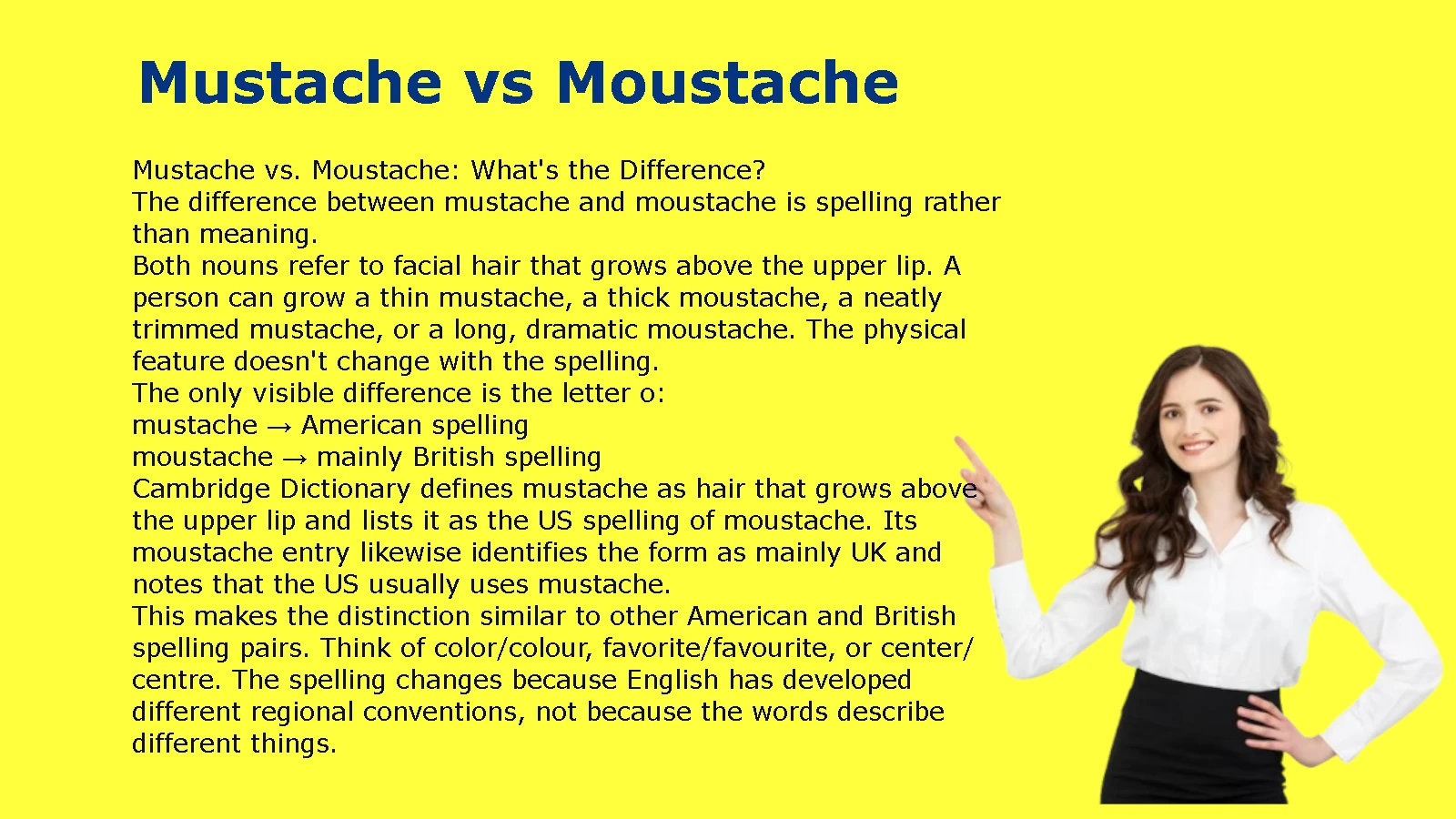
Mustache vs. Moustache: What’s the Difference?
The difference between mustache and moustache is spelling rather than meaning.
Both nouns refer to facial hair that grows above the upper lip. A person can grow a thin mustache, a thick moustache, a neatly trimmed mustache, or a long, dramatic moustache. The physical feature doesn’t change with the spelling.
The only visible difference is the letter o:
- mustache → American spelling
- moustache → mainly British spelling
Cambridge Dictionary defines mustache as hair that grows above the upper lip and lists it as the US spelling of moustache. Its moustache entry likewise identifies the form as mainly UK and notes that the US usually uses mustache.
This makes the distinction similar to other American and British spelling pairs. Think of color/colour, favorite/favourite, or center/centre. The spelling changes because English has developed different regional conventions, not because the words describe different things.
Mustache vs. Moustache at a Glance
| Question | Answer |
| Do they have the same meaning? | Yes |
| Is mustache correct? | Yes |
| Is moustache correct? | Yes |
| Which is standard in US English? | Mustache |
| Which is mainly used in UK English? | Moustache |
| Does the extra “o” change the meaning? | No |
| Are they pronounced differently because of spelling? | Generally, no |
| Should you use both forms in the same article? | Usually no |
| What should determine your choice? | Your English variety and audience |
Is Mustache or Moustache Correct?
Both spellings are correct.
However, “correct” depends on the variety of English you’re using.
In American English, mustache is the normal spelling. Cambridge labels it as the US form, while its moustache entry says that the US usually uses mustache.
In British English, moustache is the usual spelling. Collins describes mustache as the US spelling of moustache in its British English entry.
That means neither spelling deserves the label “wrong” without considering context.
For example:
He grew a mustache before his trip to New York.
This fits American English.
He grew a moustache before his trip to London.
This fits British English.
The underlying meaning remains identical.
Is Moustache Wrong in American English?
No.
American English generally prefers mustache, but moustache is still recognized as a variant. Cambridge’s American Dictionary explicitly lists moustache alongside mustache.
That distinction matters because a variant can be less common without being incorrect.
If you’re writing a formal article for an American publication, however, mustache is usually the better choice. It matches the dominant US spelling convention and keeps the text consistent with other American spellings.
Is Mustache Wrong in British English?
No.
British English generally favors moustache, but mustache remains recognizable as the American spelling. Cambridge and Collins both make the regional relationship clear.
So the practical rule is straightforward:
Use the spelling that matches the variety of English you’re writing.
Mustache vs. Moustache in American English
If you’re writing in American English, mustache should usually be your first choice.
American dictionaries and reference works recognize mustache as the standard US form. Collins lists mustache in American English and also notes moustache as an alternative spelling.
You’ll therefore see sentences such as:
- He shaved his mustache yesterday.
- His mustache was thick and neatly trimmed.
- The barber shaped his mustache carefully.
- He decided to grow a mustache during the summer.
- The actor wore a fake mustache for the role.
- His new mustache completely changed his appearance.
Notice that none of these examples needs the British spelling. The American form works naturally throughout.
Why Use Mustache in American Writing?
The main reason is consistency.
If an article uses American English, readers generally expect American spellings throughout the piece. Switching between mustache and moustache without a reason can make the writing look inconsistent.
For example, this sentence is awkward from a style perspective:
He trimmed his mustache before deciding that his moustache needed more shaping.
The sentence doesn’t contain a meaningful distinction. It simply switches spellings.
A consistent version would be:
He trimmed his mustache before deciding that it needed more shaping.
The same principle applies to the plural and related forms.
Mustache vs. Moustache in British English
In British English, moustache is the conventional spelling.
Cambridge marks moustache as mainly UK and notes that American English usually uses mustache.
British English examples include:
- He grew a moustache last year.
- His moustache was carefully trimmed.
- She asked him to shave his moustache.
- The actor wore a false moustache.
- His thick moustache covered part of his upper lip.
- He decided to keep his beard but shave his moustache.
The meaning remains exactly the same as in American English.
The spelling simply reflects a different regional convention.
Mustache vs. Moustache in Canada, Australia, and Other English Varieties
English spelling doesn’t always divide neatly into “American” and “British.”
Different English speaking countries can show their own preferences, and dictionaries may describe usage differently depending on the variety being documented. That’s why it’s better to avoid an absolute claim such as “every country outside the United States uses moustache.”
The safest approach is to follow the style guide, dictionary, publisher, school, workplace, or audience you’re writing for.
For international content, consistency becomes especially useful. If your website primarily follows American English, use mustache throughout. If it follows British English, use moustache.
The goal isn’t to declare one spelling the winner. The goal is to communicate clearly within the English variety you’ve chosen.
What Does Mustache or Moustache Mean?
A mustache or moustache is hair that grows above the upper lip.
The term usually describes facial hair between the nose and upper lip. It can appear in many shapes, lengths, and styles.
Dictionaries also record broader uses. Collins, for example, includes hair or bristles around the mouth of animals and describes marks or features that resemble a moustache.
Common Types of Mustaches
A mustache can take many forms. Some common style names include:
- Handlebar mustache: A mustache with ends that curve upward.
- Pencil mustache: A narrow, closely trimmed strip above the lip.
- Walrus mustache: A large, thick mustache that can hang over the upper lip.
- Horseshoe mustache: A full mustache with vertical extensions running downward along the sides of the mouth.
- Chevron mustache: A broad, thick mustache that follows the shape of the upper lip.
- Toothbrush mustache: A short, rectangular style centered beneath the nose.
These names describe different styles. They don’t create different spellings of the word itself.
How Do You Pronounce Mustache and Moustache?
The spelling differs, but the pronunciation is broadly equivalent within the corresponding English varieties.
Cambridge gives the American pronunciation of both forms with the familiar /ˈmʌs.tæʃ/ pattern and gives a British pronunciation using /məˈstɑːʃ/.
The important point is that the extra o in moustache doesn’t mean you pronounce the word as if it were a completely different word.
| Variety | Typical pronunciation |
| American English | /ˈmʌs.tæʃ/ |
| British English | /məˈstɑːʃ/ |
Regional accents can naturally affect the exact sound.
This is another reason not to treat mustache and moustache as two separate vocabulary words. They’re regional spellings of the same lexical item.
Mustache Examples in a Sentence
Here are natural examples using the American spelling mustache:
- He decided to grow a mustache for the first time.
- His mustache had become noticeably thicker.
- The barber trimmed his mustache with scissors.
- She barely recognized him without his mustache.
- He shaved his mustache before the interview.
- The actor wore a fake mustache during the scene.
- His gray mustache matched his silver hair.
- He carefully waxed the ends of his mustache.
- The child drew a funny mustache on the photograph.
- His mustache was short but neatly shaped.
Mustache in Formal Writing
The word works normally in both casual and formal contexts.
For example:
The officer’s neatly trimmed mustache contrasted with his otherwise clean-shaven appearance.
There’s nothing informal about the noun itself. The surrounding sentence determines the tone.
In a technical, academic, or professional context, the same regional spelling rule applies. If the document follows US English, use mustache.
Moustache Examples in a Sentence
Here are equivalent examples using the British spelling moustache:
- He decided to grow a moustache for the first time.
- His moustache had become noticeably thicker.
- The barber trimmed his moustache with scissors.
- She barely recognized him without his moustache.
- He shaved his moustache before the interview.
- The actor wore a false moustache during the scene.
- His grey moustache matched his silver hair.
- He carefully waxed the ends of his moustache.
- The child drew a funny moustache on the photograph.
- His moustache was short but neatly shaped.
The meaning doesn’t change. Only the spelling does.
Mustache or Moustache: Which One Should You Use?
The easiest rule is to match the spelling to your audience.
Use Mustache When Writing American English
Choose mustache when:
- You’re writing for a US audience.
- You’re following American English spelling.
- Your publication uses US English.
- Your school or workplace requires American English.
- You’re maintaining consistency with other US spellings.
Example:
The barber trimmed his mustache before the ceremony.
Use Moustache When Writing British English
Choose moustache when:
- You’re writing for a British audience.
- You’re following British English conventions.
- Your publication uses British spelling.
- Your style guide specifies British English.
- You’re writing a document that consistently uses forms such as colour, favourite, and centre.
Example:
The barber trimmed his moustache before the ceremony.
What If Your Audience Is International?
Pick a consistent variety.
If the rest of your website uses American spelling, mustache is the logical choice. If your site follows British English, moustache fits better.
Don’t switch between the two merely to target both spellings. You can mention the alternative naturally:
Mustache is the standard American spelling, while moustache is mainly used in British English.
That single sentence covers both forms without creating inconsistent prose.
Mustache vs. Moustache: Quick Comparison
| Feature | Mustache | Moustache |
| Meaning | Hair above the upper lip | Hair above the upper lip |
| Standard US spelling | Yes | No, but recognized |
| Standard British spelling | No, recognized as US form | Yes |
| Extra letter | None | o |
| Same meaning | Yes | Yes |
| Same basic word | Yes | Yes |
| Common US form | Mustache | Less common |
| Common UK form | Less common | Moustache |
| Plural | Mustaches | Moustaches |
| Adjective | Mustached | Moustached |
| Main difference | Regional spelling | Regional spelling |
The dictionaries agree on the central distinction. Cambridge calls mustache the US spelling and moustache mainly UK, while Collins identifies moustache as the British form and mustache as its American counterpart.
Why Does Moustache Have an Extra O?
The spelling difference has a long history.
English borrowed the word through French moustache, which came from Italian forms such as mostaccio. The word ultimately traces farther back to Greek forms associated with the upper lip and facial hair. Collins gives an origin through French and Italian and ultimately connects the word with Greek mustax.
The American spelling mustache represents a shorter spelling that became established in American English.
This history matters because it shows why the difference isn’t as simple as saying that Americans “removed an o.” English spelling changes gradually. Different forms can coexist for centuries before one becomes more common in a particular region.
The Basic Historical Path
A simplified version looks like this:
Greek → Latin and Romance forms → Italian → French → English
The French form moustache strongly influenced the spelling used in British English. American English eventually established mustache as its usual form.
So the two modern spellings aren’t unrelated inventions. They’re different established forms of the same word.
Mustache and Moustache: Related Forms
The spelling difference continues into related forms.
Mustaches vs. Moustaches
The plural of mustache is:
mustaches
The plural of moustache is:
moustaches
Examples:
- The barber specializes in shaping mustaches.
- The museum displayed portraits of men with elaborate moustaches.
Again, the rule is simple: retain the spelling system you’ve chosen.
Mustached vs. Moustached
The corresponding adjective can also reflect the regional spelling.
- mustached = American form
- moustached = British form
Collins explicitly lists moustached and the US form mustached as derived forms.
Examples:
The mustached actor became famous for his distinctive appearance.
The moustached gentleman appeared in several photographs.
Neither sentence changes the underlying meaning.
Mustache vs. Moustache vs. Mustachio
Mustachio is related to mustache and moustache, but it isn’t simply another spelling of the two standard forms.
The word can refer to a mustache, especially one that is large, prominent, or distinctive. It has a more unusual or literary flavor than ordinary mustache or moustache.
For everyday writing, use:
- mustache in American English
- moustache in British English
Use mustachio only when the word fits the intended meaning or style.
This distinction prevents a common mistake: treating every related form as a direct spelling variant.
Mustache vs. Moustache and the Word “Beard”
A mustache isn’t the same as a beard.
A mustache grows primarily above the upper lip. A beard refers to facial hair growing on areas such as the chin, cheeks, jaw, and lower face.
Someone can have:
- a mustache without a beard
- a beard without a mustache
- both a mustache and a beard
- neither
For example:
He shaved his beard but kept his mustache.
That sentence makes the distinction clear.
Cambridge’s examples also use this contrast, including examples describing someone who shaves a beard while keeping a mustache.
Common Mistakes With Mustache and Moustache
The spelling itself isn’t difficult once the regional rule is clear. Most mistakes happen when writers treat the two forms as if they had different meanings.
Assuming One Spelling Is Always Correct
The claim that mustache is correct and moustache is wrong ignores British English.
Likewise, claiming that moustache is the only correct form ignores standard American usage.
Better rule: identify the English variety first.
Switching Between Mustache and Moustache
Inconsistent spelling can distract readers.
For example:
He trimmed his mustache, then waxed his moustache.
Unless the writer intentionally distinguishes a quoted source or another stylistic feature, there is no reason to switch forms.
Choose one.
Thinking the Extra O Changes the Meaning
It doesn’t.
Mustache and moustache refer to the same facial hair.
The extra letter reflects spelling convention, not a different physical feature.
Assuming Moustache Is More Formal
Some readers may associate moustache with British English or older writing, but the spelling itself doesn’t automatically make a sentence more formal.
Compare:
He has a mustache.
and
He has a moustache.
The sentences have the same basic tone. The regional spelling changes, not the level of formality.
Using British Spelling in an Otherwise American Article
This isn’t necessarily grammatically wrong, but it can create an inconsistent style.
If an article uses color, favorite, and center, using moustache may stand out because the surrounding text follows American conventions.
Consistency is the cleaner choice.
Mustache vs. Moustache: Which Is More Common?
The answer depends on where the English is used.
In American English, mustache is the usual spelling. Cambridge directly identifies it as the US spelling, while Collins describes moustache as an alternative form in American English.
In British English, moustache is the standard spelling. Cambridge labels it mainly UK and says that US English usually uses mustache.
So there isn’t one useful worldwide answer to “Which spelling is more common?” A regional answer is more accurate:
| English variety | More typical form |
| American English | mustache |
| British English | moustache |
| International English | Depends on the chosen style |
| American publications | mustache |
| British publications | moustache |
This regional distinction is more useful than assigning a single global winner.
A Simple Case Study: Choosing the Right Spelling
Imagine two writers describing exactly the same person.
The first writes for an American magazine:
The actor grew a mustache for his latest role.
The second writes for a British newspaper:
The actor grew a moustache for his latest role.
Neither writer made a spelling mistake.
The difference comes from the publication’s English variety.
Now imagine a third writer who uses American English throughout an article but alternates between the two forms:
The actor grew a mustache for his latest role. His moustache became part of the character’s appearance.
That version creates an unnecessary inconsistency.
A cleaner American version would use mustache in both places:
The actor grew a mustache for his latest role. His mustache became part of the character’s appearance.
A British version would use moustache throughout.
This is the practical lesson: regional consistency matters more than choosing one form as universally correct.
Facts About Mustache and Moustache
Here are the key facts in one place:
- Mustache and moustache have the same basic meaning.
- Mustache is the standard American spelling.
- Moustache is mainly the British spelling.
- The extra o doesn’t change the definition.
- Both forms are recognized in English dictionaries.
- The word refers primarily to hair growing above the upper lip.
- The term can also describe similar hair, bristles, feathers, or markings in animals and birds.
- The plural of mustache is mustaches.
- The plural of moustache is moustaches.
- Mustached is the American related adjective.
- Moustached is the corresponding British form.
- The word entered English through French and ultimately has older Romance and Greek roots.
- Pronunciation varies mainly by English variety and accent rather than because one spelling has a completely different meaning.
Frequently Asked Questions About Mustache vs. Moustache
Is Mustache the American Spelling?
Yes. Mustache is the standard American spelling. Cambridge identifies it as the US spelling of moustache.
Is Moustache the British Spelling?
Yes. Moustache is mainly used in British English. Cambridge specifically labels it “mainly UK” and notes that American English usually uses mustache.
Are Mustache and Moustache the Same Thing?
Yes. They refer to the same type of facial hair: hair growing above the upper lip.
Which Should I Use in the United States?
Use mustache. It is the standard American form.
Which Should I Use in the United Kingdom?
Use moustache. It is the standard British form.
Is Moustache Wrong in American English?
No. Moustache is recognized as a variant in American English, although mustache is the usual US spelling.
Is Mustache Wrong in British English?
No. Mustache is recognized as the American spelling, while moustache is the usual British form.
Do Mustache and Moustache Have Different Meanings?
No. The spelling difference doesn’t create a different meaning.
Do Mustache and Moustache Have Different Pronunciations?
Not because of the spelling alone. Pronunciation generally follows the regional variety of English. Cambridge gives distinct US and UK pronunciations that reflect broader accent differences.
What Is the Plural of Mustache?
The American plural is mustaches.
He has trimmed his mustaches.
The word can also refer to the two sides of a particularly long mustache, although ordinary usage generally treats mustache as a singular noun.
What Is the Plural of Moustache?
The British plural is moustaches.
Several men in the painting have impressive moustaches.
Is Mustachio the Same as Mustache?
Mustachio is a related word that can refer to a mustache, especially a prominent one. It isn’t simply the standard spelling in another English variety.
Why Does Moustache Have an O?
The spelling reflects the word’s history through French and earlier forms. The French form moustache influenced the spelling, while American English established mustache as its usual form. Collins traces the word through French and Italian to an ancient Greek root associated with the upper lip.
Which Spelling Is Better for SEO?
Neither spelling is universally “better.” The best choice depends on the search audience.
If you’re targeting American English, mustache should be the primary form. If you’re targeting British English, moustache should lead.
For an article targeting both audiences, use the primary regional form consistently and mention the alternative naturally. For example:
Mustache is the American spelling, while moustache is mainly used in British English.
That approach captures the distinction without making the article difficult to read.
Mustache vs. Moustache: Final Answer
Mustache and moustache are two spellings of the same word.
The key difference is regional:
- Mustache is the standard American English spelling.
- Moustache is the standard British English spelling.
- Both refer to hair growing above the upper lip.
- The extra o in moustache doesn’t change the meaning.
- Both forms are recognized by major English dictionaries.
- Mustaches and moustaches are the corresponding plural forms.
- Mustached and moustached follow the same regional spelling pattern.
If you’re writing in US English, choose mustache. If you’re writing in British English, choose moustache.
There’s no spelling battle to win here. The better choice is simply the one that fits your audience and keeps the rest of your writing consistent.