Have you ever written “chocked” when you meant “choked” and wondered which spelling is correct? While Choked or Chocked may look like a simple spelling question, these two words have different meanings and uses.
Choked is the past tense and past participle of choke, which means to have difficulty breathing because something blocks your throat. It can also mean becoming very upset, angry, or unable to speak because of strong emotion. Chocked, on the other hand, is a less common word that usually relates to securing a wheel or object in place with a chock.
Examples:
- He choked on a piece of food.
- She was so emotional that she choked up.
The confusion is understandable. People often search for choked or chocked, choked vs chocked, is it choked or chocked, or chocked meaning because the two spellings sound similar and look almost identical. And here’s the kicker: using the wrong spelling can completely change what you mean.
In this guide, you’ll learn the difference between Choked and Chocked, their meanings, definitions, pronunciations, and correct usage. You’ll also see clear examples in sentences and learn when to use choked and when chocked is the right choice.
Choked or Chocked: The Quick Answer
The easiest way to choose the right word is to look at the base verb.
| Word | Base verb | Meaning | Example |
| Choked | choke | Had trouble breathing, became blocked, became emotional, or failed under pressure | He choked on a piece of food. |
| Chocked | chock | Secured something with a block or wedge | The mechanic chocked the wheels. |
Think of the distinction this way:
Choke → choked
Chock → chocked
The extra c in chocked isn’t an alternative spelling of choked. It comes from the separate word chock.
That small spelling difference carries a completely different meaning.
What Does “Choked” Mean?
Choked is the past tense and past participle of the verb choke.
The verb has several meanings, so you’ll see choked in many different situations. Someone can choke on food, a pipe can become choked with debris, a road can be choked with traffic, a person can become choked up with emotion, and an athlete can choke under pressure.
Merriam Webster lists meanings involving obstructed breathing, blocked or clogged spaces, restricted growth, emotional constriction, and poor performance under pressure.
Choked From Something Blocking the Throat
The most literal meaning involves difficulty breathing because something blocks the throat or airway.
For example:
- He choked on a piece of bread.
- The child choked on a peanut.
- She choked when the food went down the wrong way.
Cambridge defines choke in this sense as stopping breathing because something blocks the throat. It also gives the common construction choke on something.
The important pattern is:
choked + on + object
For example:
She choked on a piece of candy.
Not:
She chocked on a piece of candy.
The second sentence uses the wrong verb.
Choked Meaning Blocked or Clogged
Choked can also describe something that becomes blocked because too much material fills a space.
For example:
- Leaves choked the drain.
- Weeds choked the garden.
- Heavy traffic choked the streets.
- Dust had choked the air filter.
This use doesn’t necessarily involve a person’s throat. Instead, something prevents normal movement or flow.
Cambridge describes this sense as filling something such as a road or pipe so that nothing can pass through.
Merriam Webster gives similar examples involving weeds, drains, and roads filled with traffic.
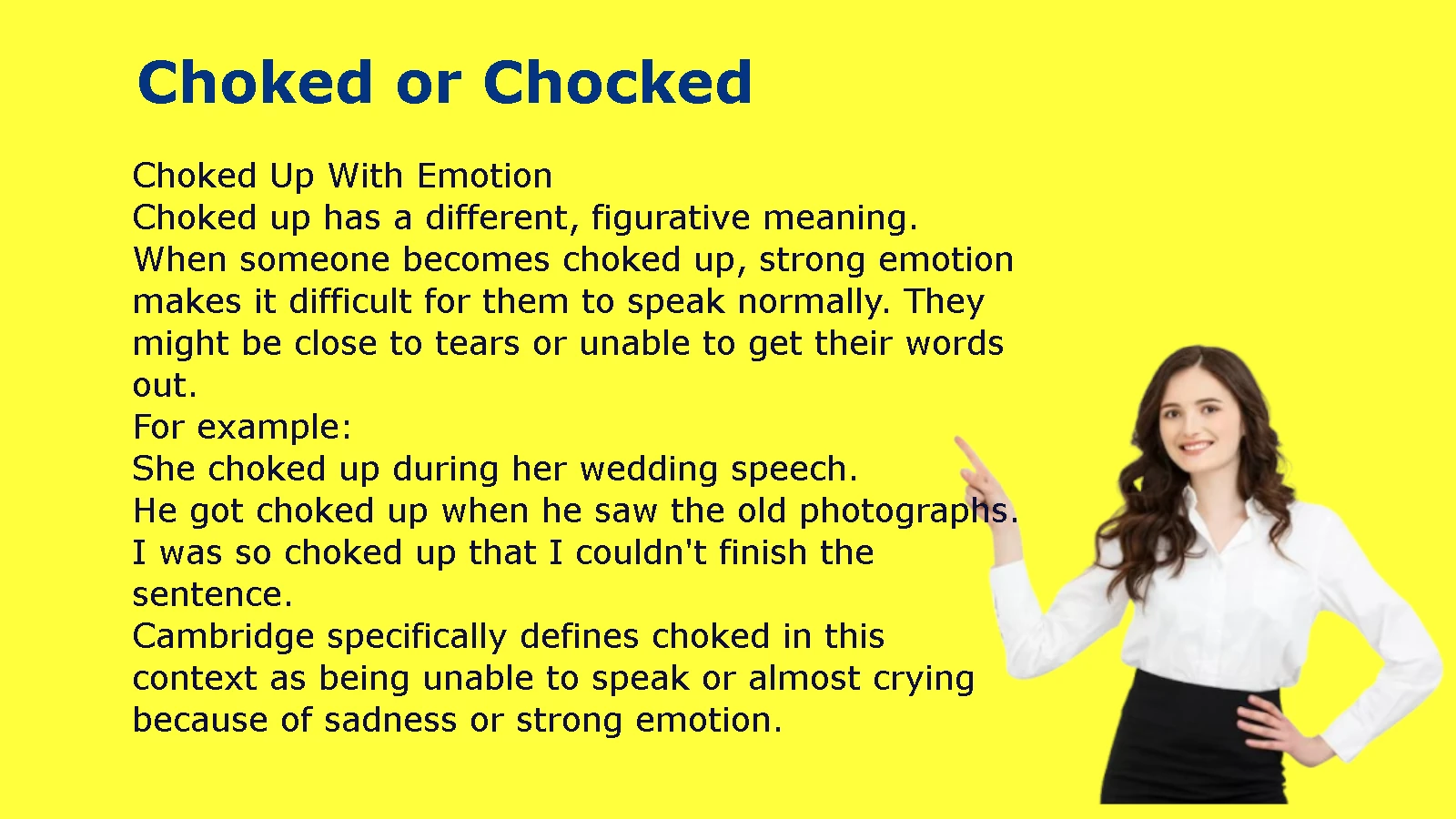
Choked Up With Emotion
Choked up has a different, figurative meaning.
When someone becomes choked up, strong emotion makes it difficult for them to speak normally. They might be close to tears or unable to get their words out.
For example:
- She choked up during her wedding speech.
- He got choked up when he saw the old photographs.
- I was so choked up that I couldn’t finish the sentence.
Cambridge specifically defines choked in this context as being unable to speak or almost crying because of sadness or strong emotion.
This is another situation where choked is correct.
Choked Under Pressure
In sports and other competitive situations, choked can mean failing at an important moment because of pressure or a sudden loss of confidence.
For example:
The player choked in the final.
This doesn’t mean the player literally couldn’t breathe.
It means the person failed to perform when the situation mattered most.
Cambridge labels this use as informal and notes that it commonly appears in sports when someone fails to do something urgent because they suddenly lose confidence.
Merriam Webster also includes this sense, defining it as losing composure and failing to perform effectively in a critical situation.
What Does “Chocked” Mean?
Chocked is a real word. It isn’t simply a misspelling of choked.
It comes from the verb chock.
A chock is a block or wedge used to stop something from moving. You might see chocks used with vehicle wheels, aircraft, boats, machinery, or heavy objects.
Merriam Webster defines chock as a wedge or block used to steady something, keep it motionless, fill a space, or prevent a wheel from moving. As a verb, chock means to stop or make something secure with a chock.
Therefore:
chock → chocked
For example:
- The mechanic chocked the wheels.
- The crew chocked the aircraft before maintenance.
- The workers chocked the trailer before unloading it.
Cambridge likewise defines a chock as a block that can go under a wheel or heavy object to prevent it from moving.
Chocked Wheels
One of the most common places you’ll encounter chocked is in phrases involving vehicles or equipment.
For example:
The wheels were chocked before the mechanic started work.
Here, chocked means someone placed chocks against the wheels to keep the vehicle from moving.
The meaning has nothing to do with choking.
Compare these two sentences:
The driver choked on a piece of food.
The mechanic chocked the wheels.
The first sentence involves choke. The second involves chock.
Chocked Vehicles and Equipment
The same distinction applies to other equipment.
For example:
- The trailer was chocked before loading began.
- Workers chocked the equipment to prevent movement.
- The vehicle was parked and its wheels were chocked.
In each case, chocked describes a deliberate action taken to secure something.
The word often appears in transportation, maintenance, construction, industrial, and mechanical contexts because physical movement needs to be controlled.
Choke vs. Chock: What Is the Difference?
The difference becomes much easier once the two base verbs are separated.
Choke
Choke generally involves blocking, restricting, obstructing, or failing.
It can refer to:
- Breathing
- The throat
- A pipe or drain
- Traffic
- Plants or weeds
- Strong emotion
- Performance under pressure
- Certain mechanical functions
Its past tense is:
choked
Examples:
- He choked on the food.
- The weeds choked the flowers.
- Traffic choked the highway.
- She choked up during the ceremony.
- The team choked in the final.
Merriam Webster records choked as the past form of choke.
Chock
Chock involves securing or stopping something with a block, wedge, or similar device.
Its past tense is:
chocked
Examples:
- They chocked the wheels.
- The crew chocked the aircraft.
- The workers chocked the trailer.
Merriam Webster explicitly lists chocked as the past tense of chock.
The Simple Rule
If you’re unsure, remove the -ed ending and ask which base verb makes sense.
Choked → choke
Chocked → chock
If the sentence means blocked breathing or flow, use choked.
If it means secured something with a block or wedge, use chocked.
Choked vs. Chocked Examples
Seeing the two words side by side makes the difference much clearer.
| Sentence | Correct word | Reason |
| He choked on a bone. | Choked | Something obstructed his throat. |
| The smoke choked the room. | Choked | The smoke filled and obstructed the space. |
| Leaves choked the drain. | Choked | The leaves blocked the drain. |
| She choked up during the speech. | Choked | Strong emotion affected her speech. |
| The team choked under pressure. | Choked | They failed during a critical moment. |
| The mechanic chocked the wheels. | Chocked | Blocks were used to prevent movement. |
| The crew chocked the aircraft. | Chocked | Wheel chocks secured the aircraft. |
| Workers chocked the trailer. | Chocked | The trailer was stabilized with chocks. |
The key isn’t how the sentence sounds. Look at what the action means.
When Should You Use “Choked”?
Use choked whenever you’re using the past form of choke.
Several common sentence patterns can help you recognize it quickly.
“Choked On”
Use choked on when something enters or blocks the throat.
Examples:
- He choked on a piece of meat.
- The child choked on a grape.
- She choked on the drink.
Cambridge specifically lists choke on something as a common construction.
“Choked By”
Use choked by when something becomes obstructed or overwhelmed by another substance or material.
Examples:
- The plants were choked by weeds.
- The drain was choked by leaves.
- The engine struggled after the filter became choked by debris.
This construction often emphasizes the thing causing the obstruction.
“Choked With”
Use choked with when something is extremely crowded or filled.
Examples:
- The streets were choked with traffic.
- The hallway was choked with smoke.
- The drainage channel was choked with mud.
This usage is closely related to the idea of blockage.
“Choked Up”
Use choked up for strong emotion that makes speaking difficult.
Examples:
- She became choked up while thanking her parents.
- He was choked up after hearing the news.
- The speaker got choked up halfway through the speech.
Cambridge recognizes choked up as an expression connected with strong emotion and difficulty speaking.
“Choked Under Pressure”
Use choked when describing a person who fails to perform in an important situation because of pressure.
Examples:
- He choked under pressure.
- The team choked in the final minutes.
- She had the lead but choked at the finish.
This is an informal use, particularly common in sports.
When Should You Use “Chocked”?
Use chocked when the verb is chock.
That usually means someone secured something so it couldn’t move freely.
Chocked Wheels
This is perhaps the clearest example.
The truck’s wheels were chocked before maintenance began.
The chocks act as physical stops.
Chocked Equipment
The word can also apply to machinery and other heavy equipment.
The workers chocked the equipment before beginning the inspection.
The exact method depends on the equipment, but the linguistic point stays the same: chocked means secured with or as if with chocks.
Chocked Aircraft
Aircraft ground operations provide another familiar context.
The aircraft was chocked after it reached its parking position.
Here, wheel chocks help prevent unintended movement while the aircraft remains on the ground.
The noun chock itself refers to a device used to prevent movement. Cambridge gives the example of a block placed under a wheel or heavy object.
Why Do People Confuse “Choked” and “Chocked”?
The confusion makes sense.
The two words look nearly identical:
choked
chocked
They also sound similar enough in ordinary speech that the spelling distinction can disappear when you hear them rather than see them.
There’s another problem: both words describe an action, and both end in -ed.
Yet their roots are completely different:
choke → choked
chock → chocked
That is the piece worth remembering.
A Useful Memory Trick
Think about what you’re doing:
- Your throat is blocked? You choked.
- A wheel is blocked with a physical stop? You chocked it.
In other words:
Choke affects breathing or flow. Chock stops movement.
That’s not a perfect definition of every possible use, but it’s an excellent practical shortcut.
Choked or Chocked in Common Phrases
Certain phrases make the correct spelling especially easy to identify.
| Common phrase | Correct spelling | Meaning |
| choked on food | Choked | Had difficulty because food blocked the throat |
| choked up | Choked | Became emotional and struggled to speak |
| choked with traffic | Choked | Filled or blocked by heavy traffic |
| choked by weeds | Choked | Growth was restricted by weeds |
| choked under pressure | Choked | Failed in an important moment |
| chocked wheels | Chocked | Wheels were secured with chocks |
| chocked the vehicle | Chocked | A vehicle was secured against movement |
| chocked the aircraft | Chocked | An aircraft was secured with wheel chocks |
Notice how choked dominates phrases involving blockage, emotion, and performance.
Chocked, by contrast, appears when something is physically secured.
Choked or Chocked in American English
In American English, choked is the standard past form of choke, while chocked is the standard past form of chock.
This isn’t an American versus British spelling issue.
That’s an important distinction.
Some English words genuinely have different US and UK spellings. Color and colour are a familiar example. Choked and chocked aren’t like that.
The difference comes from two separate verbs.
Merriam Webster gives choke as choked; choking and chock as chocked; chocking; chocks.
So writing chocked when you mean choked isn’t choosing a British spelling. It’s choosing a different word.
Is “Chocked” a Word?
Yes. Chocked is a legitimate English word.
It’s the past tense and past participle of chock.
Merriam Webster explicitly lists:
- chocked
- chocking
- chocks
under the verb chock.
For example:
The driver chocked the wheels before leaving the vehicle.
That sentence is grammatically correct.
Likewise:
The wheels were chocked before the repair work started.
Also correct.
The mistake happens when chocked gets used where choked belongs.
Incorrect:
He chocked on his dinner.
Correct:
He choked on his dinner.
Is “Choked” a Word?
Yes. Choked is the standard past tense and past participle of choke.
It’s used in both literal and figurative contexts.
You can say:
- He choked on a bone.
- The drain choked with debris.
- The streets were choked with traffic.
- She choked up during the speech.
- The player choked under pressure.
Merriam Webster lists choked as the past form of choke and includes these major senses involving breathing, obstruction, emotion, and performance.
So if you mean the past form of choke, there is no reason to add the extra c.
Choked vs. Chocked vs. Choking vs. Chocking
The present participles create another common spelling trap.
| Word | Base verb | Grammatical form | Example |
| Choked | choke | Past tense/past participle | He choked on the food. |
| Choking | choke | Present participle/gerund | He is choking on the food. |
| Chocked | chock | Past tense/past participle | They chocked the wheels. |
| Chocking | chock | Present participle/gerund | They are chocking the wheels. |
Cambridge identifies choking as the present participle of choke.
Merriam Webster gives chocking as the present participle of chock.
So these pairs should stay separate:
choke → choking → choked
chock → chocking → chocked
Why “Chocking” Looks Strange
Many readers instinctively want to write chocking when they see chocked, even though the word looks unusual.
That’s because the base word is chock, not choke.
The spelling follows the base verb:
chock + ing = chocking
The same basic distinction gives:
choke + ing = choking
The two words may look like cousins, but they aren’t interchangeable.
Common Mistakes With Choked and Chocked
Mistake: “He chocked on his food.”
Incorrect: He chocked on his food.
Correct: He choked on his food.
The verb is choke because the sentence describes an obstruction to breathing.
Mistake: “They choked the wheels.”
If you mean that someone placed wheel chocks against the wheels, the correct verb is:
They chocked the wheels.
The verb is chock because the action involves securing the wheels.
Mistake: “She was chocked up.”
Incorrect: She was chocked up.
Correct: She was choked up.
The phrase choked up describes an emotional reaction. Cambridge specifically recognizes choked up in this sense.
Mistake: “The road was chocked with traffic.”
Incorrect: The road was chocked with traffic.
Correct: The road was choked with traffic.
Traffic is obstructing or filling the road. It isn’t being secured with a physical chock.
Mistake: Treating “Chocked” as a Variant of “Choked”
This is the biggest mistake.
Chocked isn’t another spelling of choked.
They’re forms of different verbs.
| If the base word is… | Past form |
| choke | choked |
| chock | chocked |
Once you remember that relationship, most spelling decisions become automatic.
A Practical Case Study: “The Truck”
Consider a sentence about a truck.
The mechanic chocked the truck’s wheels before starting the repair.
Here, chocked is correct because the mechanic used wheel chocks to prevent movement.
Now change the context:
The driver choked on a piece of food while sitting in the truck.
Here, choked is correct because the person had an obstruction in the throat.
The subject happens to be in the same vehicle in both examples. The spelling changes because the action changes.
That’s the real lesson.
Case Study: Traffic
Now consider:
Traffic choked the downtown streets.
The traffic is blocking the flow of vehicles.
You wouldn’t write:
Traffic chocked the downtown streets.
The extra c would change the verb from choke to chock, which doesn’t express the intended meaning.
Cambridge and Merriam Webster both recognize choke for situations where roads or other spaces become obstructed or filled.
How to Remember Choked vs. Chocked
A simple two-part rule covers almost everything:
Use “choked” for choke. Use “chocked” for chock.
Then connect each word with its main idea.
Choked = blocked
Think:
- blocked throat
- blocked drain
- blocked road
- blocked speech
- blocked performance
Chocked = stopped
Think:
- stopped wheel
- secured vehicle
- stabilized equipment
- prevented movement
Here’s an even shorter memory trick:
Choke = breathing or flow.
Chock = movement.
For example:
The drain was choked with leaves.
The wheels were chocked with blocks.
Both sentences involve something being stopped, but the mechanism is different.
Choked or Chocked: Quick Reference Table
| Question | Correct answer |
| What is the past tense of choke? | Choked |
| What is the past tense of chock? | Chocked |
| Is choked a word? | Yes |
| Is chocked a word? | Yes |
| Is “chocked on food” correct? | No |
| Is “choked on food” correct? | Yes |
| Is “choked up” correct? | Yes |
| Is “chocked up” correct? | No, when you mean emotional |
| Is “chocked wheels” correct? | Yes |
| Is “choked with traffic” correct? | Yes |
| Is “chocked with traffic” correct? | No |
| Are choked and chocked interchangeable? | No |
Frequently Asked Questions About Choked or Chocked
Is “chocked” the correct spelling?
Yes, but only when it comes from the verb chock. It means to secure or stop something with a chock or similar device.
For example:
The workers chocked the wheels.
If you mean that someone had difficulty breathing, choked is correct.
Is it “choked on” or “chocked on”?
The correct phrase is choked on.
She choked on a piece of food.
The verb is choke, whose past form is choked.
Is it “choked up” or “chocked up”?
The correct phrase is choked up when you mean becoming emotional and struggling to speak.
He became choked up during the ceremony.
Cambridge specifically recognizes this emotional use.
Is it “chocked wheels” or “choked wheels”?
If you mean wheels secured with physical chocks, the correct phrase is chocked wheels.
Check that the wheels are chocked before beginning work.
What is the past tense of “choke”?
The past tense is choked.
The standard forms are:
- choke
- chokes
- choking
- choked
Merriam Webster lists choked and choking under the verb choke.
What is the past tense of “chock”?
The past tense is chocked.
The standard forms include:
- chock
- chocks
- chocking
- chocked
Merriam Webster explicitly lists these forms.
What is the difference between “choke” and “chock”?
Choke means to obstruct breathing, block or clog something, become emotionally unable to speak, or fail under pressure.
Chock means to secure or stop something with a wedge or block.
Is “chocked” a misspelling of “choked”?
No.
Chocked is a legitimate word. It’s simply the past tense of a different verb, chock.
Is “choked” always related to breathing?
No.
Although breathing is one of its most familiar meanings, choke also describes blocked roads, clogged drains, restricted growth, emotional difficulty speaking, and failure under pressure.
Is “chock” only used for wheels?
No.
A chock can secure wheels and other heavy objects. Cambridge defines it broadly as a block that can be placed under a wheel or heavy object to prevent movement.
Final Verdict: Choked or Chocked?
Both “choked” and “chocked” are correct words. The right choice depends entirely on the verb you mean.
Use choked when you’re talking about choke:
- choked on food
- choked with traffic
- choked by weeds
- choked up with emotion
- choked under pressure
Use chocked when you’re talking about chock:
- chocked the wheels
- chocked the vehicle
- chocked the trailer
- chocked the aircraft
The simplest rule is worth repeating:
Choke → choked
Chock → chocked
So if someone can’t breathe, can’t speak because of emotion, or something is blocked or clogged, choose choked.
If someone uses a block or wedge to keep something from moving, choose chocked.
Once you identify the base verb, the spelling isn’t much of a puzzle anymore.