Have you ever come across Duchess and Dutchess and wondered which spelling is correct? While these words look almost identical, Duchess or Dutchess can be confusing because only one spelling is the standard English word for a female duke.
Duchess is the correct standard spelling. It refers to a woman who holds the rank of duke or the wife of a duke. Dutchess is generally considered a misspelling when you mean the title or rank. However, Dutchess can appear as a proper name, such as in place names or surnames.
Examples:
- The Duchess attended the royal ceremony.
- The Duke and Duchess greeted the guests.
The confusion is understandable. People often search for Duchess or Dutchess, Duchess meaning, Dutchess meaning, or how to spell Duchess because the two spellings sound nearly the same. And here’s the kicker: adding just one letter can turn a correct title into a spelling mistake.
In this guide, you’ll learn the difference between Duchess and Dutchess, their meanings, correct spelling, pronunciation, and usage. You’ll also see Duchess vs. Dutchess examples in sentences and learn when Dutchess may be used as a proper name.
Duchess or Dutchess: Which Is Correct?
Duchess is the correct spelling when you’re referring to the female equivalent of a duke or to a woman who holds the rank of duke.
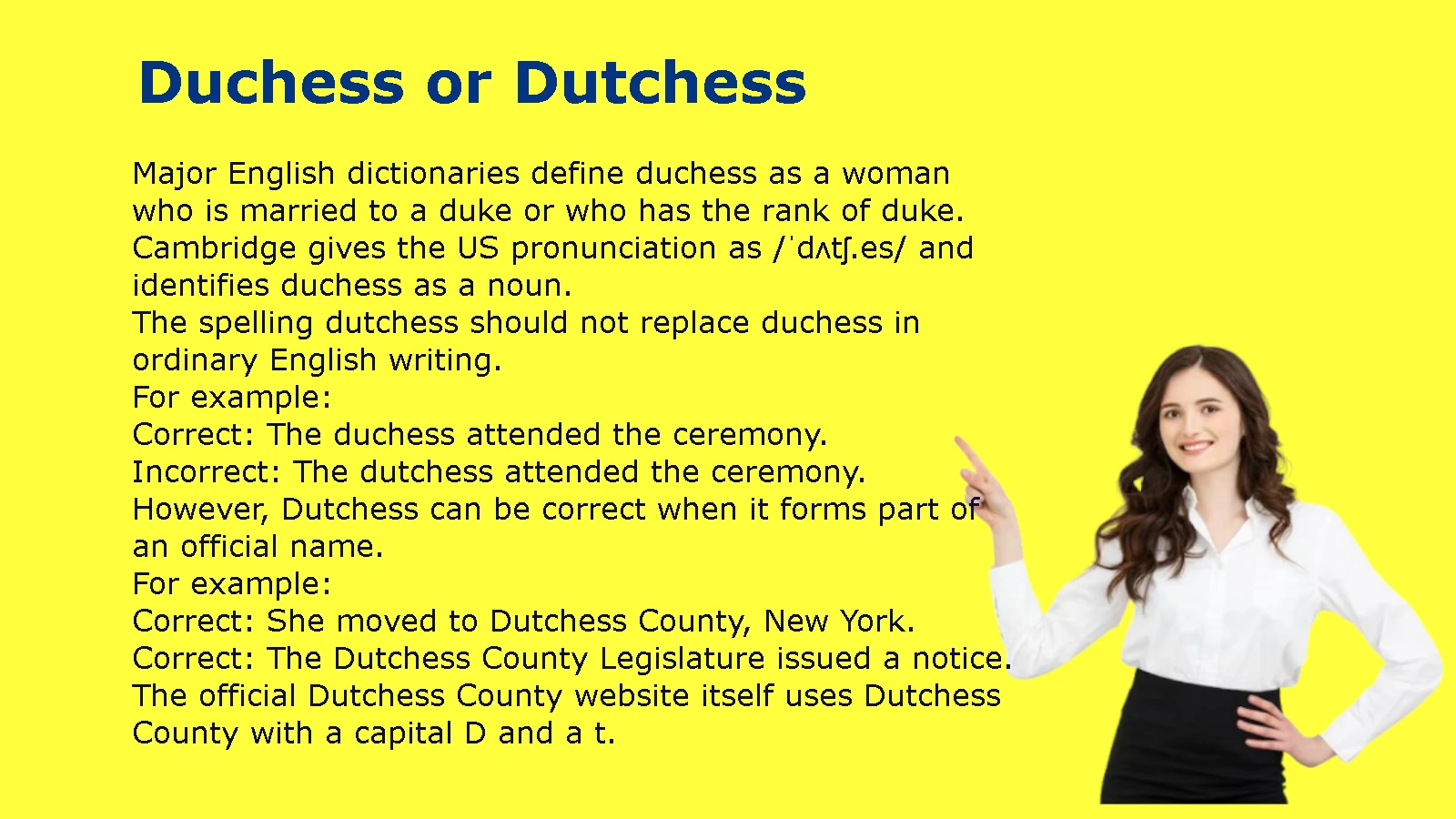
Major English dictionaries define duchess as a woman who is married to a duke or who has the rank of duke. Cambridge gives the US pronunciation as /ˈdʌtʃ.es/ and identifies duchess as a noun.
The spelling dutchess should not replace duchess in ordinary English writing.
For example:
- Correct: The duchess attended the ceremony.
- Incorrect: The dutchess attended the ceremony.
However, Dutchess can be correct when it forms part of an official name.
For example:
- Correct: She moved to Dutchess County, New York.
- Correct: The Dutchess County Legislature issued a notice.
The official Dutchess County website itself uses Dutchess County with a capital D and a t.
Duchess vs. Dutchess at a Glance
| Spelling | Standard English word? | Main use | Example |
| duchess | Yes | Title or rank | The duchess arrived. |
| Dutchess | No, not as the title | Proper names | Dutchess County, New York |
| duchesse | No, not the standard English title | Specialized or foreign language contexts | Depends on context |
The easiest rule is this: If you’re talking about the title, spell it duchess. If you’re writing an official name that contains Dutchess, preserve the proper spelling.
What Does Duchess Mean?
The word duchess refers to a woman associated with the rank of duke.
Cambridge defines a duchess as “a woman who is married to a duke or who has the rank of duke.”
That definition covers two related situations.
First, a duchess can be the wife or widow of a duke. In traditional systems of nobility, a woman could receive the title through her marriage to a man who held the rank.
Second, a woman can hold the rank herself. In that case, her title isn’t merely a courtesy title derived from her husband. She is the person who possesses the rank.
This distinction matters because it’s easy to oversimplify the word as meaning only “a duke’s wife.” Modern dictionary definitions recognize the broader meaning.
Duchess as a Female Noble
A duchess belongs to the upper levels of traditional European aristocratic titles.
The related title duke generally refers to a person holding a high-ranking noble title. Duchess is the corresponding term used for a woman.
The exact legal and social meaning of these titles has varied between countries and historical periods. Not every country has used the title in exactly the same way.
Still, in ordinary modern English, duchess usually brings to mind a woman holding a high aristocratic rank or the wife of a duke.
Duchess and Duchy
The word also connects to duchy, which refers to territory associated with a duke or duchess.
Cambridge defines a duchy as “the area of land owned or ruled by a duke or duchess.”
The relationship looks like this:
Duke → Duchess → Duchy
These words share the duch spelling. That connection provides a useful way to remember the spelling of duchess.
What Does Dutchess Mean?
Here’s where the spelling gets interesting.
Dutchess isn’t the standard English word for a female duke or a duke’s wife. Instead, you’re most likely to encounter it as part of a proper name.
The clearest example is Dutchess County, New York.
The county’s official government website uses Dutchess County throughout its current materials. Its official abbreviation guidance also lists “DUTCHESS COUNTY” as “DUT CO.”
Because proper names have their own established spellings, you shouldn’t “correct” Dutchess County to Duchess County. The extra t belongs to the official name.
Think of it like a person’s name. If someone’s name is spelled Katherine, you don’t change it to Catherine simply because both forms exist. Proper names follow their established spelling.
The same principle applies here.
Is Dutchess a Word?
Dutchess can appear as a legitimate written form within a proper name, but it isn’t the standard English spelling of the title duchess.
That’s an important distinction.
| Question | Answer |
| Is duchess a standard English word? | Yes |
| Is dutchess the standard spelling of the title? | No |
| Can Dutchess appear in a proper name? | Yes |
| Is Dutchess County spelled with a “t”? | Yes |
So, calling Dutchess “always wrong” would be too broad. Calling it the correct spelling for the noble title would also be wrong.
Context decides the answer.
Why Do People Confuse Duchess and Dutchess?
The confusion makes sense when you look at how the word sounds.
Both duchess and Dutchess can look visually plausible to someone who hears the word but hasn’t seen it written often. The beginning of duchess sounds like the beginning of Dutch, which makes the spelling with a t feel intuitive.
That’s where the trap lies.
English spelling doesn’t always give you a perfect letter for letter representation of pronunciation. A person might hear “duchess,” associate the sound with “Dutch,” and write dutchess.
The existence of Dutchess County can make the confusion even stronger.
A reader who encounters that proper name may reasonably assume that dutchess is simply an alternative spelling. It isn’t.
The Key Spelling Difference
Look closely:
- duchess
- dutchess
The only difference is the t.
That single letter changes whether you’re using the standard title or a particular proper name.
A useful memory trick is to connect the word with duke:
duke → duchess
Both contain duch.
You don’t need the t.
How Do You Pronounce Duchess?
In US English, duchess is pronounced roughly like DUCH-ess.
Cambridge gives the US pronunciation as /ˈdʌtʃ.es/.
The first syllable sounds similar to the beginning of Dutch, which helps explain why people sometimes insert a t when spelling the word.
Here’s a simple breakdown:
duchess → DUCH + ess
The word has two syllables:
- DUCH
- ess
The pronunciation itself doesn’t tell you whether the written word contains a t. That’s why seeing the correct spelling in context is useful.
Duchess Pronunciation vs. Spelling
| Word | Approximate sound | Standard spelling |
| Duchess | DUCH-ess | duchess |
| Dutchess | Similar-looking form | Usually a proper name |
The important point is that pronunciation isn’t a reliable spelling guide here. If you’re writing the title, remember duchess.
Duchess Examples in a Sentence
Seeing the word in real sentences makes the distinction easier to remember.
Examples With Duchess as a Title
- The Duchess of Kent attended the ceremony.
- The duchess greeted the guests after the event.
- Everyone waited for the duchess to arrive.
- The duchess spoke with local community leaders.
- The newspaper published an article about the duchess.
Notice how capitalization can change depending on how the title is used.
When the title forms part of a formal name, it is commonly capitalized:
the Duchess of Kent
When you’re using the word as an ordinary noun, it is lowercase:
The duchess attended the event.
Examples With the Possessive Form
The possessive form is also straightforward:
- The duchess’s speech attracted attention.
- The duchess’s residence was open to visitors.
- The duchess’s decision surprised the public.
For standard US English, duchess’s is the normal singular possessive spelling.
Dutchess Examples in a Sentence
Now compare those examples with Dutchess.
- She lives in Dutchess County, New York.
- Dutchess County has its own county government.
- The notice was published by the Dutchess County Legislature.
- The family moved to Dutchess County several years ago.
Here, Dutchess isn’t describing a noblewoman.
It’s part of a geographic proper name.
The official Dutchess County website currently uses the spelling Dutchess County, confirming that the t belongs in the name.
A Simple Context Test
When you’re unsure, ask:
Am I talking about a noble title or a place name?
If you’re talking about a noble title:
duchess
If you’re talking about the New York county:
Dutchess County
That one question will solve most spelling problems.
Duchess Plural: Is It Duchesses or Dutchesses?
The plural of duchess is duchesses.
You add es to the singular form:
duchess → duchesses
The spelling keeps the original duch beginning.
Examples of Duchesses
- Several duchesses attended the celebration.
- The book profiles famous duchesses throughout history.
- The duchesses arrived separately.
- European history includes many notable duchesses.
The plural is not dutchesses when you’re referring to the title.
Singular and Plural Forms
| Number | Correct form | Example |
| Singular | duchess | The duchess arrived. |
| Plural | duchesses | Several duchesses arrived. |
| Singular possessive | duchess’s | The duchess’s speech began. |
| Plural possessive | duchesses’ | The duchesses’ outfits attracted attention. |
The apostrophe also follows the usual English possessive pattern.
Duchess vs. Duke: What’s the Difference?
Duke and duchess are closely related titles.
A duke is a person who holds the rank of duke. Duchess refers to a woman who holds the rank or is the wife or widow of a duke, depending on the title system and context. Cambridge specifically includes both meanings in its definition.
Here’s the basic comparison:
| Title | Meaning |
| Duke | A person who holds the rank of duke |
| Duchess | A woman who holds the rank of duke or is married to a duke |
| Dukedom | The rank, title, or territory associated with a duke |
| Duchy | A territory associated with a duke or duchess |
This relationship is another reason duchess should be spelled with duch, not dutch.
Is a Duchess Always Married to a Duke?
No.
This is one of the most useful details to understand about the word.
A common simplified definition says that a duchess is “the wife of a duke.” That description works in many traditional contexts, but it doesn’t capture the entire meaning.
Cambridge explicitly defines a duchess as a woman who is married to a duke or has the rank of duke.
That means the word can describe:
- A woman who holds the rank herself.
- A woman whose title comes through marriage to a duke.
- In some contexts, a widow who retains a courtesy or established title.
The exact rules depend on the particular monarchy, aristocratic system, or historical period being discussed.
For ordinary English usage, however, the key point is simple: duchess isn’t limited to the phrase “wife of a duke.”
Duchess, Duchesse, and Dutchess: What’s the Difference?
Three forms can cause confusion:
- duchess
- duchesse
- Dutchess
They aren’t interchangeable.
Duchess
Duchess is the standard English word for the female title or rank.
Example:
The duchess attended the ceremony.
Dutchess
Dutchess appears in proper names, most notably Dutchess County, New York.
Example:
They moved to Dutchess County.
It isn’t the standard spelling of the noble title.
Duchesse
Duchesse is different again. It may appear in specialized English usage or as a form connected with other languages. It shouldn’t be treated as a routine alternative spelling of duchess.
For example, Cambridge’s French English dictionary translates French duchesse as duchess in English.
The three forms therefore serve different purposes:
| Form | Main role |
| duchess | Standard English title |
| Dutchess | Proper name, especially Dutchess County |
| duchesse | French or specialized usage |
This is why replacing one spelling with another without checking the context can create an error.
Common Duchess and Dutchess Mistakes
A few examples make the difference crystal clear.
Mistake: Using Dutchess for the Title
Incorrect:
The dutchess arrived at the palace.
Correct:
The duchess arrived at the palace.
The title takes duchess.
Mistake: Changing Dutchess County to Duchess County
Incorrect:
She lives in Duchess County, New York.
Correct:
She lives in Dutchess County, New York.
The official geographic name contains the t.
Mistake: Assuming Dutchess Is an Alternative Spelling
Incorrect assumption:
Duchess and dutchess are two accepted spellings of the same title.
Better understanding:
Duchess is the standard English title, while Dutchess appears in specific proper names.
That distinction is small but important.
How to Remember the Spelling of Duchess
Here’s the easiest trick:
Think Duke → Duchess
Start with:
duke
Then remember:
duchess
Both words begin with duch.
If you’re writing about a noble title, don’t let the sound of Dutch pull you toward the extra t.
You can also remember the phrase:
A duke has a duchess, not a dutchess.
It isn’t a complicated mnemonic. That’s the point. Simple rules are easier to recall when you’re writing quickly.
When Should You Capitalize Duchess?
Capitalization depends on how you’re using the title.
When duchess forms part of a formal title or name, capitalize it:
- the Duchess of Kent
- the Duchess of York
When you use it as a general noun, lowercase it:
- The duchess arrived early.
- Several duchesses attended the event.
This follows a broader English writing principle: formal titles can be capitalized when they directly precede or form part of a person’s name, while generic references are normally lowercase.
Always follow the style guide you’re writing under when a publication has specific capitalization rules.
Why the Correct Spelling Matters
At first glance, the difference between duchess and dutchess looks tiny. It’s only one letter.
But spelling isn’t just about individual letters. It also tells readers what you mean.
If you write:
The dutchess attended the event.
Most readers will understand what you intended. Still, the spelling looks incorrect because dutchess isn’t the standard English form of the title.
On the other hand, writing:
Dutchess County
with the t is correct because you’re using an established proper name.
Good writing depends on these small distinctions. One letter can separate an ordinary noun from a geographic name.
Quick Facts About Duchess
Here are the most important facts to remember:
- Duchess is the standard English spelling.
- A duchess is a woman who is married to a duke or who holds the rank of duke.
- Dutchess is not the standard spelling of the title.
- Dutchess County is a legitimate proper name in New York.
- The plural of duchess is duchesses.
- The US pronunciation is approximately DUCH-ess.
- The spelling connects naturally with duke, duchy, and related terms.
- Duchesse is not simply another standard spelling of duchess in English.
Duchess or Dutchess: A Practical Comparison
| Feature | Duchess | Dutchess |
| Correct spelling of the noble title | Yes | No |
| Refers to a female noble of duke rank | Yes | No |
| Can refer to a duke’s wife | Yes | No |
| Standard English noun | Yes | No |
| Used in a geographic proper name | Sometimes | Yes |
| Example | The duchess arrived. | Dutchess County |
| Plural | Duchesses | Depends on the proper name |
| Pronunciation | DUCH-ess | Depends on the name or context |
The table reveals the key idea: the spellings aren’t interchangeable.
Frequently Asked Questions About Duchess or Dutchess
Is it duchess or dutchess?
Duchess is the correct spelling when you’re referring to the noble title. Dutchess is found in proper names such as Dutchess County, New York.
Is “dutchess” a word?
Dutchess can appear as part of a proper name, but it isn’t the standard English spelling of the title duchess.
What does duchess mean?
A duchess is a woman who is married to a duke or who holds the rank of duke.
What is the plural of duchess?
The plural is duchesses.
For example:
Several duchesses attended the event.
How do you spell duchess?
Spell it:
D-U-C-H-E-S-S
The correct word contains duch, not dutch.
How do you pronounce duchess?
In US English, duchess is pronounced approximately DUCH-ess, with the first syllable receiving the main stress. Cambridge lists the US pronunciation as /ˈdʌtʃ.es/.
Why is Dutchess County spelled with a “t”?
Dutchess is part of the county’s official proper name. The county’s own government website uses Dutchess County and lists the name in its official abbreviation guidance.
Is Dutchess County spelled Duchess County?
No. The official name is Dutchess County with a t. Current county government materials continue to use that spelling.
Is a duchess the same as a female duke?
The terms overlap, but the exact title system matters. A duchess can be a woman who holds the rank of duke. The word can also refer to the wife of a duke. Cambridge recognizes both meanings.
Is “duchesse” another spelling of duchess?
Not as the standard English title. Duchesse can occur in French or specialized contexts, but duchess is the standard English spelling.
Should duchess be capitalized?
Capitalize Duchess when it forms part of a formal title used with a name, such as the Duchess of Kent. Use lowercase when referring to the person generally, such as the duchess arrived.
Final Answer: Duchess or Dutchess?
If you’re choosing between duchess or dutchess, use duchess when you mean the noble title.
Duchess is the standard English spelling for a woman who is married to a duke or who holds the rank of duke.
Dutchess is different. It appears in proper names, most famously Dutchess County, New York, where the spelling with the t is official.
The easiest rule to remember is:
Duke → Duchess
Dutchess → Proper name, such as Dutchess County
So if you’re writing about an aristocratic title, choose duchess. If you’re writing the name of the New York county, keep Dutchess exactly as it is.
One extra letter can seem insignificant, but in this case it changes the context completely.