Have you ever wondered whether you should say “disorganized” or “unorganized” when something lacks order or structure? While Disorganized or Unorganized may seem like a simple word choice, the two terms can have slightly different meanings depending on the context, usage, and what you’re describing.
Disorganized usually means lacking order, structure, or planning. It is the more common and natural choice when describing a person, system, workplace, schedule, or collection of things.
Examples:
- Her desk is always disorganized.
- The meeting became disorganized after the schedule changed.
Unorganized can also mean lacking organization, but it is less common in many contexts. It can sometimes emphasize that something has not been organized rather than that it is poorly organized.
The confusion is understandable. People often search for disorganized or unorganized, disorganized vs unorganized, is it unorganized or disorganized, and which is correct, disorganized or unorganized because both words can describe something that is not arranged properly. And here’s the kicker: although they can overlap, disorganized is usually the better choice in everyday English.
In this guide, you’ll learn the difference between disorganized and unorganized, their definitions, correct usage, examples in sentences, and common situations where each word fits best. You’ll also discover whether unorganized is a real word, how the two terms compare, and which one you should use in formal and casual writing.
Disorganized vs. Unorganized: Quick Answer
If you need a simple rule, use this:
Disorganized usually emphasizes disorder, poor planning, or a lack of structure. Unorganized usually emphasizes the absence of organization or something that has not been organized.
Here’s the distinction at a glance:
| Word | Main idea | Common use | Example |
| Disorganized | Lacking order, structure, or effective planning | People, rooms, schedules, plans, systems, thoughts | “Her schedule is disorganized.” |
| Unorganized | Not organized or not arranged into a system | Files, data, material, groups, activities | “The data is unorganized.” |
However, don’t treat this table as a rigid grammar rule. English doesn’t draw a bright line between the two words.
In fact, Oxford defines unorganized as including the sense “badly planned; not able to plan or organize well,” while also giving it the separate meaning “not having been organized.” Oxford’s American entry similarly lists disorganized as the more frequent form in the overlapping sense.
That overlap explains why both sentences can sound perfectly natural:
- “The meeting was disorganized.”
- “The meeting was unorganized.”
The first may put more emphasis on the meeting’s poor structure or confusion. The second can simply describe the meeting as lacking organization.
What Does “Disorganized” Mean?
Disorganized is an adjective that describes a person, thing, activity, or system that lacks order or effective organization.
Oxford describes it as something that is “badly planned” or a person who isn’t able to organize well.
The word can apply to both physical and abstract situations.
You can have:
- a disorganized desk
- a disorganized office
- a disorganized schedule
- a disorganized project
- a disorganized meeting
- a disorganized team
- disorganized notes
- disorganized thoughts
- a disorganized system
- a disorganized person
The central idea is a failure of order or structure.
Examples of “Disorganized”
Consider these sentences:
“My desk is disorganized because I keep putting papers wherever there’s room.”
Here, disorganized suggests more than simply “not arranged.” The desk has become difficult to use because the items don’t follow a clear system.
“The project became disorganized after the manager left.”
This sentence focuses on a breakdown in coordination and structure.
“Her schedule is so disorganized that she often forgets appointments.”
Here, disorganized describes a person’s difficulty managing activities effectively.
“The report contains disorganized information.”
The information may be present, but the reader has trouble following it because the material lacks a clear structure.
That flexibility makes disorganized especially common in everyday English.
What Does “Unorganized” Mean?
Unorganized is also a legitimate adjective. It can mean something isn’t organized, lacks a system, or hasn’t been arranged into an organized whole.
Oxford specifically gives “unorganized data” as an example of the word’s meaning “not having been organized.”
American Heritage defines unorganized as lacking order, unity, or a system and gives disorganized as a related meaning.
So, no, unorganized isn’t a mistake.
It can describe:
- unorganized data
- unorganized files
- unorganized documents
- an unorganized essay
- an unorganized group
- an unorganized activity
- unorganized material
- unorganized workers
Examples of “Unorganized”
“The files are still unorganized.”
The sentence suggests that nobody has arranged the files into a useful system yet.
“We received a large amount of unorganized data.”
The data exists, but it hasn’t been sorted, classified, or arranged.
“The essay was unorganized.”
This can mean the ideas weren’t presented in a clear or systematic order.
“The volunteers were unorganized during the event.”
Here, unorganized overlaps strongly with disorganized. It describes a lack of coordination.
This last example shows why the distinction isn’t absolute.
What Is the Difference Between Disorganized and Unorganized?
The difference between disorganized and unorganized is mainly one of emphasis and context, not basic grammatical correctness.
Disorganized often emphasizes disorder
When you call something disorganized, you’re often pointing to a problem with its structure, planning, coordination, or arrangement.
For example:
“The office is disorganized.”
This commonly suggests that the office is messy or poorly arranged.
“The company has a disorganized workflow.”
This suggests that the process lacks structure and may cause delays or confusion.
“He is disorganized.”
This describes a person’s habits or ability to manage things.
Unorganized can emphasize the absence of organization
When you use unorganized, the focus can be more neutral.
Something may simply not have been organized.
For example:
“The survey responses are unorganized.”
The responses might not be messy in a physical sense. They may simply exist as raw material that hasn’t yet been categorized.
Likewise:
“The photographs are unorganized.”
This could mean nobody has sorted them by date, event, location, or subject.
The difference becomes clearer when you imagine a box full of documents.
If you say:
“The documents are unorganized.”
You’re emphasizing that nobody has arranged them into a system.
If you say:
“The documents are disorganized.”
You’re more likely to suggest that the documents are difficult to manage because their arrangement is confusing or disorderly.
Both can be correct.
Disorganized vs. Unorganized Examples
Context makes the distinction easier to understand.
| Situation | Natural choice | Example | Why |
| Messy desk | Disorganized | “His desk is disorganized.” | Focuses on disorder |
| Poorly planned schedule | Disorganized | “Her schedule is disorganized.” | Focuses on poor organization |
| Raw data | Unorganized | “The data is unorganized.” | Emphasizes that it hasn’t been arranged |
| Confusing notes | Disorganized | “My notes are disorganized.” | Ideas lack a clear structure |
| Unsorted documents | Unorganized | “The documents are unorganized.” | They haven’t been arranged |
| Confusing meeting | Disorganized | “The meeting was disorganized.” | The event lacked structure |
| Unstructured material | Unorganized | “The material is unorganized.” | Focuses on the absence of organization |
| Person who struggles with planning | Disorganized | “He’s disorganized.” | Common description of personal habits |
The important point is that these are usage tendencies, not laws.
Merriam Webster treats disorganized and unorganized as closely related words. Its current thesaurus entry lists unorganized as a synonym of disorganized, while the reverse entry lists disorganized as a synonym of unorganized.
Can You Use “Disorganized” for a Person?
Yes. In fact, disorganized is a very natural word for describing someone’s habits.
You might say:
- “She’s disorganized.”
- “He’s extremely disorganized at work.”
- “I can be disorganized when I’m busy.”
- “My roommate is disorganized.”
- “The new manager seems disorganized.”
In these sentences, disorganized describes the person’s approach to planning, arranging, remembering, or managing things.
Oxford’s examples specifically include sentences such as “She’s so disorganized” and describe a person who struggles to plan or organize effectively.
Can You Say “Unorganized Person”?
Yes, “unorganized person” is grammatically possible.
However, in ordinary American English, “disorganized person” often sounds more natural when you mean someone who struggles with organization.
Compare:
“He’s a disorganized person.”
This naturally describes a person’s habits.
“He’s an unorganized person.”
This is understandable, but it may sound more like a general description of someone who lacks organization rather than the familiar label disorganized.
The difference isn’t about one being correct and the other being incorrect. It’s about what sounds most idiomatic in a particular context.
Can You Use “Disorganized” and “Unorganized” Interchangeably?
Sometimes, yes.
Because the meanings overlap, you can replace one with the other in many sentences without creating a grammatical error.
For example:
“The team was disorganized.”
“The team was unorganized.”
Both sentences describe a team that lacks effective organization.
But the first sentence is often the more natural everyday choice.
Now consider:
“The database contains unorganized data.”
Here, unorganized has a useful sense of data that hasn’t been processed or arranged.
You could say:
“The database contains disorganized data.”
That’s also possible, but it can suggest that the data itself is poorly structured or confusing.
So the choice can affect the shade of meaning, even when the basic message remains the same.
Is “Unorganized” a Correct Word?
Yes. “Unorganized” is a correct English word.
This point is worth making because many people assume that the only correct form is disorganized. Dictionaries don’t support that assumption.
Oxford lists unorganized as an adjective and gives several meanings, including “not having been organized.” It also lists disorganized as a more frequent equivalent in one overlapping sense.
American Heritage likewise defines unorganized as lacking order, unity, or a system and includes disorganized in its definition.
Collins also recognizes unorganized in American English and gives meanings related to having no regular order or system.
So there’s no reason to “correct” someone merely because they wrote unorganized.
Is “Unorganized” the Same as “Disorganized”?
Not perfectly.
A useful way to think about the difference is:
Unorganized: The organization is absent.
Disorganized: The organization is poor, ineffective, confused, or lacking structure.
That distinction isn’t universal, but it helps explain why one word may sound better in a particular sentence.
Is “Disorganized” a Correct Word?
Absolutely.
Disorganized is a standard adjective in American English.
Oxford’s American Dictionary lists it as the standard form and identifies unorganized as less frequent in the overlapping sense.
It can describe:
- People: “She is disorganized.”
- Places: “The garage is disorganized.”
- Events: “The conference was disorganized.”
- Plans: “The plan is disorganized.”
- Information: “The information is disorganized.”
- Thoughts: “His thoughts seemed disorganized.”
- Systems: “The filing system is disorganized.”
The word doesn’t require physical mess.
That’s an important distinction.
A person can have a perfectly clean desk and still have a disorganized schedule. Likewise, a report can look beautiful on the page while presenting its ideas in a disorganized way.
Disorganized or Unorganized for a Messy Room?
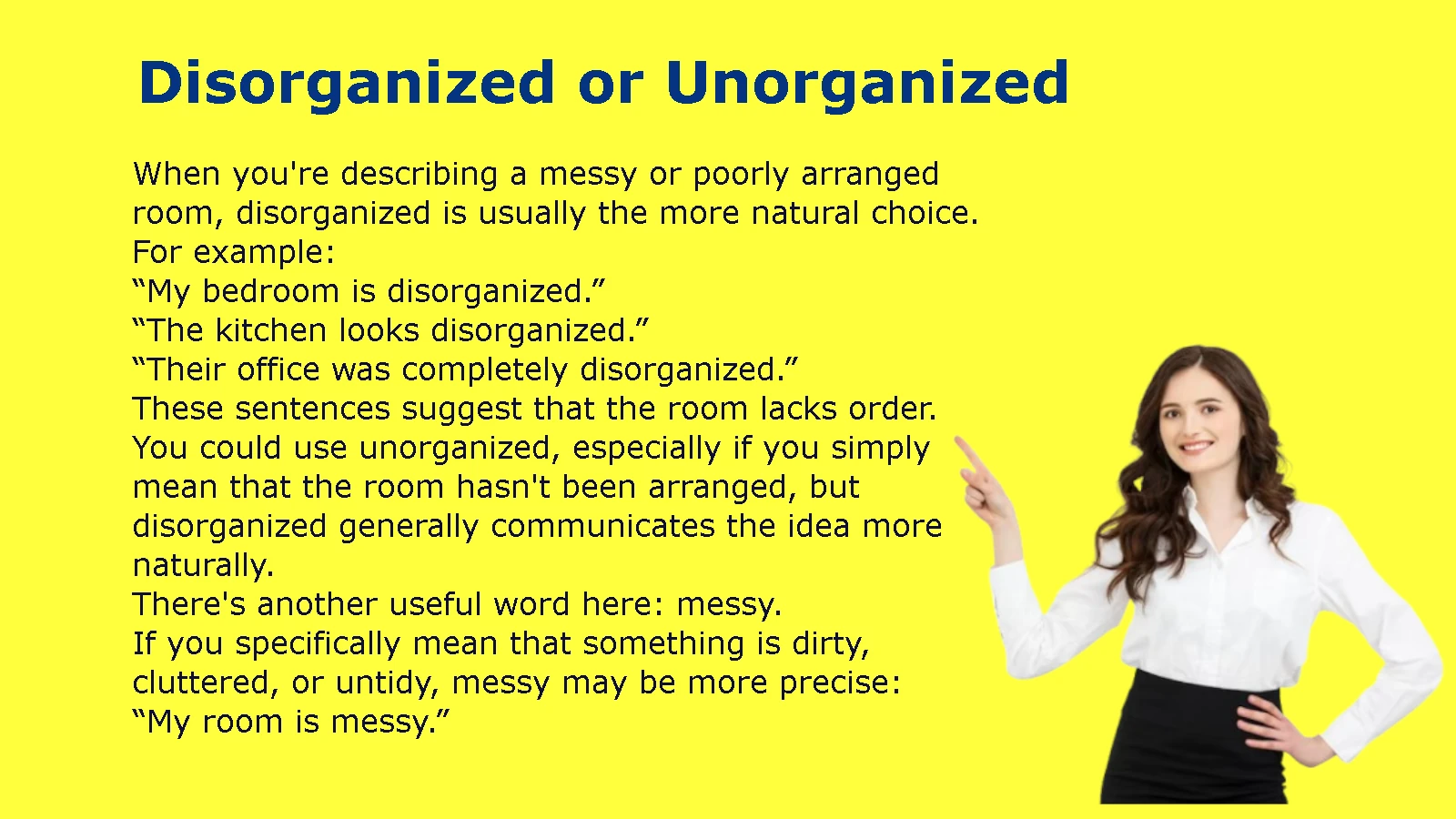
When you’re describing a messy or poorly arranged room, disorganized is usually the more natural choice.
For example:
“My bedroom is disorganized.”
“The kitchen looks disorganized.”
“Their office was completely disorganized.”
These sentences suggest that the room lacks order.
You could use unorganized, especially if you simply mean that the room hasn’t been arranged, but disorganized generally communicates the idea more naturally.
There’s another useful word here: messy.
If you specifically mean that something is dirty, cluttered, or untidy, messy may be more precise:
“My room is messy.”
If you mean that the objects aren’t arranged logically:
“My room is disorganized.”
Those meanings overlap, but they’re not identical.
A room can be messy without being disorganized, such as when someone leaves a few clothes on the floor but keeps everything else in its proper place.
Likewise, a room can be disorganized without being dirty. The furniture, books, and supplies might simply have no sensible arrangement.
Disorganized or Unorganized for Files and Data?
This is one situation where unorganized can be particularly useful.
Suppose a researcher collects 5,000 survey responses. The responses exist, but nobody has sorted them into categories.
You could say:
“The survey data is unorganized.”
That focuses on the fact that the data hasn’t been arranged.
If the data has been processed but the categories are confusing or poorly structured, you might say:
“The data is disorganized.”
The distinction is subtle, but it gives you more control over your wording.
Oxford specifically uses “unorganized data” as an example of the word unorganized.
Practical Example
Imagine three stages of handling information:
Stage one: Raw material
“The data is unorganized.”
Nothing has been sorted yet.
Stage two: Poorly arranged material
“The data is disorganized.”
Someone attempted to arrange it, but the resulting structure is confusing.
Stage three: Clear structure
“The data is organized.”
The information follows a useful system.
This isn’t a strict technical definition. It’s a practical way to understand how the words can differ in real writing.
Disorganized or Unorganized in a Sentence
The easiest way to learn the difference is to see the words working in context.
For people
- “He’s disorganized and often forgets deadlines.”
- “She’s usually organized, but this week has been hectic.”
- “The new employee seemed disorganized during the first meeting.”
- “An unorganized person may struggle to keep track of several tasks.”
For work
- “The project became disorganized after the schedule changed.”
- “The team’s files are still unorganized.”
- “The workflow is disorganized and needs a clearer structure.”
- “We received several folders of unorganized documents.”
school
- “My notes are disorganized.”
- “The research material was unorganized.”
- “Her essay felt disorganized because the ideas jumped between topics.”
- “The students had a large amount of unorganized information to review.”
schedules
- “My calendar is disorganized.”
- “The travel schedule was disorganized.”
- “The original itinerary was unorganized.”
- “His workday becomes disorganized when he doesn’t plan ahead.”
meetings
- “The meeting was disorganized.”
- “The event felt unorganized from the beginning.”
- “The discussion became disorganized after several people started speaking at once.”
Notice something important: both words can appear naturally in almost every category.
That is why memorizing an absolute rule can do more harm than good.
Common Mistakes With Disorganized and Unorganized
The biggest mistakes happen when writers treat the words as if English gives them completely separate territories.
Mistake: Assuming “unorganized” is wrong
It isn’t.
Major dictionaries recognize the word. Oxford, American Heritage, and Collins all include it.
Better approach: Choose between the words based on context and natural usage.
Mistake: Assuming “disorganized” always means messy
It doesn’t.
Someone can have disorganized:
- thoughts
- plans
- schedules
- information
- systems
- teams
None of those necessarily involves physical clutter.
Mistake: Assuming “unorganized” always means temporary
Not necessarily.
Something can remain unorganized indefinitely.
For example:
“The region remained unorganized for decades.”
Or:
“The documents were stored in an unorganized collection.”
Context determines the time frame.
Mistake: Treating the distinction as a strict grammar rule
The dictionaries themselves show substantial overlap.
Merriam Webster treats the words as synonyms, while Oxford explicitly gives unorganized as a less frequent equivalent of disorganized in one sense.
So don’t write a rule that says:
“Never use unorganized when you mean disorganized.”
That rule is simply too rigid.
Disorganized vs. Unorganized: Grammar and Word Formation
Both words are adjectives built from organized.
The prefixes create negative meanings:
- organized → disorganized
- organized → unorganized
But English prefixes don’t always produce perfectly identical words.
The prefix un- commonly expresses a lack or absence of a quality.
So unorganized can naturally mean not organized.
The prefix dis- can also indicate separation, reversal, or negation. In disorganized, the resulting word commonly describes something lacking effective order or organization.
The distinction is easiest to understand through examples rather than prefix theory.
Compare:
“The files are unorganized.”
The files aren’t organized into a system.
“The filing system is disorganized.”
The system itself is poorly structured or functioning badly.
The second sentence feels more strongly evaluative. It points to a problem.
Disorganized vs. Unorganized: Which Sounds More Natural?
If you’re unsure which word to choose, disorganized is usually the safer everyday choice when describing poor organization.
Oxford’s American entry labels unorganized as less frequent in the overlapping sense, while Oxford’s broader entry similarly identifies disorganized as the more common form.
That makes disorganized a strong choice for:
- people
- schedules
- rooms
- meetings
- plans
- projects
- teams
- thoughts
- workflows
Meanwhile, unorganized works especially well when you want to emphasize that something has not been organized or arranged.
For example:
“The photographs are unorganized.”
“The survey responses are unorganized.”
“The raw data is unorganized.”
That doesn’t make disorganized wrong in those sentences. It simply makes unorganized a useful alternative.
Practical Case Studies: Choosing the Right Word
Case Study: A cluttered desk
Imagine a desk covered with receipts, notebooks, coffee cups, pens, and unopened mail.
You say:
“The desk is disorganized.”
That’s the natural choice because the physical arrangement lacks order.
If the owner has simply dumped a box of new documents onto the desk and hasn’t sorted them yet, you could also say:
“The documents on the desk are unorganized.”
The first focuses on disorder. The second can focus on the lack of sorting.
Case Study: Raw research data
A researcher receives thousands of survey responses.
The information hasn’t been categorized yet.
The clearest sentence is:
“The survey data is unorganized.”
Once the researcher sorts it into categories but creates a confusing system, you might describe it as:
“The data is disorganized.”
Again, this is a difference in emphasis rather than an unbreakable rule.
Case Study: A poorly managed meeting
A team starts a meeting without an agenda. People interrupt each other, topics change constantly, and nobody knows what decision needs to be made.
The natural description is:
“The meeting was disorganized.”
Here, the word captures confusion, poor planning, and weak structure.
You could say unorganized, but disorganized carries the situation more naturally.
Case Study: An unsorted photo collection
Imagine thousands of digital photographs stored in one folder. Nobody has created folders for birthdays, vacations, work events, or family pictures.
You could write:
“The photo collection is unorganized.”
The photographs aren’t necessarily chaotic. They simply haven’t been arranged into a system.
If the folders exist but contain images with random names, duplicate files, missing dates, and inconsistent categories, then:
“The photo collection is disorganized.”
The organization exists, but it doesn’t work well.
Disorganized vs. Unorganized: Synonyms
Sometimes neither word is the perfect choice. The best word depends on the exact problem you’re describing.
Synonyms for “Disorganized”
- messy — lacking neatness or order
- chaotic — extremely confused or uncontrolled
- disordered — lacking proper order
- scattered — spread around without clear arrangement
- confused — difficult to understand or follow
- cluttered — crowded with too many objects
- jumbled — mixed together in a confusing way
- haphazard — lacking a clear plan or method
- unstructured — lacking a defined structure
- uncoordinated — lacking effective cooperation or planning
Merriam Webster and Cambridge thesaurus material also place words such as disordered, disjointed, confused, chaotic, unstructured, and haphazard in the same broad semantic neighborhood.
Synonyms for “Unorganized”
Depending on context, you might use:
- unsorted
- unarranged
- unordered
- unstructured
- unclassified
- random
- haphazard
- unsystematic
- uncoordinated
- disorganized
But be careful.
These aren’t interchangeable in every sentence.
For example, unsorted data specifically suggests that categories or ordering haven’t been applied. Chaotic data suggests something much more extreme. Unstructured data has a more specific technical meaning in some fields.
Choosing the most precise word often makes a sentence stronger than simply reaching for a synonym.
An Easy Way to Remember the Difference
Use this simple memory trick:
Unorganized = not organized.
Disorganized = poorly organized or lacking order.
Think about a new box of papers.
Nobody has touched the papers yet:
Unorganized.
Someone sorts them into folders but puts invoices with photographs, mixes dates, and creates duplicate categories:
Disorganized.
That mental picture won’t cover every possible sentence, but it gives you a reliable starting point.
Disorganized or Unorganized: Which One Should You Use?
When you’re writing and can’t decide, ask one question:
Am I emphasizing the absence of organization, or am I describing poor organization?
Choose unorganized when you mainly mean:
- not organized
- not sorted
- not arranged
- not classified
- not yet structured
Choose disorganized when you mainly mean:
- messy
- poorly planned
- confusing
- badly structured
- lacking coordination
- difficult to manage
- unable to organize effectively
Here’s the practical guide:
| If you mean… | Better choice |
| A person who struggles with organization | Disorganized |
| A messy desk | Disorganized |
| A poorly planned meeting | Disorganized |
| Confusing notes | Disorganized |
| Raw, unsorted data | Unorganized |
| Files that haven’t been arranged | Unorganized |
| A poorly structured system | Disorganized |
| Something simply not organized | Unorganized |
| A chaotic project | Disorganized |
| Material that hasn’t been classified | Unorganized |
The key word is tendency.
These choices aren’t absolute grammatical rules. English speakers regularly use the two words in overlapping ways.
Frequently Asked Questions About Disorganized or Unorganized
Is “unorganized” grammatically correct?
Yes. Unorganized is a standard English adjective recognized by major dictionaries. It can mean lacking organization or not having been organized.
Is “disorganized” or “unorganized” more common?
Disorganized is generally the more frequent choice in the overlapping everyday sense, especially when describing people or something that is poorly planned or lacks effective structure. Oxford explicitly marks unorganized as less frequent in this sense.
Is “unorganized” a synonym for “disorganized”?
Yes, in many contexts.
Merriam Webster lists disorganized as a synonym of unorganized and unorganized as a synonym of disorganized.
However, the words can emphasize different aspects of a situation.
Which word should I use for a person?
Disorganized is usually the more natural choice.
For example:
“She’s very disorganized.”
This sounds more idiomatic than:
“She’s very unorganized.”
The second sentence is understandable, but the first is more conventional in everyday American English.
Which word should I use for messy things?
Disorganized often works better when the thing lacks order or structure.
For example:
“The closet is disorganized.”
If you’re specifically emphasizing that items haven’t been sorted, unorganized can also work.
Can you say “unorganized data”?
Yes.
In fact, Oxford specifically gives “unorganized data” as an example of unorganized meaning data that hasn’t been organized.
Can you say “disorganized data”?
Yes.
Disorganized data can suggest that the information lacks a clear or useful structure.
What’s the opposite of “disorganized”?
The straightforward opposite is organized.
disorganized → organized
You can also use words such as orderly, structured, systematic, or well organized depending on the sentence.
What’s the opposite of “unorganized”?
Again, organized is the direct opposite.
unorganized → organized
Other possibilities include arranged, ordered, structured, and systematized, depending on context.
Is “unorganized” more formal than “disorganized”?
Not as a general rule.
The choice between the two isn’t a simple formal-versus-informal distinction. Both can appear in ordinary and more formal writing.
For professional writing, choose the word that communicates the intended meaning most precisely.
Can “disorganized” describe thoughts?
Yes.
For example:
“His thoughts seemed disorganized.”
The word can describe ideas that lack a clear or coherent structure.
However, when writing about mental health or clinical conditions, terminology can carry specific technical meanings. In those contexts, use the terminology appropriate to the particular professional or clinical context rather than treating the everyday adjective as a diagnosis.
Final Verdict: Disorganized or Unorganized?
So, disorganized or unorganized?
Both are correct.
The difference comes down mainly to emphasis.
Disorganized usually works best when you want to describe poor organization, disorder, confusion, weak planning, or a lack of structure. It’s especially natural for people, schedules, rooms, meetings, projects, systems, and thoughts.
Unorganized often works well when you want to emphasize that something is not organized, not sorted, not arranged, or not yet structured. It’s particularly useful for things such as data, documents, files, and other material that hasn’t been organized.
The distinction isn’t carved in stone. Major dictionaries recognize substantial overlap between the words. Merriam Webster treats them as synonyms, while Oxford notes that disorganized is the more frequent form in their overlapping sense.
If you’re still unsure, this rule will usually steer you in the right direction:
Use “disorganized” for poor or confusing organization. Use “unorganized” for something that simply isn’t organized.
And when both sound possible, choose the one that best matches the picture you want to create in the reader’s mind.
A disorganized meeting sounds like a meeting that’s falling apart.
An unorganized collection of files sounds like files that simply haven’t been sorted yet.
That’s the small but useful difference between disorganized and unorganized.