Have you ever come across the word “Niddy” and wondered what it means? While Niddy Meaning may seem unclear at first, this unusual word can have different meanings depending on the context, language, and way in which it is used.
Niddy is a term that can refer to a person, nickname, or informal expression, depending on where you encounter it. In some contexts, it may be used as a playful or affectionate name, while in others, it can have a more specific meaning.
Examples:
- Niddy is a cute nickname for her.
- Have you heard the word Niddy before?
The confusion is understandable. People often search for what does Niddy mean, Niddy meaning in text, Niddy meaning in chat, or Niddy definition because the word isn’t as common as everyday terms. And here’s the kicker: its meaning can change based on how and where it is used.
In this guide, you’ll learn the complete Niddy Meaning, its definition, pronunciation, origin, correct usage, and examples in sentences. You’ll also discover what Niddy means in texting and social media, whether it is used as a nickname, and the different meanings this uncommon word can have in different contexts.
Niddy Meaning in Simple English
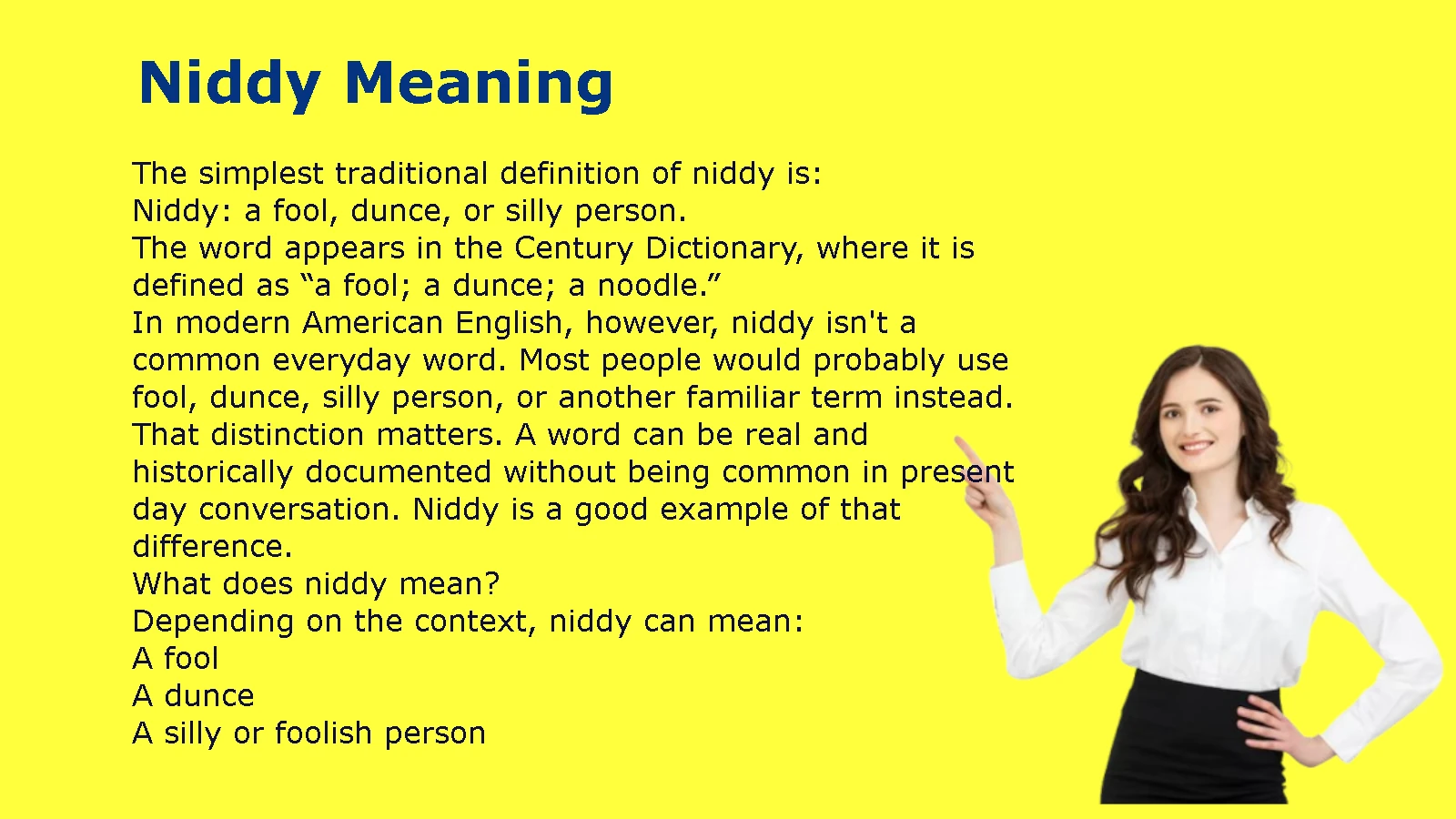
The simplest traditional definition of niddy is:
Niddy: a fool, dunce, or silly person.
The word appears in the Century Dictionary, where it is defined as “a fool; a dunce; a noodle.”
In modern American English, however, niddy isn’t a common everyday word. Most people would probably use fool, dunce, silly person, or another familiar term instead.
That distinction matters. A word can be real and historically documented without being common in present day conversation. Niddy is a good example of that difference.
What does niddy mean?
Depending on the context, niddy can mean:
- A fool
- A dunce
- A silly or foolish person
- The last one in a family in a documented variety of Aboriginal English
- Part of the compound noun niddy-noddy, a yarn winding and measuring tool
The first meaning is the traditional English dictionary sense. The family related meaning belongs to a specific variety of Aboriginal English and shouldn’t be treated as the standard meaning of the word everywhere.
Niddy Definition and Meaning
The traditional definition of niddy describes a person considered foolish or lacking good judgment.
Niddy as “fool”
A fool is someone who acts without good sense or judgment. Calling someone a niddy in this older sense therefore puts the person in the same general semantic group as fool or simpleton.
For example:
“The story portrays him as a niddy who repeatedly ignores good advice.”
This sentence uses the historical sense of the word. It would sound unusual in ordinary modern conversation, though. A modern speaker would be far more likely to say:
“The story portrays him as a fool who repeatedly ignores good advice.”
Niddy as “dunce”
A dunce traditionally refers to a person who has difficulty learning or understanding something. The word often carries a mocking or insulting tone.
Because niddy has been defined alongside dunce, it can overlap with this idea of foolishness. Still, the words aren’t perfect synonyms in every situation.
For example:
- Fool focuses broadly on poor judgment or foolish behavior.
- Dunce often suggests poor learning or understanding.
- Noodle can describe a silly or foolish person in informal or older usage.
- Niddy carries an uncommon, old fashioned feel.
Is niddy a real word?
Yes. Niddy is a documented English word. The Century Dictionary records it as a noun meaning a fool, dunce, or noodle.
However, being a real word doesn’t mean that people commonly use it today.
Think of it like finding an old tool in a workshop. The tool is genuine, but that doesn’t mean everyone still reaches for it every day. Vocabulary works the same way. Some words remain in dictionaries long after they become uncommon in everyday speech.
Niddy Meaning in Slang
The word niddy can also appear in informal or slang contexts. This creates some confusion because online slang sources may give words meanings that don’t match historical dictionary definitions.
When you see niddy used online, don’t automatically assume the writer is using the traditional dictionary sense.
Is niddy slang?
Niddy can appear in informal usage, but its traditional dictionary meaning isn’t simply “slang.”
The safest way to understand it is to separate the documented meanings from newer or informal uses.
| Use | Meaning | Context |
| Traditional English | Fool, dunce, or noodle | Historical or uncommon English |
| Informal usage | A foolish or silly person | Casual contexts |
| Aboriginal English | The last one in the family | Specific Australian Aboriginal English usage |
| Niddy-noddy | Yarn winding and measuring tool | Textile and spinning terminology |
The distinction is especially important for SEO content because many pages online treat unusual words as though they have one fixed modern slang definition. That can be misleading.
If someone uses niddy as an insult today, the intended meaning may simply be “fool” or “silly person.” The surrounding sentence gives you the strongest clue.
Niddy Meaning in Aboriginal English
One of the most interesting documented meanings of niddy appears in Aboriginal English in Australia.
A linguistic study of Australian Aboriginal English records niddy as meaning “the last one in the family.” The study gives the example “Give some to my niddy sister” and identifies the usage with Yandeyarra in Western Australia.
This meaning is important because it demonstrates how English can develop distinct vocabulary within a particular community.
What does niddy mean in Aboriginal English?
In the documented usage, niddy means the last one in the family.
The term appears among other Aboriginal English innovations connected with family relationships. The same source lists words such as budda or bruz for a brother or male peer and tidda for a sister or female peer.
That context helps explain why niddy shouldn’t be treated as merely another synonym for fool.
Why context matters
Imagine reading this sentence:
“Give some to my niddy sister.”
If you interpret niddy using the traditional dictionary meaning, the sentence may seem strange or insulting.
But within the documented Aboriginal English usage, niddy identifies the last one in the family.
This is a useful reminder that vocabulary isn’t always universal. A word can carry one meaning in historical English and another meaning within a particular regional variety.
Niddy vs. Niddy-Noddy
One of the easiest mistakes is assuming that niddy and niddy-noddy mean the same thing.
They don’t.
A niddy can refer to a fool or dunce in the traditional dictionary sense. A niddy-noddy, on the other hand, is a tool used by spinners to make skeins from yarn.
The difference becomes much clearer when you see the words side by side.
| Word | Meaning |
| niddy | A fool, dunce, or noodle in the traditional dictionary sense |
| niddy-noddy | A tool for making skeins from yarn |
| niddy-noddies | Plural form of niddy-noddy |
The compound word has a specialized meaning in textile work.
What is a niddy-noddy?
A niddy-noddy is a hand tool used to wind yarn into a skein. It generally consists of a central bar with crossbars at each end. The two crossbars sit at roughly 90 degrees to one another.
The design looks simple, but it solves a practical problem.
A spinner who has yarn on a bobbin needs a way to organize that yarn into a manageable loop or skein. The niddy-noddy provides a structured path around which the yarn can be wrapped.
Traditional niddy-noddies are often made from wood, although modern versions can also use materials such as metal, plastic, or PVC.
What is a niddy-noddy used for?
A niddy-noddy can help a spinner:
- Turn yarn into a skein
- Organize freshly spun yarn
- Estimate yarn length
- Prepare yarn for washing
- Prepare yarn for dyeing
- Store yarn neatly
- Check approximate yardage before starting a project
The tool also provides a practical way to estimate how much yarn a spinner has.
You wrap the yarn around the tool and count the completed circuits. If you know the length of one circuit, you can multiply that measurement by the number of wraps to estimate the total yardage.
How Does a Niddy-Noddy Work?
The basic process is surprisingly simple.
A spinner holds one end of the yarn against the central shaft. The yarn then travels around the four ends of the tool in a repeating path. Once enough yarn has been wrapped, the spinner ties the skein and removes it from the tool.
The tool’s dimensions determine the approximate length of each complete wrap.
For example, suppose a niddy-noddy produces a two yard loop. If you make 50 complete wraps, the rough calculation would be:
2 yards × 50 wraps = 100 yards
The result remains an estimate, because tension and wrapping conditions can affect the final measurement.
That doesn’t make the tool inaccurate for its intended purpose. It simply means the number represents practical yarn yardage rather than a laboratory measurement.
Why do spinners use skeins?
Skeins make yarn easier to wash, dye, store, and handle.
Historical sources also show that niddy-noddies have a long connection with hand spinning. A Welsh heritage resource describes the tool as part of the process of preparing yarn for washing, dyeing, storing, or selling. It also notes that niddy-noddies are still used today.
So although the word niddy may look obscure, niddy-noddy belongs to a practical craft tradition with centuries of history.
The History Behind Niddy-Noddy
The history of niddy-noddy is easier to document than the exact origin of the standalone word niddy.
The etymology of niddy-noddy remains uncertain. Wiktionary describes its origin as obscure and presents a possible connection involving niddy and noddy, but that explanation should be treated as a possibility rather than a settled fact.
What we can establish more confidently is the tool’s historical use.
A Welsh heritage resource notes that manuscript illustrations and archaeological finds provide evidence for niddy-noddies. It specifically mentions a 1570 painting by Pieter Pietersz, Man and Woman by the Spinning Wheel, which clearly shows a niddy-noddy.
That puts the tool within a much older textile tradition.
A useful historical fact
Niddy-noddies weren’t simply decorative objects.
They helped people turn loose spun yarn into organized skeins. That made the yarn easier to wash, dye, store, sell, and measure.
In other words, this little wooden tool sat at an important point between spinning yarn and using or selling it.
Niddy Pronunciation
The common pronunciation of niddy can be represented approximately as:
NID-ee
The first part sounds like nid, while the second part sounds like the ending in words such as happy.
Because the word is uncommon, you may not hear a consistent modern pronunciation in everyday conversation. If you’re discussing the historical word, the spelling gives a useful guide, but listening to a reliable dictionary pronunciation remains the best way to confirm spoken usage.
For niddy-noddy, the pronunciation follows the two-part spelling:
NID-ee NOD-ee
The exact pronunciation can vary slightly by speaker and accent.
Niddy Synonyms
If you’re looking for a modern word with the traditional meaning of niddy, several choices are much more familiar.
Synonyms for niddy meaning “fool”
- Fool
- Dunce
- Simpleton
- Dolt
- Noodle
- Idiot
- Blockhead
- Silly person
These aren’t interchangeable in every sentence.
For instance, dunce often suggests someone who struggles to learn, while dolt usually emphasizes stupidity or foolishness. Fool is broader and can describe someone who makes a foolish decision rather than someone who lacks intelligence altogether.
Niddy itself has a distinctly uncommon feel.
Niddy vs. fool
Fool is the most straightforward modern replacement.
“He’s a fool.”
is natural modern English.
“He’s a niddy.”
is understandable in light of the historical definition, but it sounds unusual to most contemporary American readers.
Niddy vs. dunce
Dunce is more specific.
A dunce is often someone who fails to understand something or performs poorly in an academic or intellectual setting.
Niddy doesn’t carry quite that narrow sense. Its dictionary definition simply groups it with a fool, dunce, or noodle.
Is Niddy an Insult?
In its traditional sense, niddy can function as an insult because it describes someone as foolish.
Still, its unusual nature changes the tone.
Calling someone a fool is immediately clear. Calling someone a niddy may sound playful, archaic, literary, or deliberately quirky because many modern readers won’t recognize the word.
The context can therefore make a big difference.
Examples of tone
Light or playful:
“You niddy, you left your keys on the table again.”
More insulting:
“Only a niddy would make such a careless decision.”
Historical or literary:
“The character appears as a niddy who never learns from his mistakes.”
The first two examples use the word creatively rather than as normal modern vocabulary. The third works better when the writing intentionally adopts an older or literary tone.
Niddy in a Sentence
Seeing the word in context makes its meaning easier to understand.
Traditional meaning
“The old tale describes the character as a niddy who refuses to listen to anyone.”
Here, niddy means a foolish person.
Another traditional example
“Everyone laughed when the niddy tried to solve the problem without reading the instructions.”
Again, the intended meaning is fool or silly person.
Aboriginal English meaning
The documented Aboriginal English usage is different. A linguistic study gives the example:
“Give some to my niddy sister.”
In that context, niddy refers to the last one in the family.
Niddy-noddy example
“After spinning the wool, she used a niddy-noddy to make a neat skein.”
Here, niddy-noddy refers to the yarn tool rather than a person.
Is Niddy a Name?
Niddy can appear as a personal name or nickname, but that doesn’t automatically give it a single established name meaning.
This distinction matters because name websites sometimes assign meanings to unusual spellings based on modern naming practices, regional traditions, or proposed origins. Those claims shouldn’t be confused with dictionary evidence for the English word niddy.
If you encounter Niddy as someone’s name, the safest approach is to treat it as a proper name unless the person or a reliable source explains its specific origin.
The traditional dictionary meaning of niddy does not establish that every person named Niddy is being called a fool. Names and ordinary vocabulary can share spellings without sharing the same function.
Niddy vs. Similar Looking Words
Unusual words often create spelling confusion. Niddy is especially easy to confuse with other short words beginning with nid, nod, or ned.
| Word | Meaning |
| Niddy | Traditionally, a fool, dunce, or noodle |
| Niddy-noddy | A tool for making skeins from yarn |
| Noddy | A separate English word with several meanings |
| Neddy | A different word, including a British informal term for a donkey |
| Nuddy | A different word with its own meanings |
Similar spelling doesn’t prove that two words have the same origin.
That’s particularly important with niddy and niddy-noddy. The longer term has its own established textile meaning.
Is Niddy an Old Fashioned Word?
Yes, the traditional “fool” sense is uncommon and has an old fashioned feel.
You probably won’t hear someone casually say, “What a niddy!” in an ordinary American conversation.
Modern English has plenty of more familiar alternatives:
- Fool
- Dummy
- Idiot
- Silly person
- Foolish person
- Dunce
- Goof
That doesn’t make niddy useless. Uncommon vocabulary can still appear in historical writing, word studies, dictionaries, literature, language games, or creative writing.
Its rarity can even give it a particular flavor. It sounds more quaint than aggressive.
Is Niddy a Scrabble Word?
If you’re asking whether niddy can be played in Scrabble, don’t assume that dictionary status automatically makes it a playable game word.
Some online Scrabble references specifically list niddy as not playable in official Scrabble dictionaries, while still providing the Century Dictionary definition.
This illustrates another useful vocabulary distinction:
A word can exist in a historical dictionary without appearing in the official word list used by a particular game.
Dictionary inclusion, game eligibility, and modern usage are three different questions.
Common Misunderstandings About Niddy
Because niddy is unusual, several misunderstandings can arise.
“Niddy” always means fool
Not necessarily.
That is the traditional English dictionary meaning, but documented Aboriginal English uses niddy to mean the last one in the family.
Niddy and niddy-noddy are the same word
No.
Niddy-noddy is a compound noun for a yarn winding tool.
Niddy is common modern slang
There isn’t enough evidence to treat it as a standard, widely used modern slang word. Its documented traditional meaning is much more firmly established.
Every use of “niddy” has the same origin
That conclusion would go too far.
The Aboriginal English usage is specifically documented as an innovation within that variety of English. The history of niddy-noddy also has an uncertain etymology.
Why Niddy Has Multiple Meanings
Languages constantly change.
Communities adapt existing words, create new terms, shorten expressions, and give familiar vocabulary new meanings. English doesn’t have one central authority deciding how every word must work in every community.
The documented Aboriginal English meaning of niddy is a good example. Researchers describe it among innovations that help Aboriginal English speakers express specific relationships and ideas.
This is why a dictionary search isn’t always enough.
When an unfamiliar word appears in a sentence, ask:
- Where did the sentence come from?
- What kind of English does the speaker use?
- Is the word part of a compound?
- Does the surrounding sentence suggest a person, family relationship, object, or action?
- Does a reliable dictionary or linguistic source support the proposed meaning?
Those questions can prevent a lot of confusion.
A Quick Case Study: Three Meanings, One Word
Consider three fictional sentences.
Case one: Historical English
“The villagers considered him a niddy.”
Here, the traditional dictionary meaning fits: a fool or dunce.
Case two: Aboriginal English
“Give some to my niddy sister.”
Here, the documented Aboriginal English meaning fits: the last one in the family.
Case three: Textile terminology
“She wrapped the yarn around the niddy-noddy.”
Here, the relevant word isn’t niddy at all. It’s niddy-noddy, the hand tool used to create a skein.
The spelling alone doesn’t tell you which interpretation is correct.
Context does.
Facts About Niddy
Here are the key facts to remember:
| Fact | Details |
| Word | Niddy |
| Traditional part of speech | Noun |
| Traditional meaning | Fool, dunce, or noodle |
| Modern frequency | Uncommon |
| Documented regional meaning | The last one in the family in a variety of Aboriginal English |
| Related compound | Niddy-noddy |
| Niddy-noddy meaning | A tool used to make skeins from yarn |
| Niddy-noddy structure | Central bar with two offset crossbars |
| Common material | Traditionally wood, although other materials are also used |
| Textile use | Skeining and approximate yarn measurement |
| Plural of niddy-noddy | Niddy-noddies |
The traditional definition comes from the Century Dictionary, while the regional Aboriginal English meaning comes from linguistic research on Australian Aboriginal English.
Frequently Asked Questions About Niddy Meaning
What does niddy mean?
Niddy traditionally means a fool, dunce, or noodle. It is an uncommon English word documented in the Century Dictionary.
Is niddy a real English word?
Yes. Historical dictionary evidence records niddy as a noun meaning a fool, dunce, or noodle.
What does niddy mean in slang?
In informal contexts, niddy may be used to describe someone as foolish or silly. However, slang definitions found online shouldn’t automatically be treated as standard English definitions.
What does niddy mean in Aboriginal English?
In a documented variety of Aboriginal English in Australia, niddy means “the last one in the family.” The usage has been recorded in Yandeyarra, Western Australia.
What is a niddy-noddy?
A niddy-noddy is a hand tool used to turn yarn into skeins. It has a central bar with crossbars at each end positioned at right angles to one another.
Is niddy the same as niddy-noddy?
No. Niddy and niddy-noddy have different meanings. The standalone word traditionally describes a foolish person, while niddy-noddy refers to a textile tool.
How do you pronounce niddy?
A simple pronunciation guide is NID-ee.
Is niddy an insult?
It can be insulting when used in its traditional sense because it describes someone as foolish. However, its rarity can make it sound playful, quaint, or old fashioned rather than strongly offensive.
What are synonyms for niddy?
Depending on the context, synonyms for the traditional sense include fool, dunce, dolt, simpleton, noodle, and silly person.
Is niddy a modern word?
It is a documented English word, but the traditional sense is uncommon in modern everyday American English.
What does niddy-noddy do?
A niddy-noddy helps a spinner form a skein and estimate the amount of yarn by wrapping yarn around the tool and counting the completed circuits.
Final Meaning of Niddy
The meaning of niddy depends heavily on context.
In its traditional English dictionary sense, niddy means a fool, dunce, or noodle. The word is genuine but uncommon, so you’ll rarely hear it in ordinary modern American conversation.
In documented Aboriginal English, however, niddy has a completely different meaning: the last one in the family. That usage appears in linguistic research on Aboriginal English in Western Australia.
Then there’s niddy-noddy, which shouldn’t be confused with either meaning. A niddy-noddy is a traditional textile tool that helps spinners turn yarn into skeins and estimate its length.
So the quickest way to remember niddy meaning is:
Niddy = traditionally a fool or dunce; in a documented Aboriginal English usage, the last one in the family. Niddy-noddy = a yarn skeining tool.
The word may be small, but its history shows something much bigger about English: meaning lives in context.