Have you ever wondered whether research and researches mean the same thing? While Research vs Researches may look like a simple singular and plural comparison, the two forms are not always interchangeable. The correct choice depends on whether you are talking about research as a general field of study or separate research studies and investigations.
Research is most commonly used as an uncountable noun to describe the process of studying a subject carefully to discover new facts or information. It can also be used as a verb. Researches, on the other hand, can be the third person singular form of the verb research, or a plural noun in contexts where different research studies or bodies of research are being treated as separate works.
Examples:
- She is conducting research on climate change.
- He researches ancient languages for a living.
- The researchers compared several independent researches.
The confusion is understandable. People often search for research vs researches, is researches a word, research plural form, or can research be plural because English does not always follow the usual rule of adding s to make a noun plural. And here’s the kicker: in everyday English, research is usually preferred even when you are talking about a large amount of information or multiple investigations.
In this guide, you’ll learn the complete difference between Research and Researches, including their meanings, grammar, correct usage, plural forms, and examples in sentences. You’ll also discover when to use research as a noun or verb, when researches is grammatically correct, and why studies is often a more natural alternative when referring to multiple research projects.
Research vs. Researches at a Glance
Before looking at the finer points, this quick comparison makes the difference easier to see.
| Word | Grammatical role | Meaning | Example |
| research | Uncountable noun | Investigation or study in general | “The research is convincing.” |
| research | Verb | To investigate or study | “They research new treatments.” |
| researches | Verb | Third person singular of research | “She researches medical history.” |
| researches | Plural noun | Separate bodies or instances of research | “His researches covered several fields.” |
| studies | Plural noun | Multiple individual investigations | “Several studies reached similar conclusions.” |
Major dictionaries support this distinction. Oxford classifies the main noun research as uncountable and notes that researches sometimes appears as a plural noun in British English, although it is much less frequent.
Merriam Webster also recognizes researches as both the plural of research and the third person singular present form of the verb research.
That means saying “researches is always wrong” would be too broad. The better explanation is that the plural noun exists, but it isn’t normally the form you want in everyday modern American English.
What Does “Research” Mean?
Research means careful investigation or study intended to discover information, understand a subject, test an idea, or develop knowledge.
Merriam Webster defines the noun in terms of systematic inquiry and examination. It also includes the gathering of information about a particular subject.
Research can happen in almost any field:
- science
- medicine
- education
- history
- business
- technology
- psychology
- economics
- journalism
- law
- marketing
For example, a scientist might conduct research into a disease. A student might do research for a term paper. A company might conduct market research before launching a product.
The word covers all of these situations without needing to become plural.
“Research” is normally an uncountable noun in its main modern use.
That point explains most of the confusion surrounding research vs. researches.
Is “Research” Singular or Plural?
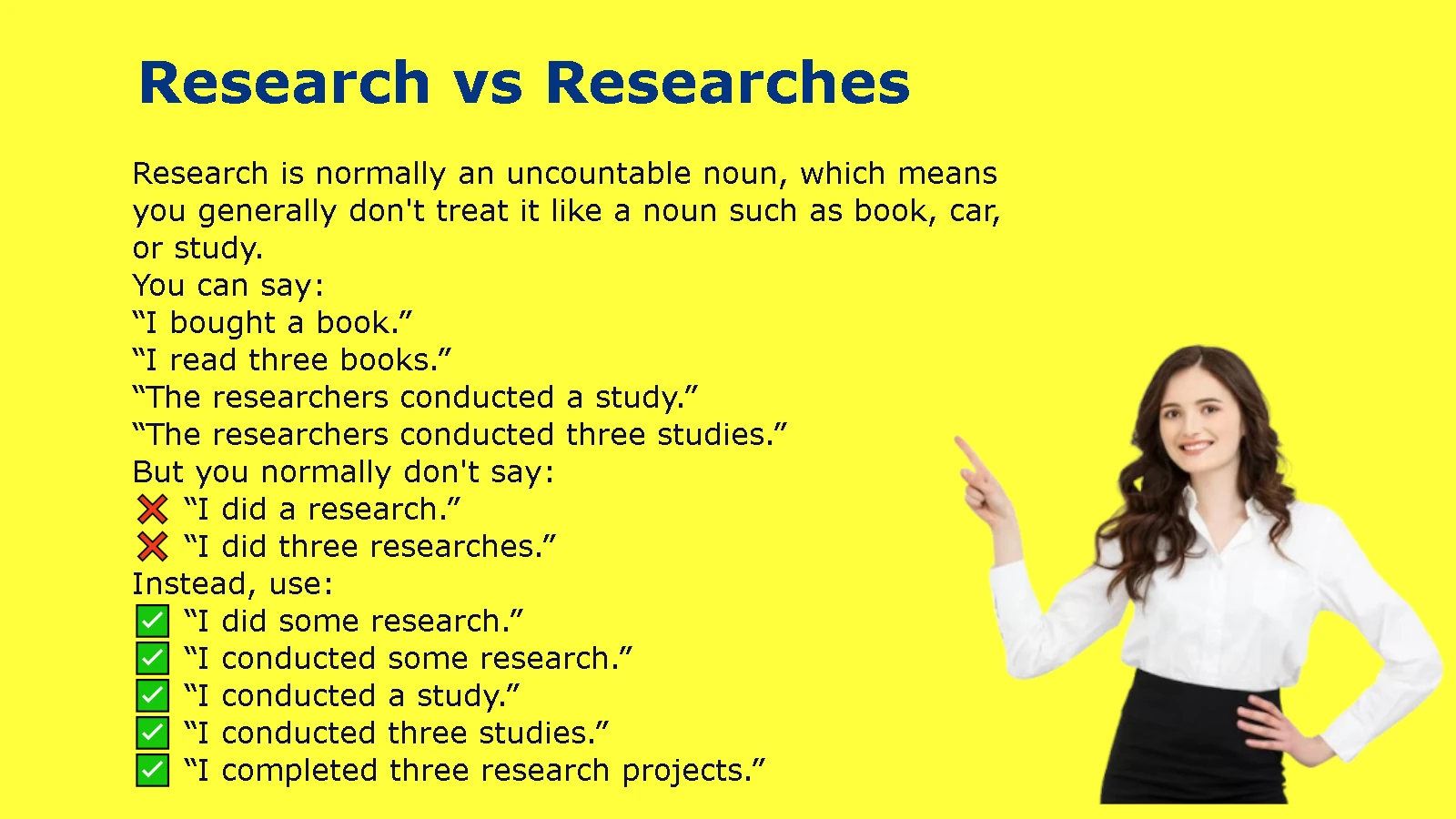
Research is normally an uncountable noun, which means you generally don’t treat it like a noun such as book, car, or study.
You can say:
- “I bought a book.”
- “I read three books.”
- “The researchers conducted a study.”
- “The researchers conducted three studies.”
But you normally don’t say:
- ❌ “I did a research.”
- ❌ “I did three researches.”
Instead, use:
- ✅ “I did some research.”
- ✅ “I conducted some research.”
- ✅ “I conducted a study.”
- ✅ “I conducted three studies.”
- ✅ “I completed three research projects.”
Cambridge’s grammar guidance specifically explains that research normally doesn’t take a or an in its main meaning. It recommends expressions such as research, some research, and a piece of research.
Why Does “Research” Stay Uncountable?
Think of research as an activity or a body of knowledge rather than one physical object.
You can measure research by amount, scope, or type:
- some research
- a lot of research
- extensive research
- detailed research
- scientific research
- medical research
- historical research
You don’t normally count the word itself.
For example:
Natural:
“The team conducted extensive research into consumer behavior.”
Less natural in standard modern usage:
“The team conducted an extensive research into consumer behavior.”
The first sentence treats research as an uncountable activity. That’s the standard pattern.
When Should You Use “Research”?
Use research when you’re talking about investigation as a general activity or about the knowledge gathered through that investigation.
Research as an Activity
When you mean the process of investigating something, research works naturally.
Examples:
- “She conducts research in biology.”
- “They spent six months doing research.”
- “We need more research before making a decision.”
- “The university funds medical research.”
- “He has done extensive research into ancient languages.”
Notice that none of these sentences requires researches.
Even when the work involves thousands of individual experiments, the broader activity can still be called research.
Research as a Body of Knowledge
Research can also refer to findings or knowledge that researchers have produced.
For example:
“Recent research suggests that the treatment may improve recovery.”
Here, research doesn’t necessarily mean one experiment. It can refer to a broader body of published evidence or findings.
Likewise:
“Previous research has examined the relationship between sleep and memory.”
The sentence may refer to many studies. Yet research remains the natural uncountable noun.
This is one of the most important points in the research vs. researches debate: the existence of multiple studies doesn’t automatically require the plural noun “researches.”
Common Expressions With “Research”
English frequently combines research with other words.
Some useful examples include:
- conduct research
- do research
- carry out research
- undertake research
- academic research
- scientific research
- medical research
- market research
- historical research
- research findings
- research data
- research methods
- research project
- research paper
- research study
- research grant
- research laboratory
- research center
- research team
Oxford lists common combinations such as conduct research, research findings, research project, and research grant.
These patterns are useful because they show how native English normally handles the noun.
When Is “Researches” Correct?
This is where the answer gets more interesting.
Researches is not simply an incorrect word. It has two legitimate grammatical uses.
The first is as a verb.
The second is as a plural noun, although that noun use is relatively uncommon.
Understanding both prevents an overly simplistic grammar rule.
“Researches” as a Verb
The most common use of researches occurs when research functions as a verb.
English adds -s to many verbs when the subject is he, she, or it in the simple present tense.
For example:
- I research.
- You research.
- We research.
- They research.
- He researches.
- She researches.
- It researches.
Oxford gives the verb forms as research, researches, researched, researching.
Examples of “Researches” as a Verb
Consider these sentences:
- “She researches historical documents.”
- “He researches consumer behavior.”
- “The journalist researches every claim before publication.”
- “The scientist researches new approaches to cancer treatment.”
- “Maria researches local history for her books.”
In each sentence, researches describes an action.
You can test the grammar by replacing the subject:
“She researches the topic.”
Change she to they:
“They research the topic.”
The -es disappears because the subject changes from third person singular to plural.
Research Verb Forms
| Subject or tense | Form | Example |
| I | research | “I research the topic.” |
| You | research | “You research the topic.” |
| He/She/It | researches | “She researches the topic.” |
| We | research | “We research the topic.” |
| They | research | “They research the topic.” |
| Past | researched | “They researched the topic.” |
| Present participle | researching | “They are researching the topic.” |
Merriam Webster likewise lists researched, researching, and researches among the verb forms of research.
So if someone asks whether researches is grammatically correct, the answer is clearly yes when it functions as this verb.
“Researches” as a Plural Noun
The plural noun researches also exists.
However, this is where usage differs from what you might expect.
Oxford says that researches is sometimes used as a plural noun in British English, but it is much less frequent than the standard uncountable noun research.
Merriam Webster also recognizes researches as the plural of research.
So the word isn’t grammatically impossible. The issue is frequency and naturalness.
For most modern American English writing, especially clear academic or professional writing, studies is usually the better choice when you mean separate investigations.
Example of the Plural Noun
Consider:
“His researches into ancient history covered several decades.”
Here, researches is a noun. It refers to distinct areas or instances of investigation.
The construction is grammatical, but it can sound formal or old fashioned to many American readers.
A more natural modern alternative would be:
“His studies of ancient history covered several decades.”
Or:
“His research into ancient history covered several decades.”
The best choice depends on the intended meaning.
Research vs. Researches in American English
For US English, the safest general rule is straightforward:
Use “research” as the noun unless you have a specific reason to use the uncommon plural “researches.”
Oxford’s American dictionary marks the noun research as uncountable.
That makes sentences such as these standard:
- “The research is promising.”
- “More research is needed.”
- “Recent research supports the theory.”
- “The researchers conducted extensive research.”
- “Her research focuses on language development.”
When you want to count individual investigations, switch to study:
- “One study found a connection.”
- “Three studies found a similar connection.”
- “Several studies examined the issue.”
- “The researchers reviewed 20 studies.”
This approach sounds natural and removes ambiguity.
Research vs. Researches in Academic Writing
Academic writing makes the distinction especially important because researchers frequently discuss both research as a broad field and individual studies.
Consider these two sentences:
“Previous research has examined the effects of exercise.”
and:
“Previous studies have examined the effects of exercise.”
Both can be correct. The difference lies in emphasis.
Research presents the work as a broader body of knowledge.
Studies highlights individual investigations.
When “Research” Works Best
Use research when discussing a general body of evidence:
“Previous research has identified several risk factors.”
“Recent research suggests that early intervention may improve outcomes.”
“More research is needed to understand the long term effects.”
The noun remains uncountable even when the underlying evidence comes from many separate studies.
When “Studies” Works Best
Use studies when you want to identify multiple individual investigations:
“Three studies examined the relationship between diet and sleep.”
“Several studies produced similar findings.”
“The review included 15 studies.”
This is particularly useful when you’re giving a number.
You wouldn’t normally write:
❌ “The review included 15 researches.”
Instead:
✅ “The review included 15 studies.”
The second version immediately tells the reader that you mean 15 distinct investigations.
Research vs. Study: What’s the Difference?
Research and study overlap in meaning, but they aren’t interchangeable in every grammatical situation.
| Research | Study |
| Usually uncountable as a noun | Usually countable when referring to an individual investigation |
| Can refer to investigation as a broad activity | Often refers to one particular investigation |
| “Some research” | “A study” |
| “More research” | “Several studies” |
| “Research shows…” | “A study shows…” |
| “We conducted research.” | “We conducted a study.” |
| “A body of research” | “A body of studies” is possible but less direct |
Merriam Webster lists study, investigation, inquiry, and examination among the relevant synonyms of research.
The grammatical difference matters more than the semantic overlap.
For example:
“Researchers conducted research into the problem.”
This describes the broader investigative process.
Meanwhile:
“Researchers conducted three studies into the problem.”
This identifies three separate investigations.
That’s why studies often provides a cleaner solution than researches.
How to Talk About One Piece of Research
Because research is normally uncountable, you need a countable expression when you want to identify one particular piece of work.
One of the most useful expressions is:
a piece of research
For example:
- “I found an interesting piece of research.”
- “This is an important piece of research.”
- “The paper presents a valuable piece of research.”
- “She published a new piece of research on language learning.”
Cambridge specifically recommends a piece of research when you want to refer to research in the singular.
You can also use study:
- “I found an interesting study.”
- “The researchers published a new study.”
- “The study produced unexpected results.”
In many contexts, study sounds more concise.
How to Talk About Multiple Pieces of Research
When you’re dealing with several individual investigations, studies usually does the heavy lifting.
Instead of “Two Researches”
Use:
- two studies
- two research studies
- two pieces of research
- two research projects, if you mean projects rather than individual studies
For example:
❌ “The researchers conducted two researches.”
Better:
✅ “The researchers conducted two studies.”
Or:
✅ “The researchers conducted two research studies.”
Instead of “Several Researches”
Use:
- several studies
- several research studies
- several pieces of research
- several research projects
For example:
❌ “Several researches have examined this question.”
Better:
✅ “Several studies have examined this question.”
Or:
✅ “Research from several studies has examined this question.”
The second option can be useful when the emphasis falls on the overall body of evidence.
Common Mistakes With Research vs. Researches
The same few errors appear repeatedly because learners naturally assume that research behaves like other countable nouns.
Mistake: Saying “A Research”
❌ “I conducted a research about climate change.”
In standard modern usage, research doesn’t normally take a in this sense.
Use:
✅ “I conducted research on climate change.”
Or:
✅ “I conducted a study on climate change.”
Or:
✅ “I conducted a piece of research on climate change.”
Cambridge explicitly identifies a research as an incorrect pattern for the main meaning of the noun and recommends alternatives such as some research and a piece of research.
Mistake: Automatically Making “Research” Plural
❌ “The researchers conducted five researches.”
Adding -es doesn’t automatically make the sentence natural.
Use:
✅ “The researchers conducted five studies.”
The distinction is subtle but important. English has its own countability patterns, and research normally belongs to the uncountable group.
Mistake: Using a Plural Verb With “Research”
❌ “Research are important for scientific progress.”
Correct:
✅ “Research is important for scientific progress.”
Because the noun is normally uncountable, it takes a singular verb.
You can compare:
“Research is important.”
with:
“Studies are important.”
The verb changes because the nouns behave differently.
Mistake: Confusing “Researches” With “Researchers”
These words look similar, but they mean completely different things.
- research = investigation or study
- researches = researches as a verb, or the uncommon plural noun
- researcher = a person who conducts research
- researchers = more than one researcher
For example:
“The researchers conducted research.”
Here, the people are researchers, while the work is research.
That’s an easy distinction to remember.
Research vs. Researches Examples
Examples become especially useful when grammar rules start to feel abstract. The following sentences show how the forms work in real contexts.
Everyday English
“I need to do some research before buying a laptop.”
“She did extensive research before choosing a university.”
“We researched several options before making a decision.”
In the first two sentences, research is a noun. In the third, researched is a verb.
Academic English
“Recent research supports the hypothesis.”
“Several studies support the hypothesis.”
“The researchers reviewed previous research before beginning the study.”
Here, research describes the wider body of knowledge while studies identifies individual investigations.
Scientific Writing
“More research is needed to determine the long term effects.”
“Five studies examined the treatment.”
“The researchers conducted additional research.”
Again, research remains uncountable even though multiple experiments may contribute to it.
Professional Writing
“Our research identified several customer concerns.”
“The company conducted two market studies.”
“The marketing team researches customer preferences before launching new products.”
Each sentence uses a different form because each sentence expresses a different grammatical idea.
Historical Writing
A formal historical text might use:
“His researches into medieval manuscripts continued throughout his career.”
The plural noun is possible here. However, modern readers may find this more formal than:
“His research into medieval manuscripts continued throughout his career.”
Or:
“His studies of medieval manuscripts continued throughout his career.”
The choice depends on the intended tone.
A Practical Decision Guide for Research vs. Researches
When you’re unsure which word to use, ask one question:
What grammatical job is the word doing?
If It Is a General Noun
Use research.
“Research shows that the approach works.”
If It Means Multiple Individual Investigations
Use studies in most modern writing.
“Several studies show that the approach works.”
If It Describes What He, She, or It Does
Use researches.
“She researches the topic carefully.”
If You Intentionally Mean Separate Bodies of Research
Researches can work as a plural noun, especially in formal or British usage.
“His researches covered several related fields.”
This last construction is legitimate, but it isn’t the default choice for most American English writers.
A Simple Grammar Test
You can use this quick test whenever research vs. researches causes trouble.
Are you using the word as a noun?
|
v
Do you mean research in general?
|
YES
|
v
Use RESEARCH
|
NO
|
v
Do you mean separate individual investigations?
|
YES
|
v
Usually use STUDIES
|
v
Do you mean what he, she, or it does?
|
YES
|
v
Use RESEARCHES
The decision becomes much easier once you stop thinking of researches as simply “the plural of research.”
It isn’t that simple.
Research vs. Researches: Quick Comparison Examples
| Less natural or incorrect | Better choice | Why |
| “I did a research.” | “I did some research.” | Research is normally uncountable |
| “I conducted three researches.” | “I conducted three studies.” | Studies naturally counts individual investigations |
| “Research are important.” | “Research is important.” | Research takes a singular verb |
| “She research the topic.” | “She researches the topic.” | Third person singular verb requires -es |
| “They researches the topic.” | “They research the topic.” | Plural subject takes the base verb |
| “I found a research.” | “I found a study.” | Study can be countable |
| “A lot of researches support it.” | “A lot of research supports it.” | General body of evidence |
| “Several researches support it.” | “Several studies support it.” | Separate investigations |
Case Study: Choosing the Right Word in Academic Writing
Imagine a researcher is writing about the effects of sleep on memory.
The researcher has reviewed 20 published investigations.
A weak sentence might say:
❌ “Twenty researches have investigated the effects of sleep on memory.”
The writer probably intends to refer to 20 individual investigations. Studies is therefore the clearest noun.
A stronger version is:
✅ “Twenty studies have investigated the effects of sleep on memory.”
Now suppose the writer wants to discuss the entire body of evidence rather than count the individual investigations:
✅ “Previous research has investigated the effects of sleep on memory.”
Both sentences can describe the same literature. They simply emphasize different things.
Studies highlights the individual investigations.
Research highlights the broader field of investigation and accumulated knowledge.
That distinction gives academic writing much more precision.
Case Study: Choosing the Right Word in Everyday English
Imagine someone wants to buy a used car.
They might say:
“I did some research before buying the car.”
That’s completely natural.
If they compared information from five separate reports, they could say:
“I looked at five studies about vehicle reliability.”
If they investigated the reports themselves, they could say:
“She researches vehicle reliability before making recommendations.”
The same root word appears in all three contexts, but grammar determines the correct form.
Why “Researches” Can Sound Unnatural
The problem isn’t that researches is inherently bad English.
The problem is that modern English speakers usually have more natural ways to express the plural idea.
Compare:
“Several researches found similar results.”
with:
“Several studies found similar results.”
The second sentence feels more direct because study is naturally countable.
Likewise, compare:
“The researchers reviewed several researches.”
with:
“The researchers reviewed several studies.”
The second version immediately tells the reader that separate investigations are involved.
When a simpler, more familiar countable noun exists, it usually makes sense to use it.
Is “Researches” Ever Preferred?
In some formal, historical, or British English contexts, researches may be used intentionally as a plural noun.
Oxford specifically notes that the plural occurs sometimes in British English, although it is much less frequent.
That means context matters.
For example:
“In the course of my researches, I discovered several previously unknown documents.”
This sentence treats researches as a noun meaning separate or extended investigations. Oxford includes this kind of formal usage among its examples.
A modern American writer might instead write:
“During my research, I discovered several previously unknown documents.”
Or:
“During my studies, I discovered several previously unknown documents.”
Neither choice changes the underlying idea very much. The difference lies in style and usage.
Research vs. Researches: What Should You Use?
For most readers, especially in US English, the following rule works extremely well:
| What you mean | Best choice |
| Research as a general activity | research |
| A broad body of evidence | research |
| One individual investigation | a study |
| Multiple individual investigations | studies |
| What he, she, or it investigates | researches |
| A rare or formal plural noun | researches |
This approach keeps your writing natural without pretending that the plural noun doesn’t exist.
Frequently Asked Questions About Research vs. Researches
Is “researches” a correct word?
Yes. Researches is a correct word.
It can serve as the third person singular present form of the verb research:
“She researches the subject.”
It can also function as a plural noun, although that use is much less common than the uncountable noun research.
Is “research” singular or plural?
Research is normally an uncountable noun.
It takes a singular verb:
“Research is important.”
You don’t normally treat it like a countable noun by saying a research or three researches when referring to the general activity.
What is the plural of research?
There are two useful answers depending on what you mean.
Research normally stays uncountable:
“More research is needed.”
Researches can exist as a plural noun, but it is relatively uncommon. When you mean separate investigations, studies is usually the more natural modern choice.
Can you say “a research”?
Usually, no, when you mean research in its ordinary sense.
Use:
- “some research”
- “a piece of research”
- “a study”
- “a research study”
Cambridge specifically recommends a piece of research for a single instance of research.
Should you say “research shows” or “researches show”?
Usually:
“Research shows…”
Use this when research means a broad body of knowledge.
If you mean multiple individual investigations, write:
“Studies show…”
The phrase “researches show” can be grammatically possible when researches functions as a plural noun, but it isn’t the usual modern American choice.
Is “researches” the plural of “research”?
It can be.
Major dictionaries recognize researches as a plural noun. However, research is normally uncountable in its main modern meaning, so English speakers usually don’t add -es simply because multiple investigations are involved.
Is “researches” a verb?
Yes.
Researches is the third person singular present form of research.
“He researches the subject.”
Oxford lists researches as the he/she/it form of the verb.
What is the difference between “research” and “researches”?
The difference depends on grammar.
Research can be an uncountable noun or the base form of the verb.
Researches can be the third person singular verb or a less common plural noun.
For example:
- “The research is valuable.” → noun
- “They research the topic.” → verb
- “She researches the topic.” → verb
- “His researches covered several fields.” → plural noun
Should you use “researches” in academic writing?
Usually, research or studies will be better.
Use research for the broader body of evidence:
“Previous research has explored this issue.”
Use studies for individual investigations:
“Several studies have explored this issue.”
Reserve the plural noun researches for contexts where that particular formal usage fits your style.
Final Verdict on Research vs. Researches
The difference between research vs. researches becomes clear once you look at the grammar rather than simply the spelling.
Research is the standard noun for the general activity of investigating a subject or the broader body of knowledge produced by that work. Major dictionaries classify this noun as uncountable in its main use.
Researches has two legitimate roles. Most commonly, it functions as the third person singular form of the verb research:
“She researches historical records.”
It can also function as a plural noun meaning separate or distinct investigations. However, that usage is less frequent, and Oxford specifically notes its limited frequency in British English.
For everyday American English, the safest rule is:
- Use research for research in general.
- Use a piece of research when you need a singular countable expression.
- Use study for one individual investigation.
- Use studies for multiple investigations.
- Use researches as a verb with he, she, or it.
- Use researches as a plural noun only when that formal or less common construction suits the context.
The simplest way to remember it is this:
Research is usually the body of work. Studies are the individual pieces. Researches is usually a verb.
Once that distinction clicks, choosing between research and researches becomes much easier. You won’t need to add an -s just because you’re talking about several investigations. Instead, choose the word that matches the exact meaning you want to express.