Have you ever wondered whether you should write “Fueled” or “Fuelled”? Both spellings are correct, but the choice depends on the English variety you are using. While Fueled vs Fuelled can look confusing at first glance, the two words have the same meaning, pronunciation, and grammatical function.
Fueled is the preferred spelling in American English, while Fuelled is more common in British English, as well as other varieties that generally follow British spelling conventions.
Examples:
- The car was fueled before the long journey.
- The car was fuelled before the long journey.
The confusion is understandable. People often search for fueled or fuelled, is it fueled or fuelled, fueled vs fuelled American English, or fuelled vs fueled British English because the extra “l” can make the spelling seem like a grammar difference. Here’s the simple answer: both are correct, but you should choose the spelling that matches your preferred variety of English.
In this guide, you’ll learn the complete difference between Fueled vs Fuelled, including their meaning, spelling, pronunciation, usage, and examples in sentences. You’ll also discover why American English uses fueled while British English uses fuelled, along with related forms such as fueling vs fuelling and fueled vs fuelled in different contexts.
Fueled vs Fuelled: Quick Answer
Here’s the difference at a glance:
| Word | Common variety | Grammatical role | Meaning |
| Fueled | American English | Past tense and past participle | Supplied with fuel or made something stronger |
| Fuelled | British English | Past tense and past participle | Supplied with fuel or made something stronger |
| Fueling | American English | Present participle/gerund | Supplying fuel or making something stronger |
| Fuelling | British English | Present participle/gerund | Supplying fuel or making something stronger |
The meaning doesn’t change. The spelling does.
Oxford lists fuelled as the British form and fueled as the US form. It also lists fuelling and fueling as their corresponding -ing forms.
That makes the choice fairly simple:
- US English: fueled, fueling
- UK English: fuelled, fuelling
Think of it like color vs colour or theater vs theatre. The regional spelling changes, but the underlying word remains the same.
What Does “Fueled” Mean?
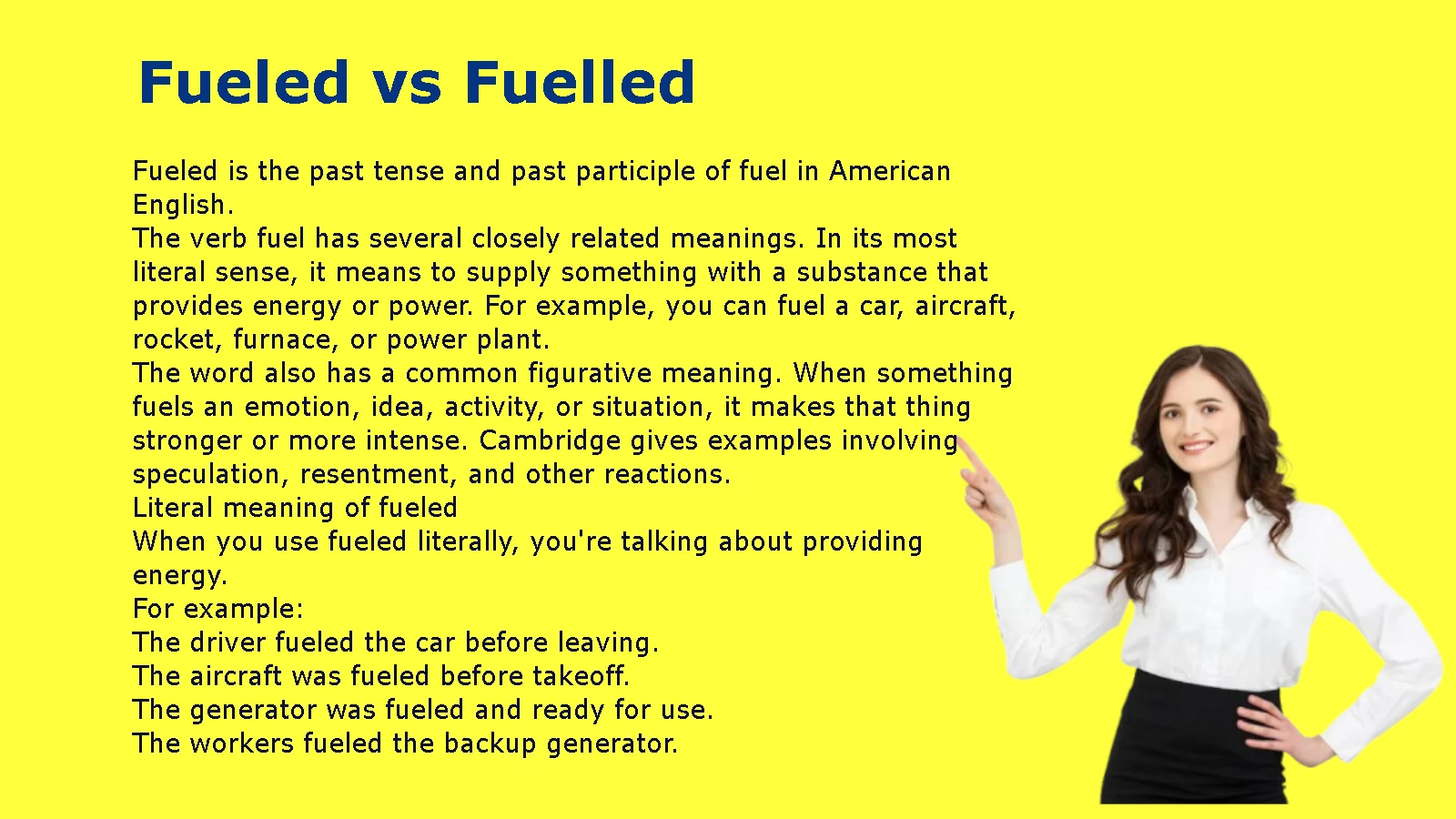
Fueled is the past tense and past participle of fuel in American English.
The verb fuel has several closely related meanings. In its most literal sense, it means to supply something with a substance that provides energy or power. For example, you can fuel a car, aircraft, rocket, furnace, or power plant.
The word also has a common figurative meaning. When something fuels an emotion, idea, activity, or situation, it makes that thing stronger or more intense. Cambridge gives examples involving speculation, resentment, and other reactions.
Literal meaning of fueled
When you use fueled literally, you’re talking about providing energy.
For example:
- The driver fueled the car before leaving.
- The aircraft was fueled before takeoff.
- The generator was fueled and ready for use.
- The workers fueled the backup generator.
In these sentences, fueled refers to putting fuel into something or supplying it with a source of energy.
Figurative meaning of fueled
The figurative use is just as common.
For example:
- The rumor fueled public concern.
- Her success fueled her ambition.
- The announcement fueled speculation.
- The argument fueled his frustration.
Here, nobody is pouring gasoline into an emotion or rumor. Instead, something increases the strength or intensity of that feeling or situation.
Oxford defines this figurative use as increasing something or making it stronger, with examples such as fueling rumors, fears, suspicions, and inflation.
What Does “Fuelled” Mean?
Fuelled has exactly the same basic meaning as fueled. The difference lies in spelling rather than definition.
British English normally uses fuelled for the past tense and past participle of fuel. Cambridge lists fuelled specifically as the past simple and past participle form.
For example:
- The car was fuelled before the journey.
- The aircraft was fuelled before departure.
- The announcement fuelled public concern.
- The report fuelled speculation about the company’s future.
The extra l doesn’t change the word’s pronunciation or meaning.
Literal use of fuelled
British English writers use fuelled when they mean that someone supplied something with fuel.
For example:
The helicopter was fuelled and ready to leave.
The sentence means that someone had supplied the helicopter with the fuel it needed.
Figurative use of fuelled
The figurative meaning works in exactly the same way:
The decision fuelled criticism of the company.
The decision didn’t literally burn. Instead, it increased or intensified the criticism.
Cambridge’s dictionary examples include uses of fuelled with ideas, demand, research, conflict, and speculation.
Fueled vs Fuelled: The Main Spelling Difference
The simplest way to understand fueled vs fuelled is to look at the number of l’s.
- Fueled → one l
- Fuelled → two l’s
American English generally uses the shorter form:
fuel → fueled
British English generally uses the doubled form:
fuel → fuelled
Cambridge specifically marks the verb as “-ll- or US usually -l-,” which captures the regional distinction neatly.
This isn’t a difference in grammar, pronunciation, or meaning. It’s a difference in spelling convention.
Fueled in American English
If you’re following standard US English, use:
- fuel
- fuels
- fueled
- fueling
Examples:
- The company fueled its expansion through new investments.
- The plane was fueled before the flight.
- The new policy fueled debate.
- Higher demand fueled sales growth.
For an American publication, fueled will usually look more natural and consistent.
Fuelled in British English
If you’re following British English, use:
- fuel
- fuels
- fuelled
- fuelling
Examples:
- The company fuelled its expansion through new investments.
- The plane was fuelled before the flight.
- The new policy fuelled debate.
- Higher demand fuelled sales growth.
The difference is small on the page, but it can signal which spelling system you’re following.
Is “Fueled” or “Fuelled” Correct?
Both are correct.
There isn’t a universal rule that says one spelling is right and the other is wrong. Instead, the correct choice depends on the variety of English you’re using.
Use “fueled” when writing in US English
American English generally prefers:
fueled
For example:
The new technology fueled rapid growth.
Use “fuelled” when writing in UK English
British English generally prefers:
fuelled
For example:
The new technology fuelled rapid growth.
The sentence means the same thing in both varieties.
Cambridge identifies fueled as the US form and fuelled as the British form, while Oxford gives the same distinction in its verb forms.
Fueled vs Fuelled in American English
American English normally favors the single l in fueled.
This spelling fits the broader tendency of American English to simplify some spellings compared with British English. However, it’s important not to turn that observation into a universal rule. English has plenty of exceptions and historical quirks.
For fuel, the American forms are straightforward:
| Verb form | American English |
| Base form | fuel |
| Third person singular | fuels |
| Past tense | fueled |
| Past participle | fueled |
| Present participle | fueling |
Oxford’s American dictionary lists fueled as the past simple and past participle and fueling as the -ing form.
Examples of “fueled” in American English
- The company fueled its growth with a new product line.
- The storm fueled concerns about flooding.
- The aircraft was fueled before the flight.
- The article fueled a heated debate.
- Her curiosity fueled her interest in science.
Notice how naturally fueled works in both literal and figurative contexts.
Fueled vs Fuelled in British English
British English generally retains the doubled l:
fuelled
Its related -ing form is:
fuelling
Oxford’s British dictionary lists fuelled as the past simple and past participle and fuelling as the present participle.
Examples of “fuelled” in British English
- The vehicle was fuelled before the journey.
- The report fuelled concerns about the economy.
- The announcement fuelled speculation.
- The new evidence fuelled further research.
- Public interest was fuelled by the discovery.
British English uses the same verb and meanings. Only the spelling convention changes.
Fueled vs Fuelled Examples
The easiest way to see the distinction is to put the two forms side by side.
| American English | British English |
| The car was fueled before the trip. | The car was fuelled before the trip. |
| The news fueled speculation. | The news fuelled speculation. |
| Her success fueled her ambition. | Her success fuelled her ambition. |
| The aircraft was fueled before departure. | The aircraft was fuelled before departure. |
| The discovery fueled public interest. | The discovery fuelled public interest. |
| The debate fueled concerns about safety. | The debate fuelled concerns about safety. |
The important point is that the meaning remains unchanged.
You don’t need to rewrite the sentence structure simply because you switch between American and British spelling. In most cases, changing fueled to fuelled is enough.
Fueled vs Fuelled in Different Contexts
The word fuel has a surprisingly wide range of uses. It can describe physical energy as well as things that intensify thoughts, feelings, and events.
Cars and vehicles
In transportation, fuel usually refers to supplying a vehicle with the energy it needs to operate.
American:
The driver fueled the truck before starting the journey.
British:
The driver fuelled the truck before starting the journey.
The meaning is identical.
Aviation
The word also appears frequently in aviation.
American:
The aircraft was fueled before takeoff.
British:
The aircraft was fuelled before takeoff.
The choice depends on the publication’s spelling system.
Energy and power
You can also use fuel when discussing power generation.
American:
The plant is fueled by natural gas.
British:
The plant is fuelled by natural gas.
Cambridge defines this literal sense as supplying a system with a substance that can be burned to provide heat or power.
Emotions
The figurative use becomes particularly common when discussing emotions.
American:
The criticism fueled her anger.
British:
The criticism fuelled her anger.
The criticism made her anger stronger.
Business and economics
Business writing frequently uses fuel in a figurative sense.
For example:
- Strong consumer demand fueled growth.
- Higher wages fueled inflation.
- New investment fueled expansion.
- The announcement fueled investor confidence.
In British English, these become:
- Strong consumer demand fuelled growth.
- Higher wages fuelled inflation.
- New investment fuelled expansion.
- The announcement fuelled investor confidence.
Oxford specifically gives examples of fueling inflation and fueling speculation, showing how common this figurative construction is.
News and public discussion
News writing often uses fuel to describe something that intensifies a public reaction.
For example:
The report fueled speculation about the company’s plans.
The report didn’t create the speculation from nothing necessarily. Instead, it added to or intensified it.
British English would write:
The report fuelled speculation about the company’s plans.
Again, the meaning stays the same.
Fueled vs Fuelled: What About “Fueling” and “Fuelling”?
The spelling difference doesn’t stop with the past tense.
The -ing form also changes between the two major varieties:
- American English: fueling
- British English: fuelling
Cambridge explicitly lists fueling as the US present participle and fuelling as the mainly UK form.
Compare these examples:
| American English | British English |
| fueling growth | fuelling growth |
| fueling debate | fuelling debate |
| fueling speculation | fuelling speculation |
| fueling a vehicle | fuelling a vehicle |
Why does the spelling change?
The difference comes from the treatment of the final l in these verb forms.
British English commonly doubles the l:
fuel → fuelled → fuelling
American English generally keeps a single l:
fuel → fueled → fueling
Cambridge’s spelling guidance notes that British and American English have a number of spelling differences and that English verb forms follow specific spelling conventions.
Why Does “Fuel” Become “Fueled” or “Fuelled”?
At first glance, the extra l can make the British form look like a different word. It isn’t.
Both forms come from the same base verb:
fuel
From there, regional spelling conventions produce:
American English
fuel → fueled → fueling
British English
fuel → fuelled → fuelling
This is why learning the forms as a set can help.
Instead of memorizing four unrelated spellings, remember two patterns:
| US English | UK English |
| fueled | fuelled |
| fueling | fuelling |
That simple pairing eliminates much of the confusion.
Fueled vs Fuelled Pronunciation
In normal English usage, fueled and fuelled have the same pronunciation.
The additional l in fuelled doesn’t create a separate pronunciation that learners need to master.
Oxford gives the same pronunciation for the British and US forms in its entries for the verb.
This makes the distinction especially easy to miss in conversation.
You may hear someone say the word and have no idea whether they would write:
fueled
or
fuelled
That information becomes visible only when the word appears in writing.
Fueled vs Fuelled: A Simple Case Study
Imagine an American editor and a British editor are describing the same event.
The American editor writes:
The announcement fueled speculation about a possible merger.
The British editor writes:
The announcement fuelled speculation about a possible merger.
At first glance, the sentences look different. In reality, they communicate the same idea.
The American version follows US spelling conventions. The British version follows UK conventions.
Neither editor needs to change the meaning, tense, or sentence structure. The spelling simply needs to match the variety of English used throughout the publication.
This illustrates an important principle in English writing: consistency matters more than forcing one regional spelling onto every audience.
Common Mistakes With Fueled and Fuelled
Although the difference is simple, several mistakes appear frequently.
Treating “fuelled” as incorrect
If you mainly read American English, fuelled may look like a spelling mistake.
It isn’t.
British English dictionaries recognize fuelled as the standard past form. Cambridge lists it directly as the past simple and past participle of fuel.
Treating “fueled” as incorrect
The opposite mistake happens among writers accustomed to British English.
Fueled isn’t a mistake. It’s the usual American form.
Oxford’s American dictionary lists fueled as the American past form.
Mixing the forms in one article
Suppose an American article says:
The new policy fueled debate and later fuelled public concern.
That combination isn’t automatically grammatically wrong, but it creates an unnecessary spelling inconsistency if the article otherwise follows US English.
For a consistent American style, write:
The new policy fueled debate and later fueled public concern.
For a consistent British style, write:
The new policy fuelled debate and later fuelled public concern.
Confusing “fuelled” with “fueld”
Fueld is not the standard spelling.
The accepted regional forms are:
- fueled
- fuelled
Don’t remove the second l from the British spelling and create fueld. That spelling doesn’t follow either standard form.
Mixing “fueling” and “fuelling”
The same issue appears with the -ing form.
Use:
- fueling in US English
- fuelling in UK English
Keeping the pair together makes your writing much easier to manage.
How to Choose Between Fueled and Fuelled
Choosing the right form takes only a few seconds.
Ask one question:
Which variety of English are you writing?
If the answer is American English, use fueled.
If the answer is British English, use fuelled.
For academic writing
Follow the spelling system required by your institution, instructor, publisher, or style guide.
An American academic paper will generally use fueled.
A British academic publication will generally use fuelled.
The key is consistency throughout the paper.
For business writing
Match the spelling to the audience and the organization’s established style.
If an American company publishes its website in US English, fueled will usually fit better.
If a British company follows UK English, fuelled will usually be the natural choice.
For websites
Website owners should choose one spelling system and apply it consistently.
For example, an American website might use:
- fueled
- fueling
- color
- center
- organization
A British website might use:
- fuelled
- fuelling
- colour
- centre
- organisation
You don’t need to force every English spelling into one system. You simply need a clear editorial standard.
For international audiences
International publications have more flexibility.
If the publication follows American English, use fueled. If it follows British English, use fuelled.
When the audience includes readers from multiple English speaking regions, consistency still helps readers understand that the spelling reflects an intentional editorial choice.
Fueled vs Fuelled: US vs UK English Comparison
Here’s the complete comparison:
| Feature | US English | UK English |
| Base verb | fuel | fuel |
| Third person | fuels | fuels |
| Past tense | fueled | fuelled |
| Past participle | fueled | fuelled |
| Present participle | fueling | fuelling |
| Meaning | Same | Same |
| Pronunciation | Essentially the same | Essentially the same |
| Standard regional use | United States | United Kingdom |
Cambridge and Oxford both support this distinction between the US and British forms.
The difference is therefore orthographic, meaning it concerns spelling rather than the underlying word or meaning.
Fueled vs Fuelled vs Fueling vs Fuelling
These four forms can seem confusing when they’re placed together. Once you separate tense from spelling, however, the pattern becomes easy.
| Word | English variety | Function |
| fueled | US | Past tense / past participle |
| fuelled | UK | Past tense / past participle |
| fueling | US | Present participle / gerund |
| fuelling | UK | Present participle / gerund |
Consider the following:
US English:
The company fueled growth by investing in new technology.
The company is fueling growth through new technology.
UK English:
The company fuelled growth by investing in new technology.
The company is fuelling growth through new technology.
The grammatical role changes between -ed and -ing, while the regional spelling difference remains consistent.
Does “Fueled” Have a Different Meaning From “Fuelled”?
No.
Fueled and fuelled have the same meaning.
Both can mean:
- Supplied with fuel.
- Provided with energy.
- Made stronger.
- Increased in intensity.
- Encouraged or intensified a feeling, reaction, trend, or situation.
For example:
The discovery fueled interest in the project.
and
The discovery fuelled interest in the project.
These sentences mean the same thing.
The spelling tells you more about the writer’s preferred variety of English than about the word’s meaning.
Is “Fueled” American or British?
Fueled is primarily the American English spelling.
British English normally uses fuelled.
Oxford’s American English dictionary lists fueled as the past form and fueling as the -ing form.
Therefore:
American English → fueled
British English → fuelled
Is “Fuelled” American or British?
Fuelled is primarily the British English spelling.
It follows the British convention of retaining the doubled l in this verb form.
Oxford’s British entry lists fuelled as the past simple and past participle and fuelling as the present participle.
Therefore:
British English → fuelled
American English → fueled
Is It Fueled or Fuelled in Canada?
Canadian English deserves a little extra care because it doesn’t always line up perfectly with either American or British spelling.
Oxford’s American English entry specifically notes fuelled and fuelling as forms commonly used in Canadian English.
That means Canadian usage can differ from the simple US versus UK rule.
If you’re writing for a Canadian publication, company, school, or organization, the safest approach is to follow its established style guide or existing editorial conventions.
For general international writing, don’t assume that every Canadian writer will choose exactly the same form.
Why Do British and American English Spell Some Words Differently?
The fueled vs fuelled difference belongs to a much larger pattern of spelling differences between British and American English.
Some familiar examples include:
| British English | American English |
| colour | color |
| centre | center |
| theatre | theater |
| labour | labor |
| neighbour | neighbor |
| programme | program |
| defence | defense |
Cambridge identifies spelling as one of the major areas where British and American English can differ.
However, English spelling doesn’t follow one perfectly predictable formula. Historical development, regional usage, and individual words all play a role.
That’s why it’s better to learn fuelled/fueled as an established spelling pair rather than trying to create a universal rule for every English verb ending in l.
A Quick Memory Trick for Fueled vs Fuelled
If you keep forgetting which spelling belongs to which variety, use this simple trick:
US = fewer letters
fueled
UK = double L
fuelled
You can remember it as:
American English: one L. British English: two Ls.
Then apply the same pattern to the -ing form:
fueling → US
fuelling → UK
It’s a small distinction, but this shortcut can save you from repeatedly checking a dictionary.
Frequently Asked Questions About Fueled vs Fuelled
Is “fueled” correct in American English?
Yes. Fueled is the usual American English spelling of the past tense and past participle of fuel. Oxford lists fueled as the US form.
Is “fuelled” correct in British English?
Yes. Fuelled is the standard British English form. Cambridge lists it as the past simple and past participle of fuel.
Do fueled and fuelled mean the same thing?
Yes. Both forms have the same meaning. The spelling reflects different English conventions rather than a difference in definition.
Is fuelled a misspelling of fueled?
No. Fuelled is a legitimate British English spelling. It isn’t an error simply because American English usually uses fueled.
Which is correct, fueled or fuelled?
Both are correct. Use fueled for standard US English and fuelled for standard UK English.
Is it fueling or fuelling?
Use fueling in American English and fuelling in British English. Cambridge explicitly identifies these as the US and mainly UK present participle forms.
Does the extra “l” change pronunciation?
No. The spelling difference doesn’t create a meaningful pronunciation difference between fueled and fuelled.
Is “fueled” the past tense of fuel?
Yes. Fueled is the usual US past tense and past participle of fuel. The British form is fuelled.
Can I use fueled in British English?
Readers in Britain will generally understand fueled, but it doesn’t follow the usual British spelling convention. If you’re writing specifically in British English, fuelled is the better choice.
Can I use fuelled in American English?
American readers will understand fuelled, but it isn’t the usual US spelling. For consistent American English, use fueled.
Final Verdict: Fueled vs Fuelled
The fueled vs fuelled debate has a very simple answer.
Fueled and fuelled are both correct forms of the verb fuel. They have the same meaning and grammatical function. The difference comes from regional spelling conventions.
| If you’re writing for… | Use… |
| 🇺🇸 United States | fueled |
| 🇬🇧 United Kingdom | fuelled |
| 🇺🇸 United States, present participle | fueling |
| 🇬🇧 United Kingdom, present participle | fuelling |
The easiest rule to remember is:
Use “fueled” in US English and “fuelled” in UK English.
Neither form is inherently better. The right choice depends on your audience and the spelling system you’re following.
Once you know that, the distinction becomes easy. Fueled is the American spelling. Fuelled is the British spelling. Same verb. Same meaning. Different spelling.