Have you ever wondered whether you should say “forecasted” or “forecast” when talking about something predicted to happen? While Forecasted vs Forecast may look like a simple grammar question, the two forms can work differently depending on the sentence, tense, and context in which they are used.
Forecast can function as both a noun and a verb. As a verb, it means to predict or estimate what is likely to happen in the future. Forecasted is the regular past tense and past participle form of the verb forecast, although forecast is also commonly used as the past tense and past participle, especially in formal and professional writing.
Examples:
- Experts forecast higher temperatures this summer.
- Experts forecasted higher temperatures this summer.
- The weather forecast calls for heavy rain tomorrow.
The confusion is understandable. People often search for forecast vs forecasted, is it forecast or forecasted, past tense of forecast, and forecasted meaning because both forms can be grammatically correct. And here’s the kicker: choosing between them often depends more on style and usage than on strict grammar rules.
In this guide, you’ll learn the complete difference between Forecasted vs Forecast, including their definitions, grammar, pronunciation, correct usage, and examples in sentences. You’ll also discover when to use forecast and forecasted, whether forecasted is grammatically correct, and how these forms differ in everyday, business, weather, and professional writing.
Forecasted vs. Forecast: Quick Answer
The simplest answer is this:
Forecast and forecasted are both correct past tense and past participle forms of the verb forecast.
However, forecast can also function as a present tense verb and as a noun. Forecasted only works as a past tense or past participle form.
| Word | Part of speech | Function | Example |
| forecast | Noun | A prediction or estimate | The weather forecast looks good. |
| forecast | Verb | Present tense | Experts forecast higher demand. |
| forecast | Verb | Past tense | Experts forecast higher demand last year. |
| forecast | Verb | Past participle | Experts have forecast higher demand. |
| forecasted | Verb | Past tense | Experts forecasted higher demand last year. |
| forecasted | Verb | Past participle | Experts have forecasted higher demand. |
| forecasting | Verb/noun form | The act or process of predicting | The company uses forecasting to plan production. |
Cambridge lists forecast or forecasted as the past tense and past participle forms of the verb. Merriam Webster likewise gives forecast also forecasted and identifies forecasted as an accepted variant.
The important point is that forecasted isn’t a grammatical mistake. At the same time, you don’t need to add -ed simply because you’re talking about the past.
For example, both sentences work:
- The economists forecast a slowdown last year.
- The economists forecasted a slowdown last year.
The meaning is essentially the same.
What Does Forecast Mean?
Forecast means to predict or estimate what is likely to happen in the future. The prediction usually relies on available information, evidence, observations, or analysis.
Cambridge defines the verb forecast as saying what you expect to happen in the future. As a noun, it means a statement about what is likely to happen.
The word appears in many areas of everyday and professional life.
You might hear about:
- A weather forecast
- An economic forecast
- A sales forecast
- A revenue forecast
- A profit forecast
- A market forecast
- A demand forecast
- A financial forecast
- A population forecast
- A traffic forecast
The underlying idea remains the same: someone uses current information to estimate a future outcome.
Forecast as a Noun
As a noun, forecast refers to the prediction itself.
Consider these examples:
- The weather forecast predicts heavy rain tonight.
- The company’s annual forecast looks positive.
- Economists released a new growth forecast.
- The sales forecast was more optimistic than expected.
Here, forecast isn’t an action. It’s the prediction or estimate.
For instance, in “The weather forecast predicts rain,” the forecast is the information telling you what weather experts expect to happen.
Cambridge gives examples of forecast as a noun in weather and economic contexts, including phrases such as economic forecast and profit forecast.
Forecast as a Verb
As a verb, forecast means to predict something.
For example:
- Meteorologists forecast rain for Friday.
- Analysts forecast stronger sales this quarter.
- Economists forecast slower growth.
- Scientists forecast a rise in temperatures.
- The company forecasts higher demand next year.
Notice something important: the verb doesn’t always need -ed.
In “Analysts forecast stronger sales,” the word forecast describes what analysts predict now.
However, forecast can also refer to something they predicted in the past:
Analysts forecast stronger sales last year.
The surrounding words, particularly last year, make the time clear.
What Does Forecasted Mean?
Forecasted is the -ed form of forecast. It can function as the simple past tense or past participle.
Its meaning doesn’t differ significantly from forecast when both are used as past forms.
Compare:
- The experts forecast a storm.
- The experts forecasted a storm.
Both sentences say that the experts predicted a storm.
The second sentence makes the regular past tense more obvious because -ed immediately signals a completed action.
Merriam Webster lists forecast also forecasted and provides examples using forecasted in past constructions.
Forecasted as a Past Tense Verb
Use forecasted when describing a prediction that someone made in the past.
Examples include:
- The analysts forecasted a decline in sales.
- Meteorologists forecasted heavy snow.
- The researchers forecasted a rise in demand.
- The company forecasted higher revenue for the following year.
The word forecasted clearly points backward.
Forecasted as a Past Participle
Forecasted can also appear after helping verbs such as has, have, had, or be.
For example:
- The experts have forecasted higher demand.
- The economists had forecasted a recession.
- A major storm was forecasted for the region.
- The increase had been forecasted several months earlier.
That said, forecast can occupy these same positions:
- The experts have forecast higher demand.
- The economists had forecast a recession.
- A major storm was forecast for the region.
- The increase had been forecast several months earlier.
Both patterns are grammatically possible.
Is Forecasted a Correct Word?
Yes. Forecasted is a correct word.
This point matters because some style guides and writers prefer forecast and may tell readers that forecasted is wrong. That claim goes too far.
Cambridge explicitly lists forecast or forecasted as the past tense and past participle forms. Its American Dictionary also identifies both forms.
Merriam Webster does the same. It lists forecast also forecasted and includes forecasted in real usage examples.
There’s also evidence of forecasted in established published usage. Cambridge’s corpus includes examples such as forecasted salary growth rates and being forecasted.
So the issue isn’t whether forecasted exists. It does.
The more useful question is which form fits your sentence and style best.
Is Forecast the Past Tense of Forecast?
Yes. Forecast can be the past tense of forecast.
That’s one reason this word causes confusion.
English has several verbs whose past forms don’t change:
- cut → cut
- put → put
- set → set
- hit → hit
- forecast → forecast
So you can write:
Present:
Economists forecast slower growth.
Past:
Economists forecast slower growth last year.
Present perfect:
Economists have forecast slower growth.
The word forecast stays exactly the same.
This structure isn’t unusual. The surrounding grammar tells the reader whether the action occurs now, occurred in the past, or has already occurred.
However, English also permits forecasted:
Economists forecasted slower growth last year.
Both versions are valid.
Forecasted vs. Forecast in Different Tenses
The easiest way to understand the difference is to see the forms in actual sentences.
| Tense or construction | Using forecast | Using forecasted |
| Present | Experts forecast higher demand. | Not normally used |
| Simple past | Experts forecast higher demand. | Experts forecasted higher demand. |
| Present perfect | Experts have forecast higher demand. | Experts have forecasted higher demand. |
| Past perfect | Experts had forecast higher demand. | Experts had forecasted higher demand. |
| Passive | Higher demand was forecast. | Higher demand was forecasted. |
| Future | Experts will forecast demand. | Not normally used |
| Continuous | Experts are forecasting demand. | Not applicable |
The table reveals the main pattern.
Forecasted belongs to the past tense and past participle forms. You wouldn’t normally use it as a present tense form.
For example:
❌ Experts forecasted higher demand every year.
If you’re describing a current habit or repeated present action, use:
Experts forecast higher demand every year.
Or, if you’re describing an action happening now:
Experts are forecasting higher demand this year.
Forecasted vs. Forecast in American English
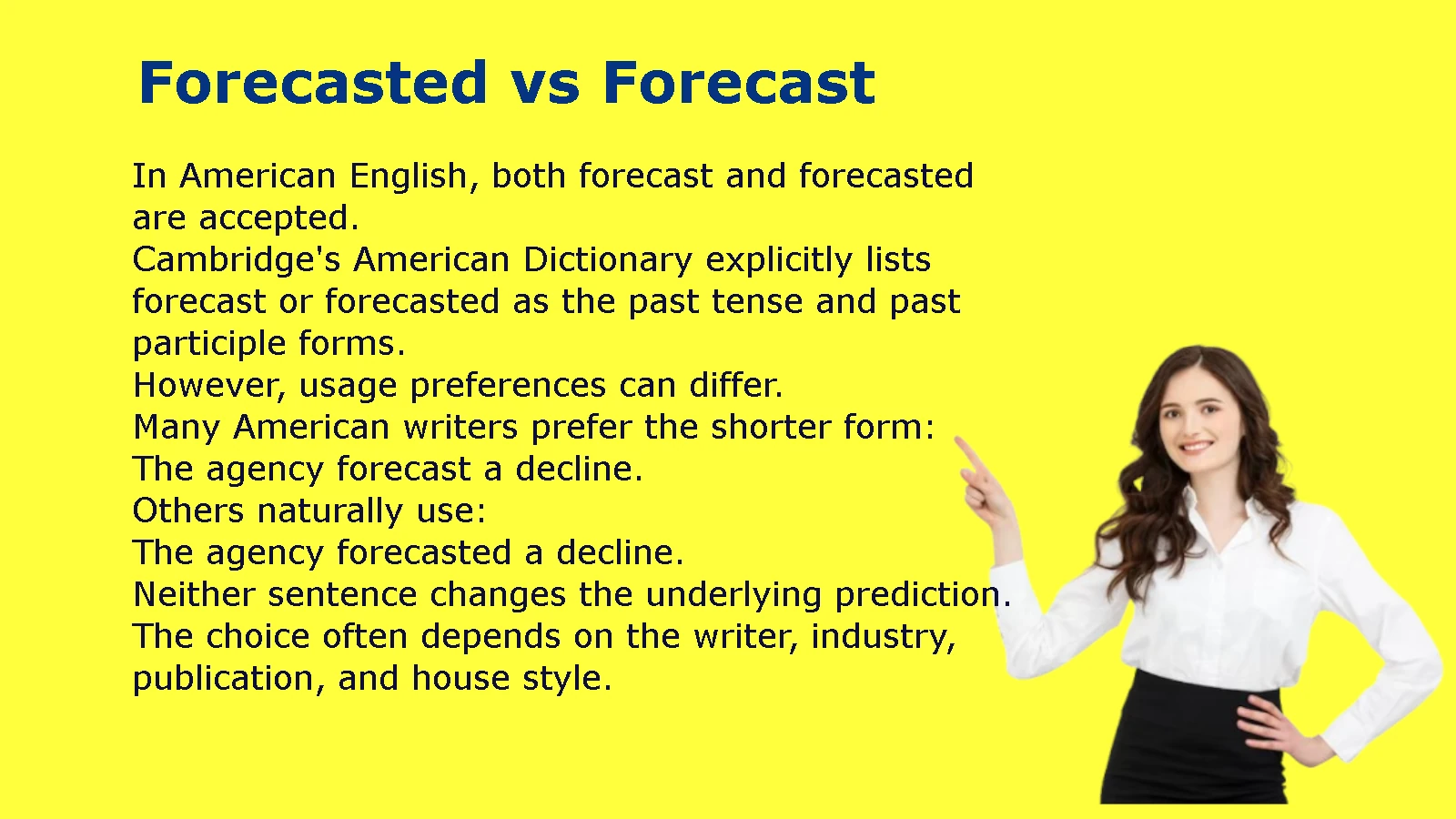
In American English, both forecast and forecasted are accepted.
Cambridge’s American Dictionary explicitly lists forecast or forecasted as the past tense and past participle forms.
However, usage preferences can differ.
Many American writers prefer the shorter form:
The agency forecast a decline.
Others naturally use:
The agency forecasted a decline.
Neither sentence changes the underlying prediction.
The choice often depends on the writer, industry, publication, and house style.
This becomes especially noticeable in business and financial writing. You may see phrases such as:
- forecasted earnings
- forecasted revenue
- forecasted growth
- forecasted demand
- forecasted expenses
At the same time, professional publications frequently use the unchanged form:
- forecast earnings
- forecast revenue
- forecast growth
- forecast demand
Merriam Webster notes that forecast is more common than the -ed form while still recognizing forecasted as a variant.
Forecasted vs. Forecast in British English
British English also uses forecast as a past form and recognizes forecasted.
The important thing to avoid is turning this into a rigid US versus UK rule. The difference isn’t as simple as saying:
“Americans use forecasted and British speakers use forecast.”
Real usage doesn’t follow that neat division.
Both forms appear in English varieties and professional contexts. Your choice should therefore depend on the sentence and the style you’re following.
Cambridge’s British and business entries show both forecast and forecasted as verb forms.
If you’re writing for an international audience, forecast is often a particularly clean choice because it is concise and widely recognized.
When Should You Use Forecast?
Forecast is a strong choice when you want a concise and traditional form.
Use it when:
- You’re using the present tense.
- You’re using the unchanged past tense.
- You’re using the past participle.
- You want concise formal writing.
- Your organization’s style favors forecast.
- The time of the prediction is already clear from context.
For example:
The economists forecast a decline last year.
The word last year establishes the past. There’s no need to add -ed to make the timing clear.
You can also use the same form in a perfect construction:
The economists have forecast a decline.
This is concise and completely grammatical.
Examples of Forecast
Here are some natural examples:
- Analysts forecast higher profits next year.
- The agency forecast heavy rainfall yesterday.
- Economists have forecast slower growth.
- The researchers had forecast a rise in demand.
- The storm was forecast for Thursday.
- Experts forecast that prices will remain stable.
The last example illustrates another common structure:
forecast that + clause
Cambridge documents structures such as forecast that, be forecast to, and be forecast for.
When Should You Use Forecasted?
Use forecasted when the regular -ed form suits your sentence or publication style.
It can be useful when you want the past tense to stand out clearly.
For example:
The researchers forecasted a sharp increase in demand in 2025.
The -ed ending makes the past action immediately visible.
It’s also common in phrases used as modifiers:
- forecasted growth
- forecasted revenue
- forecasted demand
- forecasted temperatures
- forecasted expenses
For example:
The company compared its actual revenue with its forecasted revenue.
Here, forecasted revenue means revenue that the company had previously predicted.
Dictionary.com also identifies forecasted as a past tense and past participle form and provides current published examples using the word.
Forecasted vs. Forecast in Business and Finance
Business writing provides one of the clearest places to see both forms in action.
Companies constantly make predictions about future performance. They forecast revenue, expenses, sales, demand, profits, hiring, production, and cash flow.
For example:
The company forecast revenue of $50 million for the next fiscal year.
Or:
The company forecasted revenue of $50 million for the next fiscal year.
Both sentences communicate the same basic idea.
Common Business Uses of Forecast
Some common combinations include:
| Phrase | Meaning |
| sales forecast | Prediction of future sales |
| revenue forecast | Prediction of future revenue |
| profit forecast | Prediction of future profit |
| economic forecast | Prediction about economic conditions |
| market forecast | Prediction about a market |
| demand forecast | Prediction of future customer demand |
| cash flow forecast | Estimate of future cash inflows and outflows |
| forecasted revenue | Revenue that was previously predicted |
| forecasted growth | Growth that was previously predicted |
Cambridge’s Business English Dictionary specifically includes combinations involving profit, revenue, sales, growth, and forecasts.
A Simple Business Example
Imagine a company predicts that it will sell 100,000 products next year.
At the time of making the prediction, you could write:
The company forecasts sales of 100,000 units.
Later, when discussing that prediction, you could write:
The company forecast sales of 100,000 units last year.
Or:
The company forecasted sales of 100,000 units last year.
Again, the choice between forecast and forecasted doesn’t change what the company predicted.
The key difference is grammatical form and stylistic preference.
Forecasted vs. Forecast in Weather Writing
Weather provides another familiar example.
A meteorologist might say:
Meteorologists forecast heavy rain for Friday.
After the prediction was made, you could say:
Meteorologists forecast heavy rain for Friday.
Or:
Meteorologists forecasted heavy rain for Friday.
The noun works differently:
The forecast calls for heavy rain.
Here, forecast is a noun. You can’t replace it with forecasted.
So:
✅ The forecast calls for rain.
❌ The forecasted calls for rain.
This distinction is important because forecast doesn’t always represent a verb.
Sometimes it’s the name of the prediction itself.
Common Sentence Patterns With Forecast
Understanding the structures around forecast makes the word much easier to use.
Forecast + Noun
This is one of the most common patterns.
Analysts forecast higher prices.
Economists forecast stronger growth.
Meteorologists forecast heavy snow.
The structure is:
Subject + forecast + noun phrase
Forecast + That Clause
You can also use forecast that followed by a complete clause.
Analysts forecast that sales will increase.
Economists forecast that inflation will fall.
Researchers forecast that demand will remain stable.
This structure is useful when you want to state the predicted outcome as a complete idea.
Be Forecast to + Verb
Another common pattern is:
Sales are forecast to increase.
Prices are forecast to fall.
Demand is forecast to remain strong.
This construction is particularly common in formal, financial, and analytical writing.
Be Forecast for + Time
You can also say:
Rain is forecast for Saturday.
Snow is forecast for tonight.
This structure focuses on the predicted event and the expected time.
Cambridge explicitly gives examples of be forecast for and be forecast to.
Common Sentence Patterns With Forecasted
Forecasted works in many of the same grammatical structures.
Forecasted + Noun
Analysts forecasted higher prices.
The company forecasted stronger sales.
Researchers forecasted a decline in demand.
Forecasted + That Clause
Economists forecasted that inflation would decline.
Analysts forecasted that sales would increase.
Notice the use of would in these examples.
When reporting a prediction from a past point in time, English often shifts the future form will to would.
Compare:
Analysts forecast that sales will increase.
with:
Analysts forecasted that sales would increase.
The second sentence places the prediction firmly in the past.
Was or Were Forecasted to
You can also use the passive construction:
Sales were forecasted to increase.
Temperatures were forecasted to remain below average.
The storm was forecasted to arrive overnight.
The corresponding form with forecast also works:
Sales were forecast to increase.
Temperatures were forecast to remain below average.
Forecast vs. Forecasted Examples
Seeing the forms side by side is often the fastest way to understand them.
| Meaning | Forecast | Forecasted |
| Past prediction | Experts forecast a decline. | Experts forecasted a decline. |
| Past weather prediction | Meteorologists forecast rain. | Meteorologists forecasted rain. |
| Business prediction | Analysts forecast higher profits. | Analysts forecasted higher profits. |
| Previous growth prediction | The company had forecast growth. | The company had forecasted growth. |
| Passive form | A decline was forecast. | A decline was forecasted. |
| Past reported prediction | Experts forecast that prices would rise. | Experts forecasted that prices would rise. |
The core meaning remains the same.
What changes is the verb form.
Forecast vs. Forecasted: A Practical Case Study
Consider a retail company preparing its annual business plan.
In January, its analysts predict that sales will increase by 8 percent.
The company can describe the current prediction like this:
The analysts forecast an 8 percent increase in sales.
Six months later, the company is discussing what its analysts predicted earlier.
It can write:
The analysts forecast an 8 percent increase in sales in January.
Or:
The analysts forecasted an 8 percent increase in sales in January.
Now suppose the company compares the prediction with actual results:
The analysts forecasted an 8 percent increase, but actual sales rose by only 3 percent.
Here, forecasted may feel particularly natural because the writer is clearly referring to a completed prediction made at an earlier time.
However:
The analysts forecast an 8 percent increase, but actual sales rose by only 3 percent.
also works.
That’s the heart of the issue. Context doesn’t force you to use forecasted.
Common Mistakes With Forecast and Forecasted
The biggest problems usually come from treating a style preference as an absolute grammar rule.
Mistake: Saying Forecasted Is Always Wrong
This is incorrect.
Major dictionaries recognize forecasted as an accepted form. Cambridge lists it alongside forecast, while Merriam Webster identifies it as a variant.
So don’t automatically edit every instance of forecasted to forecast.
Instead, consider the context and the publication’s preferred style.
Mistake: Assuming Forecast Cannot Refer to the Past
It can.
For example:
The economists forecast a recession last year.
The phrase last year clearly places the prediction in the past.
The unchanged form doesn’t make the sentence present tense.
Mistake: Confusing Forecast With Forecasting
Forecasting refers to the activity or process of making predictions.
Compare:
The company forecasts sales growth.
The company is forecasting sales growth.
Sales forecasting helps the company plan inventory.
The first two use forecast as a verb.
The third uses forecasting as a noun or gerund.
Mistake: Confusing the Noun and Verb
Consider:
The forecast was accurate.
Here, forecast is a noun.
Now compare:
Experts forecast a storm.
Here, forecast is a verb.
You can replace the second sentence with:
Experts forecasted a storm.
But you can’t replace the noun in the first sentence with forecasted.
Forecast vs. Forecasted vs. Forecasting
These three forms are closely related, but they don’t perform the same grammatical job.
| Word | Main role | Meaning | Example |
| forecast | Noun or verb | A prediction or to predict | Experts forecast higher demand. |
| forecasted | Past verb form | Predicted earlier | Experts forecasted higher demand. |
| forecasting | Present participle/gerund | The process of predicting | Demand forecasting helps businesses plan. |
Think of them as three different tools in the same toolbox.
Forecast names the prediction or describes the act of predicting.
Forecasted tells you that the prediction happened in the past.
Forecasting describes the ongoing activity or process.
Merriam Webster defines forecast as predicting a future event or condition, often through study and analysis of available information.
Why Does Forecast Have Two Past Forms?
The answer comes down to English usage.
The verb forecast belongs to a group of words ending in -cast, such as broadcast and telecast. Some of these verbs can retain the unchanged form in the past while also developing an -ed variant.
Merriam Webster notes that the unchanged forms are generally more common for these verbs but that forecasted is common enough to be recognized as a variant.
This is a useful reminder that English doesn’t always behave like a perfectly organized spreadsheet.
Language develops through use.
When speakers consistently use a form and that form becomes established in reputable sources, dictionaries may record it. That’s what has happened with forecasted.
Which Is More Common: Forecast or Forecasted?
Forecast is generally more common, especially as the unchanged past form.
Merriam Webster’s usage discussion explicitly notes that forecasted is less common than forecast, although it occurs often enough to be recognized as a legitimate variant.
That doesn’t make forecasted incorrect.
It simply means that forecast may sound more natural to many readers, particularly in concise formal writing.
For example:
The analysts forecast a decline in revenue.
This sounds compact and professional.
But:
The analysts forecasted a decline in revenue.
also sounds natural to many English speakers, particularly when the writer wants a clear regular past form.
Which Is Better: Forecast or Forecasted?
There isn’t one universal winner.
If you want the shorter and more traditional form, choose forecast.
If forecasted fits your organization’s style or makes the past reference clearer, use forecasted.
A practical guide looks like this:
| Situation | Recommended choice |
| Present tense | forecast |
| Concise formal writing | forecast |
| Traditional unchanged past form | forecast |
| Past tense with regular -ed form | forecasted |
| Past participle | forecast or forecasted |
| Business writing | Either, depending on style |
| Technical writing | Either, depending on style |
| Weather writing | Either for the verb |
| Noun meaning a prediction | forecast |
If you’re unsure, forecast is a safe choice.
It is short, established, and widely understood.
However, there’s no need to panic when you see forecasted in an edited article, report, research paper, or business document. It is a legitimate form.
A Note on Style Guides
Grammar and style aren’t always the same thing.
A dictionary tells you whether a word or construction exists and how speakers use it. A style guide may then recommend one form for consistency.
That’s why you might encounter a publication that prefers:
The agency forecast higher temperatures.
while another publication writes:
The agency forecasted higher temperatures.
Merriam Webster’s usage discussion notes that the Associated Press has advised using forecast for the past tense even though published examples show forecasted in actual usage.
The lesson is simple:
A style preference doesn’t automatically turn the alternative into a grammar error.
If you’re writing for a company, newspaper, academic journal, or other organization, follow its house style when one exists.
Forecasted vs. Forecast: How to Choose
When you’re sitting in front of a sentence and wondering which word belongs there, use this quick process.
Check the Grammar
First, determine what role the word plays.
Is it a noun?
The forecast was encouraging.
Use forecast.
Is it a present tense verb?
Analysts forecast higher sales.
Use forecast.
Is it a past tense verb?
Analysts forecasted higher sales.
Or:
Analysts forecast higher sales.
Both work.
Check the Style
Next, consider the type of writing.
A formal report might favor:
The researchers forecast a decline.
A company report might use:
The researchers forecasted a decline.
Neither choice changes the factual meaning.
Check for Consistency
Finally, don’t switch randomly between forms.
If a report repeatedly uses forecast as the past form, there’s little reason to suddenly use forecasted in one paragraph unless the context calls for it.
Consistency makes professional writing easier to read.
Forecasted vs. Forecast: Frequently Asked Questions
Is forecasted grammatically correct?
Yes. Forecasted is grammatically correct and is recognized by major dictionaries as a past tense and past participle form of forecast.
Is forecast also the past tense of forecast?
Yes. Forecast can function as the past tense.
For example:
The analysts forecast a decline last year.
The unchanged form is completely grammatical.
Is forecasted the past tense of forecast?
Yes. Forecasted is also an accepted past tense form.
For example:
The analysts forecasted a decline last year.
Both forecast and forecasted can express the same past action.
What is the past participle of forecast?
Both forecast and forecasted can function as past participles.
For example:
The experts have forecast a decline.
and:
The experts have forecasted a decline.
Both are grammatical.
Which is more common, forecast or forecasted?
Forecast is generally more common. Merriam Webster describes forecasted as a less common variant while recognizing it as an established form.
Should I say forecast or forecasted?
If you want the concise traditional form, forecast is an excellent choice.
Use forecasted when it fits your style or when you prefer the regular -ed past form.
Is forecasted formal English?
Yes. Forecasted can appear in formal English, including business, technical, academic, and analytical writing.
However, some publications prefer the shorter forecast form.
Can forecast be a noun?
Yes.
As a noun, forecast means a prediction or estimate about a future event or condition.
For example:
The weather forecast predicts rain.
Cambridge defines forecast as a noun referring to a statement about what is likely to happen in the future.
What is the difference between forecast and forecasting?
Forecast can mean a prediction or the act of predicting.
Forecasting refers to the process or activity of making predictions.
For example:
The company forecast higher sales.
The company uses forecasting to plan inventory.
Is “forecasted” better than “forecast”?
Not necessarily.
Forecasted isn’t inherently better, and forecast isn’t inherently better. The right choice depends on grammar, context, and style.
For most concise formal writing, forecast is a strong default.
Final Verdict: Forecasted vs. Forecast
The difference between forecasted vs. forecast is much simpler than it first appears.
Forecast has several grammatical roles. It can act as a noun, a present tense verb, a past tense verb, or a past participle.
Forecasted is the regular -ed past tense and past participle form of the verb.
Both are correct.
| Question | Answer |
| Is forecast a noun? | Yes |
| Is forecast a verb? | Yes |
| Can forecast be past tense? | Yes |
| Can forecasted be past tense? | Yes |
| Can forecast be a past participle? | Yes |
| Can forecasted be a past participle? | Yes |
| Is forecasted wrong? | No |
| Is forecast generally more common? | Yes |
The easiest rule to remember is this:
Use “forecast” for the concise, unchanged form. Use “forecasted” when the regular past form fits your sentence or style.
If you’re writing “Experts forecast a decline last year,” you’re correct.
If you’re writing “Experts forecasted a decline last year,” you’re also correct.
In other words, this isn’t a case of right versus wrong. It’s a case of two accepted forms with different usage preferences. Major dictionaries support that distinction.
For most readers, forecast will be the cleanest default. But when forecasted appears in a well written sentence, there’s no grammatical fire to put out.