Have you ever heard someone called a “newshound” and wondered what the word really means? While Newshound Meaning may sound like it has something to do with dogs, the term actually describes a person who is highly interested in news, especially someone who eagerly follows, reads, or searches for the latest stories and information.
A newshound is a person who is always looking for news and enjoys keeping up with current events. The word is informal and often describes journalists, news reporters, or people who closely follow the latest developments in politics, entertainment, sports, or other areas.
Examples:
- My brother is a real newshound and reads the news every morning.
- As a newshound, she always knows what is happening around the world.
The confusion is understandable. People often search for what does newshound mean, newshound meaning in English, newshound definition, or newshound meaning in a sentence because the word combines “news” with “hound,” which can make its meaning less obvious at first glance. And here’s the kicker: newshound doesn’t describe a type of dog. It describes someone who hunts for news.
In this guide, you’ll learn the complete Newshound Meaning, its definition, pronunciation, origin, correct usage, and examples in sentences. You’ll also discover synonyms for newshound, whether the word is formal or informal, and how to use it naturally in everyday English.
What Does Newshound Mean?
Newshound is an informal noun for a person who actively pursues news, particularly a reporter or journalist who works hard to discover new stories.
Cambridge Dictionary defines a newshound as a reporter who puts considerable effort into discovering new stories. Merriam Webster gives the shorter definition “an aggressive journalist.” These definitions point to the same central idea: a newshound doesn’t simply receive news. The person actively goes after it.
Newshound Meaning in Simple Words
A newshound is:
- A journalist who aggressively searches for stories
- A reporter who follows leads and investigates information
- Someone who is extremely interested in news
- A person who always wants to know what is happening
- An energetic news seeker
The exact meaning depends on context.
For example:
The veteran newshound spent weeks tracking down the source of the leak.
Here, newshound clearly means an investigative journalist.
Now consider:
My uncle is a political newshound who reads every major story before breakfast.
Here, the word focuses more on someone’s intense interest in news than on professional journalism.
That distinction matters. Newshound most strongly refers to someone who pursues news, but modern usage can extend beyond professional reporters.
Newshound Definition
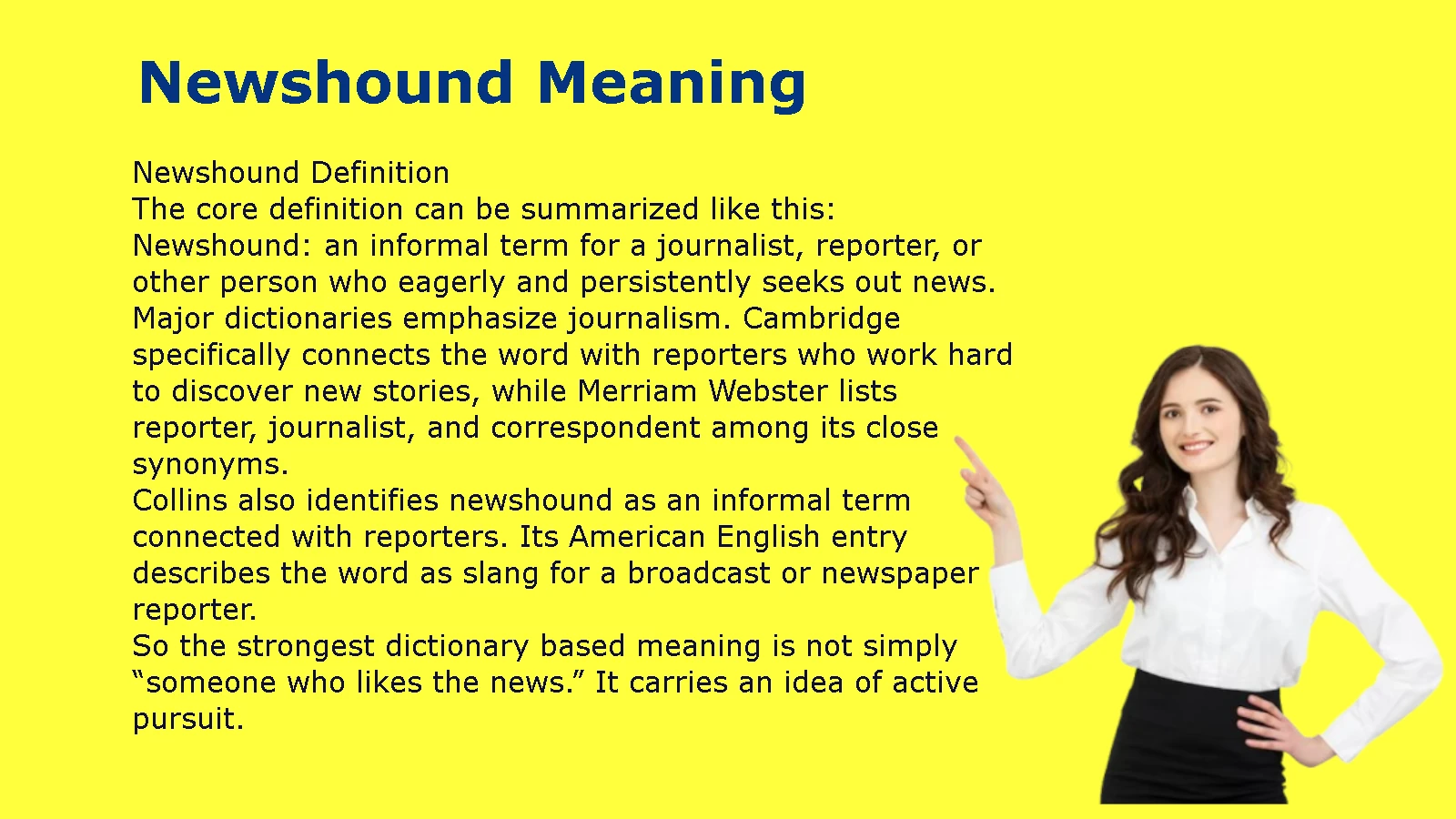
The core definition can be summarized like this:
Newshound: an informal term for a journalist, reporter, or other person who eagerly and persistently seeks out news.
Major dictionaries emphasize journalism. Cambridge specifically connects the word with reporters who work hard to discover new stories, while Merriam Webster lists reporter, journalist, and correspondent among its close synonyms.
Collins also identifies newshound as an informal term connected with reporters. Its American English entry describes the word as slang for a broadcast or newspaper reporter.
So the strongest dictionary based meaning is not simply “someone who likes the news.” It carries an idea of active pursuit.
What Makes Someone a Newshound?
A person might be called a newshound because they:
- Chase breaking stories
- Search for exclusive information
- Interview sources
- Follow tips and leads
- Investigate suspicious claims
- Track developments over time
- Look for information other reporters have missed
- Keep up with major news events
- Constantly monitor new developments
The word therefore suggests curiosity plus persistence.
A casual news reader may enjoy the morning headlines. A newshound wants to know what happened, why it happened, who knows about it, and what might happen next.
Newshound Meaning in a Sentence
Seeing the word in context makes its meaning much clearer.
Examples of Newshound in a Sentence
The newshound refused to stop investigating after the official statement raised more questions.
This example emphasizes persistence.
She’s a political newshound who never misses an important election story.
Here, newshound describes someone intensely interested in political news.
The young reporter quickly earned a reputation as a fearless newshound.
In this sentence, the word describes a journalist who actively pursues stories.
Every newsroom needs a newshound who knows how to find the story behind the headline.
This usage highlights investigation and curiosity.
He’s such a newshound that he checks the headlines before he checks his email.
Here, the word is playful rather than strictly professional.
What These Examples Show
The word can carry slightly different shades of meaning:
| Context | Meaning of newshound |
| Newspaper newsroom | An energetic reporter |
| Investigative journalism | A persistent story seeker |
| Television news | A reporter who aggressively pursues stories |
| Politics | Someone intensely interested in political news |
| Everyday conversation | Someone who follows news closely |
| Informal description | A person who always wants the latest information |
The common thread is active interest in news.
Is Newshound a Positive or Negative Word?
Newshound is usually neutral or positive, although the surrounding context can change its tone.
When used positively, it can praise a journalist’s determination, curiosity, and ability to uncover important information.
For example:
She was a relentless newshound who uncovered the facts others overlooked.
Here, newshound is clearly complimentary.
The word can also sound playful:
He’s a real newshound. He knows every local story before anyone else does.
However, the word can occasionally carry a more aggressive shade. Merriam Webster’s definition uses “aggressive journalist,” which reflects the idea of a reporter who pushes hard to obtain information.
That doesn’t automatically make the word negative. In journalism, persistence can be a strength.
When Newshound Sounds Positive
The word may suggest:
- Determination
- Curiosity
- Persistence
- Professional instinct
- Strong research skills
- Awareness of current events
- A talent for finding information
When Newshound Sounds Critical
In some contexts, it can suggest someone who:
- Pushes too hard for information
- Constantly chases sensational stories
- Is obsessed with getting the latest scoop
- Cares more about being first than being careful
The surrounding words usually tell you which meaning the writer intends.
Newshound vs. Journalist
Newshound and journalist are not exact synonyms.
A journalist is a broad professional term for someone involved in gathering, researching, writing, or presenting news and information.
A newshound is more specific in tone. It emphasizes the person’s eagerness and persistence in finding news.
| Word | Main idea | Tone |
| Journalist | A professional who gathers and reports information | Neutral |
| Reporter | A journalist who gathers and reports news | Neutral |
| Correspondent | A reporter assigned to cover a particular place or subject | Professional |
| Newshound | A person who aggressively or enthusiastically pursues news | Informal |
| News junkie | Someone who consumes a large amount of news | Informal |
Consider this difference:
She is a journalist.
This tells you about her profession.
She’s a real newshound.
This tells you something about how she approaches news.
The second sentence paints a picture. You can almost imagine someone following leads with a notebook in hand.
Newshound vs. Reporter
Reporter is generally the safer and more precise professional term.
A reporter gathers information and prepares news reports. A newshound is a more colorful description of a reporter who actively hunts for stories.
For example:
The reporter covered the city council meeting.
This is straightforward.
The newshound stayed outside city hall, looking for anyone who could explain the controversial decision.
This adds a sense of pursuit.
The second sentence gives the person more personality. It suggests that the reporter isn’t simply assigned to write a story. The reporter is hunting for one.
Newshound vs. News Junkie
These expressions overlap, but they aren’t interchangeable in every situation.
A news junkie is someone who consumes a lot of news. The term usually focuses on the person’s appetite for information.
A newshound more strongly suggests the pursuit or discovery of news.
Compare Them
Maria is a news junkie.
This suggests Maria consumes news constantly.
Maria is a newshound.
This can suggest that Maria actively follows, investigates, or pursues news.
The difference is subtle but useful.
News junkie = consumes news.
Newshound = hunts for news.
A journalist can certainly be both.
Newshound Synonyms
Several words can overlap with newshound, but each has its own shade of meaning.
Journalist
The broadest professional alternative.
Use journalist when you want a neutral, formal description.
Reporter
A particularly close synonym when newshound refers to someone gathering and reporting news.
Correspondent
A correspondent typically reports from a particular location or specializes in a particular area.
Newsman or Newsperson
These terms can refer to someone working in news, although usage and preferred terminology vary.
News Buff
A news buff is someone who knows a lot about news and enjoys following it.
This term focuses more on enthusiasm than professional reporting.
News Enthusiast
A straightforward modern phrase for someone who enjoys following current events.
News Junkie
An informal expression for someone who consumes a great deal of news.
Newshawk
Newshawk is a closely related informal term. Collins defines it as a newspaper reporter, particularly one who is energetic and aggressive, and lists newshound as another name for it.
Synonym Comparison
| Synonym | Best used for | Tone |
| Journalist | Professional news worker | Neutral |
| Reporter | Person who gathers and reports news | Neutral |
| Correspondent | Specialized or location based reporter | Professional |
| News buff | Person who enjoys news | Informal |
| News junkie | Person who consumes lots of news | Very informal |
| Newshawk | Energetic news reporter | Informal |
| Newsperson | Person working in journalism | Neutral |
| Newshound | Persistent news seeker | Informal |
No synonym perfectly replaces newshound in every sentence. The word’s distinctive feature is its sense of pursuit.
Antonyms of Newshound
English doesn’t have one perfect dictionary antonym for newshound.
Still, several phrases express the opposite idea:
- News avoider
- Someone uninterested in current events
- A person who rarely follows the news
- Someone disconnected from current affairs
These are descriptive opposites rather than exact lexical antonyms.
For example:
While his brother is a political newshound, Jake rarely follows current events.
The contrast is clear without requiring a formal antonym.
Where Does the Word Newshound Come From?
The structure of newshound is straightforward:
news + hound
The first part refers to news or new information. The second part creates the metaphor.
A hound is a dog traditionally associated with tracking and hunting. In compounds and figurative expressions, hound can also suggest a person who relentlessly pursues something.
That idea fits journalism remarkably well.
A reporter may begin with a tiny clue: a document, a phone call, an anonymous tip, a public record, or something that doesn’t quite make sense.
The reporter follows it.
One lead produces another. Another source provides a new detail. Eventually, the scattered pieces form a story.
That’s the image behind newshound: someone who tracks down news like a hound follows a scent.
Wiktionary records the word’s formation simply as news + hound and identifies its informal noun use with investigative reporting.
When Was Newshound First Used?
Merriam Webster records 1918 as the first known use of newshound.
That date places the word in the early 20th century, when newspapers remained a major source of public information and professional journalism was developing rapidly.
The timing also makes the metaphor easy to understand. Newspapers competed to publish important stories, while reporters competed to uncover information first.
The term could therefore capture a particular kind of journalist: energetic, persistent, skeptical, and always looking for the next story.
It wasn’t simply a label for someone who worked at a newspaper. It described an attitude toward finding news.
Why Is Someone Called a Newshound?
The hound part is the key.
A determined reporter works in a similar way.
A story might begin with:
- A rumor
- A suspicious transaction
- An unexplained event
- A source’s tip
- A leaked document
- A public record
- A contradictory statement
- An overlooked detail
A persistent reporter follows those clues.
That’s why newshound works so well as a metaphor. It captures the behavior rather than merely the job title.
The Metaphor in One Table
| Hound | Newshound |
| Follows a scent | Follows a lead |
| Tracks clues | Investigates information |
| Searches for something hidden | Looks for an undiscovered story |
| Doesn’t give up easily | Keeps pursuing a difficult story |
| Finds what others may miss | Uncovers information others overlooked |
The metaphor also explains why newshound sounds more vivid than journalist.
Journalist identifies the profession.
Newshound suggests the personality.
How to Use Newshound Correctly
Newshound is a noun.
You can use it to describe a person:
She’s a newshound.
You can also use it after an adjective:
He’s an aggressive newshound.
Or in a longer noun phrase:
The veteran political newshound uncovered the connection.
The plural is newshounds.
Several newshounds gathered outside the courthouse.
Common Grammatical Patterns
These patterns are natural:
- a newshound
- the newshound
- a veteran newshound
- a political newshound
- an investigative newshound
- newshounds
- the city’s newshounds
Because the word is informal, it works especially well in conversational writing, feature articles, profiles, and colorful descriptions.
Is Newshound Formal or Informal?
Newshound is informal.
Cambridge labels it as a noun used for a reporter, while Collins classifies it as informal and, in its American English entry, as slang for a broadcast or newspaper reporter.
That doesn’t mean the word is incorrect or unprofessional. It simply means that it carries more personality than a neutral term such as journalist.
Use Newshound When You Want to Sound
- Conversational
- Colorful
- Lively
- Slightly playful
- Descriptive
- Informal
Use Journalist or Reporter When You Want to Sound
- Formal
- Neutral
- Precise
- Professional
- Academic
For example, in a formal report:
The journalist investigated the allegations.
In a feature story:
The veteran newshound spent months digging into the allegations.
Both sentences work. The second simply has more flavor.
Newshound Pronunciation
In US English, newshound is pronounced:
/ˈnuːz.haʊnd/
Cambridge gives the US pronunciation as /ˈnuːz.haʊnd/ and the UK pronunciation as /ˈnjuːz.haʊnd/.
The word has two main parts:
- news
- hound
The primary stress falls on the first part.
The pronunciation also reflects a common feature of the word: the final sound of news connects naturally with the beginning of hound.
Is Newshound One Word or Two?
Newshound is normally written as one word.
Correct:
newshound
Not:
news hound
The closed compound is the standard dictionary form used by major English dictionaries. Cambridge, Merriam Webster, and Collins all list newshound as one word.
The plural form is:
newshounds
For example:
The newsroom was filled with experienced newshounds.
Is Newshound Slang?
Newshound is informal, and some dictionaries classify its American usage as slang.
Collins explicitly labels its American English definition as slang and describes the term as referring to a broadcast or newspaper reporter.
However, calling it slang shouldn’t suggest that the word is obscure or meaningless. It is an established English noun with a long history of use.
Merriam Webster records its first known use in 1918, while Cambridge includes it as a standard dictionary entry.
The practical takeaway is simple:
Newshound is a legitimate English word, but it has an informal and colorful tone.
Can Newshound Describe a Journalist?
Yes.
In fact, journalist or reporter is the central dictionary sense of newshound.
Cambridge defines the word specifically around a reporter who works hard to discover new stories. Merriam Webster similarly defines it as an aggressive journalist.
The word is especially appropriate when you want to emphasize a reporter’s determination.
For example:
The investigative newshound spent months tracking the financial records.
The sentence doesn’t merely tell readers that the person is a journalist. It highlights the person’s persistence and investigative instinct.
Can Newshound Describe Someone Who Isn’t a Journalist?
Yes, although this broader use is less central than the journalistic sense.
Modern examples show newshound being used for people who avidly follow particular kinds of information. Merriam Webster’s recent usage examples include references to people who follow political news and even people who track video game developments.
That broader usage works because the underlying metaphor remains intact.
Someone doesn’t have to work for a newspaper to hunt for information.
For example:
He’s a technology newshound who follows every major product announcement.
Here, the person may not be a professional reporter. The word simply emphasizes intense attention to news.
Newshound in Modern Usage
The digital age has changed how people find news, but it hasn’t made the word’s basic metaphor obsolete.
In fact, the idea of a person constantly hunting for information fits modern media surprisingly well.
A modern newshound might monitor:
- News websites
- Newsletters
- Government databases
- Social media
- Public records
- Press releases
- Podcasts
- Online forums
- Industry publications
- Company announcements
A journalist might also use digital tools to search large collections of documents and data.
The technology has changed. The instinct hasn’t.
The traditional newshound followed sources and telephone leads. The modern version may follow databases, digital records, online posts, and data trails.
Usage Case Studies for Newshound
Case Study: The Investigative Reporter
Imagine a reporter hears that a public contract may have been awarded under unusual circumstances.
A routine reporter might write about the official announcement.
A newshound keeps digging.
The reporter examines the contract, contacts people involved, checks previous agreements, searches public records, and asks why the winning company received the work.
Here, newshound emphasizes the reporter’s persistence and investigative instinct.
This aligns closely with the traditional dictionary sense of the word as a reporter who works hard to discover stories.
Case Study: The Political News Follower
Now imagine someone who isn’t a journalist but follows politics constantly.
They read election coverage, watch debates, track polls, follow legislative developments, and know the latest political story before their friends do.
Calling this person a political newshound is informal but understandable.
The focus shifts from professional reporting to intense news consumption and awareness.
Case Study: The Specialized News Seeker
The word can also describe someone who follows a specific field.
For example:
He’s a technology newshound who tracks every major development in artificial intelligence.
Or:
She’s a sports newshound who follows every major trade and transfer.
These uses extend the word beyond traditional newspaper journalism while keeping its core idea intact: someone who eagerly tracks information and developments.
Real World Usage of Newshound
The word appears in journalism, politics, media writing, and descriptions of people who closely follow breaking developments.
Merriam Webster’s usage examples include newshound in references to political news followers, newsroom figures, and people who closely monitor developments in specific fields.
One especially useful modern example involves Wario64, a social media account known for reporting video game news and developments. Merriam Webster describes the account as a “video game newshound” in a recent example.
This demonstrates how the word’s meaning has stretched naturally into digital media.
The person doesn’t have to work for a traditional newspaper. What matters is the habit of finding and reporting information quickly.
Newshound and Newshawk: What’s the Difference?
Newshawk is a close relative of newshound.
Collins describes newshawk as an informal term for a newspaper reporter and notes that the word can refer particularly to an energetic and aggressive reporter. It also lists newshound as an alternative name.
Both words use an animal metaphor:
- Newshound → a hound that tracks news
- Newshawk → a hawk that spots news
The metaphors differ, but the journalistic idea is similar.
Common Questions About Newshound
What does newshound mean?
Newshound means a person who actively seeks or follows news, especially an energetic or persistent journalist or reporter.
Is newshound a real word?
Yes. Newshound is an established English noun listed by major dictionaries, including Cambridge, Merriam Webster, and Collins.
Is newshound one word or two?
It is normally written as one word: newshound.
Is newshound formal or informal?
Newshound is informal. It has a lively and sometimes playful tone.
Is newshound a synonym for journalist?
It can be used as an informal synonym for journalist or reporter, but the words aren’t identical.
Journalist identifies the profession.
Newshound emphasizes the person’s enthusiasm or persistence in pursuing news.
Is newshound positive or negative?
Usually, newshound is neutral or positive. It can praise someone for being persistent and well informed. In some contexts, it may suggest aggressive or overly persistent news gathering.
Can you call a person who loves news a newshound?
Yes. In informal usage, newshound can describe someone who follows news very closely even when that person isn’t a professional journalist.
What is the plural of newshound?
The plural is newshounds.
What is a synonym for newshound?
The closest alternatives include reporter, journalist, correspondent, newsman, newsperson, and newshawk. Informal alternatives such as news buff and news junkie can work when the context focuses on consuming news rather than reporting it.
What is the opposite of newshound?
There isn’t one exact standard antonym. Phrases such as news avoider or someone uninterested in current events express the opposite idea.
What does the hound in newshound mean?
The hound creates a metaphor for someone who tracks and pursues something persistently. A newshound therefore “hunts” for news much like a hound tracks a scent.
Does newshound only refer to newspaper reporters?
No. Its strongest dictionary sense concerns reporters and journalists, but modern usage can also describe people who avidly follow or pursue news in a particular field.
Newshound Meaning: Quick Reference
| Category | Information |
| Word | Newshound |
| Part of speech | Noun |
| Plural | Newshounds |
| Basic meaning | A person who actively pursues or follows news |
| Strongest dictionary sense | An energetic or persistent reporter |
| Tone | Informal |
| US pronunciation | /ˈnuːz.haʊnd/ |
| Word formation | News + hound |
| First known use | 1918 |
| Common synonyms | Reporter, journalist, correspondent, newshawk |
| Related informal terms | News buff, news junkie |
| Typical context | Journalism, reporting, current events, specialized news |
The first known use of newshound dates to 1918, according to Merriam Webster. Cambridge gives the US pronunciation as /ˈnuːz.haʊnd/.
Final Takeaway: Newshound Meaning
The simplest way to remember newshound meaning is:
A newshound is someone who hunts for news.
The word most directly describes an energetic, persistent reporter or journalist who actively searches for stories. However, informal modern usage can also describe someone who follows news intensely, whether or not they work in journalism.
The word’s power comes from its metaphor. A hound tracks a scent. A newshound tracks a story.
That’s why newshound carries more personality than journalist. It doesn’t merely tell you what someone does. It suggests how they do it: with curiosity, persistence, and an appetite for the next story.