When talking about bringing people, ideas, sounds, or things into agreement or balance, you may come across both harmonize and harmonise. The difference between Harmonize vs Harmonise is mainly a matter of spelling, not meaning. The form you choose usually depends on the type of English and the country or audience you are writing for.
Harmonize and harmonise have the same meaning. Both mean to bring things into harmony, agreement, or balance. Harmonize is the standard spelling in American English, while harmonise is traditionally preferred in British English and other varieties that follow British spelling conventions.
Examples:
- The new policies should harmonize the different departments.
- The new policies should harmonise the different departments.
The confusion is understandable. People often search for harmonize vs harmonise, harmonize or harmonise, which spelling is correct, or harmonise meaning in English because both spellings are accepted, yet they follow different spelling conventions. And here’s the kicker: neither spelling changes the word’s meaning or pronunciation.
In this guide, you’ll learn the complete difference between Harmonize vs Harmonise, including their meaning, pronunciation, origin, correct spelling, and usage. You’ll also discover which spelling to use in American English vs British English, along with clear examples to help you choose the right form.
What Does Harmonize Mean?
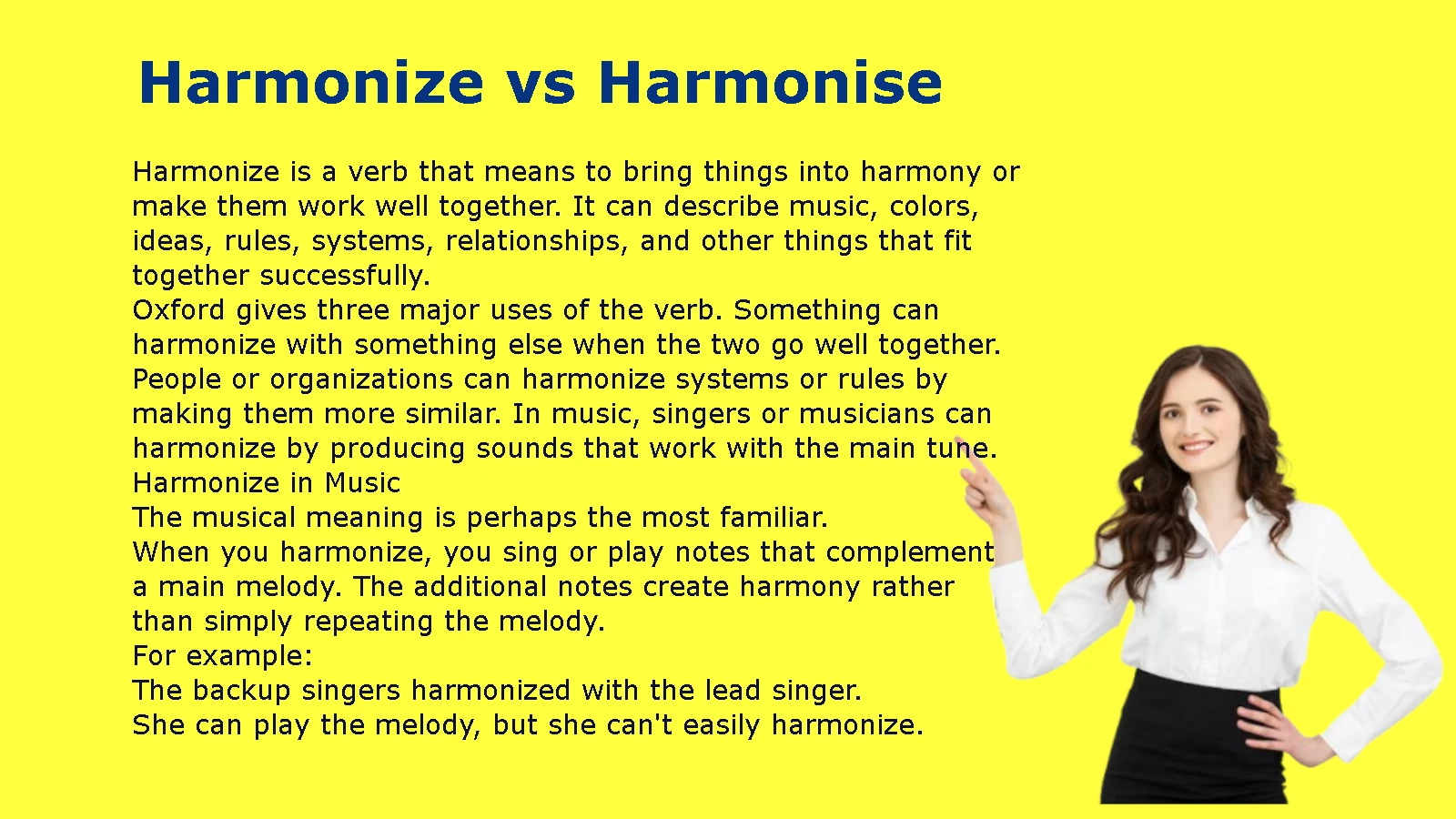
Harmonize is a verb that means to bring things into harmony or make them work well together. It can describe music, colors, ideas, rules, systems, relationships, and other things that fit together successfully.
Oxford gives three major uses of the verb. Something can harmonize with something else when the two go well together. People or organizations can harmonize systems or rules by making them more similar. In music, singers or musicians can harmonize by producing sounds that work with the main tune.
Harmonize in Music
The musical meaning is perhaps the most familiar.
When you harmonize, you sing or play notes that complement a main melody. The additional notes create harmony rather than simply repeating the melody.
For example:
- The backup singers harmonized with the lead singer.
- She can play the melody, but she can’t easily harmonize.
- The two singers harmonized beautifully during the chorus.
Cambridge defines the musical sense as adding harmonies to a tune. Merriam Webster similarly defines harmonize as playing or singing in harmony.
Think of a melody as the main line of a painting. Harmony adds the supporting colors that make the whole picture richer.
Harmonize in Everyday Language
You can also use harmonize when two things look, sound, or work well together.
For example:
The blue curtains harmonize with the gray walls.
Here, harmonize means that the colors complement each other.
The same idea works with people, ideas, plans, and situations:
- Their personalities harmonize well.
- The new design harmonizes with the historic building.
- The two proposals harmonize with the company’s goals.
Cambridge defines this sense as being suitable together or making different people, plans, or situations suitable for one another.
Harmonize in Rules and Systems
The word also appears frequently in business, law, government, and international policy.
In this context, harmonize means to make different rules, standards, laws, or systems similar enough that they can work together.
For example:
The countries agreed to harmonize their safety standards.
The countries don’t necessarily need identical laws in every detail. Instead, they may adjust their different standards so that they are compatible.
Cambridge specifically gives this meaning for systems and laws used by different companies or countries.
What Does Harmonise Mean?
Harmonise has the same meaning as harmonize. The only difference is the spelling.
British English commonly uses harmonise, while American English uses harmonize.
For example:
- The colors harmonise beautifully.
- The singers harmonised during the final verse.
- The two policies need to harmonise.
- The new building harmonises with its surroundings.
None of these sentences has a different meaning from its American English version.
Harmonise in British English
Consider these two sentences:
The colors harmonize with the room.
The colors harmonise with the room.
The meaning is identical. The first follows the American spelling convention. The second follows the British convention.
That same pattern applies to related forms:
- harmonize → harmonise
- harmonized → harmonised
- harmonizing → harmonising
- harmonization → harmonisation
Harmonize vs Harmonise: Key Differences
Although the two forms are extremely close, several useful distinctions are worth understanding.
| Feature | Harmonize | Harmonise |
| Main spelling convention | American English | British English |
| Meaning | Same | Same |
| Part of speech | Verb | Verb |
| Music meaning | Yes | Yes |
| Agreement meaning | Yes | Yes |
| Compatibility meaning | Yes | Yes |
| Pronunciation | Generally the same | Generally the same |
| Past tense | harmonized | harmonised |
| -ing form | harmonizing | harmonising |
| Noun | harmonization | harmonisation |
Oxford’s entry gives harmonize as the main headword and explicitly identifies harmonise as the British English form.
The Main Difference Is Z vs. S
The visible difference is simple:
harmonize → z
harmonise → s
That tiny spelling change reflects a broader difference between English spelling conventions.
You can see a similar pattern in words such as:
- organize / organise
- recognize / recognise
- standardize / standardise
- modernize / modernise
However, don’t turn this into a rigid rule that every British writer must always use -ise. British English has its own spelling traditions and style preferences. The safest approach is to follow the spelling system required by your audience or style guide.
Harmonize vs Harmonise in American English
If you’re writing in American English, use harmonize.
This is the form used by American dictionaries such as Merriam Webster and the American English version of Oxford’s dictionary.
Examples of Harmonize in American English
- The colors harmonize with the furniture.
- The two systems need to harmonize.
- The singers harmonize during the chorus.
- The company wants to harmonize its policies.
- The new design harmonizes with the surrounding architecture.
American English also uses the related forms:
- harmonized
- harmonizing
- harmonization
For example:
The departments harmonized their procedures.
The musicians are harmonizing with the lead vocalist.
The project requires greater harmonization between the two systems.
Merriam Webster lists harmonized and harmonizing as forms of harmonize and gives harmonization as the corresponding noun.
Harmonize vs Harmonise in British English
If you’re writing in British English, harmonise is the usual spelling.
Cambridge labels harmonise as the usual UK form, while Oxford identifies it as the British English spelling.
Examples of Harmonise in British English
- The colors harmonise with the furniture.
- The two systems need to harmonise.
- The singers harmonise during the chorus.
- The company wants to harmonise its policies.
- The new design harmonises with the surrounding architecture.
The meaning doesn’t change when the z becomes an s.
One important point is consistency. If a document follows British English, using harmonise alongside other British spellings can make the writing feel more consistent.
Is Harmonize or Harmonise Correct?
Both are correct.
The right choice depends on the English variety you’re using.
If your document uses American English, write:
harmonize
If your document uses British English, write:
harmonise
It would be misleading to say that one spelling is universally correct and the other is wrong. Major dictionaries recognize the two forms as regional spelling variants.
A Simple Decision Rule
Use this quick test:
Writing for a US audience?
→ harmonize
Writing for a British English audience?
→ harmonise
Following a specific style guide?
→ Follow that guide.
Editing an existing document?
→ Match the spelling system already used throughout the document.
That last point matters. Consistency usually matters more than choosing one spelling based on personal preference.
Harmonize vs Harmonise Pronunciation
The spelling difference doesn’t normally create a meaningful pronunciation difference.
Oxford gives the pronunciation of harmonize as /ˈhɑːmənaɪz/ in its British entry and /ˈhɑːrmənaɪz/ in its American notation. Cambridge likewise shows regional pronunciation differences while retaining the same final -ize sound.
The important point is that the s in harmonise isn’t pronounced like the /s/ in a word such as house.
The ending has a /z/ sound.
So:
harmonize → final sound like z
harmonise → final sound like z
The spelling changes, but the ending sound doesn’t turn into a plain /s/.
Harmonize vs Harmonise Examples
The easiest way to see the difference is to place the forms side by side.
| American English | British English |
| The colors harmonize well. | The colors harmonise well. |
| The systems must harmonize. | The systems must harmonise. |
| They harmonized their voices. | They harmonised their voices. |
| The policies need to harmonize. | The policies need to harmonise. |
| The teams are harmonizing their procedures. | The teams are harmonising their procedures. |
| Greater harmonization is needed. | Greater harmonisation is needed. |
Notice what doesn’t change: the meaning.
Only the spelling convention changes.
Examples With People
- The two friends harmonize surprisingly well.
- Their personalities harmonize despite their differences.
- The managers worked to harmonize their teams’ goals.
British versions would use:
- The two friends harmonise surprisingly well.
- Their personalities harmonise despite their differences.
- The managers worked to harmonise their teams’ goals.
Examples With Colors and Design
- The warm colors harmonize with the wooden furniture.
- The architecture harmonizes with the historic neighborhood.
- The curtains harmonize with the rest of the room.
In British English:
- The warm colors harmonise with the wooden furniture.
- The architecture harmonises with the historic neighborhood.
- The curtains harmonise with the rest of the room.
Examples With Ideas and Plans
- The two proposals harmonize with each other.
- The departments need to harmonize their objectives.
- The new strategy harmonizes with the company’s long-term goals.
Here, the word expresses compatibility or agreement, not music.
Harmonize and Harmonise in Music
Music provides one of the clearest examples of what harmonize means.
When a singer harmonizes with another singer, the second voice adds notes that support the melody. The singers aren’t necessarily singing the same notes. Instead, their notes work together to create harmony.
Oxford includes this musical sense in its definition of harmonize, explaining that it can mean to play or sing music that combines with the main tune.
For example:
The lead singer carried the melody while the other singers harmonized.
You could also write:
The lead singer carried the melody while the other singers harmonised.
The second sentence follows British spelling.
Harmonize Does Not Mean “Sing the Same Thing”
This distinction is useful.
If three singers sing exactly the same melody at the same pitch, they’re generally singing in unison.
If they sing different notes that fit together musically, they’re harmonizing.
So harmony adds another musical layer instead of simply copying the main melody.
Harmonize and Harmonise in Business
The word has an important role in professional and business writing.
Companies often have different departments, offices, software systems, procedures, or policies. When leaders try to make these elements work together more smoothly, they may seek to harmonize them.
For example:
The company plans to harmonize its reporting procedures across all regional offices.
Here, harmonize means to bring different procedures into greater consistency.
Cambridge’s Business English definition specifically uses the word for making systems or laws the same or similar across companies or countries so they can work together more easily.
Common Business Collocations
You may encounter phrases such as:
- harmonize standards
- harmonize regulations
- harmonize policies
- harmonize procedures
- harmonize systems
- harmonize requirements
- harmonize reporting practices
- harmonize accounting standards
For example:
The organization is working to harmonize its reporting standards.
In British English:
The organization is working to harmonise its reporting standards.
Harmonize and Harmonise in Government and Regulation
Government documents often use the word in a more technical sense.
Suppose two countries have different safety requirements for the same product. If they change their requirements so manufacturers can follow a more consistent set of standards, policymakers might describe the process as harmonization.
The verb is harmonize in American English and harmonise in British English.
This use doesn’t necessarily mean making everything identical. Instead, it can mean reducing unnecessary differences and creating compatibility.
Example
Imagine two countries have separate product labeling rules.
- Country A requires one format.
- Country B requires another.
- Businesses must create two versions of the same label.
If regulators align those requirements, the rules become more compatible.
They have harmonized the standards.
This is why the word appears frequently in discussions about international regulation, taxation, trade, safety standards, and technical requirements.
Harmonized vs Harmonised
The past tense and past participle follow the same spelling distinction.
American English
harmonize → harmonized
Examples:
- The departments harmonized their procedures.
- The two systems have been harmonized.
- The singers harmonized during the performance.
British English
harmonise → harmonised
Examples:
- The departments harmonised their procedures.
- The two systems have been harmonised.
- The singers harmonised during the performance.
Oxford lists harmonized as the past form of harmonize.
The only change is the spelling of the ending:
-ized → -ised
Harmonizing vs Harmonising
The same regional pattern appears in the -ing form.
American English
harmonizing
Example:
The departments are harmonizing their policies.
British English
harmonising
Example:
The departments are harmonising their policies.
Cambridge identifies harmonizing as the present participle of harmonize and notes harmonise as the usual UK spelling.
The pronunciation and meaning remain essentially the same.
Harmonization vs Harmonisation
The noun follows the same spelling pattern.
American English
harmonization
British English
harmonisation
The noun refers to the process or result of bringing things into harmony, agreement, or greater compatibility.
For example:
The harmonization of safety standards could simplify international trade.
British English:
The harmonisation of safety standards could simplify international trade.
Oxford’s American English entry lists harmonization as the noun associated with harmonize.
Related Word Forms
| American English | British English |
| harmonize | harmonise |
| harmonized | harmonised |
| harmonizing | harmonising |
| harmonization | harmonisation |
This table gives you the complete basic spelling pattern at a glance.
The Connection Between Harmony and Harmonize
Understanding harmony makes the verb easier to remember.
Harmony is a noun that can describe peaceful agreement, a pleasing combination, or the combination of musical notes that creates a pleasant sound. Oxford includes social, musical, and aesthetic meanings for the noun.
From that idea comes the verb harmonize:
harmony → harmonize
In simple terms:
- Harmony is the state of things working well together.
- Harmonize means to create or achieve that state.
For example:
The colors are in harmony.
becomes:
The colors harmonize.
Likewise:
The singers created beautiful harmony.
becomes:
The singers harmonized.
This relationship makes the vocabulary much easier to remember.
Common Mistakes With Harmonize and Harmonise
Most mistakes with these words aren’t about meaning. They’re about regional spelling and consistency.
Mistake: Treating Them as Different Words
Some writers assume that harmonize and harmonise have different meanings.
They don’t.
They are spelling variants of the same verb.
Mistake: Mixing Spelling Systems
A document might begin with American spellings and then suddenly switch to British forms.
For example:
The company will organize its teams and harmonise its procedures.
This mixture isn’t automatically grammatically wrong, but it may look inconsistent if the document is supposed to follow one variety of English.
A consistent American version would be:
The company will organize its teams and harmonize its procedures.
A British version could be:
The company will organise its teams and harmonise its procedures.
Mistake: Assuming “S” Means British in Every Situation
The -ize/-ise distinction is more complicated than a simple “American uses Z and British uses S” rule.
For this particular word, however, the dictionary evidence is straightforward: harmonize is the main American form, while harmonise is the usual British form.
So don’t overgeneralize. Check the specific word and the style guide you’re following.
A Practical Case Study: Choosing the Right Spelling
Imagine an editor is preparing two versions of the same company report.
The US version says:
The company plans to harmonize its procedures across all offices.
The UK version says:
The company plans to harmonise its procedures across all offices.
Both sentences communicate exactly the same idea.
Now imagine the report also uses:
- organize
- standardize
- recognize
The editor should maintain a consistent spelling system throughout the document.
US Version
- organize
- standardize
- recognize
- harmonize
UK Version
- organise
- standardise
- recognise
- harmonise
The lesson is simple: match the audience and stay consistent.
Harmonize vs Harmonise in Academic Writing
Academic writing follows the same basic principle.
There isn’t a special academic meaning that changes the choice between harmonize and harmonise. Instead, the required English variety usually comes from the university, journal, publisher, department, or style guide.
Before submitting academic work, check whether the required style uses:
- American English
- British English
- A specific institutional spelling guide
- A journal’s house style
If the guidelines specify American English, use harmonize.
If they specify British English, use harmonise.
Why Consistency Matters
Academic writing contains many words with regional spelling differences. Switching between conventions can distract readers and make an otherwise polished paper look less carefully edited.
The goal isn’t to make every word look American or British simply for the sake of it. The goal is to follow the required convention consistently.
Harmonize vs Harmonise in American and British English
Here’s the distinction in its simplest form:
| If you’re writing for… | Use |
| United States | harmonize |
| British English audience | harmonise |
| US academic publication | harmonize, unless its style guide says otherwise |
| UK academic publication | harmonise, unless its style guide says otherwise |
| American business document | harmonize |
| British business document | harmonise |
The exact audience matters more than the writer’s personal preference.
Related Words: Harmonious, Harmony, and Harmonization
Several words belong to the same word family.
Harmony
A noun meaning agreement, a pleasing combination, or musical harmony.
The two voices blended in harmony.
Harmonize / Harmonise
A verb meaning to bring things into harmony or to be compatible.
The colors harmonize with each other.
Harmonious
An adjective describing something that works or sounds well together.
The colors create a harmonious design.
Oxford defines harmonious as describing relationships that are friendly and peaceful, combinations that work pleasantly together, or sounds that work well together.
Harmonization / Harmonisation
A noun describing the process of bringing things into greater harmony or compatibility.
The harmonization of the standards took several years.
These words all revolve around the same central idea: things working well together.
Harmonize vs Harmonise: Which One Should You Use?
The answer depends on the type of English you’re writing.
Choose Harmonize When:
- You’re writing in American English.
- Your audience is primarily in the United States.
- Your publication follows American spelling.
- Your style guide requires -ize.
- You want consistency with forms such as harmonized and harmonizing.
Choose Harmonise When:
- You’re writing in British English.
- Your audience expects British spelling.
- Your publication follows British spelling conventions.
- Your style guide uses -ise.
- You want consistent forms such as harmonised and harmonising.
When You’re Not Sure
Don’t guess based only on the word itself.
Instead, look at the surrounding document.
If you see:
- organize
- recognize
- standardize
then harmonize will usually fit an American -ize style.
If you see:
- organise
- recognise
- standardise
then harmonise will usually fit a British -ise style.
The broader writing system gives you a useful clue.
Harmonize vs Harmonise: Frequently Asked Questions
Is harmonize or harmonise correct?
Both are correct. Harmonize is the standard American English spelling, while harmonise is the usual British English spelling.
Is harmonise British or American?
Harmonise is the British English spelling. Cambridge identifies it as the usual UK form, and Merriam Webster describes it as the British spelling of harmonize.
Is harmonize American English?
Yes. Harmonize is the standard American English form. Oxford’s American English dictionary gives harmonize as the headword and lists its American verb forms.
Do harmonize and harmonise mean the same thing?
Yes. They have the same basic meanings. Both can refer to singing or playing in harmony, fitting together well, or bringing systems and ideas into agreement.
Are harmonize and harmonise pronounced differently?
Not because of the spelling difference itself. The words generally have the same basic pronunciation, although British and American accents can produce small differences in vowel sounds.
What is the past tense of harmonize?
The past tense is harmonized.
Example:
The teams harmonized their procedures.
What is the British past tense of harmonize?
The British spelling is harmonised.
Example:
The teams harmonised their procedures.
What is the present participle of harmonize?
The American form is harmonizing.
The British form is harmonising.
What is the noun form of harmonize?
The American noun is harmonization.
The British spelling is harmonisation.
Can harmonize mean “agree”?
Yes. Harmonize can describe ideas, actions, plans, systems, or other things that become compatible or work together. Cambridge includes the sense of bringing ideas, feelings, or actions into agreement.
Can harmonize be used for colors?
Yes. When colors harmonize, they work well together and create an attractive combination.
For example:
The soft green walls harmonize with the natural wood furniture.
Does harmonize only refer to music?
No. Music is one important meaning, but harmonize also describes compatibility, agreement, design, policies, standards, and systems.
Final Verdict: Harmonize or Harmonise?
Harmonize and harmonise are two spellings of the same verb.
- Harmonize = standard American English spelling
- Harmonise = usual British English spelling
- Harmonized = American past tense
- Harmonised = British past tense
- Harmonizing = American present participle
- Harmonising = British present participle
- Harmonization = American noun
- Harmonisation = British noun
The meaning doesn’t change. Both forms can describe singing in harmony, fitting things together, creating agreement, or making different systems more compatible.
So, when choosing between harmonize vs harmonise, don’t ask which spelling is universally correct. Ask which variety of English you’re using.
For American English, use harmonize. For British English, use harmonise.