Have you ever wondered whether you should use Box vs Boxes when talking about one container or more than one? While the difference may seem simple, knowing when to use box and boxes can make your English more accurate and natural.
Box is the singular form, used when you are talking about one container, space, or object. Boxes is the plural form, used when you are talking about two or more boxes. The spelling changes from box to boxes because words ending in x usually form their plural by adding es.
Examples:
- I put the books in a box.
- We moved several boxes to the garage.
The confusion is understandable. People often search for box plural, box vs boxes, what is the plural of box, or how to spell boxes because English plural rules can be tricky. And here’s the kicker: adding just one small ending can change a word from singular to plural.
In this guide, you’ll learn the complete difference between Box vs Boxes, including their meaning, definition, plural form, pronunciation, correct usage, and examples in sentences. You’ll also learn why box becomes boxes, how to use both forms correctly, and the common mistakes to avoid.
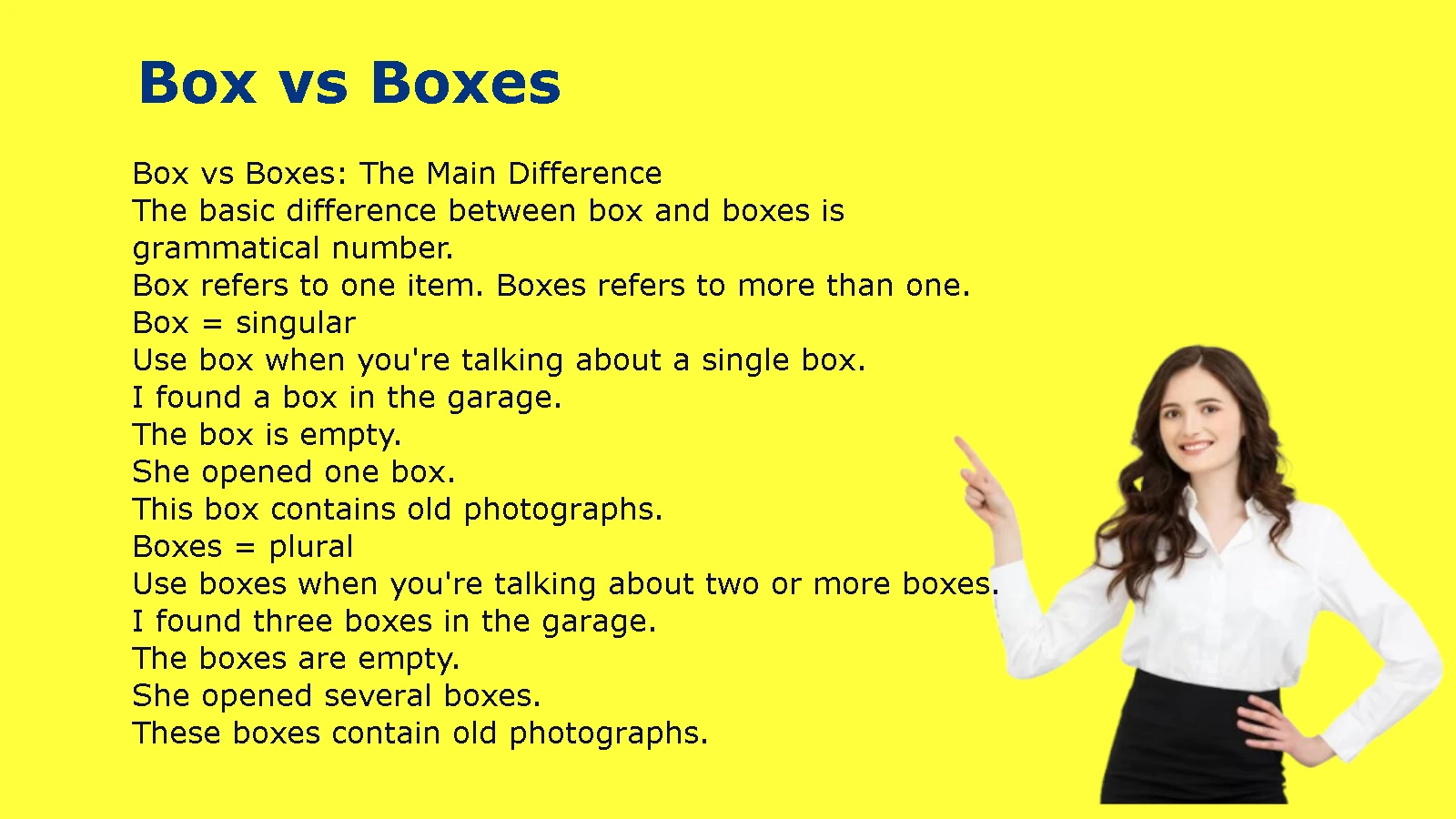
Box vs Boxes: The Main Difference
The basic difference between box and boxes is grammatical number.
Box refers to one item. Boxes refers to more than one.
Box = singular
Use box when you’re talking about a single box.
- I found a box in the garage.
- The box is empty.
- She opened one box.
- This box contains old photographs.
Boxes = plural
Use boxes when you’re talking about two or more boxes.
- I found three boxes in the garage.
- The boxes are empty.
- She opened several boxes.
- These boxes contain old photographs.
The difference is small in spelling but important in grammar. A singular noun usually works with a singular verb, while a plural noun works with a plural verb. Cambridge Dictionary explains this same singular and plural distinction in its grammar guidance.
Quick comparison
| Singular | Plural |
| one box | two boxes |
| a box | several boxes |
| this box | these boxes |
| that box | those boxes |
| the box is | the boxes are |
Think of it as a simple switch:
one → box
more than one → boxes
That’s the heart of the Box vs Boxes difference.
What Does “Box” Mean?
A box is commonly a container with a bottom and sides. It may have a lid or cover, and it can be made from materials such as cardboard, plastic, wood, or metal.
Merriam Webster defines the most common noun sense of box as a typically rigid, often rectangular container. The word also has several other meanings depending on context.
For example:
- a cardboard box
- a shoe box
- a gift box
- a storage box
- a pizza box
- a mailbox
- a toolbox
Examples of “box” in a sentence
Please put the books in the box.
I bought a box of cereal.
There is one box beside the door.
The package arrived in a large box.
The word doesn’t always describe a physical container, either. English uses box for several kinds of spaces, compartments, and enclosed areas. Merriam Webster also records meanings involving spectator seating, courtroom spaces, marked areas, equipment, and other contexts.
For example:
- a penalty box in hockey
- a jury box in a courtroom
- a box at a theater
- a batter’s box in baseball
- a check box on a form
The meaning changes with the context, but the singular form remains box when you’re referring to one.
What Does “Boxes” Mean?
Boxes is normally the plural form of box.
It means more than one box.
There are two boxes by the door.
The warehouse contains hundreds of boxes.
We packed the decorations into six boxes.
Those boxes need labels.
Merriam Webster lists boxes as the plural of the common noun box.
Boxes can refer to any number greater than one
You can use boxes with many different quantities:
- two boxes
- three boxes
- ten boxes
- twenty boxes
- several boxes
- many boxes
- hundreds of boxes
- thousands of boxes
The noun doesn’t change again as the number increases.
You don’t need a special plural form for a larger quantity. Boxes remains the correct form.
What Is the Plural of Box?
The plural of box is boxes.
This is a regular plural, but it follows a spelling pattern that differs from the most basic -s rule.
The spelling rule
Many English nouns form their plurals by adding -s:
- book → books
- car → cars
- table → tables
- phone → phones
However, nouns ending in x generally take -es:
- box → boxes
- fox → foxes
- tax → taxes
- fax → faxes
- mix → mixes
The British Council specifically gives box → boxes as an example of adding -es to nouns ending in x.
Cambridge Dictionary gives the same pattern and explains that nouns ending in -ch, -s, -sh, -x, or -z generally take -es.
So the correct transformation is:
box + es = boxes
Not:
box + s = boxs
That’s why boxs is not the standard plural spelling.
Why Does Box Become Boxes Instead of Boxs?
The answer comes down to English plural spelling and pronunciation.
When a noun ends in a sound such as /ks/, simply adding s would produce an awkward spelling and pronunciation pattern. English therefore uses -es with nouns such as box.
The result is:
box → boxes
The extra -es also creates an additional syllable in pronunciation. Cambridge gives the pronunciation pattern for words such as boxes as /ˈbɒksɪz/ in British English.
In American English, boxes is commonly pronounced approximately like:
BOX-iz
Compare:
- box → one syllable
- boxes → two syllables
That extra syllable is one reason the spelling -es makes sense in actual speech.
The same pattern appears in other words
| Singular | Plural |
| box | boxes |
| fox | foxes |
| tax | taxes |
| fax | faxes |
| mix | mixes |
| fix | fixes |
The pattern is predictable enough to learn as a group.
Is “Box” Singular or Plural?
Box is singular.
It refers to one box.
You can often identify its singular use by looking at the words around it.
Common singular combinations
- a box
- one box
- this box
- that box
- my box
- your box
- the box
- each box
Examples:
This box is heavy.
That box belongs to Maria.
I need one box.
Each box has a different label.
Because box is a singular count noun, it generally needs a determiner when used as a normal singular noun. The British Council notes that singular count nouns typically appear with determiners such as a, the, this, that, or possessives.
For example:
- a box
- the box
- this box
- my box
Simply saying “I bought box” isn’t standard English when box is being used as an ordinary singular count noun.
Is “Boxes” Singular or Plural?
Boxes is plural when it functions as the plural noun of box.
It refers to two or more boxes.
Examples include:
These boxes are heavy.
Those boxes belong to Maria.
I need three boxes.
Several boxes arrived today.
Plural nouns can appear with numbers, quantifiers, and demonstratives.
| Expression | Correct? |
| one box | ✅ |
| two boxes | ✅ |
| several boxes | ✅ |
| many boxes | ✅ |
| these boxes | ✅ |
| those boxes | ✅ |
| one boxes | ❌ |
| two box | ❌ |
| several box | ❌ |
There’s an important exception worth knowing: boxes can also appear as a verb.
For example:
He boxes three times a week.
Here, boxes doesn’t mean multiple containers. It is the third person singular present form of the verb box, meaning to engage in boxing. Merriam Webster lists both the noun and verb forms of box, including boxes as a verb form.
So context matters.
Box vs Boxes in Sentences
Seeing the two forms side by side makes the distinction much easier.
| Singular | Plural |
| I have a box. | I have three boxes. |
| The box is open. | The boxes are open. |
| This box contains books. | These boxes contain books. |
| That box belongs to Sam. | Those boxes belong to Sam. |
| One box was damaged. | Several boxes were damaged. |
| The box has a label. | The boxes have labels. |
Notice something important: changing box to boxes can affect more than the noun.
It can also change the verb.
Singular
The box is heavy.
Plural
The boxes are heavy.
Likewise:
The box has a label.
becomes:
The boxes have labels.
This happens because English subject verb agreement changes with grammatical number. Cambridge explains that singular nouns take singular verbs and plural nouns take plural verbs.
Box or Boxes After Numbers?
Numbers make the rule especially easy to see.
Use box after one:
one box
Use boxes after numbers greater than one:
two boxes
five boxes
ten boxes
100 boxes
Correct examples
- I need one box.
- I need two boxes.
- We ordered six boxes.
- They delivered twenty boxes.
- The warehouse stores thousands of boxes.
Incorrect examples
- ❌ I need two box.
- ❌ We ordered six box.
- ❌ They delivered twenty box.
The reason is straightforward: box is a count noun. Count nouns have singular and plural forms, and plural count nouns can follow numerals such as two, three, and four.
A useful shortcut
If the quantity is 1, use:
box
If the quantity is more than 1, use:
boxes
This simple test works in ordinary sentences.
Box vs Boxes With “A” and “An”
The correct singular article is a:
a box
Not:
❌ an box
That’s because box begins with a consonant sound.
The plural form doesn’t normally take a or an:
boxes
Not:
❌ a boxes
Instead, use words such as:
- two boxes
- several boxes
- many boxes
- some boxes
- these boxes
- the boxes
The article changes because the noun’s grammatical number changes.
Box vs Boxes With “Is” and “Are”
One of the most common mistakes involving Box vs Boxes is choosing the wrong form of be.
Use is with singular box.
Use are with plural boxes.
Singular
The box is empty.
This box is damaged.
That box is too large.
Plural
The boxes are empty.
These boxes are damaged.
Those boxes are too large.
The pattern is easy to remember:
box → is
boxes → are
More examples
| Incorrect | Correct |
| The boxes is heavy. | The boxes are heavy. |
| The box are heavy. | The box is heavy. |
| These box are new. | These boxes are new. |
| This boxes is new. | This box is new. |
The same principle applies to other verbs.
With “has” and “have”
The box has a lid.
The boxes have lids.
With “does” and “do”
The box does not fit.
The boxes do not fit.
The noun’s number controls the form of the verb.
Is “Boxs” Correct?
No. Boxs is not the standard plural spelling of box.
The correct plural is:
boxes
The incorrect form often appears because learners know the general rule of adding -s to form plurals. That rule works for many nouns:
- book → books
- pen → pens
- chair → chairs
But box belongs to a group that takes -es.
Remember this pattern
| Singular | Correct plural | Incorrect plural |
| box | boxes | boxs ❌ |
| fox | foxes | foxs ❌ |
| tax | taxes | taxs ❌ |
| mix | mixes | mixs ❌ |
| fix | fixes | fixs ❌ |
The British Council explicitly lists box → boxes among nouns that form their plurals with -es.
Other Words That Follow the Same Plural Rule
Learning box → boxes becomes easier when you recognize the broader pattern.
Many nouns ending in -x take -es in the plural.
Examples
- box → boxes
- fox → foxes
- tax → taxes
- fax → faxes
- mix → mixes
- fix → fixes
- prefix → prefixes
- suffix → suffixes
English uses similar -es spelling patterns with several other endings.
| Ending | Singular | Plural |
| -x | box | boxes |
| -s | bus | buses |
| -sh | dish | dishes |
| -ch | watch | watches |
| -z | quiz | quizzes |
Cambridge and the British Council both describe -es as the regular plural pattern for nouns ending in -x, among several other endings.
However, don’t assume that every English plural follows one universal spelling rule. English has many patterns and exceptions. For example, child becomes children, while person commonly becomes people.
The useful point here is narrower: when you see a regular noun ending in x, adding -es is the standard plural pattern.
Why the “-es” Ending Matters for Pronunciation
The spelling isn’t random. It reflects pronunciation as well.
If you write:
boxs
the spelling doesn’t clearly represent the way standard English pronounces the plural.
With boxes, the plural ending creates another syllable:
box → boxes
Approximately:
/bɑks/ → /ˈbɑksɪz/ in American English notation.
Cambridge specifically notes that the -es ending in words such as boxes is pronounced as an additional syllable.
Compare these:
- box = 1 syllable
- boxes = 2 syllables
- fox = 1 syllable
- foxes = 2 syllables
- tax = 1 syllable
- taxes = 2 syllables
This gives you a useful pronunciation clue. When a noun ending in x becomes plural, expect the plural ending to be pronounced as an extra syllable.
Common Mistakes With Box and Boxes
The Box vs Boxes distinction is simple once you see the pattern, but several mistakes show up repeatedly.
Mistake: Writing “boxs”
Incorrect:
I packed the books into three boxs.
Correct:
I packed the books into three boxes.
The noun ends in x, so use -es.
Mistake: Using “box” after a plural number
Incorrect:
We ordered five box.
Correct:
We ordered five boxes.
A number greater than one normally requires the plural form.
Mistake: Using “boxes” after “one”
Incorrect:
I need one boxes.
Correct:
I need one box.
The word one identifies a single item.
Mistake: Using “is” with boxes
Incorrect:
The boxes is on the floor.
Correct:
The boxes are on the floor.
Boxes is plural, so use are.
Mistake: Using “are” with box
Incorrect:
The box are on the floor.
Correct:
The box is on the floor.
Box is singular, so use is.
Mistake: Using “an” before box
Incorrect:
I found an box.
Correct:
I found a box.
The word box begins with a consonant sound, so a is the appropriate indefinite article.
Box vs Boxes: A Practical Case Study
Imagine a warehouse employee receives a delivery.
At first, there’s only one package on the loading dock.
The employee might say:
One box has arrived.
Later, four more arrive.
Now the employee says:
Five boxes have arrived.
Notice how several parts of the sentence change.
| One item | Multiple items |
| one box | five boxes |
| The box is here. | The boxes are here. |
| This box needs a label. | These boxes need labels. |
| The box has a barcode. | The boxes have barcodes. |
The noun changes from box to boxes, and the surrounding grammar changes with it.
That’s the practical value of understanding the difference. You’re not simply choosing between two spellings. You’re choosing the grammatical form that matches the number of things you’re describing.
Box vs Boxes in Everyday Writing
You can see the distinction across ordinary situations.
At home
Put the winter clothes in a box.
Put the winter clothes in three boxes.
At school
The teacher placed the supplies in a box.
The teacher distributed the supplies among several boxes.
During a move
One box contains kitchen items.
Ten boxes contain books.
In a store
The product comes in a box.
The warehouse received several boxes of the product.
During shipping
The carrier damaged one box.
The carrier damaged four boxes.
The grammatical rule stays the same regardless of the setting.
Box vs Boxes in Compound Words
The word box also appears in many compound nouns.
Examples include:
- toolbox
- mailbox
- lunchbox
- sandbox
- shoebox
- cardboard box
- gift box
- storage box
When a compound noun ends in box, its plural form generally follows the same pattern:
- toolbox → toolboxes
- mailbox → mailboxes
- lunchbox → lunchboxes
- sandbox → sandboxes
- shoebox → shoeboxes
For example:
I bought a new toolbox.
The garage contains several toolboxes.
This is another practical way to reinforce the rule. The ending -box still follows the plural pattern.
A Note About “Box” as a Verb
There is one detail that can make boxes confusing: it isn’t always a plural noun.
Box can also function as a verb.
For example:
They box at the local gym.
He boxes every Saturday.
Here, boxes is a verb form, not the plural of the noun.
Merriam Webster lists box as a verb meaning to engage in boxing and gives boxes among its present-tense forms.
Compare:
The gym has several boxes of equipment.
Here, boxes is a plural noun.
He boxes after work.
Here, boxes is a verb.
The surrounding sentence tells you which meaning applies.
Box vs Boxes: Quick Comparison
When you need a fast reference, use this table.
| Feature | Box | Boxes |
| Grammatical number | Singular | Plural |
| Refers to | One | More than one |
| Example quantity | One box | Two boxes |
| Indefinite article | a box | Not used |
| Demonstrative | this box | these boxes |
| Singular demonstrative | that box | those boxes |
| Verb with “be” | box is | boxes are |
| Verb with “have” | box has | boxes have |
| Correct spelling | box | boxes |
| Incorrect plural | — | boxs ❌ |
This table captures the central difference without any complicated grammar terminology.
Examples of Box and Boxes in Context
Here are more examples to make the rule second nature.
Singular examples
- I found a box under the bed.
- The box is full of old letters.
- Please move this box.
- She carried one box upstairs.
- That box belongs to my brother.
- Each box has a number.
- The package came in a small box.
- I need another box for these books.
Plural examples
- I found three boxes under the bed.
- The boxes are full of old letters.
- Please move these boxes.
- She carried six boxes upstairs.
- Those boxes belong to my brother.
- Each shipment contains several boxes.
- The packages came in small boxes.
- I need two more boxes for these books.
The contrast is especially clear when you compare matching sentences:
This box is heavy.
These boxes are heavy.
That box has a label.
Those boxes have labels.
The noun’s number controls the grammar around it.
Frequently Asked Questions About Box vs Boxes
What is the plural of box?
The plural of box is boxes. Because box ends in x, English uses -es to form the regular plural.
Is box singular or plural?
Box is singular. It refers to one item.
Example:
I bought one box.
Is boxes singular or plural?
Boxes is plural when it refers to more than one container.
Example:
I bought three boxes.
Is boxs correct?
No. Boxs is not the standard plural form. The correct spelling is boxes.
Why is the plural of box boxes?
English generally adds -es to nouns ending in x when forming the plural. Therefore:
box → boxes
Cambridge and the British Council both give this as a standard plural formation pattern.
Which is correct: two box or two boxes?
Two boxes is correct.
Because two means more than one, the noun must be plural.
Which is correct: one box or one boxes?
One box is correct.
The word one refers to a single item.
Is “boxes” always a plural noun?
No. Boxes can also be the third person singular present form of the verb box.
He boxes every weekend.
When boxes means multiple containers, it is a plural noun:
The boxes are stacked in the corner.
Do you say “a box” or “an box”?
Say a box.
The word begins with a consonant sound, so a is correct.
Do you say “the box is” or “the box are”?
Say the box is.
Box is singular.
For multiple boxes, use:
The boxes are ready.
Do you say “these box” or “these boxes”?
Say these boxes.
These is used with plural nouns.
For one box, use:
This box
What is the plural of a toolbox?
The plural is toolboxes.
The same plural pattern applies because the word ends in box:
toolbox → toolboxes
What is the plural of mailbox?
The plural is mailboxes.
Example:
The street has several mailboxes.
Final Answer: Box vs Boxes
The difference between box and boxes is straightforward once you focus on number.
Box is the singular form:
I have one box.
Boxes is the plural form:
I have two boxes.
Because box ends in x, its regular plural takes -es:
box → boxes
Not:
box → boxs ❌
The same pattern appears in words such as fox → foxes, tax → taxes, and fix → fixes. Standard grammar references from Cambridge Dictionary and the British Council confirm this plural formation rule.
The quickest way to remember the distinction is:
One box. Two boxes.
Once that pattern clicks, the rest follows naturally: the box is, the boxes are, this box, these boxes, a box, and several boxes.
For dictionary confirmation, Merriam Webster lists boxes as the plural of the noun box and also documents the word’s wider noun and verb meanings