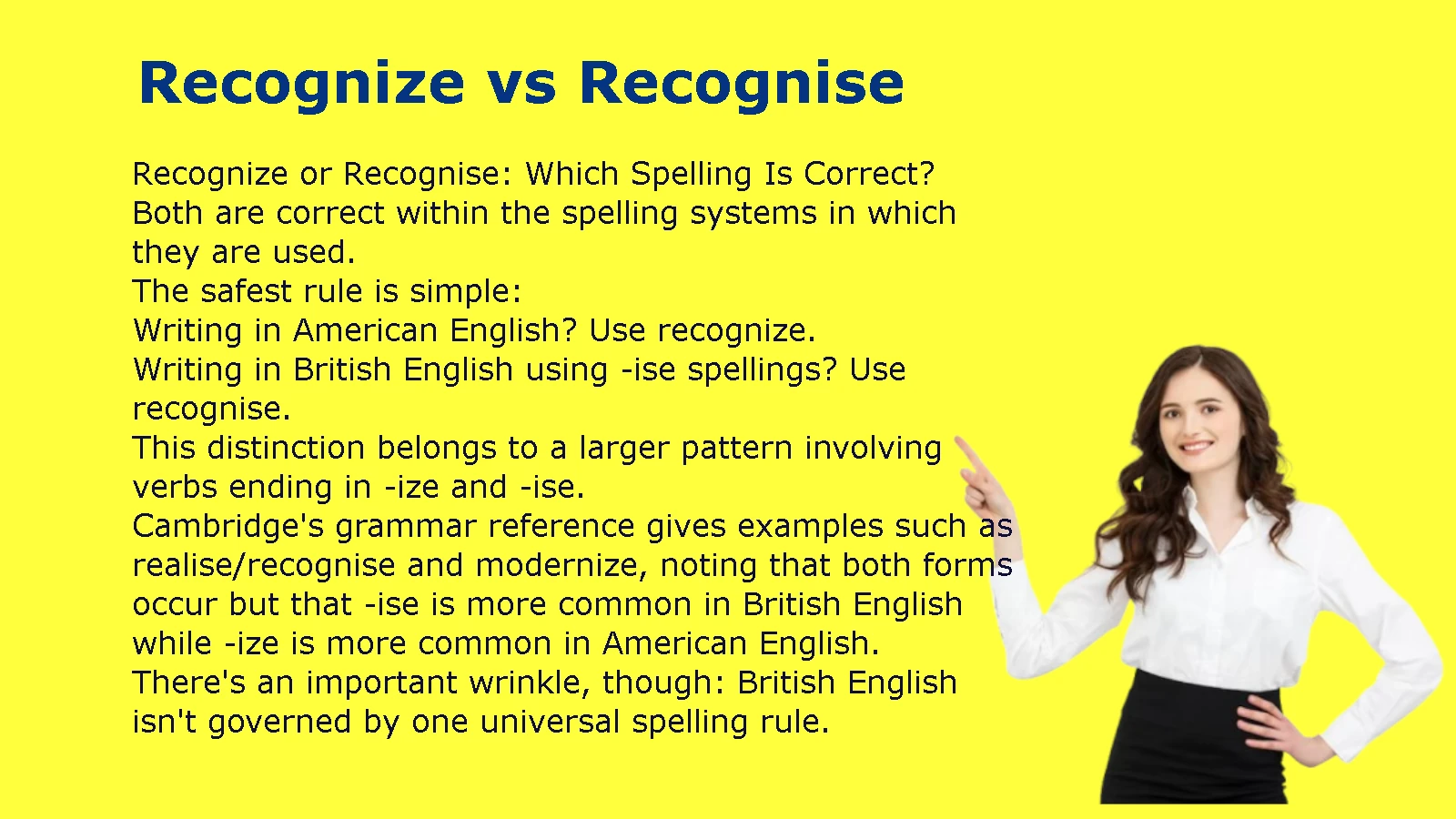
Recognize and recognise are both correct. “Recognize” is the standard American spelling, while “recognise” is commonly used in British English. They have the same meaning and pronunciation.
| Spelling | Used in |
|---|---|
| Recognize | American English |
| Recognise | British English |
Common American and British Forms
| American English | British English |
|---|---|
| recognize | recognise |
| recognizes | recognises |
| recognized | recognised |
| recognizing | recognising |
| recognition | recognition |
Recognize is the standard spelling in American English, while Both words have the same meaning: to identify someone or something, understand something clearly, or acknowledge a person, fact, or achievement.
Examples:
- I recognize that voice.
- I recognise that voice.
The confusion is understandable. People often search for recognize or recognise, recognize vs recognise meaning, is it recognize or recognise, or which spelling is correct because both forms appear in books, websites, emails, and everyday writing. And here’s the kicker: neither spelling is wrong. Your choice simply depends on your preferred variety of English.
In this guide, you’ll learn the complete difference between Recognize vs Recognise, including their meaning, pronunciation, spelling, correct usage, and examples in sentences. You’ll also discover when to use Recognize in American English, when to use Recognise in British English, and how to choose the right spelling for your writing.
Recognize vs. Recognise at a Glance
The simplest way to remember the difference is this:
US English: recognize
British English: recognise
Cambridge lists recognize as the main headword and identifies recognise as the usual UK form. Its grammar guidance also notes that both -ise and -ize forms occur, with -ise more common in British English and -ize more common in American English.
Here’s the distinction in practical terms:
| Feature | Recognize | Recognise |
| Common variety | American English | British English |
| Meaning | Same | Same |
| Pronunciation | Same | Same |
| Present tense | recognize | recognise |
| Past tense | recognized | recognised |
| Present participle | recognizing | recognising |
| Adjective | recognizable | recognisable |
| Noun | recognition | recognition |
So, if you write:
“I recognize that person.”
and someone else writes:
“I recognise that person.”
neither person has changed the meaning. The difference is simply the spelling system.
Is one spelling more correct?
Not in an absolute sense.
The right choice depends on the variety of English you’re using and the style guide you’re following. American publications generally use recognize, while many British publications use recognise.
For example, the University of Oxford’s own style guide uses -ise endings and specifically lists -ise/-isation rather than -ize/-ization.
That doesn’t make recognise universally correct or recognize universally correct. It shows why context matters.
What Does Recognize Mean?
Recognize is a verb with several closely related meanings. In everyday English, it most often describes identifying someone or something because you’ve encountered it before.
For example:
I recognized her voice immediately.
You know the voice because you’ve heard it before.
Cambridge defines recognize in this sense as knowing someone or something because you’ve previously seen, heard, or experienced it. It can also mean identifying something based on knowledge.
Recognize Someone or Something
The first major meaning is to identify someone or something from previous experience.
Consider these examples:
- I recognized my old teacher at the airport.
- She recognized the song after hearing the first few notes.
- Do you recognize this logo?
- He didn’t recognize me with my new haircut.
- The dog recognized its owner’s voice.
The important idea is familiarity.
You don’t simply see something. You connect what you’re seeing or hearing with something you already know.
Recognize Something as True or Important
Recognize can also mean accepting that something is true, real, important, or significant.
For example:
- We recognize the importance of clear communication.
- She recognized that she had made a mistake.
- The company recognizes the need for better training.
- He recognized the seriousness of the situation.
Here, recognition isn’t about remembering a face.
It’s about understanding or accepting a fact.
Cambridge includes this meaning in its definition, explaining that recognize can mean accepting something as true, important, or legal.
Recognize Someone for an Achievement
A third common meaning involves officially acknowledging someone’s achievement or contribution.
For example:
- The school recognized her academic achievements.
- The organization recognized his years of service.
- The award recognizes excellence in teaching.
- The governor recognized the volunteers for their work.
In this sense, recognition often involves praise, an award, public acknowledgment, or official approval. Cambridge also lists this use for recognize.
Recognize Something Officially
The word can also appear in legal, political, and institutional contexts.
For example:
- The government recognized the new state.
- The organization recognizes the certification.
- The court recognized the agreement as legally valid.
This use is more formal. It generally means accepting something as legitimate, valid, or officially established.
What Does Recognise Mean?
Recognise has the same meanings as recognize.
The difference is the letter s instead of z.
For example:
- I recognize her.
- I recognise her.
Both sentences mean that the speaker identifies her because they have seen or experienced her before.
Likewise:
- We recognize the problem.
- We recognise the problem.
Both mean that we understand or acknowledge the problem.
Cambridge specifically identifies recognise as the usual UK spelling of recognize.
Recognise in British English
If you’re writing in a British English style that uses -ise, you’ll normally write:
- recognise
- recognised
- recognising
- recognisable
For example:
She recognised him immediately.
That’s the British spelling of:
She recognized him immediately.
The meaning hasn’t changed. Only the spelling has.
Recognize or Recognise: Which Spelling Is Correct?
Both are correct within the spelling systems in which they are used.
The safest rule is simple:
- Writing in American English? Use recognize.
- Writing in British English using -ise spellings? Use recognise.
This distinction belongs to a larger pattern involving verbs ending in -ize and -ise.
Cambridge’s grammar reference gives examples such as realise/recognise and modernize, noting that both forms occur but that -ise is more common in British English while -ize is more common in American English.
There’s an important wrinkle, though: British English isn’t governed by one universal spelling rule.
Some British style systems prefer -ise. Others accept or use -ize.
For instance, the University of Oxford’s house style uses -ise, while Cambridge’s author guidance allows either -ise or -ize in British style as long as the choice remains consistent.
So don’t turn the rule into something more rigid than it is.
Recognize in American English
For US English, recognize is the spelling to use.
You’ll see it in everyday writing, professional documents, academic work, websites, newspapers, and other American publications.
Here are some natural examples:
- I didn’t recognize him at first.
- Do you recognize this name?
- She recognized the problem immediately.
- The company recognizes the value of customer feedback.
- The award recognizes outstanding achievement.
- We need to recognize the risks before moving forward.
If your article, report, email, or website follows US English, switching to recognise can make your spelling look inconsistent.
Common American forms of Recognize
The word changes form depending on how you use it:
| Form | American English | Example |
| Base verb | recognize | I recognize her. |
| Third person | recognizes | She recognizes him. |
| Past tense | recognized | We recognized the problem. |
| Present participle | recognizing | They are recognizing the winners. |
| Adjective | recognizable | His face is recognizable. |
| Noun | recognition | She received recognition. |
Notice something important about recognizing.
It has only one e before the -ing ending:
recognize → recognizing
You don’t write recognizeing.
The final e drops before -ing, while the z remains.
Recognise in British English
In British English styles that use -ise, the corresponding forms look like this:
| Form | British English | Example |
| Base verb | recognise | I recognise her. |
| Third person | recognises | She recognises him. |
| Past tense | recognised | We recognised the problem. |
| Present participle | recognising | They are recognising the winners. |
| Adjective | recognisable | His face is recognisable. |
| Noun | recognition | She received recognition. |
Again, the meaning doesn’t change.
Compare:
The committee recognized her contribution.
with:
The committee recognised her contribution.
The two sentences communicate exactly the same idea. The spelling reflects different conventions.
Recognize vs. Recognise Pronunciation
One of the easiest misconceptions to clear up is pronunciation.
Recognize and recognise are pronounced the same way.
Cambridge gives the pronunciation as /ˈrek.əɡ.naɪz/ for the word, with the same pronunciation shown for UK and US English.
The ending sounds like “ize” rather than an s sound.
You can think of the pronunciation roughly as:
REK-uhg-nize
The spelling recognise doesn’t mean the final sound changes to /s/.
Why Does the S Still Sound Like Z?
English spelling and pronunciation don’t always line up neatly.
In recognise, the letter s represents the voiced /z/ sound. That’s why the word doesn’t suddenly sound like recogniss.
This same pronunciation pattern appears in many words.
So don’t pronounce the British spelling differently just because you see an s.
Recognize vs. Recognise in Example Sentences
Seeing the two forms side by side makes the difference much easier to remember.
| American English | British English |
| I recognize that name. | I recognise that name. |
| She recognized him immediately. | She recognised him immediately. |
| Do you recognize this song? | Do you recognise this song? |
| They recognize the importance of education. | They recognise the importance of education. |
| The award recognizes her achievement. | The award recognises her achievement. |
| He is easily recognizable. | He is easily recognisable. |
The sentence structure remains the same.
Only the spelling changes.
A Practical Example
Imagine two editors working on the same sentence:
The organization recognizes the importance of employee training.
An American English editor would normally keep recognizes.
A British English editor using an -ise house style might write:
The organisation recognises the importance of employee training.
Now there are actually two spelling differences:
- organization → organisation
- recognizes → recognises
That illustrates an important point: English varieties often differ across several words at once. A document should follow a coherent spelling system rather than randomly mixing conventions.
Recognized vs. Recognised
Recognized and recognised follow the same regional pattern.
- recognized = American English
- recognised = common British English form
For example:
American English:
The teacher recognized the student’s effort.
British English:
The teacher recognised the student’s effort.
Both sentences mean that the teacher acknowledged or noticed the student’s effort.
More Examples
- The doctor recognized the symptoms.
- The doctor recognised the symptoms.
- She was recognized for her leadership.
- She was recognised for her leadership.
- I immediately recognized his voice.
- I immediately recognised his voice.
The only difference is z versus s.
Recognizing vs. Recognising
The same pattern appears in the present participle.
Recognizing is the American spelling.
Recognising is the common British spelling in styles that use -ise.
| American | British |
| recognizing | recognising |
| recognizing a face | recognising a face |
| recognizing the problem | recognising the problem |
| recognizing an achievement | recognising an achievement |
For example:
She is recognizing the signs of a serious problem.
British style:
She is recognising the signs of a serious problem.
Cambridge identifies recognizing as the present participle of recognize and uses the UK recognise form as the regional counterpart.
Recognizable vs. Recognisable
The adjective creates another familiar spelling difference:
- recognizable = American English
- recognisable = British English
Both mean easy to recognize.
For example:
Her voice is instantly recognizable.
British spelling:
Her voice is instantly recognisable.
The adjective can describe a person, object, sound, style, brand, image, or other feature that someone can identify.
Examples of Recognizable and Recognisable
- The building is easily recognizable from a distance.
- The building is easily recognisable from a distance.
- His writing style is highly recognizable.
- His writing style is highly recognisable.
- The logo is instantly recognizable.
- The logo is instantly recognisable.
Don’t confuse recognizable with recognition. They’re related, but they perform different grammatical jobs.
Recognize vs. Recognise: Why Does the Spelling Change?
The difference comes from a broader English spelling pattern involving -ize and -ise.
You’ll find the same pattern in words such as:
| American English | British English |
| recognize | recognise |
| realize | realise |
| organize | organise |
| apologize | apologise |
| specialize | specialise |
| modernize | modernise |
The pattern is useful because once you understand it, recognize vs. recognise stops looking like an isolated spelling puzzle.
However, don’t assume that every word ending in -ize has a simple -ise counterpart. English has exceptions and words with different histories. Treat the pattern as a spelling convention, not a universal conversion machine.
Cambridge specifically identifies -ise/-ize as a verb-forming ending and notes that both forms occur, with -ise more common in British English and -ize more common in American English.
Why American English Uses Recognize
American English generally favors -ize in this group of verbs.
That’s why American writing normally uses:
- recognize
- realize
- organize
- apologize
- customize
- modernize
- specialize
For a US English article, consistency is straightforward:
Use recognize.
The same principle applies to related forms:
recognize → recognized → recognizing → recognizable
You don’t need to switch to recognise just because the word appears in a British source. If you’re writing your own US English content, keep your chosen spelling system intact.
Why British English Uses Recognise
Many British English writers and institutions favor -ise.
The University of Oxford, for example, explicitly says its style uses -ise, -isation, and related forms rather than -ize and -ization.
That produces forms such as:
- recognise
- recognised
- recognising
- recognisable
However, British English isn’t monolithic.
Some British publishers and style guides use -ize. Cambridge’s own author style guidance allows British writers to use either -ise or -ize, provided they use the choice consistently.
That’s why the statement “British English always uses recognise” is too strong.
A better statement is:
Recognise is the usual British spelling, although some British standards and publishers use or accept recognize.
That distinction is small, but it matters if you’re writing carefully about English usage.
Recognize vs. Recognise in Different English Varieties
English spelling isn’t divided into only two neat boxes.
American and British English provide the clearest contrast, but other varieties can follow their own editorial conventions.
| English variety | Common approach |
| American English | recognize |
| British English | recognise is common |
| British English under some style guides | recognize may also be used |
| Canadian English | Style and publication dependent |
| Australian English | recognise is common |
The safest approach isn’t to memorize an enormous list of country rules.
Instead, identify the style guide, publisher, school, employer, or target audience you’re writing for.
Why Consistency Matters
Imagine an article that begins with:
We recognize the importance of good writing.
A few paragraphs later, it says:
Writers should recognise their audience.
Nothing becomes incomprehensible. The reader will understand both sentences.
Still, the inconsistency looks sloppy.
A polished article should generally choose one spelling convention and stick with it.
That’s especially important in:
- academic papers
- business reports
- websites
- books
- professional emails
- marketing copy
- technical documentation
- educational materials
For US English Writing
Use:
- recognize
- recognized
- recognizing
- recognizable
Example:
The report recognizes the need for stronger quality controls.
For British English Writing
If the style guide uses -ise, use:
- recognise
- recognised
- recognising
- recognisable
Example:
The report recognises the need for stronger quality controls.
The point isn’t to prove that one spelling wins.
The point is to write consistently for your audience.
Recognize vs. Recognise in Academic Writing
Academic writing deserves extra care because universities and journals often have established style requirements.
If you’re submitting a paper to a US institution, recognize will generally fit the expected American spelling system.
If you’re submitting to a British institution, check its style guide. Don’t assume every British institution follows exactly the same spelling convention.
For example, Oxford University’s current style guide explicitly uses -ise rather than -ize.
This creates a practical rule:
- Check the required style.
- Identify whether it uses US or British English.
- Check its treatment of -ise/-ize.
- Apply that choice consistently.
- Don’t switch spellings simply because another source uses a different convention.
Recognize vs. Recognise vs. Recognition
A common mistake is assuming that recognition should change along with recognize and recognise.
It doesn’t.
Recognition is the noun.
For example:
She received recognition for her work.
You don’t normally write:
She received recognisation for her work.
The standard noun is recognition.
Cambridge defines recognition in several related senses, including knowing someone or something from previous experience, accepting something as true or legal, and showing appreciation for someone’s achievements.
Compare the Word Forms
| Function | American English | British English |
| Verb | recognize | recognise |
| Past tense | recognized | recognised |
| Present participle | recognizing | recognising |
| Adjective | recognizable | recognisable |
| Noun | recognition | recognition |
This is an important distinction.
The spelling change affects the -ize/-ise family, not every related word.
Common Meanings of Recognition
Understanding recognition also makes the verb easier to understand.
Recognition as Identification
I gave her a smile of recognition.
You know who she is because you’ve encountered her before.
Recognition as Acceptance
There is growing recognition that the policy needs to change.
Here, recognition means acceptance or acknowledgment of a fact.
Recognition as Praise
She received recognition for her outstanding work.
Here, recognition means public appreciation or acknowledgment.
Cambridge lists all three broad uses.
Common Mistakes With Recognize and Recognise
The spelling itself is easy once you understand the regional difference. The bigger problems usually come from applying the rule too rigidly.
Mistake: Saying Recognise Is Wrong
It’s not.
Recognise is a standard British spelling.
If a British publication uses recognise, there’s no spelling error simply because American English uses recognize.
Mistake: Saying Recognize Is Wrong in British English
That’s also too broad.
Some British style systems use -ise, but others accept or use -ize. Cambridge’s guidance explicitly recognizes both forms in British style.
Mistake: Pronouncing Recognise With an S Sound
The spelling doesn’t change the pronunciation.
Both forms use the /z/ sound at the end.
Mistake: Changing Recognition to Recognition With an S
The noun remains:
recognition
The spelling isn’t recognision or recognisation merely because the verb is recognise.
Mistake: Mixing Styles Randomly
A document that uses recognize, organise, apologize, and realise has mixed spelling conventions.
That doesn’t necessarily make every individual word wrong, but it creates an inconsistent editorial style.
A Simple Case Study: One Sentence, Two English Styles
Consider this sentence:
The organization recognized the employee for her excellent work.
In a typical American English style, this is perfectly natural.
Now convert it to a British style that uses -ise:
The organisation recognised the employee for her excellent work.
Two things changed:
| American | British |
| organization | organisation |
| recognized | recognised |
The meaning, grammar, and message remain the same.
This is why spelling differences shouldn’t be mistaken for differences in meaning.
Another Case Study: Website Content
Imagine a US based company publishes:
We recognize the importance of protecting your personal information.
That’s a natural US English sentence.
Now imagine a UK company using an -ise house style:
We recognise the importance of protecting your personal information.
Neither company needs to rewrite the sentence for grammar.
They simply follow their chosen spelling convention.
For content creators, this distinction is practical. If your website targets readers in the United States, use recognize consistently. If you’re creating content for a British publication that follows -ise, use recognise.
How to Remember Recognize vs. Recognise
Here’s the easiest memory trick:
Z for American English: recognize.
S for the common British form: recognise.
You can extend the same idea to related words:
American:
- realize
- organize
- apologize
- recognize
Common British -ise style:
- realise
- organise
- apologise
- recognise
Think of the z as the familiar American pattern.
Just remember that British English can also use -ize under some style systems.
Quick Reference: Recognize vs. Recognise
| Question | Answer |
| Do recognize and recognise mean the same thing? | Yes. |
| Are they pronounced differently? | No. |
| Which spelling is standard in US English? | Recognize |
| Which spelling is common in British English? | Recognise |
| Is recognize used in British English? | Yes, in some British standards and publications. |
| Is recognise used in American English? | It’s not the standard US spelling. |
| US past tense? | recognized |
| British past tense? | recognised |
| US present participle? | recognizing |
| British present participle? | recognising |
| US adjective? | recognizable |
| British adjective? | recognisable |
| Does the noun change? | No. Use recognition. |
Frequently Asked Questions About Recognize vs. Recognise
Is “recognise” correct in American English?
Recognize is the standard American spelling. Recognise is associated with British spelling and isn’t the normal choice for US English writing.
If you’re writing specifically in American English, use recognize.
Is “recognize” correct in British English?
Yes, although recognise is the usual British spelling in many contexts.
Some British style guides and publishers use or accept -ize spellings. Cambridge’s grammar guidance notes that both forms occur, while the -ise form is more common in British English.
Do recognize and recognise have the same meaning?
Yes.
Both can mean:
- identify someone or something
- accept something as true or important
- officially acknowledge someone or something
The spelling doesn’t create a different definition.
Do recognize and recognise have the same pronunciation?
Yes.
Cambridge gives the pronunciation as /ˈrek.əɡ.naɪz/ for the word, with the same pronunciation shown for US and UK English.
Which is correct: recognized or recognised?
Both are correct according to the relevant spelling convention.
- recognized = American English
- recognised = common British English
Which is correct: recognizing or recognising?
Again, both forms exist.
- recognizing = American English
- recognising = common British English
Which is correct: recognizable or recognisable?
Both are used.
- recognizable = American English
- recognisable = common British English
Is “recognition” spelled differently in British English?
No. Recognition is the standard noun in both varieties.
For example:
She received recognition for her work.
The spelling doesn’t become recognisation simply because the verb is recognise.
Is “recognise” more formal than “recognize”?
No.
The s versus z spelling doesn’t make one form more formal.
The difference primarily reflects spelling conventions and editorial style.
Why does recognize end with a Z?
American English generally uses -ize for this group of verbs. That’s why US English writes recognize, realize, and organize.
British English commonly uses -ise instead, although some British standards use -ize as well.
Can I use recognize in a British English article?
Yes, if the style guide you’re following allows or prefers -ize.
If the publication specifically requires -ise, however, write recognise.
Can I use recognise in an American English article?
For standard US English, recognize is the better choice.
If you’re quoting a British source, preserving the original spelling is a different matter.
Final Answer: Recognize vs. Recognise
The difference between recognize and recognise is primarily a matter of English spelling convention, not meaning.
Recognize is the standard spelling for American English. Recognise is the usual British spelling, although some British style systems use recognize as well. Both forms mean the same thing and have the same pronunciation.
The easiest rule is:
US English → recognize
British English → recognise
When you’re writing for a particular audience, don’t overthink it. Check the required style, choose the appropriate form, and stay consistent.
If your article uses American English, write recognize, recognized, recognizing, and recognizable. If your chosen British style uses -ise, write recognise, recognised, recognising, and recognisable.