Have you ever wondered whether Story vs Storey is just a spelling difference or whether the two words have completely different meanings? You’re not alone. These commonly confused words look almost identical, but using the wrong one can change the meaning of your sentence entirely.
Story and storey are similar words with different meanings. Story usually refers to a tale, narrative, or account of events and is also the standard American English spelling for a level of a building. Storey is the British English spelling used only for a floor or level of a building.
Examples:
- She told an interesting story about her vacation.
- The apartment is on the third storey of the building. (British English)
- The apartment is on the third story of the building. (American English)
The confusion often comes from similar spelling and regional English variations. Many people search for story meaning, storey meaning, story pronunciation, storey pronunciation, and the difference between story and storey before writing emails, essays, or construction-related documents. And here’s the kicker: choosing the wrong word can make your writing look inaccurate or unprofessional.
In this guide, you’ll learn the difference between Story vs Storey, discover the correct usage of story and storey, understand when to use story, when to use storey, and see practical story vs storey examples in sentences. You’ll also learn how to pronounce story and storey, why storey is mainly used in British English, while story is preferred in American English for a building floor, and easy memory tricks to avoid this common word confusion.
Story vs Storey at a Glance
Before diving into the details, here’s a quick comparison.
| Word | Meaning | Used In | Example |
| Story | A narrative, tale, or account of events. In American English, it also means a floor of a building. | American English | The office is on the third story. |
| Storey | A floor or level of a building. | British, Canadian, Australian, and New Zealand English | They bought a three-storey townhouse. |
Quick takeaway
- Story has two meanings in American English.
- A narrative or tale.
- A floor in a building.
- Storey has one meaning.
- A floor or level of a building in British-style English.
Although they’re spelled differently, both words share the same pronunciation.
What Does Story Mean?
The word story is one of the most common nouns in English. Depending on the context, it can describe a fictional tale, a real-life account, or a level inside a building.
Let’s look at both meanings.
Story as a Narrative
Most people first learn story as a narrative. It refers to an account of events, whether they’re real or imaginary.
Definition
A story is a sequence of events told through writing, speech, film, or another form of communication.
Stories entertain, teach, inspire, or explain experiences.
Examples
- She wrote a touching story about friendship.
- Grandpa always tells funny stories from his childhood.
- The newspaper published the biggest story of the week.
- Every culture has its own traditional stories.
- His success story inspired thousands of young entrepreneurs.
Notice that in every sentence above, story refers to information or events rather than a building.
Common Types of Stories
Stories come in many forms.
| Type | Description |
| Short story | A brief fictional narrative |
| Novel | A long fictional story |
| Fairy tale | A magical children’s story |
| Biography | A true story about someone’s life |
| News story | A report on current events |
| Success story | A real account of achievement |
| Horror story | A frightening fictional tale |
Because storytelling exists in every culture, this meaning of story is universal in both American and British English.
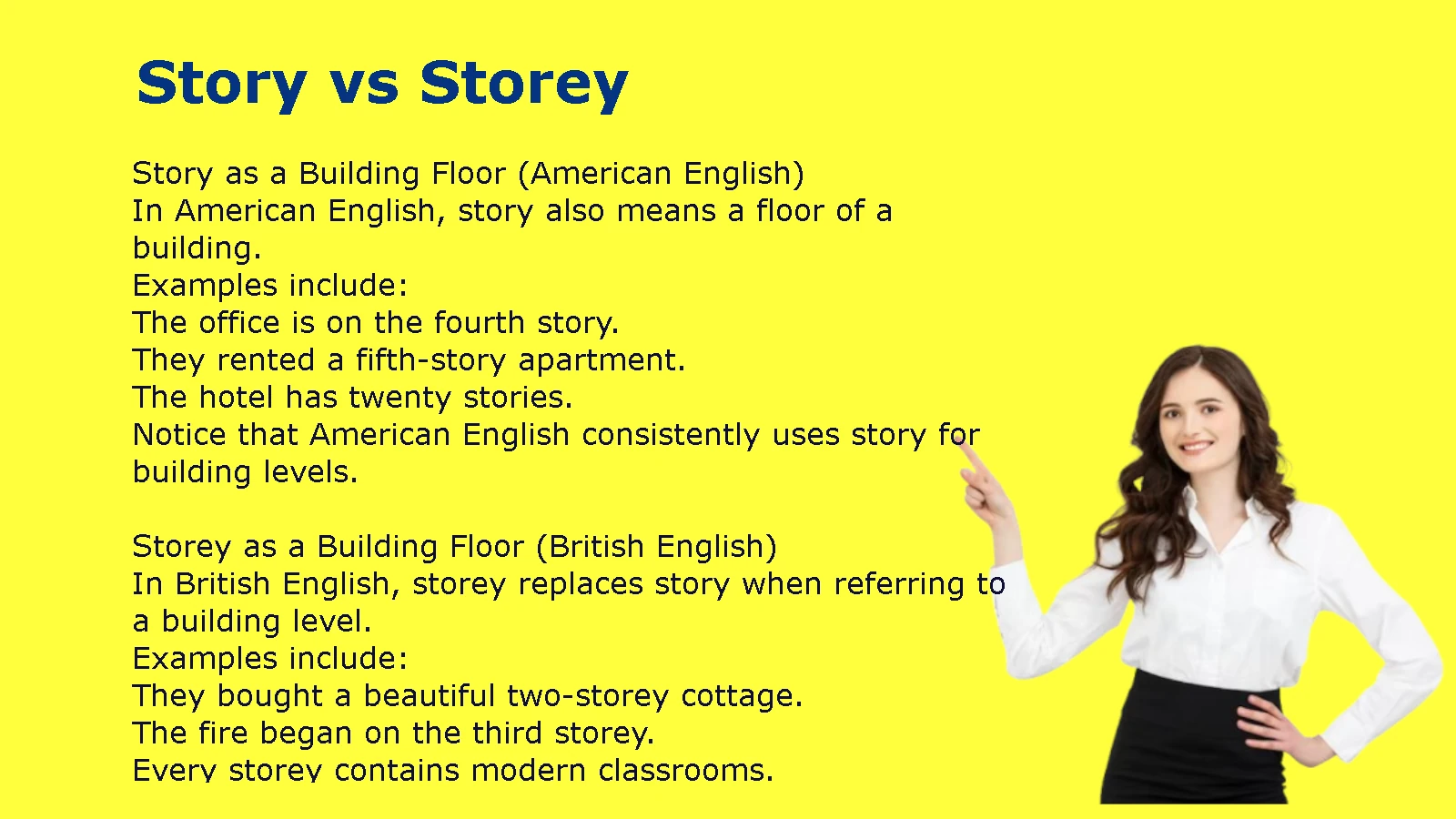
Story as a Floor of a Building (American English)
In the United States, story has another important meaning.
It can also refer to one level of a building.
Definition
In American English, a story means one floor or level within a building.
Examples
- We rented an apartment on the fifth story.
- Their office occupies the entire second story.
- The hotel has twenty stories.
- Firefighters rescued residents from the upper stories.
- They’re building a forty-story office tower downtown.
In American construction, architecture, engineering, and real estate, this spelling is completely standard.
Why Does Story Have Two Meanings?
Although the meanings seem unrelated, they developed over centuries as the English language evolved.
The “narrative” meaning comes from historical words describing an account or history.
The “building level” meaning developed later and became the standard spelling in American English.
British English eventually adopted the alternative spelling storey to distinguish building levels from narratives.
That small spelling difference helps readers understand the intended meaning immediately.
Common Expressions Using Story
You’ll often hear story in everyday conversation.
Some familiar expressions include:
- Tell a story
- Long story short
- True story
- Cover story
- Success story
- The whole story
- Story of my life
- Stick to your story
- Behind the story
These expressions always use story, never storey, because they refer to information or events.
Fun Fact: Humans have shared stories for thousands of years. Long before books existed, people passed history, traditions, and lessons from one generation to the next through spoken storytelling.
What Does Storey Mean?
Unlike story, the word storey has only one meaning.
It always refers to a floor or level of a building.
If you’re writing in British English or another variety that follows British spelling, storey is the correct choice whenever you’re talking about buildings.
Definition of Storey
A storey is one level of a building above or below the ground.
For example:
- a two-storey cottage
- a five-storey apartment building
- a ten-storey office tower
Every time you describe the height of a building in British English, you’ll use storey instead of story.
Examples of Storey
Here are several examples.
- They live in a three-storey house.
- The school has four storeys.
- The architect designed a twelve-storey hotel.
- A lift connects every storey.
- The top storey offers beautiful city views.
Notice that every example refers to a physical level inside a building.
Countries That Commonly Use Storey
The spelling storey appears in many English-speaking countries.
| Country | Preferred Spelling |
| United Kingdom | Storey |
| Australia | Storey |
| Canada | Usually Storey |
| New Zealand | Storey |
| Ireland | Storey |
American English almost always uses story instead.
Why Did British English Adopt Storey?
Centuries ago, English writers used several spellings for the word.
Eventually, British English standardized storey for building levels while keeping story for narratives.
This distinction reduced confusion in newspapers, books, engineering documents, and architectural plans.
Today, both spellings are considered correct—but only within their respective varieties of English.
Common Compound Words with Storey
You’ll often see storey used in compound adjectives.
Examples include:
- Two-storey home
- Three-storey office
- Four-storey school
- Six-storey apartment building
- Twenty-storey skyscraper
In British English, these compound adjectives usually include a hyphen before the noun.
For example:
- a three-storey building
- a two-storey house
Story vs Storey: The Key Difference
Now that you understand each word individually, let’s compare them side by side.
| Feature | Story | Storey |
| Means a narrative | ✅ Yes | ❌ No |
| Means a building level | ✅ In American English | ✅ In British English |
| Used in literature | ✅ Yes | ❌ No |
| Used in architecture | Yes (US) | Yes (UK) |
| Standard in American English | ✅ Yes | ❌ Rare |
| Standard in British English | Only for narratives | ✅ Yes |
The simplest way to remember
If you’re talking about a book, movie, experience, article, or tale, use story.
If you’re talking about building floors in British English, use storey.
Think About Your Audience
One of the easiest ways to avoid mistakes is to think about who will read your writing.
If your audience is primarily American, use:
- five-story building
- third story
- success story
If your audience is British, Australian, or New Zealander, write:
- five-storey building
- third storey
- success story
Notice something interesting?
The narrative meaning never changes.
Only the building-related spelling changes.
Side-by-Side Examples
| American English | British English |
| The hotel has ten stories. | The hotel has ten storeys. |
| We live on the fourth story. | We live on the fourth storey. |
| That’s a fascinating story. | That’s a fascinating story. |
| She published a short story. | She published a short story. |
This comparison highlights the only real spelling difference.
Story or Storey: Which Spelling Should You Use?
Choosing the correct spelling depends almost entirely on the type of English you’re writing.
Let’s break it down.
If You’re Writing in American English
American English uses story in both situations.
Use story for narratives.
Examples:
- Her story made everyone smile.
- I love mystery stories.
Use story for building floors.
Examples:
- The office is on the third story.
- They moved into a ten-story apartment building.
- The elevator stopped on the eighth story.
This dual usage is standard across American schools, newspapers, government publications, and style guides.
If You’re Writing in British English
British English separates the meanings.
Use story only for narratives.
Examples:
- The novel tells a moving story.
- Every family has a unique story.
Use storey for building levels.
Examples:
- It’s a four-storey office block.
- The fire started on the second storey.
Keeping these spellings separate makes your writing look polished and regionally accurate.
What About International Writing?
Many companies, publishers, and websites have readers from around the world.
In that case, consistency matters more than anything else.
Choose either American English or British English and stick with it throughout your document.
For example, don’t write:
- a four-storey building
- the fifth story
- a colour brochure
- an organization
Mixing regional spellings can make your writing appear inconsistent.
Story vs Storey in Different English Variants
Different English-speaking countries follow different spelling conventions.
Here’s a quick reference table.
| English Variant | Narrative | Building Floor |
| American English | Story | Story |
| British English | Story | Storey |
| Canadian English | Story | Usually Storey |
| Australian English | Story | Storey |
| New Zealand English | Story | Storey |
| Irish English | Story | Storey |
Does Canada Always Use Storey?
Canada generally follows British spelling for building levels, so storey appears more often in construction, architecture, and real estate.
However, because Canada shares close cultural and business ties with the United States, you’ll occasionally see story used for building floors in American-influenced publications or software.
The key is consistency. Once you choose a spelling style, use it throughout your writing.
Why Regional Differences Matter
Regional spelling isn’t just a matter of preference. It reflects the conventions readers expect.
For example:
- An American reader naturally expects a ten-story building.
- A British reader expects a ten-storey building.
Using the preferred spelling for your audience improves clarity and gives your writing a more professional feel.
Story vs Storey Examples in Sentences
Examples make grammar rules easier to remember. The more you see story and storey used in context, the more natural the difference becomes.
Below are examples for each meaning.
Story as a Narrative
In these sentences, story means an account of events.
- She shared an inspiring story about overcoming challenges.
- Every child enjoys hearing a bedtime story.
- His life story became a bestselling memoir.
- The reporter covered the biggest story of the day.
- That movie tells a heartwarming story about family.
- My grandmother always has an interesting story to tell.
- The teacher asked everyone to write a short story.
- Their success story motivated the entire team.
- The novel’s story kept readers guessing until the final page.
- This story reminds us that kindness matters.
In every example above, story refers to information, events, or a narrative—not a building.
Story as a Building Floor (American English)
In American English, story also means a floor of a building.
Examples include:
- The office is on the fourth story.
- They rented a fifth-story apartment.
- The hotel has twenty stories.
- Firefighters searched every story of the building.
- We walked down from the seventh story.
- The top story offers panoramic city views.
- A new ten-story office tower is under construction.
- The restaurant occupies the ground story.
- The building includes three underground stories.
- Residents on the upper stories evacuated safely.
Notice that American English consistently uses story for building levels.
Storey as a Building Floor (British English)
In British English, storey replaces story when referring to a building level.
Examples include:
- They bought a beautiful two-storey cottage.
- The fire began on the third storey.
- Each storey has emergency exits.
- The architect designed a twelve-storey office block.
- We reached the top storey by lift.
- The building has six storeys in total.
- The apartment occupies the fourth storey.
- Every storey contains modern classrooms.
- Engineers inspected every storey before reopening the building.
- The penthouse sits on the highest storey.
Story vs Storey in Real-World Writing
You’ll encounter these words in different industries. Knowing which spelling fits each situation helps you write with confidence.
| Context | American English | British English |
| Novel | Story | Story |
| Newspaper | Story | Story |
| Magazine article | Story | Story |
| Office building | Story | Storey |
| Apartment building | Story | Storey |
| Construction plans | Story | Storey |
| Real estate listing | Story | Storey |
| School textbook | Story | Storey (building) |
As you can see, only the building-related meaning changes.
Common Mistakes People Make
Although the rule is straightforward, people still confuse these words. Most mistakes happen because the pronunciation is identical.
Let’s look at the most common errors.
Using Storey in American English
Many learners assume storey is always more formal.
It isn’t.
For example:
❌ The hotel is a ten-storey building. (American audience)
✅ The hotel is a ten-story building.
If you’re writing for readers in the United States, story is the correct spelling.
Using Story for Buildings in British English
The opposite mistake happens in British English.
For example:
❌ They live in a three-story house.
✅ They live in a three-storey house.
British readers generally expect storey whenever the word refers to a floor of a building.
Assuming Story and Storey Have Different Pronunciations
Some learners believe the spelling change also changes the pronunciation.
It doesn’t.
Both words are pronounced the same.
That similarity explains why spelling mistakes are common.
Mixing American and British Spellings
Consistency matters.
Imagine reading this paragraph:
The company built a ten-storey office tower. The fifth story contains executive offices.
The first sentence follows British English, while the second switches to American English.
Instead, choose one style.
American English
- ten-story building
- fifth story
British English
- ten-storey building
- fifth storey
A consistent style makes your writing look polished and professional.
Confusing Story With Floor
Another common question is whether story and floor mean exactly the same thing.
Not always.
A story refers to an entire level of a building.
A floor can mean:
- The level of a building.
- The surface you walk on.
For example:
- The office is on the third floor.
- The office is on the third story.
Both are correct in American English.
However:
- Please clean the kitchen floor.
Here, floor refers to the surface, not the level of the building.
Story vs Storey in Grammar
Understanding the grammar behind these words helps you avoid small mistakes.
Fortunately, the rules are simple.
Part of Speech
Both story and storey are nouns.
Examples:
- That’s an exciting story.
- This building has five storeys.
Singular and Plural Forms
| Singular | Plural |
| Story | Stories |
| Storey | Storeys |
Examples:
- The building has one storey.
- The building has six storeys.
- She wrote one story.
- He published several stories.
Notice that story changes to stories, while storey changes to storeys.
Compound Adjectives
When describing buildings, both American and British English often use compound adjectives.
American English
- two-story house
- five-story building
- twenty-story tower
British English
- two-storey house
- five-storey office
- twenty-storey apartment block
When these phrases appear before a noun, they’re usually hyphenated.
Examples:
- a ten-story hotel
- a ten-storey hotel
After the noun, the hyphen usually disappears.
Examples:
- The hotel is ten stories tall.
- The hotel is ten storeys tall.
Can Story Be a Verb?
Yes.
Although this usage is uncommon, story can function as a verb in journalism, advertising, and filmmaking.
Examples:
- The documentary stories the experiences of veterans.
- The campaign was carefully storied to attract younger audiences.
However, most people encounter story as a noun.
Storey is only used as a noun.
Story vs Storey Pronunciation
Here’s an interesting fact.
Despite their different spellings, story and storey sound exactly alike.
Pronunciation Guide
| Word | IPA (US) | IPA (UK) | Sounds Like |
| Story | /ˈstɔːri/ | /ˈstɔːri/ | STOR-ee |
| Storey | — | /ˈstɔːri/ | STOR-ee |
There is no pronunciation difference between the two spellings.
This makes them homophones, which are words that sound the same but have different spellings or meanings.
Other common homophones include:
- their / there / they’re
- pair / pear
- right / write
- brake / break
- sale / sail
Homophones often cause spelling mistakes because you can’t hear the difference.
Memory Tricks to Remember the Difference
Need an easy way to remember which spelling to use?
Try these simple tricks.
Trick One: E for Elevation
The word storey contains the letter E.
Think of:
E = Elevation
Buildings rise in elevation, so storey refers to building levels in British English.
Trick Two: Story Tells Stories
If you’re talking about:
- books
- novels
- movies
- newspapers
- experiences
You’ll almost always use story.
Think:
Stories tell stories.
Simple and memorable.
Trick Three: Think About Your Location
Ask yourself one question:
Am I writing in American English or British English?
If the answer is:
- American English → story
- British English → storey
That’s usually all you need to know.
Story vs Storey in Real-Life Writing
Different professions use these words in different ways.
Let’s look at some examples.
Literature
Authors use story to describe narratives.
Examples include:
- short story
- love story
- detective story
- ghost story
You’ll never see storey used in literature unless someone is discussing buildings.
Journalism
Reporters write news stories every day.
Common phrases include:
- breaking story
- front-page story
- news story
- feature story
Again, storey doesn’t appear here because journalists report events rather than building levels.
Architecture
Architecture is where the spelling difference matters most.
American English
- five-story office building
- twenty-story skyscraper
- three-story house
British English
- five-storey office building
- twenty-storey skyscraper
- three-storey house
Architects, engineers, and builders generally follow the spelling conventions of their country.
Construction Documents
Construction plans need precise language.
For example:
United States
Proposed eight-story commercial building.
United Kingdom
Proposed eight-storey commercial building.
Using the expected regional spelling reduces confusion in contracts, blueprints, and inspection reports.
Real Estate Listings
Real estate agents also follow local spelling conventions.
American listing
Beautiful three-story home with a finished basement and spacious backyard.
British listing
Spacious three-storey townhouse close to schools and transport.
Potential buyers immediately recognize the familiar spelling used in their region.
Quote: “Good writing isn’t just about correct grammar. It’s also about choosing the spelling your audience expects.”
This principle applies perfectly to story vs storey. Understanding your readers helps you communicate more clearly and professionally.
Related Words and Expressions
Learning related words helps you understand how story and storey fit into everyday English. Some are common in writing and conversation, while others appear mainly in construction, architecture, or literature.
| Word | Meaning | Example |
| Storytelling | The art of telling stories | Storytelling helps children develop language skills. |
| Storybook | A book of stories | She received a colorful storybook for her birthday. |
| Storyline | The sequence of events in a story | The movie has an exciting storyline. |
| Backstory | Background information about a character or event | The novel slowly reveals the hero’s backstory. |
| Multistory | A building with more than one story (US spelling also written as multi-story) | The company built a multistory parking garage. |
| Multi-storey | A building with multiple storeys (UK spelling) | The city approved a new multi-storey office block. |
| High-rise | A tall building with many floors | The skyline features several high-rise buildings. |
| Floor | A level of a building or the surface you walk on | The office is on the sixth floor. |
| Level | Another word for a floor in a building | The parking area occupies the lowest level. |
Notice that only story has related words connected to narratives. Storey appears almost exclusively when describing buildings.
Story vs Storey in Common Phrases
Some expressions appear so often that they’re worth memorizing.
Common Phrases with Story
- Love story
- Short story
- Success story
- Cover story
- News story
- True story
- Story of my life
- Tell a story
- Long story short
- Storytelling
These phrases always use story, regardless of whether you’re writing in American or British English.
Common Building Expressions
American English
- Two-story house
- Three-story apartment
- Four-story office building
- Ten-story hotel
- Twenty-story skyscraper
British English
- Two-storey house
- Three-storey apartment block
- Four-storey office building
- Ten-storey hotel
- Twenty-storey skyscraper
These building-related expressions change only because of regional spelling conventions.
Story vs Storey Quiz
Test your understanding with these multiple-choice questions.
Which sentence uses the correct American English spelling?
A. They live in a five-storey house.
B. They live in a five-story house.
C. They live in a five stories house.
Answer: B
Which spelling refers to a narrative?
A. Story
B. Storey
C. Both
Answer: A
Which word is preferred in British English for a building floor?
A. Story
B. Storey
C. Floor
Answer: B
Which sentence is correct?
A. She published a short storey.
B. She published a short story.
C. She published a short stories.
Answer: B
How are story and storey pronounced?
A. Differently
B. Exactly the same
C. Only in American English
Answer: B
Which spelling would an American architect most likely use?
A. Storey
B. Story
C. Both equally
Answer: B
Which sentence follows British English?
A. The hotel is a twelve-story building.
B. The hotel is a twelve-storey building.
C. The hotel is a twelve stories building.
Answer: B
Which word has two meanings in American English?
A. Story
B. Storey
C. Neither
Answer: A
Quick Score Guide
| Correct Answers | Result |
| 8 | Excellent! You understand the difference perfectly. |
| 6–7 | Great job! Just review the regional spelling rules. |
| 4–5 | You’re getting there. Read the examples again. |
| 0–3 | Go back to the comparison tables and practice with more examples. |
Quick Reference Cheat Sheet
Need a fast reminder? Save this table for future reference.
| If You Mean… | American English | British English |
| A tale or narrative | Story | Story |
| A news report | Story | Story |
| A building level | Story | Storey |
| A three-floor house | Three-story house | Three-storey house |
| Multiple building levels | Stories | Storeys |
This simple chart answers most story vs storey questions in seconds.
Frequently Asked Questions
Is story and storey the same word?
They share the same pronunciation and historical roots, but they aren’t used the same way today.
- Story refers to a narrative in every variety of English.
- Story also means a building floor in American English.
- Storey means a building floor in British English and several other English-speaking countries.
Why does British English use storey?
British English adopted the spelling storey to distinguish a building level from a narrative.
That distinction makes written communication clearer, especially in architecture, engineering, and real estate.
Is storey correct in American English?
Not usually.
American English almost always uses story for building floors.
While American readers will understand storey, it looks unfamiliar and may appear incorrect in formal American writing.
Is story wrong in British English?
Not at all.
In British English, story is the correct spelling whenever you’re talking about:
- books
- films
- experiences
- news reports
- fictional tales
Only the building-related meaning changes to storey.
How many stories or storeys can a building have?
There’s no limit.
Buildings can have:
- one story/storey
- two stories/storeys
- twenty stories/storeys
- one hundred stories/storeys
The correct spelling depends on whether you’re writing in American or British English.
Is a basement considered a story or storey?
It depends on local building codes.
In many countries, a basement may count as a story or storey if a significant portion extends above ground level or if it’s used as occupied space.
However, legal definitions vary between jurisdictions, so architects and builders follow local regulations.
What is the plural of storey?
The plural is storeys.
Examples:
- The apartment building has six storeys.
- Every storey includes emergency exits.
What is the plural of story?
When referring to narratives, the plural is stories.
Examples:
- The author has written dozens of stories.
- Children love listening to bedtime stories.
When referring to building levels in American English, the plural is also stories.
Example:
- The skyscraper rises fifty stories above the street.
Why do story and storey sound the same?
English contains many homophones—words with different spellings but identical pronunciations.
Other examples include:
- write / right
- flower / flour
- sea / see
- knight / night
Story and storey belong to the same group.
Which spelling should I use for international audiences?
Choose one variety of English and stay consistent.
- If you’re writing primarily for readers in the United States, use story.
- If your audience is in the United Kingdom, Australia, New Zealand, or Ireland, use storey for building levels.
Consistency always looks more professional than mixing spelling styles.
Common Style Guide Recommendations
Many organizations publish style guides to keep writing consistent.
Here are the general conventions:
| Style | Building Level |
| American English | Story |
| British English | Storey |
| AP Style (US) | Story |
| Chicago Manual of Style | Story |
| Oxford Style | Storey |
| Australian Government Style | Storey |
If your workplace, school, or publisher follows a specific style guide, follow its recommendations throughout your document.
Key Takeaways
Here’s a quick recap of the most important points.
- Story always means a narrative.
- In American English, story also means a building level.
- Storey refers only to a building level.
- British English, Australian English, New Zealand English, Irish English, and most Canadian English publications prefer storey for buildings.
- Both words are pronounced exactly the same.
- The correct spelling depends on your audience.
- Avoid mixing American and British spellings in the same document.
- Consistency improves clarity and professionalism.
Final Verdict: Story vs Storey
The difference between story and storey is simple once you know the rule.
If you’re talking about a book, movie, news report, personal experience, or any narrative, always use story. That spelling never changes, no matter where your audience lives.
When you’re describing a building level, the correct choice depends on the variety of English you’re using. American English uses story, while British English and several other English-speaking countries use storey.
Although the words look different, they’re pronounced the same and share a common history. The spelling simply reflects regional writing conventions.
Whenever you’re unsure, think about your audience first. An American reader expects a ten-story building, while a British reader expects a ten-storey building. Choosing the version your readers recognize makes your writing feel natural and polished.
Master this one spelling difference, and you’ll avoid one of the most common English writing mistakes.
Remember: Every tale is a story. Every British building level is a storey. Every American building level is a story. That’s the easiest way to keep them straight.