Have you ever wondered whether Broadcasted vs Broadcast is the correct form to use? You’re not alone. This common grammar question confuses writers, students, and professionals because both words appear in everyday writing, yet only one is considered standard in most situations.
The confusion often starts when people search for broadcasted meaning, broadcast meaning, broadcast pronunciation, or broadcast examples and find conflicting answers online. But here’s the kicker: choosing the wrong form can make your writing sound unnatural or grammatically incorrect, especially in academic, business, or professional communication.
The good news? The rule is easier than you might think.
In this guide, you’ll learn the difference between Broadcasted vs Broadcast, discover the correct past tense of broadcast, understand when to use broadcast or broadcasted, and see clear broadcast examples in a sentence. You’ll also learn how to use broadcast correctly, why many dictionaries prefer broadcast as the standard past tense, and when broadcasted may still appear in certain contexts.
By the end, you’ll know which form fits modern English, avoid this common grammar mistake, and use broadcast with confidence in both speaking and writing.
Quick Answer: Broadcasted vs Broadcast
| Verb Form | Standard Form | Broadcasted Accepted? | Most Common Choice |
| Base Verb | Broadcast | — | ✅ Broadcast |
| Present | Broadcast | — | ✅ Broadcast |
| Past | Broadcast | Yes, but uncommon | ✅ Broadcast |
| Past Participle | Broadcast | Yes, but rare | ✅ Broadcast |
| Present Participle | Broadcasting | No | ✅ Broadcasting |
Quick takeaway
Use “broadcast” as the past tense and past participle in almost every situation. Although broadcasted isn’t technically wrong, it sounds less natural to most English speakers and appears far less often in professional writing.
What Does “Broadcast” Mean?
The word broadcast has grown far beyond its original meaning. Today, people use it in television, radio, sports, journalism, marketing, social media, live streaming, and everyday conversation.
At its core, broadcast means:
To transmit or distribute information, audio, video, or messages to a large audience through electronic or digital communication.
Depending on the context, it can also mean to spread information widely or make something available to many people at once.
Broadcast Meaning in Modern English
Today, broadcast commonly refers to sending content from one source to many recipients simultaneously.
Examples include:
- Television programs
- Radio shows
- Live sports coverage
- Breaking news
- Podcasts
- Internet livestreams
- Emergency alerts
- Government announcements
Examples:
- The network broadcast the championship game worldwide.
- They broadcast the concert live online.
- Local stations broadcast weather updates throughout the day.
- The company broadcast its annual meeting to employees across the country.
Notice that the verb stays the same in the past tense.
Different Meanings of Broadcast
Television and Radio
This is the most familiar use.
Examples:
- The station broadcasts news every evening.
- The documentary was broadcast nationally.
- Millions watched the live broadcast.
Internet Streaming
Digital platforms have expanded the meaning of broadcast.
Today people broadcast through:
- YouTube Live
- Twitch
- Facebook Live
- Instagram Live
- LinkedIn Live
- Corporate webinars
- Virtual conferences
Example:
The company broadcast the product launch to customers worldwide.
Public Announcements
Governments and organizations frequently broadcast important messages.
Examples include:
- Weather alerts
- Emergency notifications
- Public health announcements
- Election coverage
Example:
Officials broadcast evacuation instructions before the storm arrived.
Sports Coverage
Sports organizations rely heavily on broadcasting.
Examples:
- Football games
- Basketball tournaments
- Olympic events
- Tennis championships
- Motorsports
Example:
The match was broadcast in more than 180 countries.
Figurative Meaning
Sometimes broadcast doesn’t refer to television or radio at all.
Instead, it means sharing information widely.
Examples:
- She broadcast the news to everyone in the office.
- Don’t broadcast your passwords online.
- He broadcast his excitement across social media.
In these cases, the idea is the same: one message reaches many people.
The Origin of the Word “Broadcast”
Understanding the history of broadcast helps explain why its past tense remains unusual.
Long before radio existed, broadcast belonged to agriculture.
Farmers used the term broadcast to describe scattering seeds over a wide area by hand rather than planting them in neat rows.
Imagine standing in a field and throwing handfuls of seed across the ground. That action was called broadcasting.
The word combines two older English elements:
- Broad = wide
- Cast = throw
Together, they literally meant to throw broadly.
As radio technology developed in the early twentieth century, people noticed a similarity.
Instead of scattering seeds across a field, broadcasters scattered information across the airwaves.
The metaphor fit perfectly, and the word quickly became part of everyday English.
Today, even though the technology has changed dramatically, the original image remains surprisingly accurate.
Instead of seeds, we now broadcast:
- Television programs
- Music
- Live events
- Podcasts
- Video streams
- Digital content
- Breaking news
Broadcast as Different Parts of Speech
Another reason people become confused is that broadcast isn’t only a verb.
It functions as several parts of speech.
| Part of Speech | Example |
| Verb | They broadcast the ceremony live. |
| Noun | The broadcast lasted two hours. |
| Adjective | Broadcast equipment requires regular maintenance. |
Examples:
Verb
- They broadcast the debate nationally.
Noun
- The evening broadcast attracted millions of viewers.
Adjective
- The studio installed new broadcast cameras.
Recognizing the role the word plays makes grammar much easier.
Is “Broadcasted” a Real Word?
One of the biggest questions people ask is whether broadcasted is actually a word or simply a common mistake.
The answer may surprise you.
Yes, broadcasted is a real word.
Several respected dictionaries recognize it as an alternative past tense and past participle of broadcast. However, recognition doesn’t mean it is the preferred choice.
Modern English overwhelmingly favors broadcast.
That’s why you’ll hear professional journalists say:
- The interview was broadcast yesterday.
- The game was broadcast live.
- The speech was broadcast nationwide.
Far less often, you’ll hear:
- The interview was broadcasted yesterday.
Although this sentence is grammatically acceptable, many native speakers find it awkward because broadcast has long behaved like an irregular verb.
Why Does “Broadcasted” Exist?
English contains many regular verbs that simply add -ed to form the past tense.
For example:
| Base Verb | Past Tense |
| Walk | Walked |
| Talk | Talked |
| Watch | Watched |
| Visit | Visited |
Since learners recognize this pattern early, many naturally assume that broadcast should become broadcasted.
The logic makes sense.
If we say:
- Walk → Walked
- Paint → Painted
Why not:
- Broadcast → Broadcasted?
The answer lies in the history of the word.
Because broadcast developed from the verb cast, it inherited the same irregular pattern.
Just as we say:
- Cast
- Forecast
- Recast
without adding -ed, we usually keep broadcast unchanged.
Why Most Editors Prefer “Broadcast”
Professional editors aim for consistency and natural language.
For that reason, newspapers, magazines, universities, publishers, and broadcasting companies almost always choose broadcast.
You’ll notice this preference in:
- News articles
- Academic journals
- Business reports
- Government publications
- Television scripts
- Corporate communications
Examples:
✅ The documentary was broadcast worldwide.
✅ The event was broadcast live.
These sentences sound smooth because they match standard modern usage.
Is “Broadcasted” Wrong?
Not exactly.
Calling broadcasted “wrong” would oversimplify the issue.
Instead, it’s better to think of it this way.
| Statement | Accurate? |
| Broadcasted is a real word. | ✅ Yes |
| Broadcasted appears in dictionaries. | ✅ Yes |
| Broadcasted is common in formal English. | ❌ No |
| Broadcast is preferred by most writers. | ✅ Yes |
| Broadcast sounds more natural. | ✅ Yes |
If you’re writing for school, work, publishing, journalism, or business, choose broadcast unless a style guide specifically recommends otherwise.
That choice aligns with modern English usage and meets readers’ expectations.
Why Is “Broadcast” the Preferred Past Tense?
Even though broadcasted exists, most English speakers instinctively choose broadcast. This preference isn’t arbitrary. It reflects the word’s history, grammar, and long-standing usage in both everyday speech and professional writing.
Why Is “Broadcast” the Preferred Past Tense?
English contains hundreds of irregular verbs. Unlike regular verbs, they don’t simply add -ed to form the past tense. Instead, they follow patterns that developed over centuries.
The verb broadcast belongs to this group.
Although broadcasted is accepted in some contexts, broadcast remains the standard past tense because it follows the same pattern as several other English verbs that stay unchanged.
For example:
- Today, the network broadcasts local news.
- Yesterday, the network broadcast local news.
- The program has broadcast daily for ten years.
Notice that the verb never changes in the past tense or past participle.
This pattern feels natural to native speakers because many familiar verbs work the same way.
Historical Development
The word broadcast first described the act of scattering seeds over a wide area. Later, as radio technology emerged in the early twentieth century, people adopted the same word to describe sending signals to many listeners at once.
Since broadcast evolved from the older verb cast, it inherited its grammatical behavior. Rather than becoming a regular verb, it kept the same form in multiple tenses.
Language changes over time, but this irregular pattern has remained remarkably stable.
Why Professional Writers Prefer “Broadcast”
Professional writing values consistency and clarity. That’s one reason newspapers, television networks, publishers, universities, and businesses overwhelmingly use broadcast instead of broadcasted.
You’ll commonly see sentences like these:
- The debate was broadcast nationwide.
- The interview was broadcast live.
- The ceremony was broadcast across multiple platforms.
- The company broadcast its quarterly earnings presentation.
Using broadcast matches readers’ expectations and aligns with modern editorial standards.
What Major Dictionaries Show
Most leading dictionaries recognize both broadcast and broadcasted as possible past-tense forms. However, they also indicate that broadcast is the dominant and preferred choice in contemporary English.
In other words:
- Broadcast = Standard and most common
- Broadcasted = Acceptable but uncommon
That distinction explains why you’ll rarely encounter broadcasted in newspapers, academic papers, or professional publications.
Broadcast vs Broadcasted at a Glance
The easiest way to understand the difference is to compare the two forms side by side.
| Feature | Broadcast | Broadcasted |
| Grammatically correct | ✅ Yes | ✅ Yes |
| Preferred in modern English | ✅ Yes | ❌ No |
| Common in journalism | ✅ Very common | Rare |
| Common in academic writing | ✅ Yes | Rare |
| Common in business writing | ✅ Yes | Rare |
| Sounds natural to most speakers | ✅ Yes | Often less natural |
| Recommended for students | ✅ Yes | Usually no |
Which One Should You Choose?
If your goal is clear, polished writing, the answer is simple.
Choose broadcast in almost every situation.
Reserve broadcasted only if:
- You’re following a style guide that specifically allows it.
- You’re quoting a historical source.
- You’re preserving someone else’s original wording.
Otherwise, broadcast remains the safest and most natural choice.
Examples of “Broadcast” in Sentences
Looking at real examples makes the grammar much easier to remember.
Broadcast in the Present Tense
The base form appears when talking about habits, schedules, or general facts.
Examples:
- Local stations broadcast weather updates every morning.
- They broadcast educational programs throughout the week.
- Television networks broadcast live sports worldwide.
- Many companies broadcast webinars for remote employees.
- News channels broadcast election results in real time.
Broadcast in the Past Tense
Notice that the verb stays exactly the same.
Examples:
- The station broadcast the concert last night.
- They broadcast the announcement across every channel.
- The network broadcast the championship game live.
- Officials broadcast emergency instructions before the hurricane.
- The university broadcast the graduation ceremony online.
Each sentence refers to the past, yet the verb never changes.
Broadcast as the Past Participle
The past participle often appears with helping verbs such as has, have, had, was, or were.
Examples:
- The interview has been broadcast worldwide.
- The documentary was broadcast on public television.
- The podcast has broadcast hundreds of episodes. (Less common because “released” or “published” often sounds better.)
- Every debate has been broadcast live.
- The ceremony had already been broadcast before we arrived.
Broadcasting in the Present Continuous
When discussing ongoing actions, use broadcasting.
Examples:
- They are broadcasting the game live.
- The radio station is broadcasting from downtown.
- We’re broadcasting today’s conference online.
- She is broadcasting her podcast every Friday.
- The network is broadcasting breaking news around the clock.
Examples of “Broadcasted” in Sentences
Although less common, broadcasted still appears in some writing.
Examples include:
- The lecture was broadcasted online for international students.
- The speech was broadcasted on several local stations.
- The event was broadcasted to viewers across the region.
- Their presentation was broadcasted through a private network.
- The concert was broadcasted live on social media.
These sentences are grammatically acceptable.
However, many editors would revise them to:
- The lecture was broadcast online.
- The speech was broadcast on several local stations.
- The event was broadcast to viewers across the region.
Those revisions simply reflect current usage rather than correcting an actual grammatical error.
Broadcast as an Irregular Verb
One reason learners struggle with broadcasted vs broadcast is that they expect every English verb to follow the regular -ed pattern.
English doesn’t work that way.
Many common verbs keep exactly the same spelling in the past tense.
Here’s how broadcast fits into that family.
| Base Verb | Past Tense | Past Participle |
| Broadcast | Broadcast | Broadcast |
| Cast | Cast | Cast |
| Cut | Cut | Cut |
| Hit | Hit | Hit |
| Put | Put | Put |
| Set | Set | Set |
| Cost | Cost | Cost |
| Spread | Spread | Spread |
Instead of memorizing broadcast alone, it’s easier to remember it as part of this larger pattern.
A Helpful Observation
Notice something interesting.
Most of these verbs are:
- Short
- Frequently used
- Very old English words
Because speakers have used them for centuries, they resisted becoming regular verbs.
That’s why English says:
- He cut the paper.
- She put the books away.
- They broadcast the game.
Not:
- Cutted
- Putted
- Broadcasted (usually)
Recognizing this pattern makes the grammar much easier to remember.
Common Mistakes People Make
Even experienced writers occasionally misuse broadcast because English contains both regular and irregular verb patterns.
Here are the mistakes that appear most often.
Using “Broadcasted” in Formal Writing
Many learners automatically add -ed because that’s the rule they know best.
Example:
❌ The interview was broadcasted nationally.
Preferred:
✅ The interview was broadcast nationally.
Although the first sentence isn’t technically incorrect, the second sounds much more natural.
Confusing the Past Tense with the Present Participle
Some writers accidentally mix up verb forms.
Incorrect:
❌ They were broadcast the ceremony.
Correct:
✅ They were broadcasting the ceremony.
Remember:
- Broadcast = Past tense
- Broadcasting = Ongoing action
Mixing the Verb and Noun
Because broadcast can function as both a noun and a verb, some people confuse the two.
Verb:
- They broadcast the game.
Noun:
- The broadcast lasted three hours.
Understanding the sentence structure usually makes the difference obvious.
Assuming Every Verb Needs “-ed”
One of the biggest grammar mistakes comes from overgeneralizing.
English has countless irregular verbs.
Examples include:
- Read → Read
- Put → Put
- Hit → Hit
- Spread → Spread
- Broadcast → Broadcast
Whenever you encounter a verb like this, checking a dictionary is the safest approach.
Broadcast vs Other Similar Irregular Verbs
Learning groups of similar verbs helps grammar stick.
Here’s a comparison.
| Base Verb | Past Tense | Past Participle | Example |
| Broadcast | Broadcast | Broadcast | They broadcast the meeting yesterday. |
| Cast | Cast | Cast | She cast her vote early. |
| Cut | Cut | Cut | He cut the rope carefully. |
| Hit | Hit | Hit | The storm hit overnight. |
| Put | Put | Put | We put the boxes away. |
| Set | Set | Set | They set a new record. |
| Cost | Cost | Cost | The repairs cost more than expected. |
| Spread | Spread | Spread | The news spread quickly. |
Rather than memorizing each verb separately, notice the shared pattern.
None of these verbs adds -ed in standard English.
That observation makes it easier to remember broadcast whenever you’re writing.
American English vs British English
A common question is whether American English and British English treat broadcast differently.
The answer is simpler than many people expect.
Both varieties overwhelmingly prefer broadcast as the past tense and past participle.
Whether you’re reading:
- American newspapers
- British newspapers
- Academic journals
- Television transcripts
- Government publications
- Corporate communications
You’ll almost always see broadcast.
American English
In the United States, journalists, broadcasters, teachers, and editors almost universally write:
- The speech was broadcast live.
- ABC broadcast the event nationally.
- The interview has been broadcast online.
The form broadcasted occasionally appears in conversation or informal writing, but it remains uncommon.
British English
British English follows the same pattern.
Examples include:
- The match was broadcast across the UK.
- The BBC broadcast the documentary yesterday.
- The announcement was broadcast on national radio.
Again, broadcasted exists but appears far less often than broadcast.
Does Either Variety Prefer “Broadcasted”?
Not really.
Neither American English nor British English treats broadcasted as the standard form.
While some speakers use it naturally, dictionaries and professional editors in both regions overwhelmingly favor broadcast.
That consistency makes choosing the correct form much easier.
When Can You Use “Broadcasted”?
Although broadcast is the standard and preferred form, broadcasted isn’t automatically incorrect. In fact, several dictionaries list it as an acceptable alternative. The key difference is frequency and style. Modern English simply favors broadcast in most situations.
If you’re writing professionally, broadcast is almost always the better choice. However, there are a few situations where broadcasted may appear without sounding completely out of place.
Informal Conversation
In everyday speech, people often regularize irregular verbs without realizing it. Since many English verbs form the past tense by adding -ed, some speakers naturally say broadcasted.
For example:
- We broadcasted the meeting to everyone in the office.
- They broadcasted the concert on social media.
These sentences are understandable, but most editors would replace broadcasted with broadcast in formal writing.
Historical or Older Texts
Older publications and archived documents occasionally use broadcasted, especially in the early years of radio and television broadcasting.
If you’re quoting an original source, it’s best to preserve the wording exactly as it appears.
Example:
“The announcement was broadcasted to neighboring towns.”
When quoting historical material, accuracy matters more than modernization.
Technical or Internal Writing
Some organizations develop their own writing conventions. In technical documentation or internal reports, you may occasionally encounter broadcasted, particularly if the document follows older terminology.
Even so, most modern style guides recommend broadcast for consistency.
Should You Use “Broadcasted”?
For almost every writer, the answer is no.
Unless you have a specific reason to use it, choose broadcast. It sounds more natural, aligns with current usage, and meets the expectations of most readers.
Which Form Should You Use?
If you’re still unsure, this table offers a quick recommendation based on different writing situations.
| Writing Context | Recommended Form | Why? |
| School essays | Broadcast | Matches standard grammar |
| College assignments | Broadcast | Preferred by instructors |
| Journalism | Broadcast | Industry standard |
| Academic writing | Broadcast | Consistent with style guides |
| Business communication | Broadcast | Sounds professional |
| Government documents | Broadcast | Standard editorial practice |
| Blog posts | Broadcast | More natural for readers |
| Books | Broadcast | Common publishing preference |
| Everyday conversation | Broadcast | Most natural choice |
A Simple Rule to Remember
When in doubt, use broadcast.
You rarely need to second-guess this choice because it works in almost every context.
Memory Trick to Remember the Correct Form
Grammar becomes much easier when you connect new information to patterns you already know.
Here’s a simple trick.
Think about the verb cast.
You say:
- She cast her vote yesterday.
Not:
- She casted her vote yesterday.
Now apply the same pattern to broadcast.
- The station broadcast the game yesterday.
Not:
- The station broadcasted the game yesterday.
Because broadcast contains cast, remembering cast can help you remember broadcast.
Another Easy Pattern
Group broadcast with these common irregular verbs.
| Verb | Past Tense |
| Broadcast | Broadcast |
| Cast | Cast |
| Cut | Cut |
| Hit | Hit |
| Put | Put |
| Set | Set |
| Spread | Spread |
Instead of memorizing one verb, memorize the entire family.
Practice Sentences
Choose the correct word.
- The network ______ the final match yesterday.
✅ broadcast
- The speech was ______ nationwide.
broadcast
- They are ______ today’s conference live.
broadcasting
- The radio station has ______ local news for decades.
broadcast
Practicing with complete sentences helps reinforce the pattern until it becomes automatic.
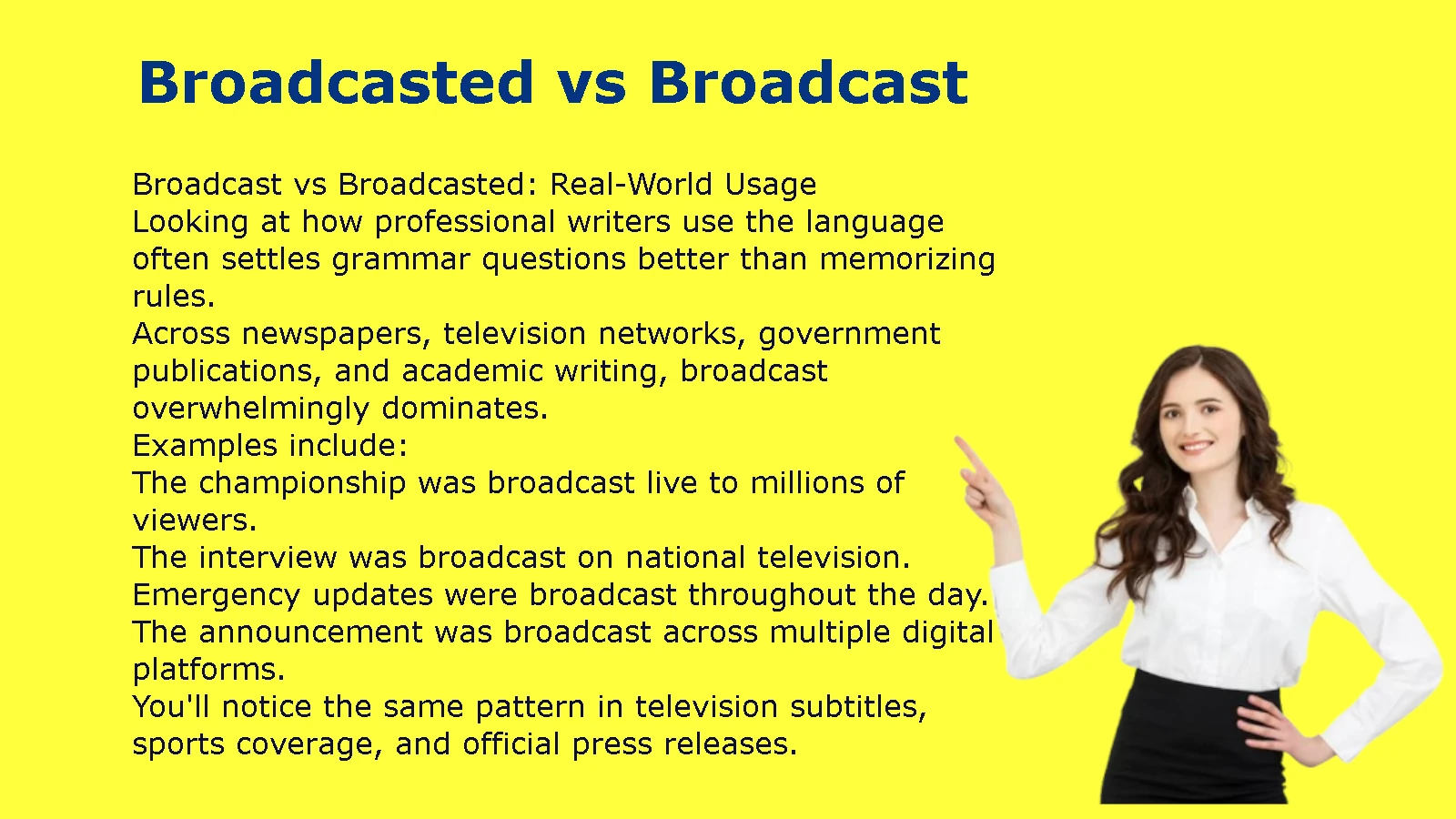
Broadcast vs Broadcasted: Real-World Usage
Looking at how professional writers use the language often settles grammar questions better than memorizing rules.
Across newspapers, television networks, government publications, and academic writing, broadcast overwhelmingly dominates.
Examples include:
- The championship was broadcast live to millions of viewers.
- The interview was broadcast on national television.
- Emergency updates were broadcast throughout the day.
- The announcement was broadcast across multiple digital platforms.
You’ll notice the same pattern in television subtitles, sports coverage, and official press releases.
That consistency explains why teachers, editors, and publishers continue to recommend broadcast.
Mini Case Study: Editing a News Article
Imagine you’re editing the following sentence.
Original Draft
The governor’s speech was broadcasted live on every major television network.
While this sentence is grammatically acceptable, many editors would revise it.
Edited Version
The governor’s speech was broadcast live on every major television network.
Why the Edit?
The revised sentence:
- Matches modern editorial standards.
- Sounds smoother to native speakers.
- Reflects the form used by major news organizations.
- Keeps the writing concise.
This small change improves readability without altering the meaning.
Expert Insight
“Language isn’t just about what’s possible. It’s also about what’s preferred by educated speakers and professional writers.”
That’s exactly why broadcast has become the dominant past-tense form.
Although English accepts some variation, usage determines what sounds natural. Over time, readers have grown accustomed to seeing broadcast, making it the safer and more polished choice.
Frequently Asked Questions About Broadcasted vs Broadcast
Is broadcasted grammatically correct?
Yes. Broadcasted is grammatically correct and appears in several dictionaries. However, it is much less common than broadcast and is rarely the preferred choice in formal writing.
Is broadcast an irregular verb?
Yes.
Unlike regular verbs, broadcast usually keeps the same form in the present tense, past tense, and past participle.
Examples:
- We broadcast every Friday.
- We broadcast yesterday.
- We have broadcast weekly for years.
Why doesn’t broadcast become broadcasted?
Because broadcast follows the same irregular pattern as cast, cut, put, and several other English verbs that don’t change in the past tense.
The language preserved this pattern over time, even as many newer verbs adopted the regular -ed ending.
Which form do journalists use?
Professional journalists almost always use broadcast.
You’ll see it consistently in:
- News reports
- Television scripts
- Radio transcripts
- Press releases
- Sports coverage
Is broadcasted outdated?
Not exactly.
It’s better described as uncommon rather than outdated.
Some speakers still use it, and dictionaries continue to recognize it. However, broadcast remains the dominant form in modern English.
Which form should students use?
Students should almost always choose broadcast unless a teacher specifically requests otherwise.
Using the standard form demonstrates familiarity with current English usage and avoids unnecessary corrections.
Is broadcasted wrong in American English?
No.
American English recognizes broadcasted, but broadcast is far more common in schools, journalism, publishing, and professional writing.
The same preference exists in British English.
Can broadcast be used as a noun?
Yes.
Examples:
- We watched the evening broadcast together.
- The live broadcast attracted millions of viewers.
- The morning broadcast included weather updates and traffic reports.
As a noun, broadcast refers to a television program, radio program, livestream, or any transmitted communication.
What’s the difference between broadcast and broadcasting?
The difference lies in the verb tense.
| Word | Function | Example |
| Broadcast | Base verb, past tense, or past participle | They broadcast the event yesterday. |
| Broadcasting | Present participle or gerund | They are broadcasting the event live. |
Key Takeaways
Here’s a quick summary of everything covered in this guide.
- Broadcast is the standard past tense and past participle in modern English.
- Broadcasted is a real word, but it appears far less often.
- American and British English both strongly prefer broadcast.
- Professional editors, journalists, teachers, and publishers overwhelmingly use broadcast.
- Broadcast belongs to a family of irregular verbs that don’t change in the past tense.
- When writing essays, reports, blog posts, or business documents, broadcast is the safest and most natural choice.
- Broadcasting is the correct form for ongoing actions.
- Learning the pattern shared by cast, cut, put, and broadcast makes the rule much easier to remember.
Conclusion
The debate over broadcasted vs broadcast isn’t really about right versus wrong. It’s about understanding which form modern English speakers actually use.
While broadcasted is recognized as a legitimate variant, broadcast has become the clear favorite across journalism, education, publishing, business, and everyday communication. Its long history as an irregular verb, combined with widespread editorial preference, makes it the form you’ll encounter most often.
Whenever you’re unsure, choose broadcast. It reads naturally, aligns with current grammar standards, and works in nearly every context. Whether you’re describing a live sporting event, a televised interview, a streamed webinar, or a public announcement, broadcast will help your writing sound polished, accurate, and professional.
The next time you pause over broadcasted vs broadcast, you’ll know exactly which word belongs in your sentence—and why.