Big vs Large: What’s the Difference?
Big is more common in everyday conversation and can describe size, importance, or impact. Large is more formal and usually refers to physical size, quantity, or amount.
Examples:
- They bought a big house. (Common, conversational)
- They ordered a large pizza. (Standard size)
- She made a big decision. (Importance, not size)
Use big for informal speech and figurative meanings, and large when referring to measurable size or in more formal contexts.
In this guide, you’ll learn the difference between Big vs Large, discover when to use big and large, explore big vs large examples, and understand the subtle differences in meaning, usage, and common expressions. You’ll also see practical examples that make it easy to choose the correct word in everyday conversations and writing.
By the end, you’ll know exactly when big is the better choice, when large sounds more appropriate, and how to avoid one of the most common word-choice mistakes in English
Big vs. Large: The Quick Difference
If you’re looking for the short answer, here it is:
- Big usually emphasizes importance, significance, emotion, or impact.
- Large usually emphasizes physical size, quantity, or measurable dimensions.
Although both words describe something greater than average in size, they create different impressions.
Consider these examples:
- A big smile ✔
- A large smile ✔ (possible but much less common)
- A big decision ✔
- A large decision ✘
- A large audience ✔
- A big audience ✔ (more conversational)
One sounds warmer and more personal. The other sounds more factual.
Big vs. Large Comparison Table
| Feature | Big | Large |
| Primary meaning | Great in size or importance | Great in size, quantity, or extent |
| Tone | Informal and expressive | Neutral and formal |
| Focus | Importance, emotion, influence | Measurement, size, quantity |
| Everyday speech | Very common | Common but slightly more formal |
| Academic writing | Less common | Preferred |
| Business writing | Sometimes | Frequently |
| Technical writing | Rare | Common |
| Physical objects | Yes | Yes |
| Quantities | Sometimes | Frequently |
| Abstract ideas | Very common | Limited |
| Emotional emphasis | Strong | Minimal |
| Interchangeable? | Sometimes | Sometimes |
What Does “Big” Mean?
The adjective big generally means larger than average in size, but English speakers use it far beyond physical dimensions.
Depending on the context, big can describe:
- Physical size
- Importance
- Success
- Popularity
- Emotion
- Influence
- Age differences
- Personal relationships
Because of its flexibility, big ranks among the most frequently used adjectives in everyday English.
Literal Meaning of Big
The most obvious meaning relates to physical size.
Examples:
- That’s a big tree.
- We bought a big sofa.
- Their dog is incredibly big.
Here, big simply means larger than expected.
Figurative Meaning of Big
English speakers often use big metaphorically.
Examples include:
- Big opportunity
- Big change
- Big surprise
- Big dream
- Big problem
- Big achievement
Notice that none of these involve physical size.
Instead, big highlights importance or impact.
Compare:
“It was a big day.”
The speaker doesn’t mean the day lasted longer. They mean the day mattered.
Common Contexts Where Big Appears
You’ll hear big in conversations about:
- Family
- Sports
- Business
- Entertainment
- Education
- Politics
- Personal achievements
Examples:
- She’s my big sister.
- Tomorrow is the big game.
- That’s big news.
- He got his big break.
Replacing big with large in these examples would sound unnatural.
Examples of Big in Sentences
- We moved into a big house near the lake.
- She made a big difference in the project.
- They announced some big changes today.
- Winning that award was a big moment in his career.
- He has a big personality that fills every room.
Notice how only the first sentence refers to physical size.
What Does “Large” Mean?
The adjective large usually refers to something greater than average in measurable size, quantity, volume, or extent.
Unlike big, it rarely expresses emotion.
Instead, large sounds objective and precise.
Because of that, you’ll often find it in:
- Newspapers
- Scientific papers
- Business reports
- Legal documents
- Technical manuals
Literal Meaning of Large
Examples include:
- A large building
- A large island
- A large box
- A large suitcase
These describe measurable dimensions.
Large for Quantity
One major difference between big vs. large appears when discussing quantities.
Natural examples include:
- A large amount of rain
- A large number of students
- A large percentage
- A large collection
- A large inventory
Although people occasionally say big number, large number sounds more formal and precise.
Formal Meaning of Large
Professional writing often favors large because it avoids emotional language.
Examples:
Business report:
The company experienced a large increase in annual revenue.
Research paper:
Scientists collected a large sample size for the experiment.
Government report:
A large population lives in urban areas.
These examples sound factual rather than expressive.
Examples of Large in Sentences
- The museum has a large collection of paintings.
- They hired a large workforce.
- A large audience attended the conference.
- The university conducted a large-scale study.
- She transferred a large file to the server.
Big vs. Large: The Main Differences
Although dictionaries often list these words as synonyms, native speakers don’t always treat them equally.
Let’s explore the differences.
Big Often Expresses Importance
Many times, big doesn’t describe size at all.
Examples:
- Big decision
- Big announcement
- Big responsibility
- Big success
- Big concern
The word suggests significance.
You couldn’t naturally replace these with large.
Large Usually Describes Measurable Size
When discussing dimensions or quantity, large often sounds better.
Examples:
- Large warehouse
- Large shipment
- Large investment
- Large order
- Large population
These refer to measurable facts.
Big Sounds More Conversational
Imagine two friends talking.
“That’s a big house.”
Now imagine a real estate brochure.
“This property features a large living room.”
Both are correct.
The second simply sounds more polished.
Large Sounds More Formal
You’ll often see large in:
- Academic journals
- Government publications
- Company reports
- Financial documents
- Medical studies
Meanwhile, big dominates everyday conversation.
Big Adds Emotion
Compare these sentences.
She received a big promotion.
This sounds exciting.
Now compare:
She received a large promotion.
It sounds unusual because promotions aren’t measured by physical size.
Large Adds Precision
Now compare another pair.
A large percentage of customers renewed.
versus
A big percentage of customers renewed.
The second sentence isn’t wrong, but professionals almost always choose large percentage.
Precision matters.
When Big and Large Mean the Same Thing
Sometimes the difference disappears completely.
When describing physical size, both adjectives often work well.
Here are common examples.
| Big | Large |
| Big house | Large house |
| Big building | Large building |
| Big truck | Large truck |
| Big garden | Large garden |
| Big hotel | Large hotel |
| Big airport | Large airport |
| Big room | Large room |
| Big suitcase | Large suitcase |
| Big lake | Large lake |
| Big farm | Large farm |
In these cases, the choice mostly depends on tone.
- Big sounds conversational.
- Large sounds slightly more formal.
Example Comparisons
Big house
They finally bought a big house outside the city.
Natural in conversation.
Large house
The architect designed a large house overlooking the coast.
Natural in writing.
Both are correct.
Objects
Both adjectives commonly describe:
- Tables
- Cars
- Boats
- Buildings
- Parks
- Factories
- Schools
- Stores
Examples:
- A big factory
- A large factory
Neither changes the meaning significantly.
Animals
Examples include:
- Big elephant
- Large elephant
- Big whale
- Large whale
- Big horse
- Large horse
Again, both work naturally.
Areas and Places
Examples:
- Big city
- Large city
- Big island
- Large island
- Big forest
- Large forest
Notice that big city appears more frequently in everyday speech because it can also suggest excitement and opportunity rather than just population.
When You Should Use Big Instead of Large
Some expressions have become fixed over hundreds of years.
Changing them sounds strange because native speakers simply don’t say them that way.
Big Deal
✔ That’s a big deal.
✘ That’s a large deal.
Here, big means important.
Big Mistake
✔ That was a big mistake.
✘ That was a large mistake.
The mistake isn’t physically large.
It’s serious.
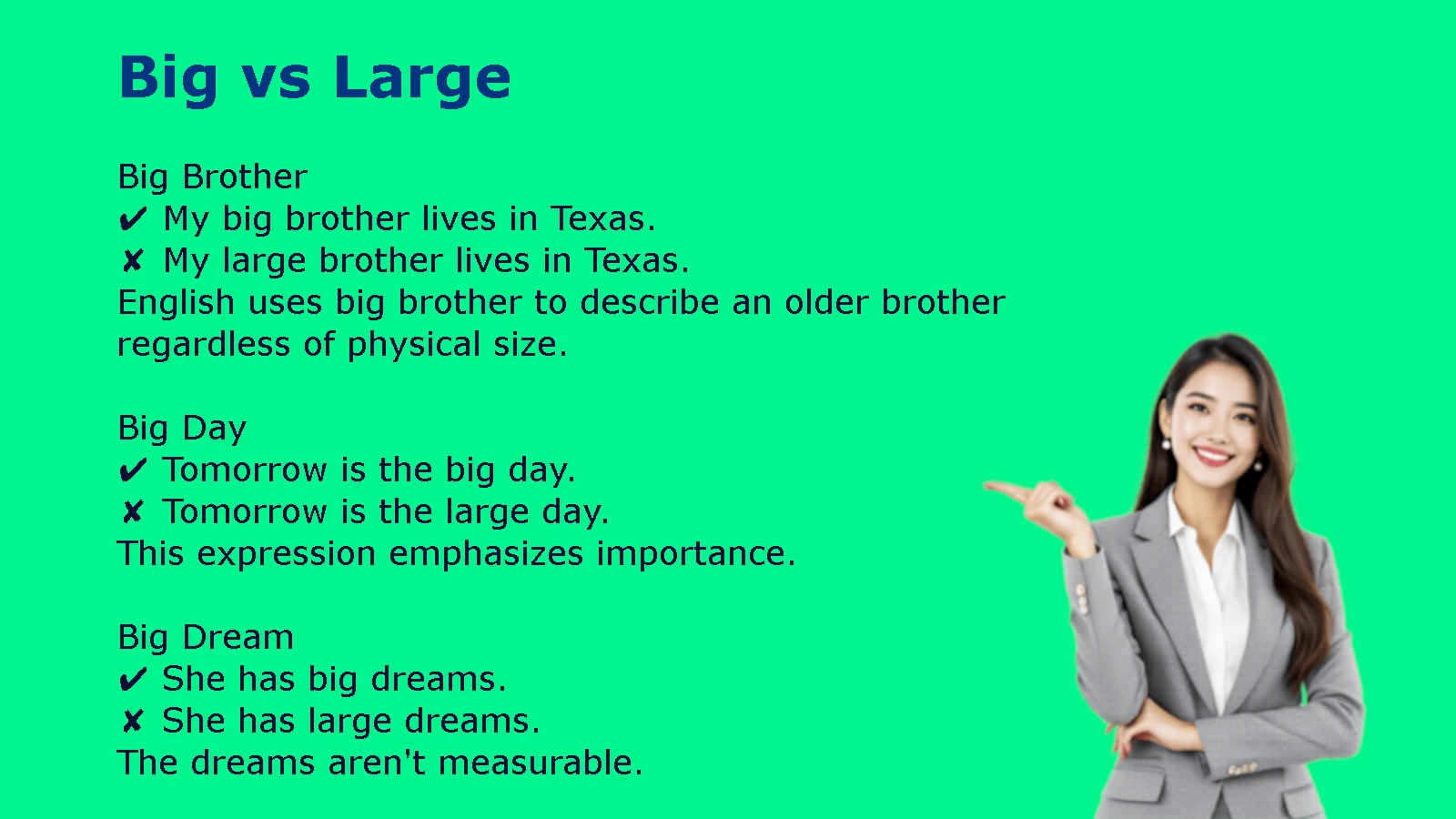
Big Brother
✔ My big brother lives in Texas.
✘ My large brother lives in Texas.
English uses big brother to describe an older brother regardless of physical size.
Big Day
✔ Tomorrow is the big day.
✘ Tomorrow is the large day.
This expression emphasizes importance.
Big Dream
✔ She has big dreams.
✘ She has large dreams.
The dreams aren’t measurable.
They’re ambitious.
Big Opportunity
✔ This is a big opportunity.
✘ This is a large opportunity.
Again, the focus is importance rather than size.
Big Personality
Some people naturally attract attention.
Examples:
- She has a big personality.
- He’s a big character in the community.
These expressions describe influence and energy rather than physical appearance.
Big Picture
The phrase big picture means the overall situation rather than small details.
Example:
Instead of worrying about tiny problems, look at the big picture.
Saying large picture completely changes the meaning because it now refers to an actual oversized image rather than a metaphorical overview.
, grammar rules, writing styles, idioms, and closely related words.
When You Should Use Large Instead of Big
While big feels more conversational, large is often the better choice when you’re describing quantity, measurable size, scale, or statistics. In many formal contexts, replacing large with big makes the sentence sound less polished.
You’ll notice this pattern in newspapers, research papers, business reports, and government publications. Writers choose large because it communicates facts without adding emotion.
Let’s look at the most common situations where large is the natural choice.
Large Amount
When talking about an uncountable noun, large amount is the standard expression.
Examples:
- A large amount of rainfall fell overnight.
- The project required a large amount of funding.
- She spent a large amount of time preparing.
Although you might hear big amount in casual conversation, native speakers overwhelmingly prefer large amount.
Large Number
For countable nouns, large number is the standard collocation.
Examples:
- A large number of people attended.
- The website receives a large number of visitors each month.
- Researchers analyzed a large number of responses.
Large Quantity
Scientific, technical, and manufacturing fields frequently use this phrase.
Examples:
- The warehouse stores large quantities of grain.
- The factory produces large quantities of steel.
- Water is transported in large quantities every day.
Large Population
Demographers and economists almost always use large population.
Examples:
- California has a large population.
- The city supports a large population of students.
- Countries with a large population face different infrastructure challenges.
Large Scale
This collocation describes projects, operations, or events involving extensive planning or resources.
Examples:
- A large-scale construction project
- A large-scale survey
- A large-scale emergency response
- A large-scale marketing campaign
Large Audience
When discussing attendance, presentations, or performances, large audience sounds more professional.
Examples:
- The speaker addressed a large audience.
- The concert attracted a large audience.
- The webinar reached a large audience worldwide.
Large Corporation
Business writing often prefers large when referring to companies.
Examples:
- A large corporation
- A large employer
- A large enterprise
Large Database
Technology professionals regularly use expressions like:
- Large database
- Large dataset
- Large network
- Large file
- Large server cluster
These phrases emphasize measurable size rather than emotional significance.
Large Sample Size
Researchers use large sample size because it has a specific statistical meaning.
Example:
A large sample size generally produces more reliable results because it reduces random variation.
Common Collocations with Big
English contains hundreds of fixed expressions with big. Many of them describe importance instead of physical size.
The following table includes some of the most common ones.
| Expression | Meaning | Example |
| Big city | Major urban area | She moved to a big city after college. |
| Big house | Large home | They bought a big house in the suburbs. |
| Big problem | Serious issue | That’s a big problem for everyone. |
| Big decision | Important choice | It’s a big decision for the family. |
| Big opportunity | Valuable chance | This internship is a big opportunity. |
| Big surprise | Unexpected event | Your visit was a big surprise. |
| Big success | Major achievement | The campaign became a big success. |
| Big change | Significant difference | Retirement brought a big change. |
| Big mistake | Serious error | That was a big mistake. |
| Big impact | Strong influence | Education has a big impact on society. |
| Big question | Important issue | Here’s the big question. |
| Big smile | Wide smile | She greeted everyone with a big smile. |
| Big game | Important sporting event | Tonight is the big game. |
| Big picture | Overall view | Focus on the big picture. |
| Big heart | Kind personality | He has a big heart. |
| Big favor | Significant help | Can you do me a big favor? |
| Big break | Major opportunity | She finally got her big break. |
| Big project | Major assignment | We’re launching a big project. |
| Big win | Major victory | It was a big win for the team. |
| Big moment | Memorable event | Graduation was a big moment. |
Why These Matter
These expressions are fixed collocations. Native speakers learn them naturally through repeated use. Switching big to large often sounds unnatural even though the dictionary definitions overlap.
Common Collocations with Large
Unlike big, large often appears in professional, technical, and statistical writing.
| Expression | Meaning | Example |
| Large family | Many family members | She comes from a large family. |
| Large company | Major business | He works for a large company. |
| Large audience | Many listeners | The keynote attracted a large audience. |
| Large crowd | Many people | A large crowd gathered downtown. |
| Large investment | Significant financial commitment | The project required a large investment. |
| Large order | High-volume purchase | They placed a large order. |
| Large inventory | Extensive stock | The warehouse maintains a large inventory. |
| Large budget | High spending limit | Marketing received a large budget. |
| Large shipment | Major delivery | A large shipment arrived this morning. |
| Large collection | Many items | The museum owns a large collection. |
| Large percentage | High proportion | A large percentage agreed. |
| Large database | Extensive data storage | The company manages a large database. |
| Large workforce | Many employees | The manufacturer employs a large workforce. |
| Large facility | Spacious building | The hospital operates a large facility. |
| Large estate | Extensive property | The family inherited a large estate. |
| Large sample | Many research participants | Scientists used a large sample. |
Grammar Rules for Big and Large
Understanding grammar helps you use both adjectives confidently.
Fortunately, big and large follow the same basic adjective rules.
Both Are Adjectives
Both words describe nouns.
Examples:
- A big truck
- A large truck
- A big office
- A large office
Comparative Forms
When comparing two things:
| Positive | Comparative |
| Big | Bigger |
| Large | Larger |
Examples:
- My apartment is bigger than yours.
- Their warehouse is larger than ours.
Superlative Forms
When comparing three or more things:
| Positive | Superlative |
| Big | Biggest |
| Large | Largest |
Examples:
- Alaska is the largest U.S. state by area.
- The blue whale is the biggest animal on Earth.
Interestingly, largest often appears in measurements while biggest frequently emphasizes significance or overall impression.
Compare:
- The world’s largest desert.
- The world’s biggest movie star.
Both can be correct depending on context.
Can They Modify Countable Nouns?
Yes.
Examples:
- Big house
- Large building
- Big dog
- Large factory
Can They Modify Uncountable Nouns?
Only in certain expressions.
Examples:
✔ Large amount of water
Big improvement
✔ Big progress
Notice the pattern.
Big often describes abstract ideas.
Large often describes measurable quantities.
Can They Appear After Linking Verbs?
Absolutely.
Examples:
- The house is big.
- The warehouse is large.
- Their office became larger.
- My suitcase looks big beside yours.
Big vs. Large in Different Types of Writing
Choosing between these adjectives depends on your audience.
Everyday Conversation
People overwhelmingly prefer big.
Examples:
- That’s a big dog.
- We have big plans.
- She’s having a big party.
This sounds warm and natural.
Academic Writing
Researchers usually prefer large.
Examples:
- Large sample
- Large population
- Large dataset
- Large volume
Academic writing values precision over emotion.
Business Communication
Business documents often mix both.
Examples:
- Big opportunity
- Big client
- Large investment
- Large acquisition
Notice how big highlights importance while large describes measurable value.
Journalism
News articles commonly alternate between the two.
Example:
The company announced a large investment that experts described as a big step toward expansion.
Each adjective serves a different purpose.
Technical Writing
Engineers, scientists, and software developers usually prefer large.
Examples:
- Large memory allocation
- Large database
- Large file
- Large network
Precision matters.
Marketing and Advertising
Advertisers often favor big because it creates excitement.
Examples:
- Big savings
- Big event
- Big launch
- Big rewards
- Big announcement
These phrases sound energetic and memorable.
Big vs. Large in Idioms and Fixed Expressions
Many English idioms use one adjective exclusively.
Changing it makes the expression sound unnatural.
Big Fish in a Small Pond
Meaning: An important person in a small community.
Example:
He was a big fish in a small pond before moving to New York.
Big Mouth
Someone who talks too much or reveals secrets.
Example:
Don’t tell him. He’s got a big mouth.
Big Shot
An influential or powerful person.
Example:
Everyone wanted to meet the big shot from headquarters.
Think Big
This motivational phrase encourages ambitious goals.
Example:
Successful entrepreneurs learn to think big.
Go Big or Go Home
A popular expression encouraging full commitment.
Meaning:
If you’re going to do something, do it boldly.
Big Picture
Perhaps the most common metaphor using big.
It means looking at the overall situation instead of getting distracted by small details.
At Large
Unlike previous examples, this idiom uses large.
It has several meanings:
- Not captured by police
- Free without restrictions
- Representing everyone rather than one district
Examples:
- The suspect remains at large.
- The ambassador serves at large.
By and Large
This centuries-old idiom means generally or overall.
Example:
By and large, customers were satisfied.
Large-Hearted
Although uncommon today, large-hearted means generous or compassionate.
Example:
She was known as a large-hearted leader who always helped others.
“Words often carry more than their dictionary meanings. They also carry history, culture, and habit.” — David Crystal, linguist
That idea perfectly explains why big and large aren’t always interchangeable, even when both describe size.
Words Commonly Confused with Big and Large
Sometimes neither big nor large is the best choice.
Here’s how other size-related adjectives compare.
| Word | Meaning | Best Used For |
| Huge | Extremely big | Informal emphasis |
| Massive | Very heavy or enormous | Buildings, rocks, structures |
| Enormous | Exceptionally large | General descriptions |
| Gigantic | Extremely large | Dramatic writing |
| Immense | Vast beyond ordinary size | Oceans, deserts, influence |
| Vast | Very great in area | Landscapes, knowledge, space |
| Great | Important or impressive | Achievements, historical figures |
| Considerable | Significant amount | Formal writing |
| Sizeable | Fairly large | Business and journalism |
| Giant | Exceptionally large | Objects, companies, people (figuratively) |
Quick Comparison
| Situation | Best Word |
| Friendly conversation | Big |
| Scientific report | Large |
| Extreme size | Huge |
| Massive physical object | Massive |
| Vast geographic area | Vast |
| Statistical quantity | Large |
| Emotional importance | Big |
Mini Case Study: Why One Word Changed the Tone
Imagine two companies announcing the same news.
Version A
“We’re making a big investment in renewable energy.”
This sounds enthusiastic and inspiring. It appeals to emotion and momentum.
Version B
“We’re making a large investment in renewable energy.”
This sounds factual and professional. It emphasizes the scale of the investment rather than the excitement surrounding it.
Both sentences are correct. The choice depends on the tone the writer wants to create.
Common Mistakes English Learners Make with Big vs. Large
Even advanced English learners occasionally confuse big and large because both words share similar dictionary definitions. The challenge isn’t grammar. It’s natural usage.
Native speakers rely heavily on collocations, context, and tone. Learning those patterns will help your English sound much more fluent.
Using “Large” in Everyday Conversation
Many learners assume large always sounds more sophisticated. In casual speech, however, big often feels more natural.
Less Natural
- I live in a large house.
- We had a large dinner yesterday.
- She gave me a large hug.
More Natural
- I live in a big house.
- We had a big dinner yesterday.
- She gave me a big hug.
People generally choose big when talking informally with family, friends, or coworkers.
Replacing Fixed Expressions
Some expressions simply don’t change.
| ✅ Correct | ❌ Incorrect |
| Big mistake | Large mistake |
| Big deal | Large deal |
| Big brother | Large brother |
| Big day | Large day |
| Big dream | Large dream |
| Big picture | Large picture (unless referring to an actual oversized image) |
| Big break | Large break |
These phrases became part of English through years of common use. Memorizing them will improve both your writing and speaking.
Using “Big” in Formal Writing
Although big isn’t wrong, professional writing often benefits from more precise wording.
Casual
The company saw a big increase in revenue.
More Formal
The company reported a large increase in revenue.
Similarly:
- Large percentage
- Large investment
- Large sample
- Large population
- Large quantity
These combinations appear regularly in academic journals, business reports, and government publications.
Choosing the Wrong Collocation
Many English errors involve collocations rather than grammar.
Compare these examples.
| Natural | Less Natural |
| Large amount | Big amount |
| Large number | Big number |
| Big opportunity | Large opportunity |
| Big success | Large success |
| Large audience | Big audience (acceptable but more conversational) |
| Large corporation | Big corporation (acceptable but less formal) |
Reading widely helps you recognize these patterns over time.
Confusing Physical Size with Importance
One of the biggest differences between big and large is meaning beyond size.
Look at these examples.
Physical Size
- A large warehouse
- A big truck
- A large airport
Importance
- A big announcement
- A big achievement
- A big decision
When the emphasis is importance, big almost always sounds better.
Real-World Examples of Big vs. Large
Seeing these words in authentic contexts makes the distinction much easier to understand.
Business
Example
The company announced a large acquisition worth $2 billion.
Why large?
Because the sentence focuses on measurable financial value.
Example
The acquisition represents a big milestone for the company.
Why big?
Because milestone refers to importance rather than measurable size.
Education
Example
Researchers surveyed a large sample of university students.
The emphasis is statistical quantity.
Example
The findings could have a big impact on education policy.
The emphasis shifts from measurement to influence.
Healthcare
Medical writing often prefers large.
Examples:
- Large clinical trial
- Large patient group
- Large healthcare network
However, healthcare professionals may still say:
- A big improvement
- A big concern
- A big challenge
Again, context determines the better choice.
Sports
Sports commentators frequently use big.
Examples:
- A big win
- A big game
- A big moment
- A big comeback
These phrases create excitement.
By contrast:
- A large stadium
- A large crowd
Here, the focus is physical size or attendance.
Technology
Technology writing often mixes both adjectives.
Examples:
- Large database
- Large software update
- Large file
- Large storage capacity
But you’ll also hear:
- Big announcement
- Big release
- Big innovation
The first group describes measurable characteristics. The second highlights significance.
Big vs. Large: Side-by-Side Examples
The following comparisons show how context affects word choice.
| Sentence with Big | Sentence with Large | Which Sounds Better? | Why? |
| A big house | A large house | Both | Difference is mainly tone. |
| A big city | A large city | Both | Big city often suggests excitement and opportunity. |
| A big family | A large family | Both | Large family is slightly more common in formal writing. |
| A big problem | A large problem | Big | Refers to seriousness. |
| A big mistake | A large mistake | Big | Fixed expression. |
| A big opportunity | A large opportunity | Big | Importance, not size. |
| A big smile | A large smile | Big | More natural in everyday English. |
| A big audience | A large audience | Large | Preferred in formal writing. |
| A big number | A large number | Large | Standard collocation. |
| A big amount | A large amount | Large | Standard expression. |
| A big company | A large company | Both | Large sounds more professional. |
| A big investment | A large investment | Both | Depends on whether you emphasize excitement or value. |
| A big change | A large change | Big | More common in everyday speech. |
| A big increase | A large increase | Large | Preferred in reports and research. |
| A big project | A large project | Both | Context determines tone. |
| A big surprise | A large surprise | Big | Fixed expression. |
| A big decision | A large decision | Big | Refers to importance. |
| A big celebration | A large celebration | Both | Large emphasizes attendance. |
| A big event | A large event | Both | Depends on meaning and style. |
| A big victory | A large victory | Big | Focuses on significance. |
Practice Exercises
Try these exercises before checking the answers.
Fill in the Blank
Choose big or large.
- They ordered a ______ pizza.
- Scientists collected a ______ sample.
- Tomorrow is a ______ day for our family.
- The company employs a ______ workforce.
- She made a ______ mistake.
- The concert attracted a ______ audience.
- We live in a ______ apartment.
- That’s a ______ opportunity.
- The report includes a ______ amount of data.
- Winning the championship was a ______ moment.
Choose the Better Expression
Select the phrase that sounds more natural.
- Big amount / Large amount
- Big mistake / Large mistake
- Big audience / Large audience
- Big opportunity / Large opportunity
- Big decision / Large decision
- Big population / Large population
- Big investment / Large investment
- Big brother / Large brother
- Big game / Large game
- Big picture / Large picture
Rewrite the Sentences
Replace the adjective with the more natural choice.
- It was a large mistake.
- The university has a big population.
- We made a big investment in new equipment. (formal report)
- She gave a speech to a big audience. (academic article)
- Tomorrow is our large day.
Match the Collocations
| Word | Correct Pair |
| Big | Deal |
| Big | Dream |
| Big | Break |
| Large | Number |
| Large | Quantity |
| Large | Population |
| Large | Database |
| Large | Sample |
| Big | Smile |
| Big | Success |
Answer Key
Fill in the Blank
- Big
- Large
- Big
- Large
- Big
- Large
- Big (or Large)
- Big
- Large
- Big
Better Expressions
- Large amount
- Big mistake
- Large audience
- Big opportunity
- Big decision
- Large population
- Large investment
- Big brother
- Big game
- Big picture
Sentence Revisions
- It was a big mistake.
- The university has a large population.
- We made a large investment in new equipment.
- She gave a speech to a large audience.
- Tomorrow is our big day.
Frequently Asked Questions About Big vs. Large
Are big and large synonyms?
Yes. Both words describe something greater than average in size. However, they aren’t interchangeable in every context because English relies on common collocations and established expressions.
Which word is more formal?
Large is generally more formal.
That’s why you’ll see it more often in:
- Academic papers
- Business reports
- Scientific studies
- Government publications
Can I always replace big with large?
No.
Expressions like big mistake, big deal, big brother, and big dream sound natural because they’ve become fixed parts of English.
Replacing them with large creates awkward sentences.
Why do we say “big mistake” instead of “large mistake”?
Because big emphasizes importance or seriousness rather than physical size. It’s also the established collocation that native speakers use.
Why is “large amount” more common than “big amount”?
Large amount has become the standard phrase for discussing quantities. Although big amount isn’t impossible, it sounds much less natural.
Which word should I use in academic writing?
In most cases, choose large when referring to measurable data.
Examples include:
- Large sample
- Large dataset
- Large population
- Large increase
- Large percentage
Which word is more common in American English?
Both words appear frequently, but big dominates everyday conversation because it’s versatile and works in many figurative expressions.
Can big describe importance instead of size?
Absolutely.
Examples include:
- Big decision
- Big announcement
- Big success
- Big opportunity
- Big challenge
In each case, big refers to significance rather than physical dimensions.
Can large describe emotions?
Rarely.
Large usually focuses on measurable characteristics. For emotions, relationships, or importance, big almost always sounds more natural.
How can I remember the difference?
A simple rule works most of the time:
- Use big for importance, emotion, or everyday conversation.
- Use large for measurable size, quantity, or formal writing.
When you’re unsure, listen to how native speakers use the phrase. Over time, common collocations will become familiar and choosing the right word will feel natural.
Key Takeaways: Big vs. Large
Here’s a quick summary of the most important points.
| Situation | Preferred Word |
| Casual conversation | Big |
| Formal reports | Large |
| Importance or significance | Big |
| Physical measurements | Large |
| Quantities and statistics | Large |
| Fixed expressions | Big |
| Academic writing | Large |
| Emotional emphasis | Big |
| Scientific research | Large |
| Everyday idioms | Big |
“The right word doesn’t just convey meaning—it conveys tone, intent, and confidence.”
Choosing between big and large isn’t about memorizing one rigid rule. It’s about understanding how native English speakers naturally use each word. Big brings warmth, emphasis, and personality to a sentence. Large adds precision, objectivity, and a more formal tone. Once you recognize those patterns, you’ll write and speak with greater clarity, confidence, and fluency.