Nucleus and nuclei are both correct words, but they have different meanings. Nucleus is the singular form, while nuclei is the traditional Latin plural used in scientific and general writing. When comparing Nucleus vs. Nuclei, use nucleus for one and nuclei for more than one.
The confusion often comes from the fact that “nucleus” and “nuclei” refer to the same concept but differ in singular and plural forms. But here’s the kicker: choosing the wrong form can lead to grammar mistakes in academic writing, scientific discussions, and everyday communication.
In this guide, you’ll learn the difference between Nucleus vs Nuclei, understand the meaning of nucleus, the meaning of nuclei, discover when to use nucleus or nuclei, and see nucleus vs nuclei examples in real sentences. You’ll also find the correct plural of nucleus, pronunciation tips, and easy memory tricks to help you use both words with confidence.
By the end, you’ll know exactly when to use nucleus and when nuclei is the correct choice, so you’ll never mix them up again.
Nucleus vs. Nuclei at a Glance
Before diving deeper, here’s a quick comparison.
| Feature | Nucleus | Nuclei |
| Number | Singular | Plural |
| Meaning | One central core or one cell nucleus | More than one central core or multiple nuclei |
| Part of Speech | Noun | Plural noun |
| Origin | Latin | Latin plural |
| Common Fields | Biology, Chemistry, Physics, Astronomy, Anatomy | Same fields when referring to multiple structures |
| Example | The nucleus controls the cell. | The nuclei stained dark blue under the microscope. |
Quick Summary
- Nucleus = one
- Nuclei = more than one
- Both words refer to a central part of something.
- The plural follows Latin grammar, not regular English grammar.
- Scientific writing almost always uses nuclei instead of nucleuses.
What Does “Nucleus” Mean?
The word nucleus refers to the central or most important part of something. Depending on the context, it can describe the control center of a cell, the dense core of an atom, the central region of a galaxy, or even the core group within an organization.
The word comes from the Latin nucleus, meaning “little nut” or “kernel.” Ancient Romans used it to describe the edible center inside a nut. Over time, scientists adopted the term because many important structures occupy the middle of larger systems.
Today, dictionaries define nucleus as:
The central and usually most important part of an object, system, or structure.
The exact meaning changes slightly depending on the subject.
Nucleus in Biology
In biology, the nucleus is the membrane-bound organelle found in most eukaryotic cells. It stores DNA and directs the cell’s activities.
Inside the nucleus, you’ll find:
- DNA organized into chromosomes
- The nucleolus, where ribosomes begin forming
- Nuclear pores that regulate movement in and out
- Genetic instructions that guide growth and reproduction
Without a functioning nucleus, most eukaryotic cells cannot properly divide or regulate protein production.
Nucleus in Chemistry and Physics
In atomic science, the nucleus is the dense center of an atom.
It contains:
- Protons
- Neutrons
Although the nucleus occupies only a tiny fraction of an atom’s total volume, it contains more than 99.9% of the atom’s mass. Electrons move around this central region in surrounding electron clouds.
Nucleus in Astronomy
Astronomers use nucleus to describe the central region of celestial objects.
Examples include:
- The nucleus of a comet
- The nucleus of a galaxy
- The active nucleus of certain galaxies powered by supermassive black holes
In each case, the nucleus represents the object’s most concentrated or influential area.
Nucleus in Everyday Language
Outside science, nucleus can describe any central group or essential part.
Examples include:
- The nucleus of a community
- The nucleus of a business team
- The nucleus of an idea
- The nucleus of a political movement
In these examples, the word emphasizes importance rather than physical location.
What Does “Nuclei” Mean?
Nuclei is simply the plural form of nucleus.
Whenever you’re discussing two or more nuclei, this is the correct word to use.
Examples include:
- Multiple cell nuclei
- Several atomic nuclei
- Brain nuclei
- Galactic nuclei
- Numerous comet nuclei
Unlike most English nouns, nucleus doesn’t become plural by adding -s. Instead, it keeps its traditional Latin plural ending.
Why Scientists Prefer “Nuclei”
Scientific disciplines value consistency and precision. Since many technical terms originate from Latin, researchers continue using the original plural forms.
Examples include:
| Singular | Plural |
| Nucleus | Nuclei |
| Fungus | Fungi |
| Radius | Radii |
| Stimulus | Stimuli |
| Alumnus | Alumni |
Because of this tradition, you’ll almost always encounter nuclei in textbooks, research papers, and laboratory reports.
When to Use “Nuclei”
Use nuclei whenever the quantity is greater than one.
Correct examples include:
- The microscope revealed two nuclei inside the cell.
- Scientists examined several atomic nuclei.
- The MRI highlighted different brain nuclei.
- The researchers compared the nuclei of hundreds of cells.
Nucleus vs. Nuclei: The Main Difference
At first glance, these words seem like they might describe different structures. In reality, they refer to the same thing. The only difference is number.
Think of it this way:
| If You’re Talking About… | Correct Word |
| One cell | Nucleus |
| Five cells, each with a nucleus | Nuclei |
| One atom | Nucleus |
| Several atoms | Nuclei |
| One galaxy center | Nucleus |
| Multiple galaxy centers | Nuclei |
The meaning never changes.
Only the quantity does.
Side-by-Side Examples
| Correct Sentence | Why It’s Correct |
| The nucleus contains DNA. | One nucleus |
| The nuclei contained visible chromosomes. | More than one nucleus |
| Each cell has a nucleus. | Refers to each individual cell |
| Many cells have distinct nuclei. | Refers to multiple cells collectively |
Visual Comparison
One Cell
│
└──► One Nucleus
Many Cells
│
──► Nucleus
├──► Nucleus
─► Nucleus
└──► Nuclei (collectively)
This simple distinction eliminates nearly every grammar mistake involving these two words.
How to Pronounce Nucleus and Nuclei
Correct pronunciation helps you communicate clearly, especially in classrooms, laboratories, and professional discussions.
| Word | IPA | Easy Pronunciation |
| Nucleus | /ˈnuː.kli.əs/ | NOO-klee-us |
| Nuclei | /ˈnuː.kli.aɪ/ | NOO-klee-eye |
Notice that only the ending changes.
- Nucleus ends with -us.
- Nuclei ends with the sound “eye.”
Common Pronunciation Mistakes
Many English learners mistakenly pronounce:
- “NOO-klee-ee”
- “NOO-clee”
- “NEW-klee-us”
The standard American pronunciation remains:
- NOO-klee-us
- NOO-klee-eye
Listening to scientific lectures or educational videos can help reinforce these pronunciations.
A Simple Memory Trick
Think of these endings:
- One us → nucleus
- Many eye → nuclei
The changing ending immediately signals whether you’re discussing one structure or several.
Why the Plural Is “Nuclei” Instead of “Nucleuses”
English borrows thousands of words from other languages. Many scientific terms come directly from Latin, and nucleus is one of them.
In classical Latin, nouns ending in -us often form their plural by changing -us to -i.
That pattern survives in modern scientific English.
| Latin Singular | Latin Plural |
| Nucleus | Nuclei |
| Radius | Radii |
| Cactus | Cacti |
| Fungus | Fungi |
| Stimulus | Stimuli |
Because science values standardized terminology, these Latin plurals remain widely accepted across biology, chemistry, medicine, anatomy, and physics.
Is “Nucleuses” Ever Correct?
Technically, nucleuses appears in some dictionaries as an accepted English plural. However, it is rarely used in scientific or academic writing.
Here’s how the two forms compare:
| Form | Acceptance | Common Usage |
| Nuclei | Standard | Very common |
| Nucleuses | Acceptable in general English | Rare |
If you’re writing:
- a research paper,
- a biology assignment,
- a medical article,
- a scientific report, or
- educational content,
Examples of “Nucleus” in Sentences
Seeing nucleus in context makes it much easier to remember when to use it. Since nucleus is singular, every sentence below refers to one central structure or core.
Biology Examples
- The nucleus stores the cell’s genetic material.
- Every plant cell contains a nucleus that regulates cellular activities.
- The damaged nucleus prevented the cell from dividing normally.
- A healthy nucleus helps coordinate protein production.
Chemistry and Physics Examples
- The atom’s nucleus contains positively charged protons.
- Scientists measured the size of the uranium nucleus.
- The nucleus remains extremely small compared to the entire atom.
- Nuclear reactions occur inside the atomic nucleus.
Astronomy Examples
- The comet’s icy nucleus released gas as it approached the Sun.
- The galaxy’s nucleus contains a supermassive black hole.
- Researchers captured detailed images of the comet’s nucleus.
- Dust surrounded the nucleus, creating a bright coma.
Figurative Examples
The word nucleus doesn’t always describe a physical object. It can also represent the central or most important part of a group or idea.
For example:
- The founding members became the nucleus of the organization.
- Trust forms the nucleus of every successful partnership.
- The original volunteers created the nucleus of the community project.
- That single idea became the nucleus of the entire business strategy.
Examples of “Nuclei” in Sentences
Whenever more than one nucleus is involved, nuclei becomes the correct choice.
Cell Biology Examples
- The microscope revealed two nuclei inside the muscle cell.
- Scientists compared the nuclei of healthy and diseased cells.
- The stained nuclei appeared dark blue under the microscope.
- Some fungal cells contain multiple nuclei.
Physics Examples
- Researchers accelerated atomic nuclei to nearly the speed of light.
- Heavy nuclei become unstable over time.
- Nuclear fusion combines light nuclei into heavier ones.
- The experiment examined collisions between hydrogen nuclei.
Astronomy Examples
- Active galactic nuclei emit enormous amounts of energy.
- Several comet nuclei were observed during the survey.
- Astronomers classified galaxies according to the behavior of their nuclei.
- Bright nuclei often indicate intense activity near a galaxy’s center.
Medical Examples
- Pathologists examined abnormal nuclei under high magnification.
- Enlarged nuclei may help doctors identify certain diseases.
- The biopsy showed irregularly shaped nuclei.
- Cancer cells often display changes in their nuclei.
Nucleus vs. Nuclei in Different Subjects
Although the grammatical difference never changes, the meaning of nucleus depends on the field you’re studying. Understanding these contexts helps you recognize the word wherever it appears.
Nucleus vs. Nuclei in Biology
In biology, the nucleus is often called the cell’s control center. It houses DNA, which contains the instructions for building and maintaining the organism.
Key functions include:
- Storing genetic information
- Regulating gene expression
- Directing cell growth
- Controlling cell division
- Coordinating protein synthesis
Most animal and plant cells contain one nucleus, although there are exceptions.
Cells With Multiple Nuclei
Some specialized cells naturally contain more than one nucleus.
Examples include:
- Skeletal muscle fibers
- Certain fungal cells
- Osteoclasts (bone-resorbing cells)
In these cases, nuclei is the correct plural form.
Quick Biology Facts
| Fact | Information |
| Typical number of nuclei | One per cell |
| DNA location | Inside the nucleus |
| Membrane | Double-layered nuclear envelope |
| Present in | Eukaryotic cells |
| Absent in | Most bacteria and archaea |
Nucleus vs. Nuclei in Chemistry
Chemistry focuses on the atomic nucleus, the dense center of every atom.
It contains:
- Protons
- Neutrons
Electrons occupy regions surrounding the nucleus rather than orbiting it like tiny planets, as older models suggested.
Why the Atomic Nucleus Matters
The nucleus determines:
- Atomic identity
- Atomic number
- Isotope type
- Nuclear stability
- Radioactive behavior
Without the nucleus, atoms would not exist as stable structures.
Nucleus vs. Nuclei in Physics
Physics expands on chemistry by exploring how atomic nuclei behave during nuclear reactions.
Scientists study:
- Nuclear fusion
- Nuclear fission
- Radioactive decay
- Particle collisions
- Nuclear energy
Example
Inside the Sun, hydrogen nuclei fuse together to create helium. This process releases tremendous amounts of energy, producing the sunlight that reaches Earth.
This phenomenon powers nearly every star in the universe.
Nucleus vs. Nuclei in Astronomy
Astronomers use the term nucleus differently depending on the object being studied.
Comets
A comet’s nucleus consists mainly of:
- Ice
- Dust
- Frozen gases
- Rocky material
As the comet approaches the Sun, heat causes these materials to vaporize, creating the glowing coma and tail.
Galaxies
The galactic nucleus refers to the central region of a galaxy.
Many galaxies contain:
- Dense star clusters
- Massive gas clouds
- Supermassive black holes
Some galaxies possess active galactic nuclei (AGN). These regions emit extraordinary amounts of energy because material falling toward the central black hole becomes extremely hot.
Nucleus vs. Nuclei in Anatomy and Neuroscience
In neuroscience, a nucleus doesn’t refer to a cell’s nucleus. Instead, it describes a cluster of nerve cell bodies within the brain or spinal cord.
Examples include:
- Caudate nucleus
- Red nucleus
- Suprachiasmatic nucleus
- Dentate nucleus
Together, these structures are called brain nuclei.
They play essential roles in:
- Movement
- Memory
- Sleep regulation
- Vision
- Hearing
- Emotion
- Hormone control
Common Mistakes People Make
Despite being a simple singular-versus-plural distinction, nucleus vs. nuclei still causes frequent errors.
Recognizing these mistakes helps you avoid them.
Using “Nuclei” for One Object
❌ The cell contains one nuclei.
✅ The cell contains one nucleus.
Remember:
One = nucleus
Using “Nucleus” for Multiple Objects
❌ Scientists examined several nucleus.
✅ Scientists examined several nuclei.
Whenever the quantity exceeds one, switch to the plural form.
Confusing Grammar With Meaning
Some people assume nucleus and nuclei describe different scientific structures.
They don’t.
The meaning remains identical.
Only the number changes.
Pronouncing “Nuclei” Incorrectly
Many speakers instinctively pronounce every Latin plural like an English word.
Instead of saying:
❌ NOO-klee-ee
Use:
✅ NOO-klee-eye
Using “Nucleuses” in Scientific Writing
Although some dictionaries recognize nucleuses, scientific publications overwhelmingly prefer nuclei.
If you’re writing:
- a biology paper,
- a medical report,
- a chemistry assignment,
- or a scientific article,
choose nuclei.
Quick Error Guide
| Incorrect | Correct |
| One nuclei | One nucleus |
| Two nucleus | Two nuclei |
| The nuclei controls the cell. | The nucleus controls the cell. |
| Several nucleus divided. | Several nuclei divided. |
Nucleus vs. Core vs. Center
People often use core, center, and nucleus interchangeably in everyday conversation. While they share similar meanings, they aren’t always perfect substitutes.
Nucleus
A nucleus usually refers to the central structure of something with a specific scientific or technical meaning.
Examples include:
- Cell nucleus
- Atomic nucleus
- Brain nucleus
- Galactic nucleus
The term often implies a structure with an essential function, not just a location.
Core
A core generally means the innermost or most important part of something.
Examples include:
- Earth’s core
- Apple’s core
- Core values
- Processor core
- Core muscles
Unlike nucleus, core appears frequently in both scientific and everyday language.
Center
The word center simply identifies the middle point of an object, place, or area.
Examples include:
- Center of a circle
- City center
- Shopping center
- Center line
- Center seat
It usually describes position rather than function.
Comparison Table
| Word | Typical Meaning | Common Contexts | Scientific Use |
| Nucleus | Central functional structure | Biology, chemistry, physics, astronomy, neuroscience | Very common |
| Core | Innermost or essential part | Science and everyday language | Common |
| Center | Middle location | Everyday speech, mathematics, geography | Limited |
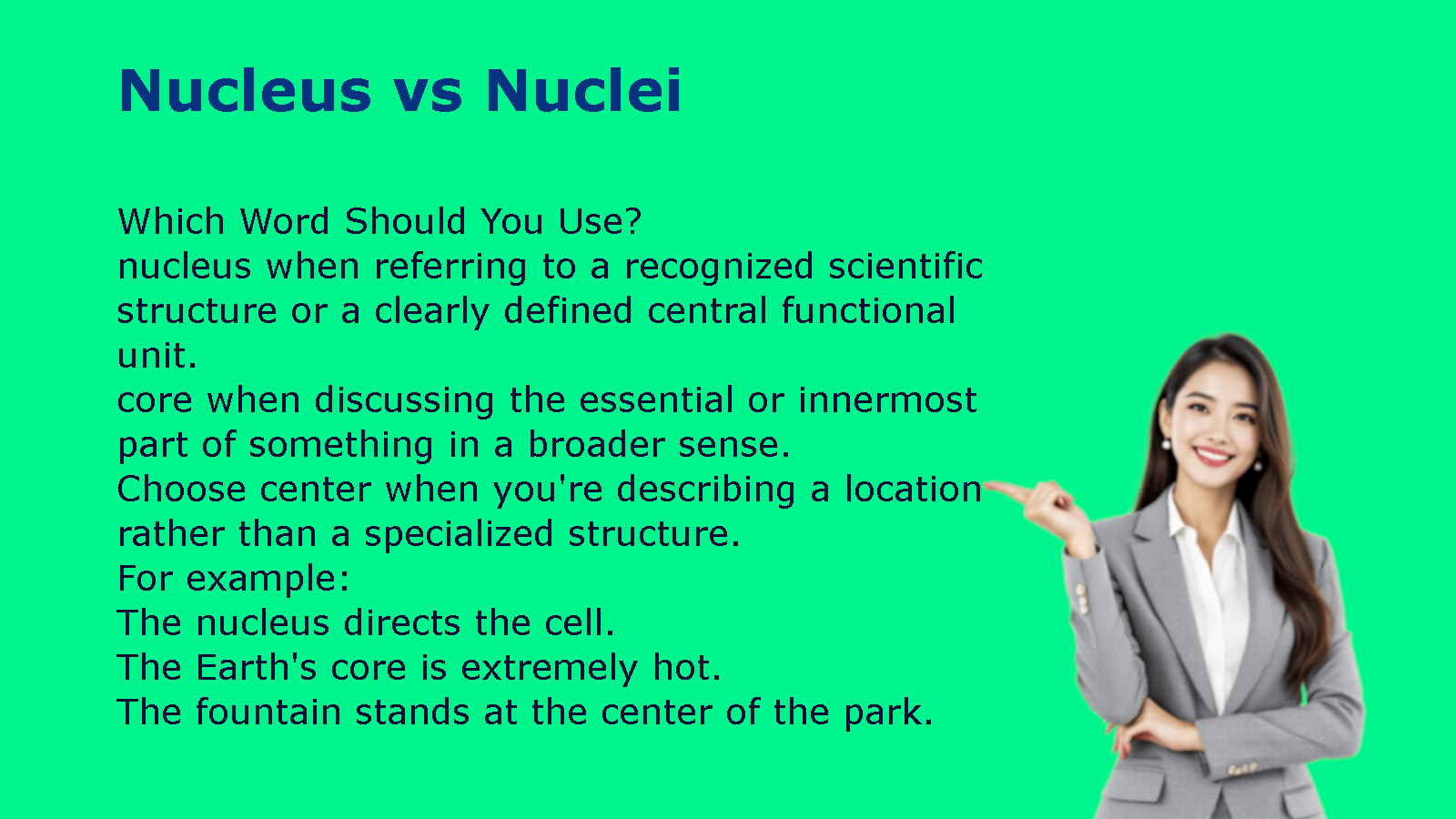
Which Word Should You Use?
nucleus when referring to a recognized scientific structure or a clearly defined central functional unit.
core when discussing the essential or innermost part of something in a broader sense.
Choose center when you’re describing a location rather than a specialized structure.
For example:
- The nucleus directs the cell.
- The Earth’s core is extremely hot.
- The fountain stands at the center of the park.
Words Related to Nucleus
Understanding words related to nucleus helps you recognize scientific terminology more easily. While these terms are connected, they don’t all mean the same thing.
Nuclear
Nuclear is the adjective form of nucleus. It describes something related to a nucleus, especially an atomic or cellular nucleus.
Examples:
- Nuclear membrane
- Nuclear DNA
- Nuclear energy
- Nuclear reaction
- Nuclear medicine
Nucleolus
The nucleolus is a small, dense structure located inside the nucleus of a eukaryotic cell. Its primary role is to produce ribosomal RNA (rRNA) and assemble ribosome components.
Key facts:
- Found inside the nucleus
- Not surrounded by its own membrane
- Essential for protein production
- Usually one to several nucleoli exist within a nucleus
Cytoplasm
The cytoplasm is the jelly-like substance that fills a cell outside the nucleus. It contains organelles, nutrients, proteins, and the fluid where many cellular reactions occur.
Chromosome
Chromosomes are long DNA molecules packaged with proteins inside the nucleus. Humans typically have 46 chromosomes, arranged into 23 pairs, in most body cells.
Genome
A genome is the complete set of genetic material in an organism. In eukaryotes, most of the genome resides inside the nucleus, though small amounts of DNA also exist in mitochondria and, in plants, chloroplasts.
Atom
In chemistry, the atom is the smallest unit of an element that retains its chemical properties. At its center lies the nucleus, which contains protons and neutrons.
Related Word Comparison
| Word | Meaning | Related to Nucleus? |
| Nuclear | Pertaining to a nucleus | ✅ Yes |
| Nucleolus | Structure inside the nucleus | ✅ Yes |
| Cytoplasm | Material surrounding the nucleus | ✅ Yes |
| Chromosome | DNA structure within the nucleus | ✅ Yes |
| Genome | Complete genetic material | ✅ Yes |
| Atom | Basic unit of matter containing a nucleus | ✅ Yes |
| Core | General central part | Sometimes |
| Center | Middle point or location | Sometimes |
Quick Memory Tricks for Nucleus vs. Nuclei
Grammar rules become easier to remember when you associate them with simple patterns.
Remember the Numbers
- One = Nucleus
- More than one = Nuclei
This is the most reliable rule.
Think About Other Latin Plurals
Several scientific words follow the same pattern.
| Singular | Plural |
| Nucleus | Nuclei |
| Radius | Radii |
| Fungus | Fungi |
| Stimulus | Stimuli |
| Alumnus | Alumni |
If you’ve already memorized one of these pairs, nucleus → nuclei feels much more natural.
Focus on the Ending
The endings provide a useful clue.
- -us usually signals the singular form.
- -i often signals the Latin plural.
Examples:
- Nucleus
- Radius
- Fungus
become:
- Nuclei
- Radii
- Fungi
Picture the Objects
Visualizing the concept can reinforce the grammar.
One Cell
│
└──► Nucleus
Several Cells
│
├─► Nucleus
──► Nucleus
Nucleus
└──► Nuclei
Practice With Simple Sentences
Repeating short examples helps build confidence.
- The cell has one nucleus.
- The tissue contains many nuclei.
- The atom has one nucleus.
- Scientists studied several atomic nuclei.
A few minutes of practice usually makes the distinction second nature.
Case Study: Why Using “Nuclei” Matters in Scientific Writing
Imagine two students submitting biology lab reports.
Student A
The microscope revealed several nucleus in the sample.
Although the sentence communicates the basic idea, the grammar is incorrect because several requires a plural noun.
Student B
The microscope revealed several nuclei in the sample.
This version follows accepted scientific terminology and standard English grammar.
The difference may seem small, but scientific writing values precision. Using the correct plural demonstrates familiarity with the subject and aligns with textbooks, research papers, and professional publications.
Quote About Scientific Precision
“Science advances through careful observation and precise language.”
That principle applies to grammar as much as it does to experiments. Choosing nucleus or nuclei correctly helps readers understand your meaning without confusion.
Frequently Asked Questions
Is nuclei singular or plural?
Nuclei is the plural form of nucleus. Use it whenever you’re referring to two or more nuclei.
Examples:
- Two nuclei
- Several nuclei
- Multiple nuclei
What is the plural of nucleus?
The standard plural is nuclei.
Although nucleuses appears in some dictionaries, nuclei is the preferred form in scientific, academic, and professional writing.
Can I say “nucleuses”?
Yes, nucleuses is recognized in general English. However, it is uncommon and rarely appears in scientific publications.
If you’re writing about biology, chemistry, physics, medicine, or anatomy, nuclei is the better choice.
Why is the plural nuclei instead of nucleuses?
The word nucleus comes from Latin. In Latin, many nouns ending in -us form their plural by changing the ending to -i.
English has preserved this pattern for many scientific terms.
How do you pronounce nuclei?
The standard American pronunciation is:
NOO-klee-eye
IPA:
/ˈnuː.kli.aɪ/
What is the difference between nucleus and nuclei in biology?
There is no difference in meaning.
The only difference is quantity:
- Nucleus refers to one cell nucleus.
- Nuclei refers to two or more cell nuclei.
Can one cell have multiple nuclei?
Yes. While most eukaryotic cells contain a single nucleus, some specialized cells naturally have multiple nuclei.
Examples include:
- Skeletal muscle fibers
- Osteoclasts
- Certain fungal cells
These cells are described as multinucleated.
What is the nucleus of an atom?
The atomic nucleus is the dense central region of an atom that contains:
- Protons
- Neutrons
It accounts for nearly all of the atom’s mass, while electrons occupy the surrounding electron cloud.
What are brain nuclei?
In neuroscience, brain nuclei are clusters of nerve cell bodies within the central nervous system.
Examples include:
- Caudate nucleus
- Red nucleus
- Dentate nucleus
- Suprachiasmatic nucleus
These structures help regulate movement, memory, sleep, sensory processing, and many other essential functions.
Is nucleus only used in biology?
No.
The word appears across many disciplines, including:
- Biology
- Chemistry
- Physics
- Medicine
- Anatomy
- Neuroscience
- Astronomy
- Geology
- Sociology
- Political science
It can also describe the central group or core of an organization, movement, or idea.
Common Expressions Using “Nucleus”
Although nucleus is a scientific term, it also appears in broader contexts.
Examples include:
- The nucleus of a research team
- The nucleus of a new business
- The nucleus of an idea
- The nucleus of a community
- The nucleus of a political movement
In each case, the word refers to the central or most influential part of a larger whole.
Key Takeaways: Nucleus vs. Nuclei
Choosing between nucleus and nuclei is easier than it first appears. Once you know that one is singular and the other is plural, the decision becomes automatic.
Here’s a quick recap:
- Nucleus is the singular form.
- Nuclei is the standard plural form.
- Both words refer to the same type of central structure. Only the number changes.
- Nuclei is the preferred plural in scientific and academic writing.
- The words appear in biology, chemistry, physics, astronomy, anatomy, medicine, and neuroscience.
- The plural follows the original Latin pattern, which is why nuclei replaces nucleuses in most professional contexts.
- Correct pronunciation is NOO-klee-us for nucleus and NOO-klee-eye for nuclei.
When in doubt, remember this simple rule:
| Quantity | Correct Word |
| One | Nucleus |
| Two or more | Nuclei |
Mastering this distinction improves your grammar and makes your scientific writing more accurate. Whether you’re writing a biology assignment, reading a research paper, or simply expanding your vocabulary, using nucleus and nuclei correctly helps you communicate with clarity and confidence.