Nebulas and nebulae are both correct plural forms of nebula, but they are used in different contexts. Nebulae is the traditional Latin plural commonly used in astronomy and scientific writing, while nebulas is the regular English plural that appears more often in general writing. When comparing Nebulas vs Nebulae, both spellings are correct, but nebulae is generally preferred in scientific contexts
The confusion comes from the fact that nebula has two accepted plural forms, but they aren’t always used in the same context. But here’s the kicker: choosing the right one can make your writing sound more accurate, especially in scientific, academic, or everyday communication.
The good news? The difference is easier to understand than you might think.
In this guide, you’ll learn the difference between Nebulas vs Nebulae, discover the plural of nebula, understand nebula meaning, compare nebulae vs nebulas, and see nebula examples in real sentences. You’ll also learn when to use nebulae, when to use nebulas, and which form is preferred in scientific writing versus general English.
By the end, you’ll know exactly which plural fits your context and how to use both forms confidently in your writing.
What Is a Nebula?
A nebula is a massive cloud of gas and dust floating through space. These clouds rank among the most fascinating objects in the universe because they often serve as the birthplace of new stars or the remnants of stars that have reached the end of their lives.
The word nebula comes from the Latin word for “mist,” “fog,” or “cloud.” Early astronomers used the term because these celestial objects appeared as fuzzy patches through primitive telescopes. As technology improved, scientists discovered that many of these hazy objects were enormous interstellar clouds composed primarily of hydrogen, helium, dust, and trace elements.
Today, astronomers classify nebulae into several categories based on how they form and what they contain.
Common Types of Nebulae
| Type | Description | Example |
| Emission Nebula | Glows because nearby stars ionize the surrounding gas. | Orion Nebula |
| Reflection Nebula | Reflects the light of nearby stars instead of producing its own. | Witch Head Nebula |
| Dark Nebula | Dense clouds that block light from stars behind them. | Horsehead Nebula |
| Planetary Nebula | Forms when a dying Sun-like star sheds its outer layers. | Ring Nebula |
| Supernova Remnant | Left behind after a massive star explodes. | Crab Nebula |
Why Nebulae Matter
Nebulae play a crucial role in astronomy because they reveal how stars and planetary systems evolve.
Scientists study nebulae to understand:
- Star formation
- Chemical composition of galaxies
- Life cycles of stars
- Cosmic dust and gas distribution
- The evolution of the Milky Way
Without nebulae, many of the universe’s stars—including our own Sun—would never have formed.
Nebulas vs. Nebulae: What’s the Difference?
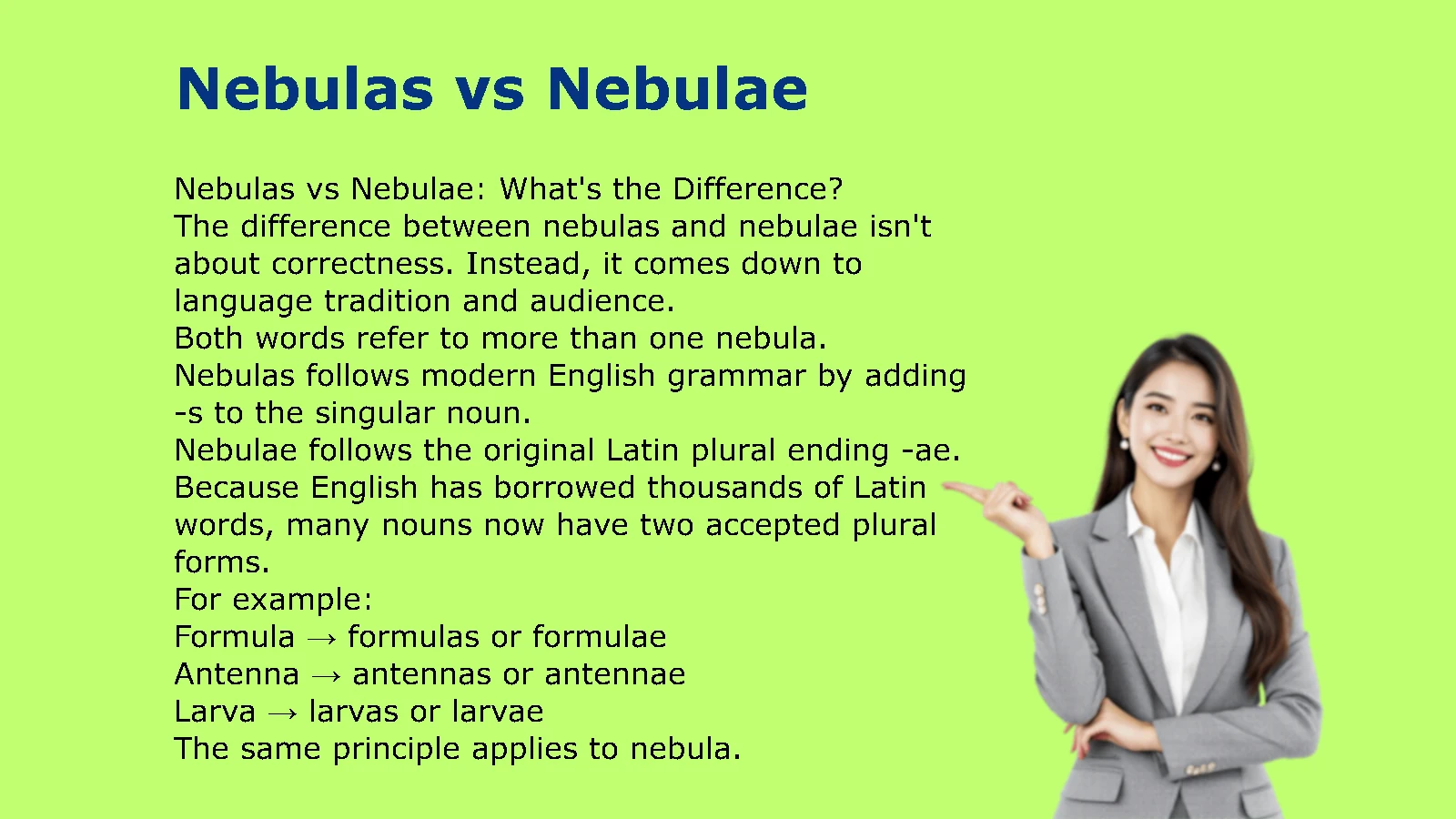
The difference between nebulas and nebulae isn’t about correctness. Instead, it comes down to language tradition and audience.
Both words refer to more than one nebula.
- Nebulas follows modern English grammar by adding -s to the singular noun.
- Nebulae follows the original Latin plural ending -ae.
Because English has borrowed thousands of Latin words, many nouns now have two accepted plural forms.
For example:
- Formula → formulas or formulae
- Antenna → antennas or antennae
- Larva → larvas or larvae
The same principle applies to nebula.
Quick Comparison
| Feature | Nebulas | Nebulae |
| Meaning | Plural of nebula | Plural of nebula |
| Grammar | English plural | Latin plural |
| Correct? | ✅ Yes | ✅ Yes |
| Common in everyday writing | Yes | Less common |
| Common in astronomy | Occasionally | Very common |
| Formality | Neutral | More formal and scientific |
Neither word changes the meaning. They simply reflect different linguistic traditions.
Is “Nebulas” Grammatically Correct?
Yes. Nebulas is completely grammatically correct.
English regularly adapts borrowed words by applying its own plural rules. Instead of preserving the original Latin ending, English often adds -s or -es, making words easier to pronounce and understand for modern readers.
Because of this natural evolution, dictionaries recognize nebulas as a valid plural.
You’ll frequently see nebulas in:
- Educational websites
- Science blogs
- Newspapers
- Children’s books
- General reference materials
- Popular science magazines
Many editors even recommend using nebulas when writing for a broad audience because readers recognize the standard English plural more quickly.
Example Sentences
- Several nebulas appeared in the telescope during the observation session.
- Astronomers photographed dozens of colorful nebulas across the Milky Way.
- The documentary explained how different nebulas create new stars.
Each sentence is grammatically correct.
Is “Nebulae” Grammatically Correct?
Absolutely.
In fact, nebulae remains the traditional plural used throughout astronomy.
Since nebula entered English from Latin, scholars originally preserved its Latin plural ending.
Singular:
Nebula
Traditional Latin plural:
Nebulae
Modern scientific literature continues to favor this form because it aligns with long-standing academic conventions.
You’ll commonly find nebulae in:
- Peer-reviewed astronomy journals
- University textbooks
- NASA publications
- Observatory websites
- Scientific conferences
- Professional astronomy lectures
Pronunciation
Many people hesitate because they’re unsure how to pronounce nebulae.
The most common pronunciation is:
neh-BYOO-lee
Some speakers pronounce it slightly differently depending on regional accent, but this version appears most frequently in educational settings.
Example Sentences
- The telescope captured images of several distant nebulae.
- These nebulae contain enormous quantities of hydrogen gas.
- Astronomers analyzed multiple planetary nebulae during the survey.
Notice how naturally the Latin plural fits within scientific writing.
Nebulas vs. Nebulae: Side-by-Side Comparison
| Feature | Nebulas | Nebulae |
| Singular Form | Nebula | Nebula |
| Meaning | More than one nebula | More than one nebula |
| Origin | Modern English | Classical Latin |
| Grammatical Form | English plural | Latin plural |
| Accepted by Dictionaries | Yes | Yes |
| Preferred in Scientific Writing | Sometimes | Usually |
| Preferred in General Writing | Often | Less often |
| Formal Tone | Neutral | More academic |
| Reader Familiarity | High | Moderate |
| Pronunciation Difficulty | Easy | Slightly harder |
At a Glance
| If you’re writing for… | Best Choice |
| General readers | Nebulas |
| Astronomy students | Nebulae |
| Scientific journals | Nebulae |
| School assignments | Either (follow your instructor’s preference) |
| Science blogs | Either, depending on tone |
When to Use “Nebulas”
Although nebulae dominates scientific literature, nebulas works perfectly well in many situations.
Choose nebulas when your goal is clarity rather than scientific tradition.
Best Situations
General Articles
Readers unfamiliar with Latin plurals usually understand nebulas immediately.
Example:
Modern telescopes can photograph hundreds of colorful nebulas across our galaxy.
Educational Content for Beginners
Science educators often simplify terminology for younger audiences.
Instead of introducing an unfamiliar Latin plural, they may write:
Different nebulas form in different ways.
News Reports
Journalists typically follow modern English style rather than classical grammar.
Example:
Scientists discovered two previously unknown nebulas using infrared imaging.
Blogs and Online Content
SEO-focused content often favors the simpler English plural because it matches how many readers naturally search.
For example, someone may search:
- colorful nebulas
- famous nebulas
- photos of nebulas
instead of using the Latin form.
When to Use “Nebulae”
If you’re writing within an academic or scientific setting, nebulae remains the stronger choice.
It reflects the terminology astronomers have used for generations.
Scientific Research
Researchers almost always write:
Planetary nebulae reveal the final evolutionary stages of Sun-like stars.
University Textbooks
Most astronomy textbooks continue using the Latin plural throughout their chapters.
Professional Presentations
Conference papers, observatory lectures, and scholarly publications almost always prefer nebulae because readers expect traditional scientific vocabulary.
Astronomy Organizations
Many observatories, research institutions, and university astronomy departments naturally use nebulae in articles, educational materials, and public outreach.
Why Do Two Plural Forms Exist?
English has borrowed words from dozens of languages over centuries. Latin contributed thousands of scientific, medical, legal, and academic terms.
Some borrowed nouns kept their original Latin plurals, while others gradually adopted regular English endings.
This process explains why both nebulas and nebulae exist today.
The Latin Pattern
Many Latin nouns ending in -a originally formed their plural by changing -a to -ae.
Examples include:
| Singular | Latin Plural |
| Nebula | Nebulae |
| Larva | Larvae |
| Vertebra | Vertebrae |
| Alga | Algae |
As English evolved, everyday speakers began applying standard English plural rules instead.
That created alternative forms such as:
- Nebulas
- Larvas
- Vertebras
- Algas
Some of these English plurals became common, while others remained rare because scientific communities continued favoring the Latin versions.
Why Both Forms Survive
Unlike many languages, English rarely eliminates older forms if people continue using them.
Instead, it often accepts both versions and lets context determine which sounds more natural.
That’s exactly what happened with nebulas and nebulae.
One follows modern English grammar. The other preserves a centuries-old Latin tradition. Both communicate the same meaning, and both remain grammatically correct today.
Words Similar to Nebulas vs. Nebulae
Nebulas vs. nebulae isn’t the only pair of words with two accepted plural forms. English has borrowed thousands of words from Latin and Greek over the centuries. Some kept their original plural endings, while others gradually adopted standard English plurals.
As a result, you’ll often see two correct plural forms for the same word. In many cases, the Latin plural appears more often in academic or scientific writing, while the English plural feels more natural in everyday communication.
The table below highlights some of the best-known examples.
| Singular | English Plural | Latin Plural | Most Common Today |
| Nebula | Nebulas | Nebulae | Both |
| Formula | Formulas | Formulae | Formulas |
| Larva | Larvas | Larvae | Larvae |
| Alga | Algas | Algae | Algae |
| Vertebra | Vertebras | Vertebrae | Vertebrae |
| Antenna | Antennas | Antennae | Depends on context |
| Curriculum | Curriculums | Curricula | Curricula |
| Memorandum | Memorandums | Memoranda | Both |
| Referendum | Referendums | Referenda | Referendums |
Context Matters More Than Grammar
Many people assume the Latin plural is always the “correct” choice. That’s a common misconception.
Modern dictionaries recognize many English plurals as equally correct. The better choice usually depends on who you’re writing for.
For example:
- A scientist writing a research paper will likely choose nebulae.
- A travel writer describing a planetarium exhibit might prefer nebulas.
- A fourth-grade science textbook may use whichever form the publisher’s style guide recommends.
The goal isn’t to sound more scholarly. It’s to communicate clearly.
Writing Tip: Match your vocabulary to your audience. Readers shouldn’t have to stop and decode familiar concepts because of unnecessarily formal language.
Examples of Nebulas and Nebulae in Sentences
Seeing words in context makes them much easier to understand. Both plural forms work correctly, although the surrounding content often hints at which one sounds more natural.
Examples Using “Nebulas”
These examples reflect general English usage.
- The telescope revealed several colorful nebulas near the edge of the galaxy.
- Students learned how different nebulas form during the science lesson.
- The documentary featured stunning images of distant nebulas.
- Astronomers continue discovering new nebulas with advanced space telescopes.
- Visitors admired photographs of famous nebulas from around the universe.
Notice how these sentences sound natural without requiring readers to know Latin grammar.
Examples Using “Nebulae”
These examples resemble the style found in astronomy textbooks and scientific publications.
- The survey identified dozens of emission nebulae within the Milky Way.
- Several planetary nebulae showed unusually complex structures.
- These nebulae contain ionized hydrogen that emits visible light.
- Researchers compared infrared observations of nearby nebulae.
- Massive nebulae provide the raw material needed for star formation.
The scientific tone fits naturally with the traditional plural.
Examples Comparing Both Forms
Sometimes the easiest way to understand the difference is to compare identical sentences.
| General English | Scientific Style |
| Several nebulas appeared in the image. | Several nebulae appeared in the image. |
| These nebulas contain gas and dust. | These nebulae contain gas and dust. |
| We studied famous nebulas in class. | We studied famous nebulae in class. |
The meaning never changes. Only the style does.
Incorrect Usage Examples
Although both plurals are correct, writers still make mistakes when using them.
Mistake: Treating Nebulae as Singular
❌ The nebulae is visible tonight.
✅ The nebula is visible tonight.
✅ The nebulae are visible tonight.
Mistake: Mixing Singular and Plural
❌ One of the most famous nebulae is the Orion Nebula.
✅ One of the most famous nebulas is the Orion Nebula.
or
✅ One of the most famous nebulae is the Orion Nebulae (incorrect because Orion Nebula is singular)
The correct sentence is:
✅ One of the most famous nebulae is the Orion Nebula if referring to the group and then naming one singular object.
Mistake: Assuming One Form Is Wrong
Many people write comments like:
❌ “Nebulas isn’t a real word.”
That statement is inaccurate.
Modern dictionaries recognize nebulas as a standard English plural.
Likewise:
❌ “Nebulae is outdated.”
That isn’t true either.
Professional astronomers continue using nebulae extensively.
Common Mistakes People Make
Even experienced writers occasionally second-guess themselves when choosing between nebulas and nebulae.
Fortunately, the mistakes are easy to avoid.
Thinking Only Nebulae Is Correct
Because astronomy often uses Latin terminology, many readers believe nebulae is the only acceptable plural.
It isn’t.
Most modern dictionaries include both plural forms.
Believing Nebulas Sounds Wrong
Some writers avoid nebulas because they assume it sounds informal.
In reality, English has gradually accepted many anglicized plurals.
Using nebulas doesn’t make your writing incorrect.
Ignoring Your Audience
Imagine explaining astronomy to elementary school students.
Using several unfamiliar Latin plurals in every paragraph may distract readers from the lesson itself.
On the other hand, replacing every scientific term in a university research paper with everyday English could make the writing feel less precise.
Always consider who will read your work.
Mispronouncing Nebulae
People sometimes pronounce nebulae exactly like nebula.
The more common pronunciation is:
neh-BYOO-lee
Learning the pronunciation helps when discussing astronomy aloud.
Switching Between Forms Without Reason
Choose one style and stay consistent.
For example:
❌ These nebulas formed millions of years ago. Later the nebulae became brighter.
Unless you’re intentionally discussing both forms, consistency improves readability.
Why Scientists Usually Prefer “Nebulae”
Scientific language values consistency. Once a term becomes established in research literature, it tends to remain stable for decades.
That’s one reason astronomers still prefer nebulae.
The tradition stretches back centuries, when scientific works were commonly written in Latin.
Even after English became the dominant language of science, researchers retained many classical plurals.
Examples include:
- Nebulae
- Larvae
- Algae
- Vertebrae
Using these traditional forms creates consistency across textbooks, journal articles, and research databases.
Case Study: Professional Astronomy Publications
Organizations such as NASA, the European Space Agency (ESA), university astronomy departments, and peer-reviewed astronomy journals frequently use nebulae when describing celestial objects.
For example, educational articles discussing star formation commonly refer to:
- planetary nebulae
- emission nebulae
- reflection nebulae
- dark nebulae
Because generations of astronomers have written this way, the terminology remains familiar within the scientific community.
“Astronomy depends on precise language. Consistent terminology helps researchers communicate clearly across countries and generations.”
How Major Dictionaries Treat the Two Words
One of the easiest ways to settle grammar questions is to consult trusted dictionaries.
Leading dictionaries agree that both plurals are correct.
Here’s how they generally present the word.
| Dictionary | Nebulas | Nebulae |
| Merriam-Webster | ✔ Accepted | ✔ Accepted |
| Oxford English Dictionary | ✔ Accepted | ✔ Accepted |
| Cambridge Dictionary | ✔ Accepted | ✔ Accepted |
| Collins Dictionary | ✔ Accepted | ✔ Accepted |
| Dictionary.com | ✔ Accepted | ✔ Accepted |
While wording varies slightly, the overall message remains the same.
Both forms belong to standard English.
Some dictionaries list nebulae first because of its historical origin. Others mention nebulas first because it’s easier for modern readers to recognize.
Neither listing implies that the other form is incorrect.
Style Guide Recommendations
Grammar tells you what’s correct. Style guides help you decide what’s appropriate.
That’s an important distinction.
Both nebulas and nebulae are grammatically correct. However, different writing situations call for different choices.
General Writing
For newspapers, blogs, magazines, and websites aimed at the public, nebulas often improves readability.
Readers immediately recognize the familiar English plural.
Academic Writing
University essays, astronomy textbooks, and scholarly articles generally favor nebulae.
Using the traditional scientific plural aligns with the conventions readers expect.
Scientific Publications
Peer-reviewed journals almost always use nebulae because the term matches decades of published research.
Maintaining consistent terminology helps scientists compare studies across disciplines.
Educational Materials
Educational publishers choose whichever form best matches the intended audience.
For younger students, nebulas may simplify reading.
For advanced astronomy courses, nebulae becomes more common.
Online Content and SEO
Search behavior varies.
Some users search for:
- nebulae
- what are nebulae
- types of nebulae
Others type:
- nebulas
- pictures of nebulas
- how nebulas form
When writing online, it’s often beneficial to use both forms naturally throughout the article. Doing so improves clarity while matching different search habits without sounding forced.
Quick Decision Guide
| Writing Situation | Recommended Form |
| Blog post | Nebulas or both |
| News article | Nebulas |
| School assignment | Either |
| Astronomy textbook | Nebulae |
| Scientific journal | Nebulae |
| Research paper | Nebulae |
| Educational website | Either, based on audience |
Quick Rules to Remember About Nebulas vs. Nebulae
After exploring the grammar, history, and usage of both words, the decision becomes much simpler. You don’t have to memorize complex Latin rules. Instead, keep a few practical guidelines in mind.
Choose “Nebulas” When:
- You’re writing for a general audience.
- You want to use standard English grammar.
- Readability is your top priority.
- You’re writing blogs, news articles, or educational content for beginners.
- Your style guide prefers anglicized plurals.
Choose “Nebulae” When:
- You’re writing an astronomy paper.
- You’re following scientific or academic conventions.
- You’re quoting research or textbooks.
- Your audience expects traditional scientific terminology.
- You want to match the language commonly used by astronomers.
Remember These Simple Facts
- ✅ Nebula is the singular form.
- ✅ Nebulas is a correct English plural.
- ✅ Nebulae is a correct Latin plural.
- ✅ Both appear in major dictionaries.
- ✅ Neither changes the meaning of the word.
A Simple Memory Trick
If you’re ever unsure which form to use, think about your audience.
- General readers usually find nebulas easier to recognize.
- Scientists and astronomy students are more accustomed to nebulae.
Here’s another easy way to remember it:
English audience? Think “nebulas.”
Scientific audience? Think “nebulae.”
That simple distinction works in nearly every situation.
Case Study: How Word Choice Changes with the Audience
Imagine three people writing about the same astronomical object.
Scenario 1: A Science Journalist
A journalist writing for a newspaper might say:
The telescope captured breathtaking images of several colorful nebulas, giving readers a glimpse into regions where new stars are born.
The sentence feels natural and approachable.
Scenario 2: A University Professor
An astronomy professor preparing lecture notes might write:
These emission nebulae consist primarily of ionized hydrogen illuminated by nearby massive stars.
The scientific audience expects technical vocabulary, so nebulae fits perfectly.
Scenario 3: A Museum Exhibit
A museum creating displays for families could choose either form depending on its style guide.
For younger visitors:
Explore giant nebulas where stars begin their lives.
For visitors interested in astronomy:
Discover the spectacular nebulae scattered throughout our galaxy.
Neither choice is wrong. The intended audience shapes the decision.
Common Questions About Nebulas vs. Nebulae
Is “nebulas” a real word?
Yes. Nebulas is an accepted English plural of nebula. Major dictionaries recognize it alongside nebulae.
Is “nebulae” more correct than “nebulas”?
No.
Nebulae isn’t more correct. It’s simply the traditional Latin plural. Nebulas follows standard English pluralization rules, making both forms grammatically correct.
Which plural do astronomers use most often?
Professional astronomers usually prefer nebulae.
You’ll see it frequently in research papers, astronomy textbooks, observatory websites, and scientific presentations.
Can I use “nebulas” in school assignments?
Yes.
Unless your teacher specifically requests scientific terminology, nebulas is perfectly acceptable.
If you’re writing an advanced astronomy paper, however, nebulae may better match academic conventions.
Why does English allow both forms?
English has borrowed words from many languages throughout its history.
Some borrowed words keep their original plural forms, while others adopt English endings. In many cases, both versions remain in use because neither has replaced the other completely.
Do other scientific words have two plural forms?
Yes. Many scientific and academic terms follow the same pattern.
Examples include:
| Singular | English Plural | Traditional Plural |
| Formula | Formulas | Formulae |
| Antenna | Antennas | Antennae |
| Memorandum | Memorandums | Memoranda |
| Referendum | Referendums | Referenda |
| Curriculum | Curriculums | Curricula |
As with nebulas vs. nebulae, context often determines which form sounds most natural.
How do you pronounce “nebulae”?
The most common pronunciation is:
neh-BYOO-lee
Although accents may vary slightly, this pronunciation is widely accepted in educational and scientific settings.
Is “nebulae” outdated?
No.
Some people assume Latin plurals have become obsolete, but that’s not the case.
Modern astronomers, universities, and scientific organizations continue using nebulae because it has long been the standard term in the field.
Can I use both forms in the same article?
Yes, provided you do so intentionally.
For example, an article discussing grammar might compare nebulas and nebulae, as this one does.
However, if you’re writing about astronomy rather than language, it’s usually better to choose one form and use it consistently.
Does American English prefer “nebulas” or “nebulae”?
American English accepts both.
General publications often lean toward nebulas because it follows standard English grammar, while scientific publications continue to favor nebulae.
The preference depends more on the publication’s style than on regional English.
Expert Insight: Why This Difference Still Matters
Grammar isn’t just about following rules. It’s also about choosing words that help readers understand your message.
Writers sometimes assume that using the more technical form automatically makes their work stronger. In reality, effective writing depends on clarity.
If you’re writing for astronomy professionals, nebulae demonstrates familiarity with scientific conventions.
If you’re explaining space to young learners or casual readers, nebulas may feel more welcoming.
As the renowned science communicator Carl Sagan once said:
“Science is a way of thinking much more than it is a body of knowledge.”
That idea applies to writing as well. The best word is the one that communicates your ideas clearly to your audience.
Nebulas vs. Nebulae: Final Comparison
Before choosing between the two forms, review the key differences one last time.
| Feature | Nebulas | Nebulae |
| Meaning | More than one nebula | More than one nebula |
| Grammar | English plural | Latin plural |
| Correctness | Correct | Correct |
| Dictionary Status | Accepted | Accepted |
| Everyday Usage | Very common | Less common |
| Scientific Writing | Occasionally used | Preferred |
| Reader Familiarity | Higher | Moderate |
| Best For | General audiences | Academic and scientific audiences |
Key Takeaways
If you only remember a few points about nebulas vs. nebulae, make them these:
- Nebula is the singular form.
- Nebulas and nebulae are both correct plural forms.
- Nebulae comes from the original Latin plural.
- Nebulas follows modern English grammar.
- Scientists usually prefer nebulae.
- General readers often find nebulas more familiar.
- Major dictionaries recognize both forms.
- Your audience should guide your choice.
Ultimately, the debate over nebulas vs. nebulae isn’t about right versus wrong. It’s about selecting the form that best fits your readers and your purpose. Whether you’re writing a science article, preparing a classroom assignment, or simply satisfying your curiosity about the English language, understanding both plurals allows you to communicate with confidence and precision.