Discreet vs Discrete can be confusing because the words look similar but have different meanings. Discreet means careful, private, or tactful, while discrete means separate, distinct, or individual. Understanding the difference helps you choose the correct word in every context.
The confusion often begins because people search for discreet meaning, discrete meaning, discreet pronunciation, discrete pronunciation, and the difference between discreet and discrete without realizing that choosing the wrong word can completely change the message they’re trying to convey. And here’s the kicker: even experienced writers mix them up.
The good news? The distinction is easier than you might think.
In this guide, you’ll learn the difference between Discreet vs Discrete, discover the correct usage of discreet and discrete, understand when to use discreet, when to use discrete, and see plenty of discreet vs discrete examples in real sentences. You’ll also learn simple memory tricks to avoid this common word confusion and use each word with confidence.
By the end, you’ll know exactly which word fits your context and never second-guess Discreet vs Discrete again.
Discreet vs. Discrete: The Key Difference
Although discreet and discrete differ by only one letter, their meanings are unrelated in modern English.
| Word | Meaning | Used For | Example |
| Discreet | Careful, tactful, and respectful of privacy | People, actions, conversations | She was discreet about the confidential project. |
| Discrete | Separate, individual, or distinct | Objects, ideas, numbers, categories | The report contains three discrete sections. |
The easiest way to remember the difference is this:
- Discreet relates to secrets, privacy, and tact.
- Discrete relates to separate parts or individual units.
Even though these words share similar spelling, they aren’t interchangeable. Choosing the wrong one can confuse readers or make your writing appear less polished.
Quick Comparison
| Feature | Discreet | Discrete |
| Part of Speech | Adjective | Adjective |
| Main Idea | Careful and private | Separate and distinct |
| Refers To | People or behavior | Things, groups, numbers |
| Common Fields | Business, healthcare, customer service | Mathematics, science, computing |
| Opposite | Indiscreet | Continuous |
Discreet Meaning
What Does Discreet Mean?
The adjective discreet describes someone who behaves with care, good judgment, and sensitivity. A discreet person knows when to keep information private and how to avoid unnecessary attention.
Being discreet doesn’t necessarily mean hiding something dishonest. Instead, it often reflects professionalism, respect, and maturity.
For example:
- A lawyer keeps client information discreet.
- A doctor discusses medical records discreetly.
- A manager handles employee concerns discreetly.
In each case, discretion protects privacy and builds trust.
Definition
Discreet means:
Careful in speech or actions, especially to avoid embarrassment or revealing confidential information.
Common ideas associated with discreet include:
- Privacy
- Tact
- Diplomacy
- Confidentiality
- Professionalism
- Good judgment
Pronunciation
Discreet
IPA: /dɪˈskriːt/
It has two syllables:
dis-CREET
The stress falls on the second syllable.
Part of Speech
Discreet functions only as an adjective.
Examples:
- a discreet employee
- discreet behavior
- discreet conversation
- discreet investigation
Origin and Etymology
The word discreet traces back to the Latin word discretus, meaning separated or distinguished.
During the Middle English period, the meaning gradually shifted toward wise judgment and careful behavior. Over time, English developed two separate spellings—discreet and discrete—each taking on its own distinct meaning.
Although they originated from the same Latin root, centuries of language evolution gave each word a specialized purpose.
Common Contexts Where “Discreet” Is Used
You’ll usually encounter discreet when discussing people, communication, or situations involving privacy.
Common examples include:
Professional Settings
Businesses value discreet employees because they protect confidential information.
Examples include:
- Human Resources
- Legal firms
- Banks
- Healthcare providers
- Government agencies
Personal Relationships
People appreciate friends who remain discreet about personal matters.
Examples:
- family discussions
- financial struggles
- relationship advice
- private celebrations
Customer Service
Luxury brands often advertise discreet service, meaning staff provide assistance without disturbing guests.
Examples include:
- private entrances
- confidential consultations
- personalized service
- VIP experiences
Healthcare
Medical professionals must remain discreet while handling sensitive patient information.
Examples include:
- discussing diagnoses
- reviewing medical records
- scheduling appointments
- counseling sessions
Hospitality
Hotels frequently promise discreet accommodations for celebrities, executives, and guests seeking privacy.
Synonyms of Discreet
Although no synonym perfectly replaces discreet in every context, these words often carry similar meanings.
| Synonym | Best Used When |
| Careful | General situations |
| Tactful | Sensitive conversations |
| Diplomatic | Conflict resolution |
| Judicious | Wise decision-making |
| Confidential | Privacy-related matters |
| Reserved | Personal behavior |
| Circumspect | Formal writing |
| Prudent | Making wise choices |
| Thoughtful | Considering others |
| Cautious | Avoiding unnecessary risks |
Antonyms of Discreet
These words express the opposite idea.
- Indiscreet
- Careless
- Reckless
- Thoughtless
- Loud
- Blunt
- Inconsiderate
- Impulsive
- Irresponsible
Example:
❌ He was indiscreet and shared confidential documents.
Discrete Meaning
What Does Discrete Mean?
Unlike discreet, the adjective discrete describes something that exists as an individual unit instead of forming part of a continuous whole.
Think of separate puzzle pieces. Each piece exists independently, making every piece discrete.
This meaning appears frequently in technical subjects like mathematics, computer science, engineering, and statistics.
Definition
Discrete means:
Individually separate, distinct, or disconnected from other elements.
It focuses on separation rather than privacy.
Pronunciation
Discrete
IPA: /dɪˈskriːt/
Interestingly, discrete and discreet are pronounced exactly the same.
This identical pronunciation explains why they’re so often confused.
Part of Speech
Like discreet, discrete is also an adjective.
Examples:
- discrete variables
- discrete categories
- discrete signals
- discrete components
Origin and Etymology
Discrete also comes from the Latin word discretus, meaning separated.
Unlike discreet, however, discrete preserved the original idea of separation.
Today, its meaning remains closely connected to distinct parts, independent units, and non-continuous values.
Common Contexts Where “Discrete” Is Used
Mathematics
One of the most common uses appears in mathematics.
Examples include:
- discrete numbers
- discrete probability
- discrete functions
- discrete variables
- discrete mathematics
Unlike continuous values, discrete values can only take specific numbers.
For example:
- Number of students in a classroom
- Number of books on a shelf
- Number of cars in a parking lot
You can’t have 12.5 students, making the variable discrete.
Computer Science
Computers often process information in discrete units.
Examples include:
- discrete algorithms
- discrete states
- discrete memory addresses
- discrete logic
Statistics
Researchers classify many datasets as discrete.
Examples:
- survey responses
- number of purchases
- goals scored
- customer complaints
Engineering
Engineers regularly refer to:
- discrete circuits
- discrete components
- discrete sensors
- discrete systems
Each component performs a specific function while remaining physically separate.
Scientific Research
Scientists divide complex systems into discrete categories for easier analysis.
Examples include:
- species classification
- chemical groups
- geological layers
- biological populations
Synonyms of Discrete
| Synonym | Meaning |
| Separate | Not joined together |
| Distinct | Clearly different |
| Individual | Existing alone |
| Independent | Operating separately |
| Detached | Not connected |
| Isolated | Standing alone |
| Independent | Self-contained |
| Unconnected | Not linked |
| Divided | Split into parts |
Antonyms of Discrete
- Continuous
- Connected
- Unified
- Integrated
- Combined
- Blended
- Joined
- Linked
Example:
A continuous line has no discrete breaks.
Discreet vs. Discrete Comparison Table
The following table summarizes the differences between discreet and discrete at a glance.
| Feature | Discreet | Discrete |
| Meaning | Careful, tactful, private | Separate, distinct, individual |
| Focus | Behavior and confidentiality | Independent objects or values |
| Used With | People, conversations, actions | Numbers, objects, systems |
| Common Fields | Business, healthcare, law | Mathematics, computing, science |
| Related Idea | Privacy | Separation |
| Opposite | Indiscreet | Continuous |
| Example | She remained discreet. | The graph contains discrete values. |
| Common Mistake | Used instead of discrete | Used instead of discreet |
When to Use “Discreet”
Choosing discreet becomes easy once you recognize situations involving privacy, professionalism, or careful behavior. If the focus is on how someone acts rather than how things are organized, discreet is almost always the correct choice.
Use “Discreet” When Talking About Privacy
Perhaps the most common use of discreet involves protecting confidential information. Whether you’re discussing personal matters, financial records, or sensitive business details, this word emphasizes careful handling and respect for privacy.
Examples include:
- A therapist remains discreet during counseling sessions.
- The company promised a discreet investigation.
- Staff handled the complaint in a discreet manner.
People trust professionals who know how to keep information private without drawing unnecessary attention.
Use “Discreet” for Tactful Communication
Sometimes the goal isn’t secrecy but kindness. A discreet person chooses words carefully, especially when discussing delicate topics.
For example, a manager delivering difficult feedback may speak discreetly to preserve an employee’s dignity. Likewise, a friend offering advice often exercises discretion by avoiding judgmental language.
This thoughtful approach strengthens relationships and reduces misunderstandings.
Use “Discreet” to Avoid Drawing Attention
Sometimes discretion has nothing to do with secrets. Instead, it simply means acting in a quiet, unobtrusive way.
For example:
- Security officers may provide discreet protection for a public figure without making their presence obvious.
- Hotel staff often offer discreet service to guests who value privacy.
- A photographer may capture candid moments while remaining discreet.
In each example, the goal is to avoid unnecessary attention while still completing the task effectively.
Use “Discreet” in Professional Settings
Many industries depend on discretion because employees regularly handle confidential information.
Examples include:
- Human resources departments
- Law firms
- Banks
- Medical offices
- Government agencies
- Financial consulting firms
In these environments, being discreet isn’t just appreciated—it is often an ethical or legal responsibility.
Quote: “Discretion is the better part of valor.” — William Shakespeare
Although Shakespeare used the word discretion, the idea closely relates to acting wisely and carefully before speaking or taking action.
When to Use “Discrete”
While discreet describes behavior, discrete describes things that exist independently. If something can be separated into individual units without losing its identity, discrete is usually the correct word.
Use “Discrete” for Separate Objects
Many everyday items exist as separate units rather than continuous wholes.
Examples include:
- Three discrete buildings on a property
- Five discrete projects assigned to different teams
- Several discrete departments within a company
- Independent software modules
Although these items may belong to the same organization, they remain separate from one another.
Use “Discrete” in Mathematics
One of the most common technical uses appears in mathematics.
A discrete variable can only take specific, countable values.
Examples include:
| Discrete Variable | Possible Values |
| Number of students | 20, 21, 22 |
| Number of pets | 0, 1, 2 |
| Dice roll | 1–6 |
| Goals scored | 0, 1, 2, 3 |
Notice that fractions usually don’t make sense here. You can’t have 2.7 dogs or 14.3 employees.
By contrast, continuous variables can take any value within a range, such as height, weight, temperature, or time.
Use “Discrete” in Statistics
Statisticians classify data into different categories.
Discrete data consists of countable observations.
Examples include:
- Number of customers
- Number of emails received
- Defective products
- Survey responses
- Website purchases
- Books sold
This type of data differs from continuous measurements like rainfall or body weight.
Use “Discrete” in Computer Science
Computer science relies heavily on discrete concepts because computers process information as individual units.
Examples include:
- Discrete algorithms
- Discrete logic
- Discrete memory addresses
- Discrete event simulation
- Discrete data structures
In programming, information is often broken into separate elements that computers can process efficiently.
Use “Discrete” in Engineering
Electrical and mechanical engineers frequently use the word when discussing components that operate independently.
Examples include:
- Discrete transistors
- Discrete circuits
- Discrete sensors
- Discrete control systems
Instead of one integrated unit, each component performs its own function.
Use “Discrete” in Scientific Research
Researchers often divide complex systems into discrete categories to simplify analysis.
Examples include:
- Species classifications
- Geological layers
- Population groups
- Experimental treatments
- Chemical compounds
Keeping categories discrete helps prevent overlap and improves the accuracy of research findings.
Discreet vs. Discrete in Grammar
Although these words have different meanings, they share several grammatical characteristics.
Both Words Are Adjectives
Neither word functions as a noun or verb.
Instead, they describe nouns.
Examples:
- A discreet assistant
- A discrete category
- A discreet conversation
- A discrete measurement
Common Sentence Patterns
Before the Noun
- a discreet employee
- a discrete variable
- a discreet meeting
- a discrete signal
After Linking Verbs
- The lawyer was discreet.
- The data remained discrete.
- Her response seemed discreet.
- The components are discrete.
Can They Be Used Interchangeably?
No.
Although they sound identical, replacing one with the other changes the meaning completely.
Compare these sentences:
❌ The doctor remained discrete.
✔ The doctor remained discreet.
❌ The graph contains discreet values.
✔ The graph contains discrete values.
Discreet vs. Discrete Pronunciation
One reason people confuse these words is that they are pronounced exactly the same.
| Word | IPA | Pronunciation |
| Discreet | /dɪˈskriːt/ | dis-CREET |
| Discrete | /dɪˈskriːt/ | dis-CREET |
Because pronunciation offers no clue, understanding the context becomes essential.
Syllable Breakdown
Both words contain two syllables.
Dis-creet
Dis-crete
Stress falls on the second syllable in both cases.
Why Spelling Matters
English contains many homophones—words that sound alike but have different meanings and spellings.
Other examples include:
| Word Pair | Difference |
| Their / There | Possession vs. Place |
| Principle / Principal | Rule vs. Person |
| Compliment / Complement | Praise vs. Complete |
| Affect / Effect | Verb vs. Noun (most common use) |
| Brake / Break | Stop vs. Separate |
Discreet and discrete belong to this same category.
Discreet vs. Discrete Examples
The easiest way to master these words is through context.
Everyday Examples
Discreet
- She gave a discreet smile.
- Please be discreet about the surprise party.
- The receptionist handled the issue discreetly.
- He remained discreet during the negotiation.
- Their conversation stayed discreet.
Discrete
- The museum contains five discrete galleries.
- The report divides the project into discrete phases.
- Researchers examined three discrete populations.
- The machine contains discrete components.
- The software stores information in discrete records.
Business Examples
Discreet
- Our advisors provide discreet financial planning.
- The HR department conducted a discreet investigation.
- Executives requested discreet transportation.
- Customer complaints were handled discreetly.
Discrete
- The company manages three discrete product lines.
- Marketing divided customers into discrete segments.
- Each office operates as a discrete business unit.
- Manufacturing occurs in discrete stages.
Academic Examples
Discreet
- Researchers remained discreet while interviewing participants.
- Faculty handled student records discreetly.
Discrete
- Discrete mathematics supports computer science.
- The experiment analyzed discrete variables.
- The sample consisted of discrete age groups.
- Data appeared in discrete intervals.
Technology Examples
Discreet
- Cybersecurity experts handled the breach discreetly.
- Engineers kept the prototype discreet until launch.
Discrete
- The processor performs discrete operations.
- The simulation models discrete events.
- The application stores information in discrete objects.
Discreet in a Sentence
Below are examples showing how discreet works in different situations.
- She remained discreet during the meeting.
- Please be discreet when discussing salaries.
- The attorney gave discreet legal advice.
- Our concierge provides discreet assistance.
- He asked a discreet question.
- The investigator handled the case discreetly.
- Nurses remain discreet with patient records.
- She offered discreet support.
- Security staff maintained a discreet presence.
- The accountant treated financial information discreetly.
- Their conversation stayed discreet.
- The CEO appreciated discreet employees.
- Parents answered the child’s question discreetly.
- Reporters respected the family’s request for discreet coverage.
- The counselor responded with discreet professionalism.
- The assistant arranged a discreet appointment.
- Guests appreciated the hotel’s discreet service.
- The company promised discreet shipping.
- He quietly made a discreet exit.
- She handled the disagreement in a discreet manner.
Discrete in a Sentence
These examples demonstrate how discrete refers to separate or distinct things.
- The graph contains discrete values.
- The company operates through discrete divisions.
- Researchers identified discrete populations.
- The software stores discrete records.
- Engineers tested each discrete component.
- The survey measured discrete categories.
- The algorithm processes discrete events.
- Students learned about discrete mathematics.
- The project contains discrete milestones.
- Every chapter discusses a discrete topic.
- The model separates information into discrete states.
- Scientists observed discrete changes.
- The laboratory analyzed discrete samples.
- The presentation covered discrete issues.
- Each machine functions as a discrete unit.
- The system processes discrete signals.
- Researchers counted discrete observations.
- Data appears in discrete intervals.
- The network includes discrete devices.
- The report organizes findings into discrete sections.
Common Mistakes People Make
Even experienced writers occasionally confuse discreet and discrete because the words look and sound so similar.
Here are the mistakes that appear most often.
| Incorrect | Correct | Why? |
| Please remain discrete. | Please remain discreet. | Refers to careful behavior. |
| These are discreet categories. | These are discrete categories. | Categories are separate units. |
| The lawyer stayed discrete. | The lawyer stayed discreet. | A person’s conduct is discreet. |
| The graph shows discreet values. | The graph shows discrete values. | Mathematical values are discrete. |
One useful proofreading tip is to replace the word with private or separate:
- If private fits, choose discreet.
- If separate fits, choose discrete.
That simple substitution catches most errors before they reach the final draft.
How to Remember the Difference
Learning a reliable memory trick makes this word pair much easier to use correctly.
The “EE” Memory Trick
Notice that discrEEt contains two Es together.
Think of:
- EE = keep everything enclosed
- EE = keep everything secret
If privacy or confidentiality is involved, discreet is the correct choice.
The “T” in Discrete
Think of the final T as standing for things.
Discrete = separate things.
If you’re describing individual items, categories, numbers, or components, choose discrete.
Another simple reminder is this:
- Discreet = Don’t Repeat Secrets.
- Discrete = Distinct Pieces.
These quick associations are easy to remember and work well in everyday writing.
Discreet vs. Discrete in Academic Writing
Academic writing demands precision. Choosing discreet when you mean discrete—or vice versa—can undermine your credibility, especially in research papers, technical reports, or scholarly publications.
Because the two words are homophones, spell-check software usually won’t flag the mistake. That’s why understanding the context is far more important than relying on automated proofreading tools.
Using “Discreet” in Academic Writing
Use discreet when describing people, communication, or actions involving confidentiality, sensitivity, or tact.
Examples include:
- Researchers remained discreet while conducting confidential interviews.
- The ethics committee required discreet handling of participant information.
- The counselor responded in a discreet and professional manner.
- University staff treated student records discreetly.
In these examples, the emphasis is on careful behavior, not separation.
Using “Discrete” in Academic Writing
Use discrete when discussing separate units, categories, variables, or measurable values.
Examples include:
- The study examined discrete variables.
- Data were grouped into discrete categories.
- Researchers analyzed discrete time intervals.
- The model consists of several discrete components.
Fields where discrete frequently appears include:
- Mathematics
- Statistics
- Computer science
- Engineering
- Physics
- Economics
- Data science
- Artificial intelligence
Academic Writing Tips
Before submitting your paper, ask yourself one simple question:
Am I describing careful behavior or separate things?
If you’re describing careful behavior, choose discreet.
If you’re describing individual units, choose discrete.
That single question eliminates most errors.
Discreet vs. Discrete in Business Writing
Strong business communication depends on accuracy and clarity. Misusing similar-looking words can distract readers and weaken your message.
Fortunately, distinguishing between discreet and discrete becomes straightforward once you focus on the context.
When Businesses Use “Discreet”
Many organizations promise discretion because customers value privacy.
Examples include:
- Law firms
- Financial advisors
- Healthcare providers
- Executive search firms
- Luxury hotels
- Wealth management companies
Typical phrases include:
- discreet consultation
- discreet investigation
- discreet customer service
- discreet packaging
- discreet delivery
- discreet support
Example:
Our team provides discreet financial planning tailored to your goals.
When Businesses Use “Discrete”
Businesses also organize operations into discrete departments or systems.
Examples include:
- discrete product lines
- discrete software modules
- discrete manufacturing stages
- discrete customer segments
- discrete business units
Example:
The organization divided the project into four discrete phases.
Here, each phase remains separate while contributing to the overall project.
Business Writing Checklist
Use this quick checklist before publishing emails, reports, proposals, or marketing materials.
| Question | Correct Word |
| Does it involve privacy? | Discreet |
| Is someone acting tactfully? | Discreet |
| Are you describing separate parts? | Discrete |
| Are you discussing countable values? | Discrete |
| Is confidentiality important? | Discreet |
| Are independent categories involved? | Discrete |
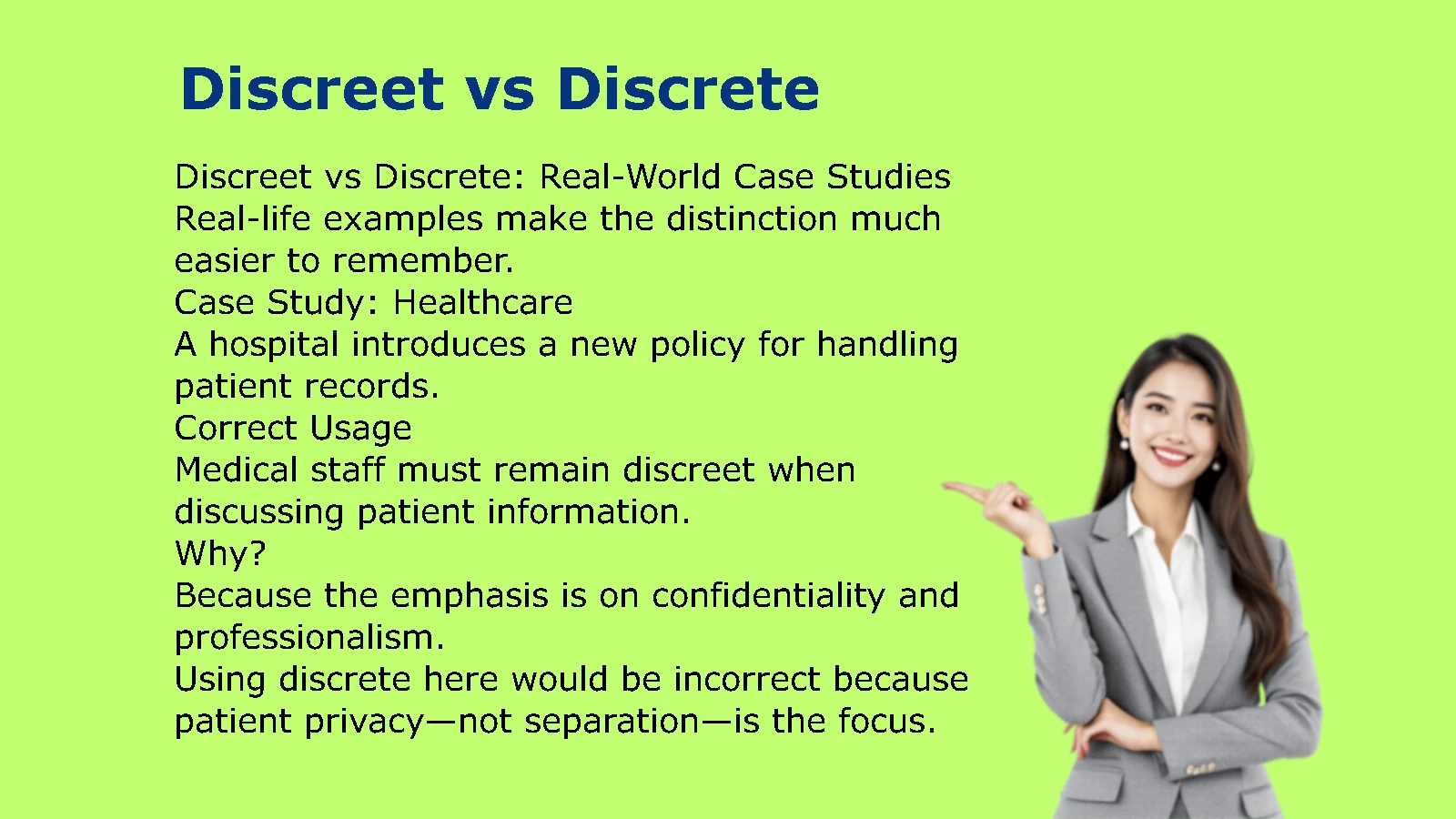
Discreet vs Discrete: Real-World Case Studies
Real-life examples make the distinction much easier to remember.
Case Study: Healthcare
A hospital introduces a new policy for handling patient records.
Correct Usage
Medical staff must remain discreet when discussing patient information.
Why?
Because the emphasis is on confidentiality and professionalism.
Using discrete here would be incorrect because patient privacy—not separation—is the focus.
Case Study: Software Development
A software company redesigns its application.
Instead of one large program, developers split it into several independent modules.
Correct Usage
The application now consists of discrete modules.
Each module performs a different function while remaining separate.
Case Study: Retail Business
A luxury jewelry store advertises its services.
Marketing copy reads:
Enjoy discreet consultations in private showrooms.
Customers expect privacy during high-value purchases.
Here, discreet is the only correct choice.
Case Study: Data Analytics
An analyst studies online shopping behavior.
Instead of measuring continuous values, the report counts purchases.
Examples include:
- 10 purchases
- 18 purchases
- 27 purchases
These are discrete values because customers cannot make 18.5 purchases.
Common Word Pair Comparisons
Many English learners confuse discreet and discrete with similar words. Understanding these related comparisons makes your vocabulary even stronger.
Discreet vs. Secret
Although they’re related, they aren’t identical.
| Discreet | Secret |
| Describes careful behavior | Describes hidden information |
| Often professional | Can refer to any concealed fact |
| Focuses on tact | Focuses on concealment |
Example:
A lawyer behaves discreetly, but client records remain secret.
Discrete vs. Separate
These words are very similar.
However, discrete usually appears in formal or technical writing.
Examples:
- discrete variables
- separate rooms
- discrete categories
- separate buildings
In everyday conversation, separate is usually more common.
Discrete vs. Distinct
Both words emphasize differences.
However:
- Discrete means individually separate.
- Distinct means clearly different or recognizable.
Example:
The company has three discrete departments.
Each department has a distinct culture.
Discreet vs. Private
These words overlap but aren’t interchangeable.
Private describes information or places.
Discreet describes behavior.
Examples:
- private office
- private meeting
- discreet employee
- discreet response
Discrete vs. Independent
Independent things often operate alone.
Discrete things simply exist separately.
Example:
The machines are discrete units.
Each machine operates independently.
Sometimes both words fit the same sentence, but their meanings remain slightly different.
Frequently Confused Word Pairs
If you’re learning English, these word pairs deserve extra attention because they often appear alongside discreet vs. discrete.
| Word Pair | Difference |
| Affect vs. Effect | Action vs. Result |
| Complement vs. Compliment | Complete vs. Praise |
| Principal vs. Principle | Person vs. Rule |
| Stationary vs. Stationery | Not Moving vs. Writing Materials |
| Accept vs. Except | Receive vs. Exclude |
| Then vs. Than | Time vs. Comparison |
| Farther vs. Further | Physical Distance vs. Additional Degree |
Learning these pairs together helps improve both writing accuracy and vocabulary.
Frequently Asked Questions
Is it discreet or discrete information?
If the information is confidential or should be handled carefully, discreet information is the correct phrase.
If you’re referring to separate pieces of information, use discrete information.
The correct choice depends entirely on the context.
Is it discreet or discrete data?
In mathematics, statistics, and computer science, discrete data is the standard term because the values are countable and distinct.
Examples include:
- Number of employees
- Number of sales
- Number of website visits
Is mathematics discrete or discreet?
The correct term is discrete mathematics.
Discrete mathematics studies countable structures such as:
- Graphs
- Sets
- Logic
- Algorithms
- Combinatorics
- Boolean algebra
It forms the foundation of computer science and many areas of engineering.
Can a person be discrete?
Generally, no.
People are usually described as discreet, meaning careful, tactful, or respectful of privacy.
A person may belong to a discrete group, but the person’s behavior is discreet.
Can an object be discreet?
Usually not.
Objects are more commonly described as discrete because they exist as separate units.
However, an object can be described as discreet if it is intentionally designed to avoid attracting attention.
Example:
A discreet security camera blends into the surrounding décor.
Here, the adjective describes its unobtrusive appearance rather than its physical structure.
What is the easiest way to remember the difference?
Try this simple memory trick:
- DiscrEEt = kEEp it sEEcret.
- DiscretE = sEparatE things.
Another helpful reminder:
- Discreet = Privacy
- Discrete = Separate
Are discreet and discrete pronounced the same?
Yes.
Both words are pronounced:
/dɪˈskriːt/
Since pronunciation doesn’t distinguish them, careful spelling is essential.
Why are these words commonly confused?
Several factors contribute to the confusion:
- They differ by only one letter.
- They share the same pronunciation.
- They originated from the same Latin root.
- Both function as adjectives.
- Spell-check tools rarely identify misuse because both words are correctly spelled.
Reading the surrounding sentence carefully is the best way to choose the correct word.
Which word is more common in everyday English?
Discreet appears more often in everyday conversations because people frequently discuss privacy, manners, and professional behavior.
Discrete is more common in technical fields such as mathematics, engineering, computer science, and statistics.
Are discreet and discrete interchangeable?
No.
Despite their similar spelling and pronunciation, they have distinct meanings and should never be substituted for one another.
Replacing one with the other changes the meaning of the sentence and may confuse readers.
Quick Summary
Understanding discreet vs. discrete becomes much easier once you focus on what each word describes.
- Discreet means careful, tactful, and respectful of privacy. It almost always refers to people, behavior, communication, or actions.
- Discrete means separate, distinct, or individual. It typically describes objects, categories, variables, systems, or measurable values.
The table below provides a final side-by-side comparison.
| Feature | Discreet | Discrete |
| Meaning | Careful and private | Separate and distinct |
| Describes | Behavior and communication | Things, categories, numbers |
| Common Contexts | Business, healthcare, law, hospitality | Mathematics, science, engineering, computing |
| Related Idea | Confidentiality | Separation |
| Opposite | Indiscreet | Continuous |
| Example | She was discreet during the meeting. | The data consists of discrete values. |
Remember this simple rule whenever you’re unsure:
If it involves privacy, choose discreet. If it involves separate parts, choose discrete.
That one distinction will help you use both words confidently in everyday conversations, professional writing, and academic work.