Schema vs Scheme: Schema is a structured framework or model used in fields like psychology, databases, and linguistics, while scheme refers to a plan, strategy, or organized system of action. Although the words look similar, they have different meanings and should not be used interchangeably.
The confusion is understandable. Schema is commonly used in psychology, database design, and computer science, while scheme often refers to a plan, strategy, or program. And here’s the kicker: choosing the wrong word can change the meaning of your sentence and make your writing less accurate.
The good news? Once you understand the distinction, it’s easy to remember.
In this guide, you’ll learn the difference between Schema vs Scheme, discover the correct usage of schema and scheme, explore their definitions, pronunciation, and examples in sentences, and find out when to use schema and when to use scheme. You’ll also see simple memory tips that make this commonly confused word pair easy to master.
By the end, you’ll know exactly how to use schema and scheme with confidence in academic, professional, and everyday writing.
Quick Answer: Schema vs Scheme
The simplest way to remember the difference is this:
- Schema = a structured framework, model, or blueprint used to organize knowledge or information.
- Scheme = a plan, arrangement, program, or method designed to achieve a purpose.
Although both words come from the Greek word schēma, modern English gives each one its own role.
| Feature | Schema | Scheme |
| Meaning | Structured framework or model | Plan, arrangement, or organized program |
| Part of Speech | Noun | Noun |
| Everyday Use | Rare | Very common |
| Technical Use | Very common | Limited |
| Common Fields | Psychology, databases, linguistics, XML | Business, government, design, finance |
| Example | Database schema | Retirement scheme |
Quick Examples
✅ The developer updated the database schema.
Children build mental schemas through experience.
The government introduced a new housing scheme.
We selected a blue and white color scheme.
What Does “Schema” Mean?
Definition of Schema
A schema is an organized framework that helps arrange, interpret, or classify information. Think of it as a blueprint that shows how different pieces fit together.
The exact meaning changes slightly depending on the subject, yet the central idea stays the same. A schema provides structure rather than action.
For example:
- In psychology, a schema organizes knowledge.
- In databases, a schema organizes data.
- In linguistics, a schema represents language patterns.
- In XML, a schema defines document structure.
Despite these differences, every use involves a carefully organized framework.
Origin and Etymology
The word schema comes from the ancient Greek word σχῆμα (schēma), meaning form, shape, or figure.
Latin later borrowed the term, and English adopted it primarily for scholarly and technical writing. Unlike scheme, which became common in everyday English, schema remained closely associated with academic and scientific disciplines.
That distinction continues today.
Where Is Schema Commonly Used?
You’ll usually encounter schema in specialized fields where information needs a formal structure.
Psychology
Psychologists use schema to describe the mental frameworks people develop through experience.
Imagine meeting a dog for the first time. Your brain stores information about its appearance, behavior, and sounds. Over time, you create a mental schema that helps you recognize other dogs quickly.
For example:
- A child learns that birds have wings.
- Later, the child sees a penguin.
- The existing bird schema changes to include birds that cannot fly.
This continuous process helps people learn more efficiently.
Education
Teachers often discuss schemas because students understand new ideas more easily when they connect them to prior knowledge.
For example, before teaching the American Revolution, an instructor might review colonial life. That activates students’ existing schemas and makes new information easier to absorb.
Educational research consistently shows that linking lessons to previous experiences improves comprehension and long-term memory.
Database Design
In computer science, schema has a very specific meaning.
A database schema defines the overall structure of a database. It specifies:
- Tables
- Columns
- Data types
- Relationships
- Keys
- Constraints
- Rules for storing information
Without a schema, a database would have no organized framework.
For example:
| Table | Purpose |
| Customers | Stores customer information |
| Orders | Stores purchase records |
| Products | Stores product details |
| Payments | Stores transaction history |
The schema explains how these tables connect.
XML and Structured Data
An XML Schema (XSD) defines the rules an XML document must follow.
It specifies:
- Required elements
- Allowed attributes
- Data types
- Document hierarchy
- Validation rules
This ensures that every XML document follows the same structure.
Linguistics
Linguists use schema to describe recurring patterns in language and communication.
For instance, native English speakers naturally recognize sentence structures such as:
Subject + Verb + Object
That familiar pattern functions as a language schema.
Philosophy
In philosophy, schema often describes conceptual frameworks that connect abstract ideas with practical understanding.
One of the most influential philosophers to discuss schemas was Immanuel Kant, who argued that the human mind uses structured concepts to organize experience.
Although modern philosophy uses the term less frequently than psychology or computer science, the underlying idea remains the same: schemas organize thought.
Examples of Schema in Sentences
Understanding the word becomes easier when you see it in context.
- The researcher developed a new cognitive schema for memory testing.
- Our database schema contains twenty interconnected tables.
- Children build new schemas as they gain life experience.
- The XML schema validates every document before processing.
- Teachers often activate prior schemas before introducing new material.
Notice that each example focuses on structure, organization, or mental frameworks rather than plans or programs.
What Does “Scheme” Mean?
Definition of Scheme
A scheme is an organized plan, system, program, or method created to accomplish a goal.
Unlike schema, which describes structure, scheme emphasizes action or implementation.
The word appears in everyday conversations, business documents, government announcements, design discussions, and financial reports.
Origin and History
Like schema, scheme ultimately traces its roots to the Greek word schēma.
Over centuries, English speakers gradually broadened its meaning. Instead of referring only to shape or form, scheme evolved into a word describing planned actions and organized systems.
Today, it appears far more frequently than schema in general writing.
Common Meanings of Scheme
The meaning depends on context.
A Plan
This is the most common use.
Examples include:
- A marketing scheme
- A study scheme
- A fundraising scheme
- A business expansion scheme
Example sentence:
The company introduced a new pricing scheme to attract customers.
A Government Program
Many countries use scheme to describe official public programs.
Examples include:
- Housing scheme
- Scholarship scheme
- Pension scheme
- Employment scheme
- Healthcare scheme
Example:
The scholarship scheme helped thousands of students continue their education.
An Organized System
Sometimes scheme refers to the arrangement of something rather than a detailed plan.
Examples include:
- Naming scheme
- Classification scheme
- Filing scheme
- Coding scheme
These systems help people organize information consistently.
A Dishonest Plot
The word scheme can also carry a negative meaning.
In this sense, it refers to a secret or deceptive plan intended to benefit someone unfairly.
Examples include:
- Fraud scheme
- Tax scheme
- Pyramid scheme
- Investment scheme
Context determines whether the word sounds positive, neutral, or negative.
Compare these examples:
✅ The charity launched a community housing scheme.
✅ Investigators uncovered an illegal investment scheme.
The first example is positive.
The second describes criminal activity.
Examples of Scheme in Sentences
These examples show how flexible the word is.
- Our office adopted a new filing scheme.
- The city announced a recycling scheme.
- Designers selected a warm color scheme.
- The company developed an employee bonus scheme.
- Police dismantled an international fraud scheme.
Each sentence describes a plan, system, or organized arrangement, not a conceptual framework.
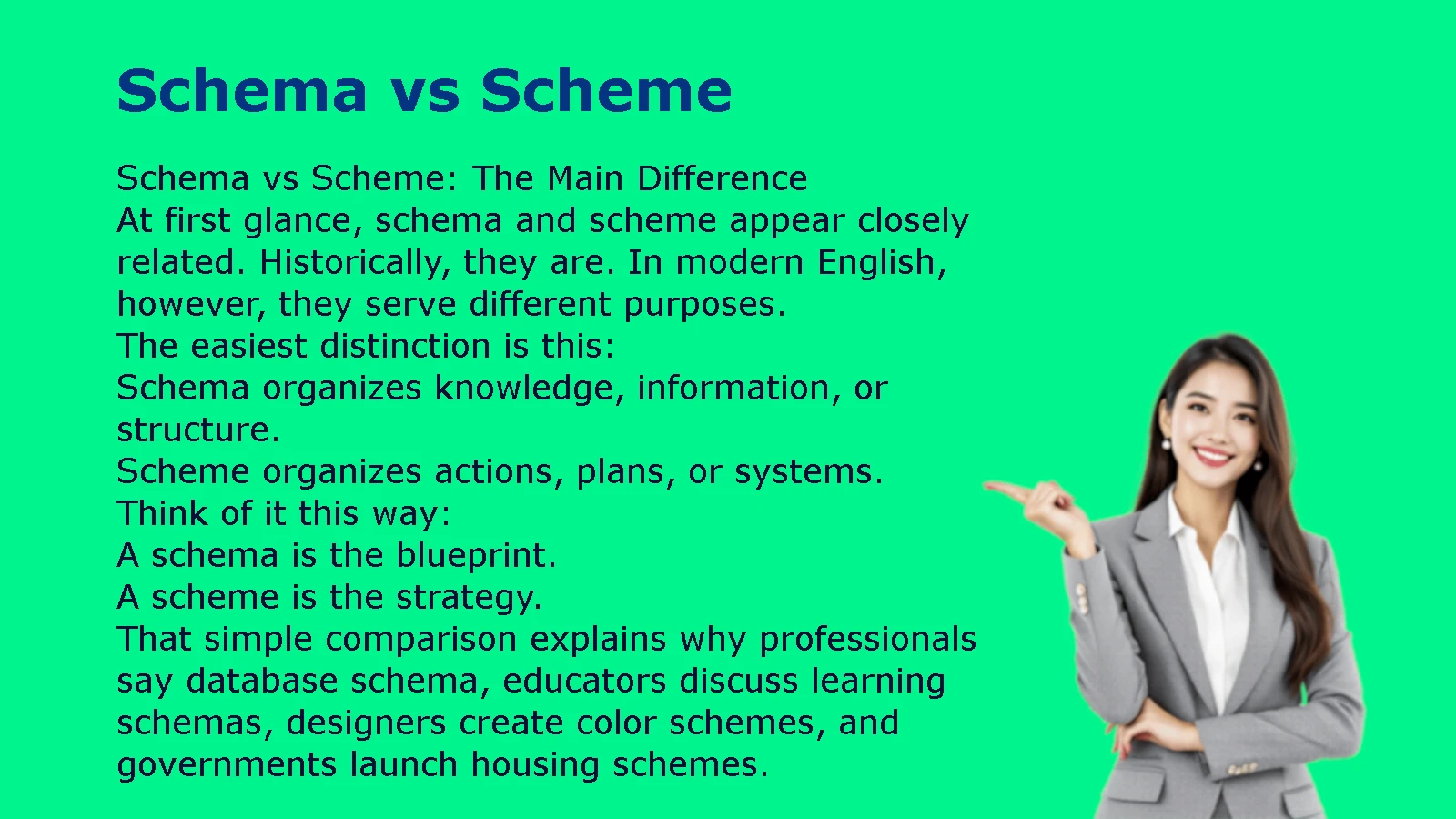
Schema vs Scheme: The Main Difference
At first glance, schema and scheme appear closely related. Historically, they are. In modern English, however, they serve different purposes.
The easiest distinction is this:
- Schema organizes knowledge, information, or structure.
- Scheme organizes actions, plans, or systems.
Think of it this way:
- A schema is the blueprint.
- A scheme is the strategy.
That simple comparison explains why professionals say database schema, educators discuss learning schemas, designers create color schemes, and governments launch housing schemes.
When to Use Schema
Use schema when you’re referring to a structured framework, organized model, or conceptual blueprint. The word almost always appears in academic, scientific, educational, or technical contexts.
A good rule of thumb is this:
If you’re describing how information is organized, schema is usually the correct choice.
Let’s explore the most common situations where schema belongs.
Schema in Psychology
One of the best-known uses of schema comes from cognitive psychology.
A mental schema is a framework your brain creates to organize knowledge. Instead of treating every new experience as completely unfamiliar, your mind compares it with information you’ve already stored.
Imagine a young child who learns what a cat looks like. Over time, the child builds a mental picture that includes features such as:
- Four legs
- Fur
- Whiskers
- A tail
- Meowing
Later, the child sees a lion. At first, they may call it a “big cat.” As they learn more, their existing schema expands to include both domestic cats and wild cats.
This process allows people to learn faster because the brain doesn’t start from scratch every time it encounters something new.
Common Types of Schemas in Psychology
| Schema Type | Purpose | Example |
| Person Schema | Organizes knowledge about people | Understanding a teacher’s role |
| Self Schema | Shapes personal identity | Seeing yourself as organized |
| Event Schema | Predicts familiar situations | Knowing what happens at a wedding |
| Role Schema | Defines expected behavior | Expectations of a police officer |
| Object Schema | Organizes information about objects | Knowing how a bicycle works |
Why Schemas Matter
Schemas help people:
- Process information quickly
- Recognize familiar patterns
- Make predictions
- Solve problems efficiently
- Learn new concepts faster
However, schemas can also create bias. When people rely too heavily on existing mental frameworks, they may overlook new evidence or make incorrect assumptions.
Schema in Education
Teachers use the idea of schema every day, even if they don’t always mention the term.
Students understand new material more easily when they connect it with something they already know. Activating prior knowledge prepares the brain to absorb fresh information.
For example, before teaching ecosystems, a science teacher might ask students about parks, forests, or animals they’ve seen. Those familiar experiences activate existing schemas and make the lesson easier to understand.
Classroom Example
Instead of introducing the water cycle immediately, a teacher might ask:
- Where does rain come from?
- What happens to puddles after a sunny day?
- Why do clouds form?
These questions awaken existing knowledge. The new lesson then fits naturally into the student’s mental framework.
Schema in Databases
In technology, schema has a precise technical meaning.
A database schema defines the structure of a database before any data is entered. It acts as the architectural blueprint that tells the database management system how information should be stored and connected.
A schema typically defines:
- Tables
- Fields
- Data types
- Primary keys
- Foreign keys
- Relationships
- Constraints
- Indexes
Without a schema, databases would quickly become disorganized.
Example
Imagine an online bookstore.
Instead of placing every detail into one enormous table, the schema separates information into related sections.
| Table | Stores |
| Customers | Customer profiles |
| Books | Book information |
| Orders | Purchase records |
| Payments | Payment history |
| Reviews | Customer reviews |
Relationships connect these tables so the database remains efficient and accurate.
Why Database Schemas Matter
A well-designed schema helps developers:
- Reduce duplicate data
- Improve search performance
- Maintain consistency
- Prevent errors
- Scale applications more easily
That explains why professionals always refer to a database schema, not a database scheme.
Schema in XML and Structured Data
Another technical use appears in XML Schema (XSD).
XML documents store structured information, but they need rules that define what is allowed.
An XML Schema specifies:
- Required elements
- Optional elements
- Accepted data types
- Parent-child relationships
- Validation rules
Without a schema, different systems might interpret the same XML document differently.
Schema in Linguistics
In linguistics, a schema describes recurring language patterns that speakers naturally recognize.
Native speakers rarely think about grammar rules consciously. Instead, they rely on internal schemas developed through years of exposure.
For example, English speakers instinctively recognize this sentence pattern:
Subject → Verb → Object
Even without formal grammar training, most people know that:
The dog chased the ball.
sounds natural, while
Chased the dog ball the.
does not.
Their language schema guides comprehension automatically.
Schema in Philosophy
Philosophers have long used the word schema to describe the mental structures that connect abstract ideas with real-world experience.
The philosopher Immanuel Kant argued that the mind doesn’t simply receive information. Instead, it actively organizes experience using structured concepts.
Modern philosophy still uses the term in discussions of:
- Knowledge
- Perception
- Logic
- Reasoning
- Human understanding
Although psychology popularized the concept, philosophy helped lay its foundation.
When to Use Scheme
Unlike schema, the word scheme belongs in everyday English.
Use scheme when describing:
- A plan
- A program
- A strategy
- An organized system
- A method
- An arrangement
If someone can implement or carry out it, scheme is usually the correct choice.
Scheme as a Plan
This is the most common meaning.
Businesses, schools, charities, and individuals all create schemes to achieve goals.
Examples include:
- Marketing scheme
- Savings scheme
- Investment scheme
- Reward scheme
- Pricing scheme
Example
The company launched a loyalty scheme that increased customer retention.
Here, the scheme describes an organized business plan.
Government Schemes
Many governments use the word scheme to describe public programs.
These initiatives usually provide assistance or services.
Examples include:
- Housing scheme
- Employment scheme
- Scholarship scheme
- Healthcare scheme
- Pension scheme
Example
The new housing scheme provides affordable homes for low-income families.
This usage is especially common in official documents and news reports.
Scheme as an Organized System
Sometimes scheme refers to the way something is arranged rather than a detailed plan.
Examples include:
- Naming scheme
- Coding scheme
- Classification scheme
- Filing scheme
- Pricing scheme
Each describes an organized method for handling information or resources.
Color Scheme
One of the most familiar expressions is color scheme.
Interior designers, artists, and web designers use the phrase to describe a coordinated group of colors.
For example:
- Black and gold
- Navy and white
- Earth tones
- Pastel colors
A successful color scheme creates visual harmony.
Notice that color schema would sound incorrect to native speakers.
Scheme as a Negative Plan
Not every scheme is positive.
The word sometimes describes secret or dishonest plans.
Examples include:
- Fraud scheme
- Tax evasion scheme
- Pyramid scheme
- Ponzi scheme
Example
Authorities uncovered an international investment scheme that defrauded thousands of investors.
Context determines whether scheme sounds neutral or suspicious.
Can Schema and Scheme Ever Mean the Same Thing?
Historically, yes.
In modern English, almost never.
Both words developed from the same Greek root, which originally referred to shape or form. Over centuries, English gradually assigned each word a different role.
Today:
- Schema refers to structured frameworks.
- Scheme refers to organized plans.
You’ll occasionally encounter older academic texts where the meanings overlap slightly. Modern dictionaries and style guides, however, clearly distinguish between them.
Using the correct word improves clarity and professionalism.
Why People Confuse Schema and Scheme
The confusion isn’t surprising. Several factors contribute to it.
Shared Origin
Both words evolved from the Greek word schēma. Their shared ancestry explains why they resemble each other.
Similar Pronunciation
Although they aren’t pronounced identically, both begin with the same “skee” sound.
- Schema → SKEE-muh
- Scheme → SKEEM
That similarity causes many spelling mistakes.
Similar Spelling
Only two letters separate the words.
When typing quickly, it’s easy to substitute one for the other.
Technical vs Everyday Language
Most people encounter scheme regularly but rarely see schema unless they study psychology, education, computer science, or linguistics.
Because scheme feels more familiar, some writers mistakenly use it in technical contexts.
Industry-Specific Vocabulary
Different professions favor different terms.
| Industry | Correct Word |
| Psychology | Schema |
| Database Design | Schema |
| Artificial Intelligence | Schema |
| Education | Schema |
| Government | Scheme |
| Finance | Scheme |
| Marketing | Scheme |
| Interior Design | Scheme |
Understanding the context eliminates most confusion.
Pronunciation Guide
Although the words look alike, their endings differ.
| Word | IPA | Pronunciation |
| Schema | /ˈskiːmə/ | SKEE-muh |
| Scheme | /skiːm/ | SKEEM |
Pronunciation Tips
- Schema ends with a soft “muh” sound.
- Scheme ends sharply with “me.”
Saying them aloud a few times helps reinforce the difference.
Common Expressions Using Scheme
These expressions appear frequently in everyday English.
| Expression | Meaning |
| Color scheme | Coordinated group of colors |
| Pension scheme | Retirement savings program |
| Scholarship scheme | Educational funding program |
| Pricing scheme | Pricing strategy |
| Reward scheme | Customer incentive program |
| Naming scheme | Organized naming method |
| Coding scheme | Classification system |
| Marketing scheme | Promotional plan |
| Insurance scheme | Coverage program |
| Investment scheme | Financial arrangement or, in some contexts, a fraudulent plan |
Common Expressions Using Schema
These expressions are common in technical and academic writing.
| Expression | Meaning |
| Database schema | Database structure |
| Schema theory | Theory explaining how knowledge is organized |
| Cognitive schema | Mental framework for processing information |
| XML Schema | XML validation standard |
| Metadata schema | Structure describing data about data |
| Schema markup | Structured data vocabulary used by search engines |
| Learning schema | Framework built through education |
| Conceptual schema | High-level representation of a system |
Real-World Case Study: One Word Changed the Meaning
A software company was preparing documentation for a new database platform. One section instructed developers to “update the database scheme before importing records.”
Several junior developers interpreted this as a request to revise the implementation plan rather than the database’s structural design. The documentation team later corrected the phrase to database schema, making it clear that developers needed to modify tables, relationships, and field definitions instead of changing the project’s workflow.
This small wording change eliminated confusion, reduced support requests, and highlighted an important lesson: choosing the precise word matters. In technical writing, accuracy saves time and prevents costly misunderstandings.
Common Mistakes to Avoid When Using Schema and Scheme
Even experienced writers occasionally mix up these words because they share a similar spelling and history. Fortunately, the mistakes are easy to avoid once you understand each word’s role.
Here are the most common errors.
Using Scheme Instead of Schema in Technical Writing
This is by far the most frequent mistake.
❌ Incorrect
The software engineer updated the database scheme.
✅ Correct
The software engineer updated the database schema.
A database has a schema because it defines the structure of the data, not a plan for using it.
Saying Color Schema
Some writers assume that schema sounds more formal, so they replace scheme in common expressions.
❌ Incorrect
We chose a blue and gray color schema.
✅ Correct
We chose a blue and gray color scheme.
The established English expression is color scheme.
Referring to a Mental Framework as a Scheme
In psychology and education, schema is the accepted term.
❌ Incorrect
Children build mental schemes as they learn.
✅ Correct
Children build mental schemas as they learn.
Although older texts occasionally use scheme, modern psychology overwhelmingly uses schema.
Assuming the Words Are Interchangeable
Because the words share the same Greek root, many people believe they can substitute one for the other.
Modern English doesn’t work that way.
Compare these examples:
| ❌ Incorrect | ✅ Correct |
| Database scheme | Database schema |
| Color schema | Color scheme |
| Pension schema | Pension scheme |
| Cognitive scheme | Cognitive schema |
| XML scheme | XML Schema |
Learning these common combinations will make your writing sound more natural and accurate.
Schema vs Scheme: Side-by-Side Comparison
Sometimes a quick comparison is easier than reading long explanations.
| Feature | Schema | Scheme |
| Primary Meaning | Framework or structure | Plan or organized arrangement |
| Common Context | Psychology, databases, linguistics | Everyday English, business, government |
| Technical Word | Yes | Usually no |
| Everyday Use | Rare | Very common |
| Refers To | Organization of information | Organization of actions |
| Common Examples | Database schema, schema theory | Color scheme, pension scheme |
| Tone | Academic or technical | General or professional |
| Can Have Negative Meaning? | No | Yes, depending on context |
Memory Trick: How to Remember the Difference
A simple memory trick can help you choose the correct word every time.
Think of the Letter A in Schema
The A in schema can remind you of:
- Architecture
- Arrangement of information
- Academic fields
A schema is like the architectural drawing of a building. It shows how everything fits together before construction begins.
Think of the Letter E in Scheme
The E in scheme can remind you of:
- Execution
- Everyday planning
- Events
- Enterprise
A scheme focuses on carrying out a plan rather than organizing knowledge.
Another Easy Analogy
Imagine building a house.
- The schema is the blueprint.
- The scheme is the construction plan.
Both are important, yet they serve different purposes.
Quick Checklist: Which Word Should You Use?
Ask yourself one simple question:
Am I talking about information or action?
If the answer involves structure, choose schema.
If the answer involves planning, choose scheme.
Use Schema When Talking About
- Mental frameworks
- Learning
- Knowledge organization
- Database structures
- XML validation
- Linguistic patterns
- Conceptual models
Use Scheme When Talking About
- Business plans
- Government programs
- Marketing strategies
- Pricing systems
- Color combinations
- Savings programs
- Organized methods
This simple test works in almost every situation.
Expert Insight
“People understand new information by connecting it to what they already know.”
This idea sits at the heart of schema theory. Researchers in cognitive psychology have shown that prior knowledge strongly influences learning, reading comprehension, and memory. Rather than storing isolated facts, the brain organizes information into interconnected frameworks that help people recognize patterns and make informed decisions.
The same principle applies outside psychology. In technology, a database schema organizes related data into meaningful structures. In everyday life, a well-designed scheme organizes actions toward a specific goal.
The words may share a common history, yet modern English gives each one a clear purpose.
Frequently Asked Questions
Is schema the same as scheme?
No.
A schema is a structured framework or model, while a scheme is a plan, arrangement, or organized program. Although they share the same historical origin, they have different meanings in modern English.
Why do databases use schema instead of scheme?
A database schema defines the structure of a database, including its tables, relationships, fields, and constraints.
The word schema emphasizes organization and structure, which accurately describes a database’s design.
Is scheme always negative?
No.
Many people associate scheme with dishonest activities because of expressions like Ponzi scheme or fraud scheme.
However, the word is often completely neutral.
Examples include:
- Pension scheme
- Scholarship scheme
- Recycling scheme
- Savings scheme
- Housing scheme
Context determines the meaning.
Is schema only used in psychology?
No.
Although psychology popularized the term, schema also appears in:
- Computer science
- Database management
- Artificial intelligence
- Education
- Linguistics
- Philosophy
- Information science
- Structured data technologies
Each field uses the idea of an organized framework.
What is schema theory?
Schema theory explains how people organize knowledge into mental frameworks.
According to the theory, individuals interpret new information by comparing it with what they already know. Existing schemas make learning faster because the brain builds on prior experience instead of treating every situation as completely new.
Teachers often apply schema theory by connecting new lessons to students’ existing knowledge.
Is color schema correct?
No.
The standard English expression is color scheme.
Designers, artists, architects, and web developers consistently use color scheme to describe coordinated groups of colors.
Is database scheme incorrect?
In standard technical English, yes.
Professionals use database schema because it refers to the structural design of a database.
Using database scheme may confuse readers or make technical documentation appear inaccurate.
Which word appears more often in everyday English?
Scheme is much more common.
People regularly discuss:
- Color schemes
- Savings schemes
- Pension schemes
- Business schemes
- Marketing schemes
Outside technical or academic fields, schema appears far less frequently.
Key Takeaways
If you’re still unsure about schema vs scheme, these points summarize everything you need to remember.
| Schema | Scheme |
| Organized framework | Organized plan |
| Technical and academic | Everyday English |
| Mental models | Business strategies |
| Database structure | Government programs |
| XML Schema | Color scheme |
| Schema theory | Pricing scheme |
| Learning framework | Savings scheme |
Remember These Rules
- Use schema for frameworks, models, and structures.
- Use scheme for plans, systems, and programs.
- A database has a schema, not a scheme.
- Designers create color schemes, not color schemas.
- Students develop mental schemas through learning.
- Governments introduce public schemes to support communities.
Final Verdict: Schema vs Scheme
The difference between schema and scheme becomes much clearer once you focus on their purpose rather than their spelling.
Choose schema when you’re describing a structured framework that organizes knowledge, data, or concepts. That’s why psychologists discuss mental schemas, database administrators design database schemas, and developers implement XML Schemas.
Choose scheme when you’re talking about a plan, strategy, program, or organized arrangement. Businesses create pricing schemes, designers select color schemes, and governments launch housing schemes or scholarship schemes.
Although both words trace their roots to the same Greek term, centuries of language evolution have given each one a specialized role. Using the correct word not only improves accuracy but also helps your writing sound more natural, professional, and trustworthy.
The next time you encounter schema vs scheme, remember one simple idea:
- Schema builds structure.
- Scheme builds action.
That distinction will help you choose the right word with confidence in academic writing, technical documentation, and everyday communication alike.