Have you ever paused while writing and wondered whether to use Evoke vs. Invoke? Although these two words sound similar and share a Latin origin, they have different meanings and are used in completely different contexts. This common English grammar and vocabulary question often confuses students, writers, professionals, and even native speakers because choosing the wrong word can change the meaning of an entire sentence.
If you’ve ever written an email, essay, speech, or legal document and hesitated between Evoke vs. Invoke, you’re not alone. The confusion usually comes from their similar pronunciation and spelling, but their usage follows different grammar rules and depends on the intended meaning. While evoke is commonly used to bring back memories, emotions, feelings, or mental images, invoke means to call upon, appeal to, cite authority, or request help, especially in legal, religious, or formal contexts.
The good news? Once you understand the distinction, choosing the correct word becomes much easier.
In this guide, you’ll learn the meaning of Evoke vs. Invoke, their definitions, pronunciation, grammar differences, real-life examples, common mistakes, and practical usage tips. We’ll also compare how each word is used in American English and British English, explain when to use each one in formal and everyday writing, and share an easy memory trick so you never confuse these commonly confused words again.
So, if you’re ready to master Evoke vs. Invoke, improve your English vocabulary, and write with greater clarity and confidence, let’s dive in.
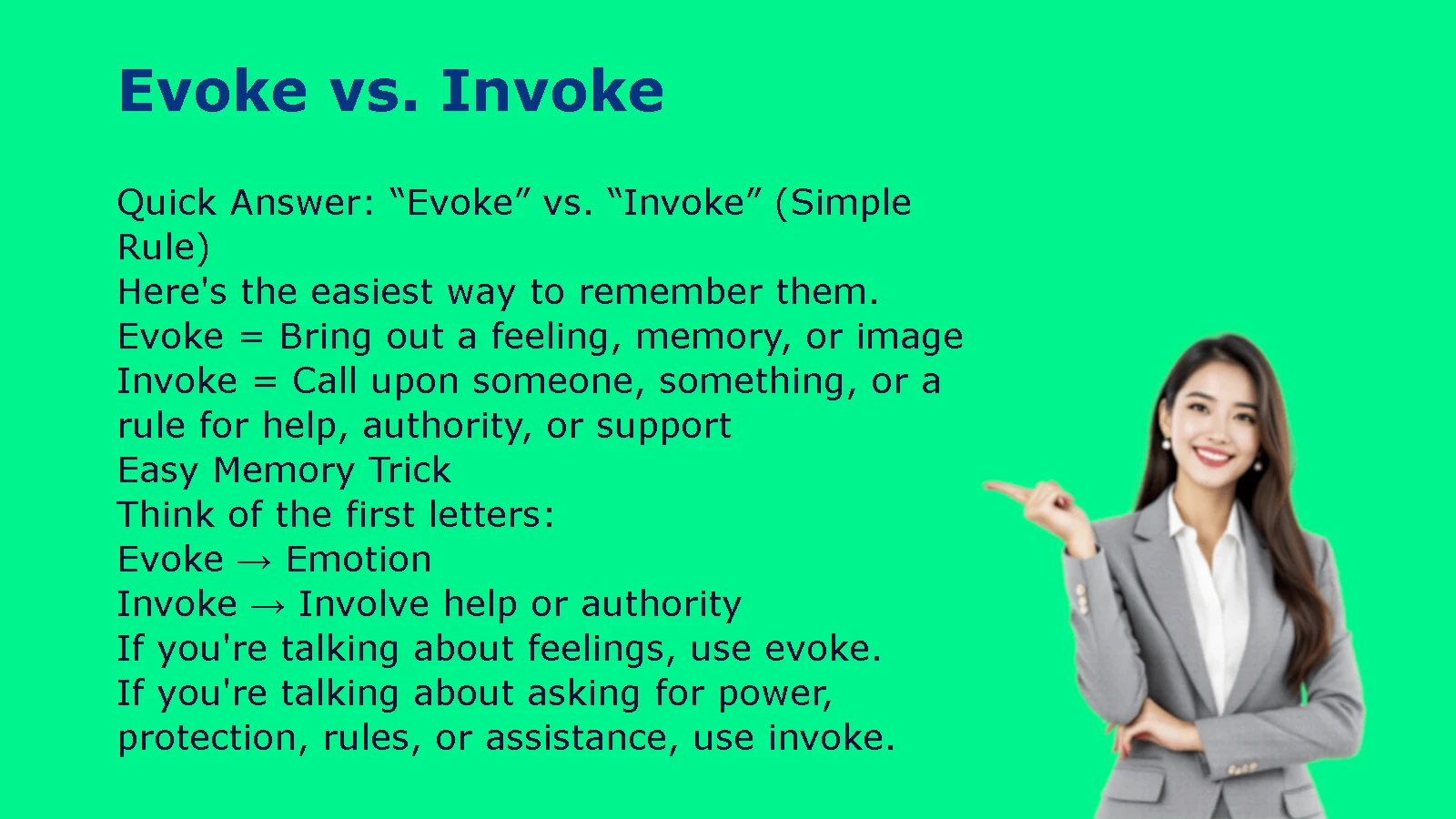
Quick Answer: “Evoke” vs. “Invoke” (Simple Rule)
Here’s the easiest way to remember them.
Evoke = Bring out a feeling, memory, or image
Invoke = Call upon someone, something, or a rule for help, authority, or support
Easy Memory Trick
Think of the first letters:
Evoke → Emotion
Invoke → Involve help or authority
If you’re talking about feelings, use evoke.
If you’re talking about asking for power, protection, rules, or assistance, use invoke.
How People Actually Use “Evoke” and “Invoke”
These words appear in different situations.
In Everyday Conversations
People usually use evoke when discussing memories or emotions.
Examples:
- “That old song evokes childhood memories.”
- “The smell of rain evokes happiness.”
Invoke is less common in casual speech but still appears.
Examples:
- “He invoked his right to remain silent.”
- “They invoked the company’s policy.”
In Academic or Professional Writing
Both words appear frequently.
Writers use evoke in literature, art, psychology, and marketing.
They use invoke in law, religion, politics, business, and formal communication.
Why People Mix Them Up
- They sound alike.
- Both come from Latin.
- Both involve “bringing something forward.”
- Their meanings overlap slightly in abstract contexts.
The Core Difference Between “Evoke” and “Invoke”
The easiest way to understand them is to focus on what is being brought forward.
Think About the Purpose
Evoke
→ Brings out emotions, memories, ideas, or mental images.
Invoke
→ Calls upon authority, assistance, laws, rights, or higher powers.
Key Insight
Evoke happens inside the mind.
Invoke usually reaches outside for help or authority.
“Evoke” Explained Clearly (With Edge Cases)
At its core, evoke means to produce or bring forth something that already exists inside someone’s thoughts or emotions.
Standard Meaning
Use evoke when something causes people to remember or feel something.
Examples:
- The painting evokes peace.
- Her voice evoked memories of home.
- The movie evoked deep emotions.
Common Uses
- Memories
- Feelings
- Images
- Atmosphere
- Imagination
Edge Case
Sometimes evoke refers to creating a particular mood.
Example:
“The restaurant’s décor evokes old Paris.”
It doesn’t literally transport people there—it simply creates that feeling.
Key Takeaway
If something makes people feel, remember, imagine, or visualize, use evoke.
“Invoke” Explained Clearly (With Edge Cases)
Now let’s look at invoke.
At its core, invoke means to call upon something for support, authority, or assistance.
Standard Meaning
Examples:
- She invoked the law.
- He invoked his constitutional rights.
- The priest invoked divine blessings.
Common Uses
People invoke:
- Laws
- Rights
- Rules
- Authority
- God’s name
- Traditions
- Emergency powers
Edge Case
Sometimes people invoke an idea rather than a person.
Example:
“The speaker invoked history to strengthen his argument.”
Here, history is used as supporting authority.
Key Takeaway
If you’re calling upon something to strengthen, justify, or protect your position, use invoke.
The Biggest Mistake People Make
The most common mistake is using invoke when talking about emotions.
Incorrect
“The movie invoked sadness.”
Better
“The movie evoked sadness.”
Likewise:
Incorrect
“He evoked his legal rights.”
Correct
“He invoked his legal rights.”
Lesson
Ask yourself:
Are you creating a feeling?
→ Evoke.
Are you calling upon authority or assistance?
→ Invoke.
Side-by-Side Comparison Table
| Word | Meaning | Common Objects | Best Used For |
| Evoke | Bring out feelings or memories | Emotions, memories, images, moods | Creative writing, storytelling, art |
| Invoke | Call upon authority or support | Laws, rights, God, policies, traditions | Legal, formal, religious, professional writing |
Real-Life Examples of “Evoke”
Let’s see how evoke works naturally.
Common Situations
- The smell of fresh bread evokes childhood memories.
- Her smile evoked comfort.
- The music evoked strong emotions.
- Autumn colors evoke nostalgia.
- The novel evokes life in ancient Rome.
Mini Scenario
You’re walking through your old school.
The familiar hallway suddenly evokes memories of your first day.
Nothing is being requested—you simply remember.
Real-Life Examples of “Invoke”
Now compare with invoke.
Common Situations
- The lawyer invoked constitutional protections.
- She invoked company policy.
- The witness invoked the Fifth Amendment.
- The leader invoked national unity.
- The ceremony invoked divine guidance.
Mini Scenario
An employee refuses to share private information.
Instead, they invoke company privacy policy.
They’re using a rule for protection.
Regional and Professional Differences
Although both words have consistent meanings, they’re used more often in different fields.
In Literature
Authors frequently use evoke.
Examples:
- evoke emotion
- evoke imagery
- evoke atmosphere
In Law
Lawyers regularly use invoke.
Examples:
- invoke a statute
- invoke legal rights
- invoke constitutional protections
In Business
Managers may invoke:
- company policy
- contract clauses
- workplace regulations
Key Tip
When reading legal documents, you’ll almost always see invoke, not evoke.
How to Avoid Confusion Every Time
Here are some simple strategies.
Think About the Result
If something creates a feeling…
Use evoke.
If someone relies on authority…
Use invoke.
Look at the Object
Ask:
What follows the verb?
Emotion?
→ Evoke.
Law? Rule? Right? God?
→ Invoke.
Read the Sentence Again
If you can replace it with:
“causes people to feel”
→ Evoke.
If you can replace it with:
“calls upon”
→ Invoke.
What to Say Instead (Clear Alternatives)
Sometimes another word works even better.
Alternatives to “Evoke”
- Bring to mind
- Remind
- Inspire
- Recall
- Suggest
- Create
Alternatives to “Invoke”
- Call upon
- Appeal to
- Cite
- Refer to
- Use
- Request
Quick Tip
Choose the simplest word whenever possible, especially in everyday writing.
Quick Decision Guide (Use This Instantly)
When you’re unsure, remember this:
Feeling or memory?
→ Evoke
Rule, law, authority, or help?
→ Invoke
Still unsure?
Replace the word with:
- Bring to mind → Evoke
- Call upon → Invoke
Simple. Reliable. Done.
FAQ: “Evoke” vs. “Invoke”
Can “evoke” and “invoke” ever mean the same thing?
Not usually. Although both involve bringing something forward, evoke focuses on emotions or memories, while invoke focuses on authority, support, or assistance.
Is “invoke” only used in legal language?
No. It’s also common in religion, politics, business, public speaking, and formal writing.
Can you evoke a memory?
Yes. That’s one of the most common uses of evoke.
Can you invoke an emotion?
Generally, no. The natural choice is evoke an emotion.
Case Study: A Common Writing Mistake
A student wrote:
“The photograph invoked happy memories.”
The teacher corrected it to:
“The photograph evoked happy memories.”
Why?
The photograph wasn’t asking for help or authority.
Instead, it caused memories to return, which is exactly what evoke means.
The correction made the sentence accurate and more natural.
Key Facts You Should Remember
- Evoke brings out emotions, memories, images, or moods.
- Invoke calls upon authority, laws, rights, or assistance.
- Evoke is common in literature and storytelling.
- Invoke is common in law, business, politics, and religion.
- The object after the verb usually tells you which word is correct.
- When in doubt, ask whether you’re creating a feeling or calling upon authority.
Final Takeaway: The One Rule That Never Fails
Here’s the easiest way to remember the difference between Evoke vs. Invoke.
If something creates a feeling, memory, or mental picture, use evoke.
If someone calls upon a law, rule, right, tradition, or higher power, use invoke.
Think of it this way:
Evoke works inside the mind.
Invoke reaches outside for support or authority.
That one simple distinction will help you choose the correct word every time and make your English writing clearer, more precise, and more professional.