Ever wondered why Tyre vs Tire looks like a simple spelling difference but still confuses so many people online? The truth is, both words are correct—but they belong to different versions of English.
This is where things get tricky. British English British English uses “tyre,” while American English American English uses “tire,” and that small shift often leads to spelling confusion in writing, emails, and even search results.
You’re not alone if you’ve ever paused mid-sentence wondering which version is right. And here’s the kicker: both spellings refer to the same thing—a rubber covering around a wheel used in vehicles.
But there’s more to it than just spelling. In everyday usage, terms like spelling differences Spelling differences play a big role in how people interpret your writing, especially in global communication.
In this guide, you’ll clearly understand Tyre vs Tire, when to use each spelling, and how regional English impacts words related to car tyre/tire usage and even vehicle maintenance concepts like tire pressure and road safety awareness.
And it gets better—you’ll also learn simple memory tricks so you never mix them up again, whether you’re writing for the UK, US, or global audience.
So, let’s break it down and finally clear up the confusion once and for all.
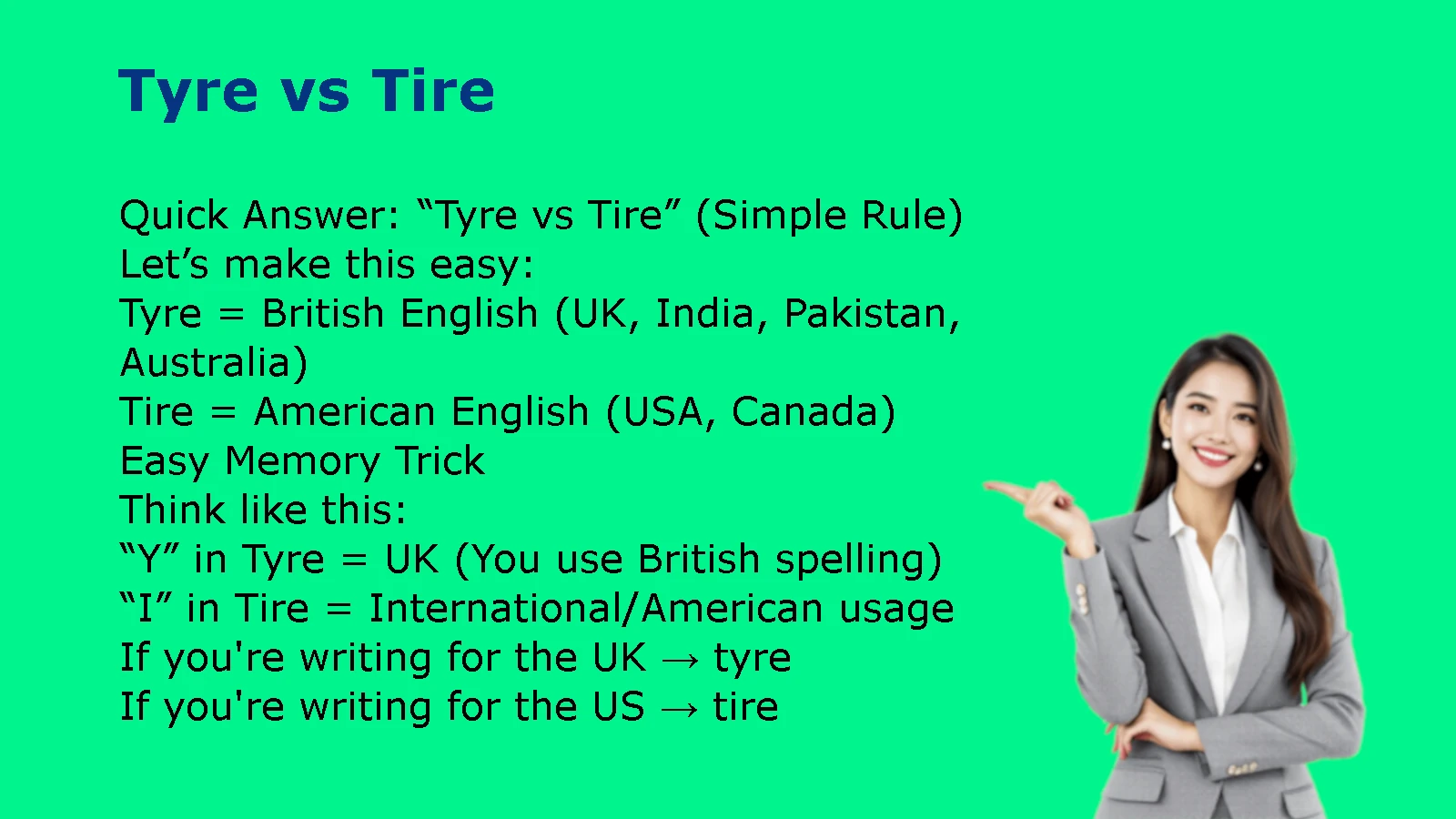
Quick Answer: “Tyre vs Tire” (Simple Rule)
Let’s make this easy:
- Tyre = British English (UK, India, Pakistan, Australia)
- Tire = American English (USA, Canada)
Easy Memory Trick
Think like this:
- “Y” in Tyre = UK (You use British spelling)
- “I” in Tire = International/American usage
If you’re writing for the UK → tyre
If you’re writing for the US → tire
What Does “Tyre/Tire” Mean?
Both words mean the same thing:
👉 The rubber covering around a wheel of a car, bike, or vehicle.
Example:
- The car has a flat tyre/tire.
- You need new tyres/tires for better grip.
No difference in meaning—only spelling changes.
Why Are There Two Spellings?
The difference comes from historical spelling reforms.
British English (Tyre)
- Preserves older English spelling patterns
- Common in UK-influenced regions
American English (Tire)
- Simplified spelling system introduced in the 18th–19th century
- Words were shortened or standardized for easier use
Key Insight:
It’s not grammar—it’s regional spelling evolution.
“Tyre” Explained (British English Usage)
In British English, “tyre” is the standard spelling.
Common Examples:
- “My car needs new tyres before the trip.”
- “The bike tyre is punctured.”
- “Check the air pressure in the tyres.”
Where You’ll See It:
- UK newspapers
- Pakistan & India English writing
- Australia & New Zealand
Simple Rule:
If the audience follows British English → use tyre
“Tire” Explained (American English Usage)
In American English, “tire” is the correct spelling.
Common Examples:
- “My car needs new tires.”
- “The front tire is flat.”
- “Rotate your tires regularly.”
Where You’ll See It:
- USA websites
- American textbooks
- Global tech content written in US English
Simple Rule:
If the audience is American → use tire
Tyre vs Tire: Side-by-Side Comparison
| Word | Region | Meaning | Example |
| Tyre | UK / British English | Rubber wheel covering | The tyre is worn out |
| Tire | US / American English | Rubber wheel covering | The tire is worn out |
👉 Meaning stays identical—only spelling changes.
Common Mistakes People Make
Here’s where confusion usually happens:
❌ Mixing both in one document
Example:
- “The car tyre is flat and needs new tires.”
❌ Using the wrong region spelling
- Writing “tyre” for US audience
- Writing “tire” for UK formal writing
❌ Not knowing audience preference
This is the biggest mistake in professional writing.
Real-Life Examples of “Tyre”
- “The mechanic replaced all four tyres.”
- “Check your tyre pressure before driving.”
- “A worn-out tyre can be dangerous.”
👉 Used in British English contexts.
Real-Life Examples of “Tire”
- “I bought new tires for my SUV.”
- “The front tire went flat on the highway.”
- “Rotate your tires every 5,000 miles.”
👉 Used in American English contexts.
How to Never Get Confused Again
Use this simple system:
Step 1: Identify audience
- UK / Commonwealth → Tyre
- US audience → Tire
: Match spelling
- British = Y → Tyre
- American = I → Tire
: When unsure
👉 Pick one style and stay consistent
Pro Tip for Writers & Students
If you’re writing essays, blogs, or SEO content:
- Choose one English style
- Stick to it throughout the entire document
- Don’t mix tyre/tire unless comparing them
Consistency matters more than preference.
FAQ: Tyre vs Tire
Is “tyre” correct in English?
Yes, in British English.
Is “tire” correct spelling?
Yes, in American English.
Do they mean different things?
No, they mean the same object.
Which spelling should I use?
Use based on your target audience.
Final Takeaway: The One Rule That Always Works
Here’s the simplest truth:
- Tyre = British English
- Tire = American English
- Same meaning, different regions
So instead of memorizing rules, just remember this:
👉 Write for your audience, not just the word.
Because in real communication, clarity always matters more than spelling debates.