Desensitize vs Desensitise is a spelling difference between American and British English. Desensitize is the standard American spelling, while desensitise is commonly used in British English. Both words mean to make someone or something less sensitive or responsive to a stimulus.
The word has several meanings depending on the context. You might become emotionally desensitized after repeated exposure to disturbing news, undergo desensitization therapy to manage a fear, or use desensitizing toothpaste to reduce tooth sensitivity. Understanding these meanings helps you choose the right word, use it naturally, and recognize when desensitization may require professional support.
| Question | Answer |
| Is it desensitize or desensitise? | Both are correct. Use desensitize in American English and desensitise in British English. |
| What does desensitized mean? | It means having reduced sensitivity or a weaker response to something. |
| What are examples of desensitization? | Examples include becoming less reactive to disturbing images, gradually overcoming a fear, and reducing tooth sensitivity. |
| Is it bad to be desensitized? | Not always. Reduced sensitivity can help in some situations, but persistent emotional numbness may affect well-being. |
| What is desensitization therapy? | It is a treatment approach that uses structured techniques, often gradual exposure, to reduce distressing responses to specific triggers. |
Desensitize vs Desensitise: Which Spelling Is Correct?
Both desensitize and desensitise are correct spellings of the same verb. The difference comes from regional spelling conventions, not meaning. American English generally favors the ending -ize, while British English commonly uses -ise for this word.
Choose the spelling that matches your audience and remain consistent throughout your writing. If you write for an American audience, use desensitize. For a British audience, desensitise is a natural choice.
Desensitize or Desensitise in American and British English
American and British English often spell certain verbs differently, even when the words have identical meanings and pronunciations.
The -ize and -ise distinction appears in several words, including organize/organise, recognize/recognise, and sensitize/sensitise. The preferred form depends on the regional convention and the style guide you follow.
| American English | British English | Meaning |
| Desensitize | Desensitise | Make less sensitive |
| Sensitize | Sensitise | Make more sensitive or aware |
| Organize | Organise | Arrange or coordinate |
| Recognize | Recognise | Identify or acknowledge |
| Standardize | Standardise | Make consistent |
For example:
- American English: The training helped desensitize the dog to loud noises.
- British English: The training helped desensitise the dog to loud noises.
Both sentences are grammatically correct. Neither spelling changes the meaning of the sentence.
British English also accepts many -ize forms, particularly in styles influenced by Oxford spelling conventions. Therefore, desensitize is not automatically incorrect in every British publication. Follow the spelling policy of your publisher, school, or organization.
Sensitise or Sensitize: Which Spelling Should You Use?
The same spelling distinction applies to sensitize and sensitise. Both verbs mean to make someone or something more sensitive, responsive, or aware.
The context determines the meaning, while the regional spelling convention determines the form you choose.
Examples:
- The campaign aims to sensitize employees to workplace harassment.
- The campaign aims to sensitise employees to workplace harassment.
- Repeated exposure to the chemical may sensitize the skin.
- Repeated exposure to the chemical may sensitise the skin.
Notice that sensitize generally describes an increase in sensitivity, whereas desensitize describes a decrease.
Desensitize UK Spelling and Common Spelling Mistakes
If you are writing for readers in the United Kingdom, desensitise is a common and appropriate choice. American readers will generally expect desensitize.
The most common mistakes involve mixing spelling conventions or confusing related words.
Avoid these errors:
- Writing desensitise in one paragraph and desensitize in another without a reason.
- Assuming the two spellings have different meanings.
- Confusing sensitize with desensitize.
- Treating desensitized and desensitization as unrelated words.
A simple editing rule works well: choose your target variety of English before drafting, then apply the same convention to every related word.
Desensitize Meaning and Definition
To desensitize means to reduce a person’s or an organism’s sensitivity or responsiveness to a particular stimulus. The stimulus might be emotional, physical, psychological, or environmental. Desensitization can happen through repeated exposure, a structured treatment program, or a product designed to reduce sensitivity. The exact meaning depends on the situation.
For example, someone who regularly encounters disturbing news may develop a weaker emotional reaction to it. A person receiving therapy may gradually become less afraid of a particular situation. A dental product may reduce the pain caused by hot or cold foods.
What Does Desensitized Mean?
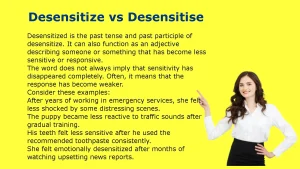
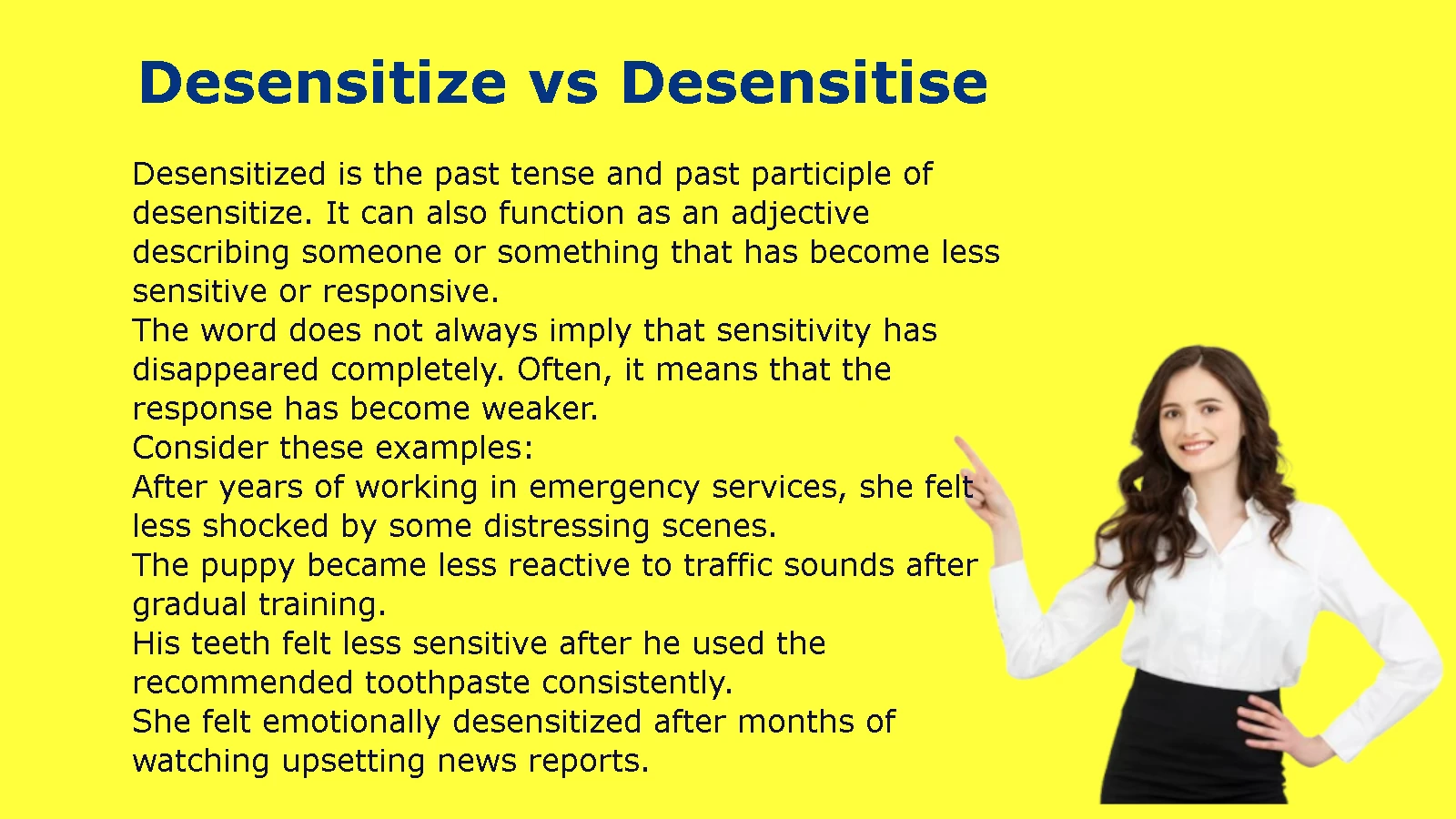
Desensitized is the past tense and past participle of desensitize. It can also function as an adjective describing someone or something that has become less sensitive or responsive.
The word does not always imply that sensitivity has disappeared completely. Often, it means that the response has become weaker.
Consider these examples:
- After years of working in emergency services, she felt less shocked by some distressing scenes.
- The puppy became less reactive to traffic sounds after gradual training.
- His teeth felt less sensitive after he used the recommended toothpaste consistently.
- She felt emotionally desensitized after months of watching upsetting news reports.
These examples describe different processes. Emotional desensitization concerns feelings and reactions, behavioral desensitization concerns responses to triggers, and dental desensitization concerns physical discomfort.
The distinction matters because a person who feels emotionally numb may need a different kind of support from someone experiencing tooth sensitivity.
Desensitize, Desensitized, and Desensitization
The related forms serve different grammatical purposes.
| Word | Part of speech | Definition | Example |
| Desensitize | Verb | To reduce sensitivity | The exercises may desensitize him to the situation. |
| Desensitizes | Verb, present tense | Reduces sensitivity | The treatment desensitizes the affected area. |
| Desensitized | Past tense or participle; adjective | Made less sensitive | She felt desensitized to the criticism. |
| Desensitizing | Present participle or adjective | Reducing sensitivity | He uses a desensitizing toothpaste. |
| Desensitization | Noun | The process of reducing sensitivity | Gradual desensitization helped the dog tolerate the carrier. |
The verb often appears in the construction desensitize someone or something to something.
For example, a therapist might help a client desensitize themselves to a specific fear through a structured treatment plan. A trainer might gradually desensitize a dog to the sound of a vacuum cleaner.
You can also use the passive construction become desensitized to something.
For example: “After repeated exposure to the noise, the workers became desensitized to it.”
Types of Desensitization
Desensitization can describe several processes. These categories help explain the word’s different meanings, although they are not one universal clinical classification.
Emotional desensitization occurs when someone experiences a weaker emotional response to a stimulus. Repeated exposure to distressing news may contribute to this response.
Psychological desensitization involves reducing distress associated with certain thoughts, objects, situations, or experiences. Some therapeutic methods use gradual exposure to achieve this goal.
Physical desensitization refers broadly to reduced sensitivity to a physical stimulus. The exact mechanism depends on the stimulus and the condition.
Dental desensitization aims to reduce discomfort caused by exposed dentin or other causes of tooth sensitivity.
Behavioral desensitization involves helping a person or animal respond more calmly to a particular trigger. Training may use controlled exposure, rewards, and gradual increases in difficulty.
Although these processes share the idea of reduced sensitivity, they do not work in exactly the same way. Emotional numbness, psychological treatment, and dental sensitivity require different explanations and responses.
Desensitize in a Sentence: Examples and Usage
The word desensitize usually takes an object: someone desensitizes a person, animal, or system to a stimulus. You can also describe the result by saying that someone or something becomes desensitized. The right construction depends on whether you want to emphasize the action or the resulting state.
Desensitized Examples in Everyday English
Here are original sentences that show how the word works in different contexts.
Emotional examples
- Repeated exposure to graphic news reports can desensitize some viewers to disturbing events.
- Constant criticism left him feeling desensitized to other people’s opinions.
- She worried that scrolling through upsetting videos every day was making her emotionally desensitized.
- The film explores how repeated violence can desensitize an audience over time.
Psychological examples
- The therapist used gradual exercises to help the client become less afraid of public speaking.
- Controlled practice helped desensitize him to the anxiety he experienced before presentations.
- The treatment aimed to reduce her distress when she encountered a specific trigger.
Animal behavior examples
- Short, positive training sessions helped desensitize the puppy to the sound of the doorbell.
- The owner gradually introduced the cat to its carrier before the veterinary visit.
- The trainer stopped the session when the dog showed signs of distress.
Dental examples
- The dentist recommended a desensitizing toothpaste for cold-triggered tooth sensitivity.
- The product helped reduce discomfort when she drank cold water.
- Persistent sensitivity prompted him to schedule a dental examination.
How to Use Desensitize and Desensitized Correctly
Use desensitize when describing an action or process.
Example: “The trainer will desensitize the dog to the sound of fireworks.”
Use desensitized when describing a completed action or a resulting condition.
Example: “The dog became desensitized to the sound after gradual training.”
You can also use the adjective before a noun:
- A desensitized response
- An emotionally desensitized viewer
- Desensitized skin, where appropriate to the medical context
However, don’t assume that a person who shows little emotion has necessarily become desensitized. Their behavior might reflect fatigue, stress, distraction, personality, or another factor. The word describes reduced responsiveness, not a diagnosis or a complete explanation of someone’s feelings.
Desensitized Synonyms and Related Words
Several words overlap with desensitized, but each carries a slightly different meaning.
| Synonym or related word | Meaning | Best use |
| Numb | Unable to feel normally, emotionally or physically | Describing emotional numbness or loss of physical sensation |
| Unresponsive | Showing little or no reaction | Describing behavior or a response to a stimulus |
| Less sensitive | Having a weaker response | Neutral, straightforward explanations |
| Hardened | Less emotionally affected by something | Describing a response shaped by difficult experiences |
| Accustomed | Familiar with something through experience | Explaining why a stimulus feels less unusual |
| Habituated | Showing a reduced response after repeated exposure | Discussing a learned or natural response |
| Indifferent | Showing little interest, concern, or preference | Describing a lack of concern rather than sensitivity itself |
These words are not interchangeable in every sentence.
For instance, someone may become accustomed to working in a noisy environment without feeling emotionally numb. A person can also remain deeply concerned about a problem while becoming less shocked by repeated reports about it.
Habituation is particularly relevant. It describes a reduced response to a repeated, often harmless stimulus. Desensitization is a broader term and may refer to deliberate therapeutic techniques or other forms of reduced sensitivity.
Choose the synonym that expresses the actual change you want to describe.
Desensitize Pronunciation and Spanish Translation
The words desensitize and desensitise have essentially the same pronunciation in standard English. Their spelling differs, but the regional spelling distinction does not usually create a corresponding difference in how people say them.
The Spanish translation also depends on context. In many situations, desensibilizar is an appropriate translation, but a natural translation may change depending on whether the subject is emotional sensitivity, a medical procedure, or a physical response.
How to Pronounce Desensitize
A common American English pronunciation is /diːˈsɛnsɪtaɪz/. The word has four syllables, with the main stress on the second syllable.
A useful breakdown is:
dee-SEN-si-tize
Focus on the stressed second syllable. The final part sounds like the word size.
The British spelling desensitise generally follows the same pronunciation pattern. Regional accents may produce small differences in vowel quality, but the spelling distinction does not usually change the word’s basic sound.
The related noun desensitization has a different ending and stress pattern, so avoid treating the two words as if they were pronounced identically.
Desensitize in Spanish
The Spanish verb desensibilizar commonly translates to desensitize. Its meaning depends on the surrounding sentence.
Examples:
- English: The treatment may desensitize the affected area.
- Spanish: El tratamiento puede desensibilizar la zona afectada.
Another example:
- English: Repeated exposure may desensitize people to disturbing images.
- Spanish: La exposición repetida puede desensibilizar a las personas ante imágenes perturbadoras.
For a general emotional context, you might also need a phrase that conveys becoming less affected or less sensitive rather than a direct word-for-word translation.
When translating medical or psychological material, use the terminology appropriate to the specific treatment or condition. A general dictionary equivalent may not communicate the precise clinical meaning.
Why Am I So Desensitized?
Feeling desensitized can mean that you no longer react as strongly to something that once affected you. Repeated exposure, prolonged stress, emotional exhaustion, and difficult experiences may contribute to this change. However, emotional numbness has several possible causes, and the feeling alone cannot identify which one applies to you.
For some people, the change is limited to a particular stimulus. For others, it affects relationships, interests, motivation, or their ability to experience positive emotions.
Common Causes of Emotional Desensitization
Several factors can contribute to feeling emotionally detached or less responsive.
Repeated exposure to disturbing content: Constantly viewing violent videos, upsetting news, or distressing images may make some people feel less shocked over time. The response varies, and repeated exposure does not affect everyone in the same way.
Chronic stress: Long periods of pressure can leave people mentally exhausted. They may feel that they have little emotional energy left to respond to everyday problems.
Difficult experiences or trauma: Some people experience emotional numbness after frightening or overwhelming events. This response can occur as part of a broader stress reaction, but it does not automatically mean someone has a particular disorder.
Depression or anxiety: Mental health conditions can affect emotional experience in different ways. Some people report emptiness, detachment, reduced enjoyment, or difficulty connecting with others.
Repeated exposure to familiar situations: A person who once felt intense anxiety before every presentation may gradually respond less strongly after practice. This can be a useful form of adaptation rather than a problem.
The context matters. Becoming less frightened of public speaking after gradual practice is different from losing interest in relationships or feeling emotionally numb across many areas of life.
Is It Bad to Be Desensitized?
Being desensitized is not always bad. A weaker reaction can help people handle familiar, stressful, or demanding situations. However, persistent emotional numbness may become a concern when it interferes with relationships, daily responsibilities, or the ability to experience enjoyment.
The key question is whether the change helps you function or leaves you feeling disconnected.
Potential benefits include:
- Feeling less overwhelmed by a familiar but manageable situation.
- Responding more calmly during routine emergencies or demanding work.
- Developing confidence after gradual practice with a feared activity.
- Becoming less reactive to harmless triggers.
Potential concerns include:
- Feeling disconnected from people you care about.
- Losing interest in activities that once mattered to you.
- Feeling little joy, sadness, or emotional connection across many situations.
- Becoming less responsive to other people’s distress.
- Struggling to understand or communicate your own emotions.
Consider two examples.
A student who becomes less anxious after repeatedly practicing presentations may be developing confidence. A person who feels emotionally empty for weeks, withdraws from friends, and stops enjoying favorite activities may need more support.
The word desensitized does not establish whether a response is healthy or harmful. Duration, intensity, context, and its effect on everyday life all matter.
Signs That Emotional Numbness May Need Attention
Emotional numbness deserves attention when it persists, causes distress, or interferes with daily life.
Possible signs include:
- Feeling disconnected from friends, family, or a partner.
- Losing interest in hobbies and activities.
- Finding it difficult to experience positive emotions.
- Feeling detached from your surroundings or experiences.
- Struggling to respond emotionally to situations that matter to you.
- Noticing changes in sleep, concentration, motivation, or everyday functioning.
These experiences can have several explanations. Avoid diagnosing yourself based on one symptom.
If the numbness persists or affects your relationships or responsibilities, consider speaking with a qualified mental health professional. They can help explore possible causes and discuss suitable support.
How to Cope With Unwanted Emotional Desensitization
You don’t need to force yourself to feel a particular emotion. Instead, start by identifying what has changed and whether it is affecting your life.
Reduce overwhelming exposure. If disturbing videos or news reports leave you feeling numb or exhausted, consider setting limits on how often you view them. You can stay informed without repeatedly consuming graphic material.
Pay attention to basic needs. Sleep, regular meals, movement, and time away from screens can support your general well-being. These steps may help, although they do not replace treatment when a more serious problem is present.
Reconnect with people. Spend time with trusted friends or family members, even if you don’t feel especially expressive. Honest conversation can help you understand what you are experiencing.
Notice patterns. Write down when the numbness appears, what happened beforehand, and whether it affects particular situations or nearly everything. This information may help you recognize triggers and explain your experience to a professional.
Seek appropriate support. A therapist or other qualified professional can help assess persistent emotional detachment, especially when it follows a difficult experience or occurs alongside other symptoms.
The goal is not to make every experience feel intense. It is to understand why your responses have changed and find a healthy way forward.
What Is Desensitization Therapy?
Desensitization therapy refers to approaches that aim to reduce a distressing response to a specific trigger. Some methods use gradual exposure, relaxation skills, or structured practice. The exact approach depends on the problem, and treatment should be tailored to the person’s needs rather than based on uncontrolled or overwhelming exposure.
The term covers different applications. Psychological treatment for a phobia, allergy immunotherapy, and dental treatment for sensitive teeth do not use identical methods.
Systematic Desensitization
Systematic desensitization is a behavioral therapy technique traditionally associated with reducing anxiety. It combines gradual exposure to feared situations with relaxation or other coping skills.
A therapist may begin by helping someone identify situations that trigger anxiety. They then arrange those situations from less difficult to more challenging.
For example, a person who fears public speaking might work through the following sequence:
- Imagine speaking in front of a small group.
- Practice a short presentation alone.
- Deliver the presentation to a trusted friend.
- Speak to a small group in a supportive setting.
- Work toward presenting to a larger audience.
The sequence should fit the individual’s circumstances. A person does not need to advance to the next step until the current exercise feels manageable.
Systematic desensitization differs from simply forcing yourself to endure a frightening situation. Structured treatment considers the level of distress, the individual’s goals, and the need for appropriate support.
Exposure Therapy and Gradual Desensitization
Exposure therapy helps people confront feared situations, sensations, or reminders in a structured therapeutic setting. It can be used for certain anxiety-related conditions and phobias.
The purpose is not necessarily to eliminate fear immediately. Treatment may help someone learn that a feared situation can be tolerated, that anxiety can change over time, or that an expected negative outcome does not always occur.
Gradual exposure is one possible approach, but not every effective exposure treatment follows a simple ladder from easiest to hardest. The plan depends on the condition, the person’s circumstances, and the therapeutic method.
For example, someone who avoids elevators because of a specific fear may work with a therapist to practice appropriate elevator-related situations. The therapist can help identify realistic goals and address avoidance without overwhelming the person.
If trauma, severe anxiety, or another significant mental health concern is involved, seek guidance from a qualified professional rather than attempting intense exposure on your own.
Types of Desensitization Used in Treatment
Different applications share a broad goal of reducing sensitivity, but their methods and purposes vary.
| Approach | Main purpose | Typical context |
| Systematic desensitization | Reduce anxiety through structured exposure and coping skills | Certain fears and phobias |
| Exposure therapy | Help a person respond differently to feared situations or reminders | Selected anxiety-related conditions |
| Allergy immunotherapy | Modify the immune response to a specific allergen | Certain diagnosed allergies under medical supervision |
| Dental desensitization | Reduce discomfort from sensitive teeth | Tooth sensitivity |
| Behavioral desensitization | Reduce an unwanted reaction to a specific trigger | Selected human or animal training situations |
Allergy immunotherapy deserves particular attention because it is a specialized medical treatment. It uses carefully managed allergen exposure under appropriate medical supervision. It should not be confused with psychological desensitization or attempted through self-directed exposure to allergens.
Similarly, dental desensitization addresses a physical problem and may involve specific ingredients or dental procedures.
Desensitization Therapy Examples and Limitations
Imagine someone who becomes extremely anxious whenever they need to speak during a meeting. They begin avoiding opportunities to contribute, which limits their work.
With appropriate support, they might practice short speaking exercises, identify unhelpful expectations, and gradually participate in manageable situations. Over time, they may find that the anxiety becomes easier to handle.
This example illustrates how structured practice may help change a response. It does not mean that every person will experience the same result or that every fear requires formal treatment.
Desensitization approaches have limitations:
- Progress may be gradual rather than immediate.
- A response may improve in one situation but remain strong in another.
- Poorly planned exposure can increase distress.
- Different conditions require different treatments.
- Some physical symptoms need medical assessment rather than behavioral training.
A useful treatment plan defines the problem, sets realistic goals, monitors progress, and adjusts the approach when necessary.
What Does Desensitized Toothpaste Mean?
Desensitizing toothpaste is toothpaste designed to reduce discomfort caused by sensitive teeth. Depending on its active ingredients, it may help block pathways through which stimuli reach the tooth’s nerve or reduce the nerve’s response. It can help manage certain forms of sensitivity, but it does not treat every cause of dental pain.
Sensitivity often appears as a brief, sharp sensation when you consume something cold, hot, sweet, or acidic, or when you brush your teeth.
How Desensitizing Toothpaste Works
Different formulations work in different ways.
Potassium nitrate is used in some products to help reduce nerve sensitivity. With consistent use as directed, it may help reduce the discomfort associated with sensitive teeth.
Stannous fluoride can help protect teeth and may reduce sensitivity through effects that include blocking exposed dentinal tubules. These microscopic channels in dentin can transmit stimuli toward the inner part of the tooth.
Other formulations may use different active ingredients or combinations. Read the product label to understand its intended use and directions.
Desensitizing toothpaste usually requires consistent use rather than producing an instant, permanent result. Follow the instructions on the package and your dentist’s recommendations.
When Should You Use Desensitizing Toothpaste?
You might consider a desensitizing toothpaste if you experience sensitivity triggered by cold drinks, hot foods, or brushing.
However, tooth sensitivity has several possible causes, including enamel wear, gum recession, exposed dentin, tooth decay, cracks, or other dental problems. A toothpaste may help some forms of sensitivity without addressing the underlying cause.
Consider these practical steps:
- Use the product according to its directions.
- Brush gently with a soft-bristled toothbrush.
- Avoid aggressive brushing that may contribute to gum recession or enamel wear.
- Reduce frequent exposure to acidic foods and drinks if they worsen your symptoms.
- Arrange a dental examination if the sensitivity persists, worsens, or affects one specific tooth.
Seek prompt dental advice for severe pain, swelling, or other concerning symptoms. Do not assume that every painful tooth simply needs desensitizing toothpaste.
Desensitizing Toothpaste vs. Regular Toothpaste
| Feature | Desensitizing toothpaste | Regular toothpaste |
| Main purpose | Help reduce tooth sensitivity | Support routine oral hygiene |
| Active ingredients | May include potassium nitrate or stannous fluoride | Often contains fluoride, with formulation varying by product |
| Sensitivity relief | Specifically formulated for certain sensitivity symptoms | May not provide targeted sensitivity relief |
| Use | Follow the product label or dental advice | Follow the product label and normal brushing guidance |
| Limitations | Does not treat every cause of dental pain | Does not necessarily address tooth sensitivity |
Both types can support oral hygiene. The right choice depends on your symptoms, the formulation, and whether a dental professional has identified an underlying problem.
What Does Desensitized Cat Mean?
A desensitized cat has become less reactive to a particular stimulus, such as a carrier, household noise, or unfamiliar object. Gradual exposure can help some cats become more comfortable with these triggers. However, a cat that suddenly seems unusually unresponsive may have a medical or behavioral problem rather than showing successful desensitization.
The word describes a response to a specific stimulus. It does not mean that a cat should become unresponsive to everything around it.
Cat Desensitization Through Gradual Exposure
Cats may react strongly to unfamiliar sounds, handling, carriers, visitors, or changes in their surroundings. Gradual desensitization aims to introduce the trigger at a level the cat can tolerate without becoming overwhelmed.
Suppose a cat hides whenever its owner brings out the carrier. The owner might begin by placing the carrier in a familiar room with the door open and allowing the cat to investigate it freely.
The process may involve these steps:
- Place the carrier in a quiet, familiar area.
- Let the cat approach it voluntarily.
- Use treats or positive experiences to build a comfortable association.
- Practice brief interactions without forcing the cat inside.
- Increase the challenge gradually when the cat remains comfortable.
For a cat that fears a vacuum cleaner, the owner might begin with the switched-off appliance at a distance. Any later exposure to sound should remain controlled and appropriate to the cat’s response.
The aim is not to force the animal to endure fear. If the cat hides, freezes, refuses food, or shows other signs of distress, reduce the difficulty or stop the session.
Signs That a Cat Is Becoming More Comfortable
Progress depends on the trigger and the cat’s normal behavior. Potential signs include:
- Less avoidance when the specific trigger appears.
- A calmer response at a previously difficult distance.
- Willingness to explore or approach voluntarily.
- Ability to eat or play during an appropriately mild exposure.
- Faster recovery after a brief, manageable trigger.
Look for changes across multiple sessions rather than assuming one calm moment proves that the cat has become fully comfortable.
A cat may tolerate the carrier at home but still feel anxious during travel or a veterinary visit. Skills learned in one setting do not always transfer immediately to another.
When to Stop and Seek Professional Advice
Stop or reduce exposure if the cat shows persistent fear, attempts to escape, becomes aggressive, or appears overwhelmed. Forcing repeated exposure can worsen fear rather than reduce it.
You should also seek veterinary advice if your cat suddenly becomes unusually quiet, stops interacting, seems lethargic, or shows a significant change in behavior. These signs may indicate pain or illness, not desensitization.
For persistent fear-related behavior, a veterinarian or qualified feline behavior professional can help you develop a suitable plan.
Desensitize vs. Sensitize: Key Differences
Desensitize means to reduce sensitivity or responsiveness. Sensitize means to increase sensitivity or awareness. The words describe opposite directions of change, although their precise meanings depend on the context.
In psychology, desensitization may involve reducing distress associated with a trigger. Sensitization can describe an increased response after repeated exposure to certain stimuli. In communication, sensitize often means making people more aware of an issue.
| Term | Meaning | Example |
| Desensitize | Reduce sensitivity or responsiveness | Gradual training helped desensitize the dog to the carrier. |
| Sensitize | Increase sensitivity or awareness | The workshop aims to sensitize employees to workplace harassment. |
| Desensitized | Having reduced sensitivity or responsiveness | He felt desensitized after constant exposure to disturbing news. |
| Sensitized | Having increased sensitivity or responsiveness | Repeated exposure to the substance may have sensitized the skin. |
One important distinction is that sensitize can refer to increased awareness in a social context, while desensitize generally refers to reduced responsiveness. They are related words, but their meanings are not always exact opposites in every technical use.
For example, a campaign can sensitize people to the effects of bullying by helping them recognize its signs. A therapeutic process may desensitize someone to a specific fear by reducing the distress associated with the trigger.
Choose the word that reflects the direction of the change and the context in which it occurs.
Frequently Asked Questions
Is Desensitize or Desensitise Correct?
Both spellings are correct. Desensitize is the standard form in American English, while desensitise is commonly used in British English. Both mean to make someone or something less sensitive or responsive. Choose the form that matches your audience or required style guide.
What Does Desensitized Mean in Simple Words?
Desensitized means that someone or something has become less sensitive or reacts less strongly to a stimulus. For example, a person may become less shocked by repeated exposure to disturbing images, while a dog may become less reactive to a familiar sound after gradual training.
Why Do People Become Desensitized?
People may become desensitized because of repeated exposure, stress, emotional exhaustion, difficult experiences, or learning. The reason depends on the situation. Becoming less anxious after practicing a speech differs from persistent emotional numbness, which may warrant professional support if it affects daily life.
Is It Bad to Be Desensitized?
Not necessarily. Reduced sensitivity can help someone handle a familiar or manageable situation with less distress. However, persistent emotional numbness may affect relationships, motivation, and enjoyment. Consider the context, duration, and impact rather than assuming that all forms of desensitization are harmful.
What Are the Main Types of Desensitization?
Common contexts include emotional, psychological, physical, dental, and behavioral desensitization. Psychological methods may use structured exposure to reduce fear, while dental products aim to reduce tooth sensitivity. These approaches share a broad idea but involve different mechanisms and purposes.
Does Desensitizing Toothpaste Really Work?
Desensitizing toothpaste can help manage certain forms of tooth sensitivity. Some formulations reduce nerve sensitivity, while others help block pathways through exposed dentin. Results depend on the product and the cause of the discomfort. Persistent or severe tooth pain needs dental evaluation.
Conclusion: Choose the Right Meaning and Spelling of Desensitize
The difference between desensitize and desensitise is regional spelling. American English generally uses desensitize, while British English commonly uses desensitise. Both forms have the same meaning and pronunciation.
The broader term describes reduced sensitivity in several contexts, from emotional reactions and behavioral training to psychological treatment and dental care. Understanding the context helps you use the word accurately and avoid confusing everyday emotional numbness with a clinical treatment.