Until is the correct spelling, while untill is a common misspelling in standard English. Both American and British English use until, and neither variety accepts untill as the standard form. However, till is also correct and has the same time-related meaning as until. Understanding Until vs Untill, until vs. till, and until vs. unless helps you write clearer sentences and avoid common spelling and grammar mistakes.
The word until refers to a point in time when something stops, changes, or reaches an endpoint. You can use it with a time expression, such as until Friday, or a clause, such as until the meeting ends. It also appears in negative constructions like not until, which often emphasizes a delay. Learning these patterns makes it easier to use until naturally in emails, conversations, academic writing, and professional documents.
Until vs Untill: Which Spelling Is Correct?
Until is the correct spelling in standard English. Untill is incorrect because the word ends with one L, not two. This spelling rule applies to both American and British English. For example, write “I’ll wait until tomorrow,” not “I’ll wait untill tomorrow.”
| Spelling | Correct or Incorrect | Example |
| Until | Correct | We stayed until midnight. |
| Untill | Incorrect | We stayed untill midnight. |
| Till | Correct | We stayed till midnight. |
| ‘Til | Informal variant | I’ll wait ’til tomorrow. |
The easiest way to remember the correct spelling is to focus on the final letters. Until ends in til, with only one L.
Why Is Untill Incorrect?
The spelling untill is a common typing and spelling mistake. Writers may double the final L because many English words follow spelling patterns that involve doubled consonants.
However, until does not follow that pattern. The standard spelling contains one L at the end.
Here are a few examples:
- Incorrect: Please wait untill the manager arrives.
- Correct: Please wait until the manager arrives.
- Incorrect: The store will remain closed untill Monday.
- Correct: The store will remain closed until Monday.
- Incorrect: I didn’t understand untill she explained it.
- Correct: I didn’t understand until she explained it.
A useful proofreading technique is to search your document for untill. If you find it, replace it with until, unless you’re deliberately quoting or discussing the misspelling itself.
Historical texts may contain spelling variations that differ from modern usage. However, those historical forms don’t make untill an acceptable spelling for contemporary standard writing.
Until or Untill in British and American English
Until is correct in both British and American English. Unlike words such as colour and color or organise and organize, this spelling doesn’t change between the two varieties.
| English Variety | Correct Spelling | Incorrect Spelling |
| American English | Until | Untill |
| British English | Until | Untill |
| Canadian English | Until | Untill |
| Australian English | Until | Untill |
Examples:
- American English: The deadline is until Friday.
- British English: The deadline is until Friday.
- Australian English: The office remains closed until Monday.
The sentences use the same spelling regardless of the English variety.
One additional point matters: although the spelling remains the same, writers may prefer different expressions depending on context. For example, until further notice works naturally in formal writing across English varieties.
Until or Untill: Correct Spelling Examples
Use these original examples to understand how until works in everyday sentences.
- I will save my money until I can afford a new laptop.
- The children played outside until the rain started.
- Please keep the announcement private until Monday.
- She waited until everyone had arrived.
- We cannot publish the article until the editor approves it.
- The road remained closed until the workers repaired the damage.
Each sentence uses until to identify a time boundary or event that marks a change.
Until Meaning: What Does Until Mean?
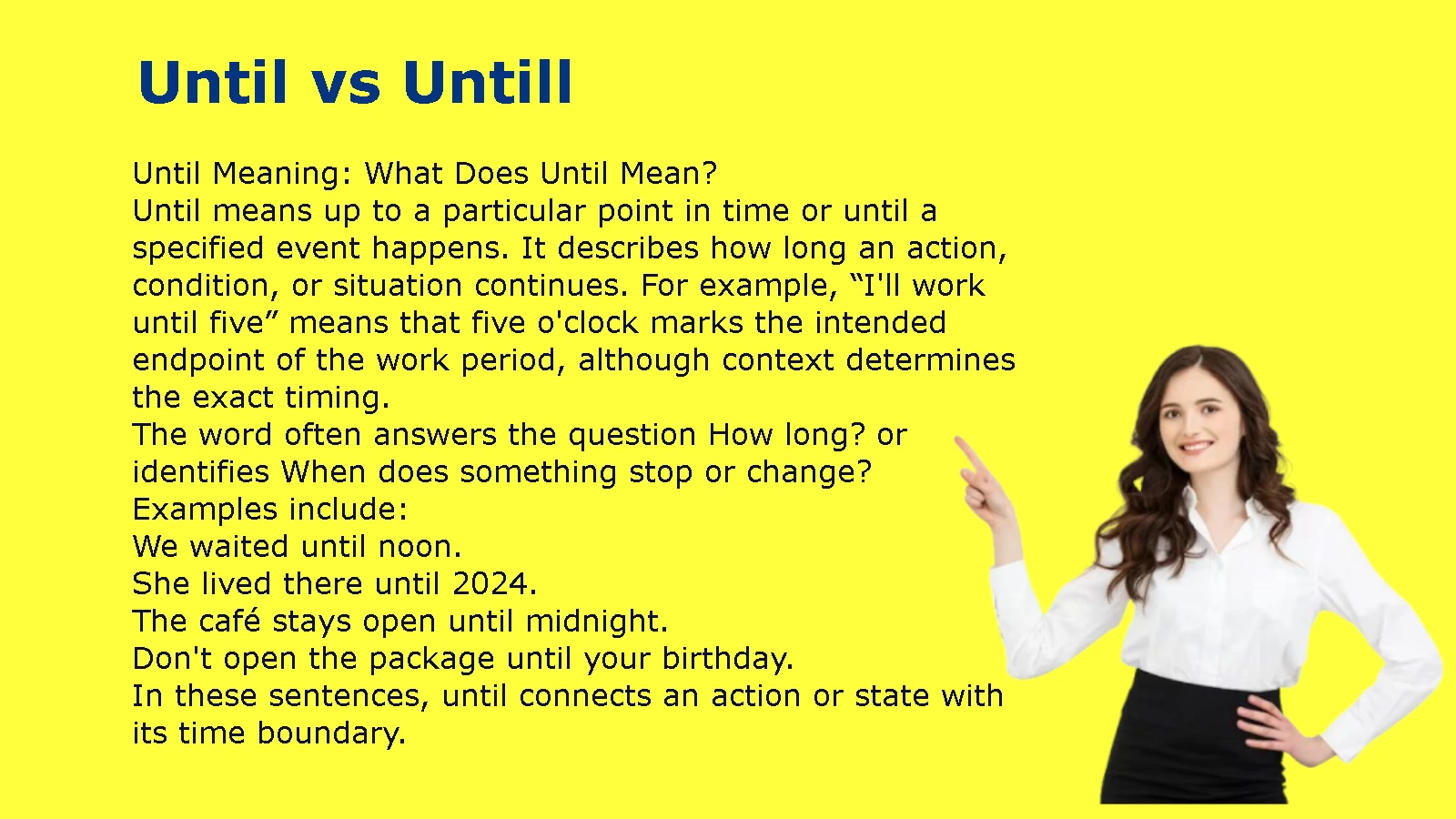
Until means up to a particular point in time or until a specified event happens. It describes how long an action, condition, or situation continues. For example, “I’ll work until five” means that five o’clock marks the intended endpoint of the work period, although context determines the exact timing.
The word often answers the question How long? or identifies When does something stop or change?
Examples include:
- We waited until noon.
- She lived there until 2024.
- The café stays open until midnight.
- Don’t open the package until your birthday.
In these sentences, until connects an action or state with its time boundary.
Until Meaning in Simple English
In simple English, until means up to a certain time or event.
Imagine waiting for a friend at a train station. Your friend tells you, “Wait here until I arrive.”
This instruction means you should continue waiting up to the point when your friend arrives.
The word can describe:
- A clock time: I’ll stay until 7 p.m.
- A day: We have until Thursday.
- An event: Keep stirring until the mixture thickens.
- A change in condition: The room remained dark until someone turned on the lights.
The endpoint doesn’t always involve a clock. It can be an event, a change, or the completion of an activity.
For example, in “Keep walking until you reach the bridge,” the bridge marks the endpoint of the walking instruction.
Until Meaning Examples in Sentences
The following examples show how until expresses time in different situations.
| Example | Meaning |
| I’ll stay here until noon. | Noon marks the intended endpoint of the stay. |
| The store is closed until Monday. | Monday marks the stated endpoint of the closure. |
| Wait until the traffic clears. | Continue waiting until the traffic clears. |
| She studied until she felt confident. | Her studying continued until that condition was reached. |
| We didn’t hear the news until evening. | The news wasn’t heard before evening. |
Notice that until doesn’t always guarantee that something happens at the exact endpoint.
For example, “I’ll wait until 6 p.m.” describes a planned endpoint. It doesn’t necessarily prove that the person will leave at exactly 6 p.m. Real-world actions may vary with context.
This distinction helps prevent overly rigid interpretations of the word.
What Does Not Until Mean?
Not until usually means not before a particular time or event. It emphasizes that something doesn’t happen earlier than the specified point.
Consider this sentence:
“We didn’t leave until sunset.”
This means the speakers didn’t leave before sunset. They left at sunset or sometime afterward, depending on context.
More examples:
- The restaurant didn’t open until 10 a.m.
- I didn’t realize my mistake until I checked the results.
- She won’t return until next week.
- The team didn’t announce the winner until the final round ended.
Not until can also create emphasis when it appears at the beginning of a sentence.
For example:
“Not until the lights went out did we notice the noise.”
This construction uses inversion. The auxiliary verb did comes before the subject we.
Compare:
- Normal order: We didn’t notice the noise until the lights went out.
- Emphatic order: Not until the lights went out did we notice the noise.
Both sentences communicate the same basic idea, but the second gives more emphasis to the delay.
Until vs. Till: What’s the Difference?
Until and till generally have the same meaning: up to a particular time or event. Both are correct English words, and both can function as prepositions or conjunctions. Until often suits formal writing, while till sounds natural in conversation and informal writing. The choice usually reflects style rather than grammar.
For most sentences, you can replace until with till without changing the central meaning.
| Until | Till |
| I’ll wait until Friday. | I’ll wait till Friday. |
| The shop stays open until six. | The shop stays open till six. |
| Don’t leave until I return. | Don’t leave till I return. |
Both versions are grammatically acceptable.
Is Till Correct English?
Yes. Till is a correct English word, not simply a shortened or incorrect form of until.
It has a long history in English and predates until. Both words developed as expressions of time and are now established in standard usage.
Some writers assume that till must be informal or incorrect because it looks shorter. However, dictionaries recognize it as a standard word.
You can use till in:
- Everyday conversations
- Text messages
- Informal emails
- Dialogue in stories
- Many ordinary professional sentences
For example:
“I’ll be available till lunchtime.”
This sentence is correct and natural.
In highly formal documents, you may choose until for consistency or tone, but you don’t need to avoid till because of grammar.
When Should You Use Until or Till?
Choose between until and till based on your audience, writing style, and sentence rhythm.
Use until when:
- Writing academic assignments
- Preparing formal business documents
- Drafting policies or instructions
- Maintaining a consistent formal tone
Use till when:
- Writing casual messages
- Creating natural dialogue
- Speaking conversationally
- Matching an informal brand voice
Consider these examples:
Formal: Applications will remain open until December 15.
Conversational: I’ll hang around till you finish.
The difference is subtle. Neither word is automatically better in every situation.
If your article, report, or email already uses until consistently, there’s usually no reason to switch to till halfway through.
Until vs. Till Examples
Here are additional examples that demonstrate how both words work.
Example: Scheduling
- We need to finish the presentation until Friday.
- We need to finish the presentation by Friday.
The second sentence is more appropriate if Friday is the deadline for completion. Until Friday would usually describe how long an activity continues.
This illustrates an important distinction: choosing between until and till is not the same as choosing between until and by.
Example: Waiting
- I’ll wait until the bus arrives.
- I’ll wait till the bus arrives.
Both sentences are correct.
Example: Opening hours
- The pharmacy stays open until 9 p.m.
- The pharmacy stays open till 9 p.m.
Both sentences describe the same general closing time.
Until vs. Till vs. ‘Til
Although these forms look similar, their usage differs slightly.
| Form | Usage | Recommendation |
| Until | Standard form | Best all-purpose choice |
| Till | Standard alternative | Correct in formal and informal English |
| ‘Til | Informal variant | Use selectively |
| Untill | Misspelling | Avoid |
The apostrophe in ’til often signals an informal shortened spelling. However, till already exists as a complete word, so the apostrophe isn’t necessary.
For example:
- Standard: I’ll be there until seven.
- Standard: I’ll be there till seven.
- Informal: I’ll be there ’til seven.
For professional and academic writing, until remains a dependable choice.
Until vs. Unless: What’s the Difference?
Until refers to a time boundary, while unless introduces a condition or exception and generally means except if. Use until when something continues up to a time or event. Use unless when an outcome depends on a condition. Confusing these words can change the meaning of an entire sentence.
The easiest way to distinguish them is to ask two questions:
- Until: When does something stop or change?
- Unless: Under what condition will something happen?
When to Use Until
Use until when describing how long something continues.
Examples:
- I’ll stay until the meeting ends.
- The road will remain closed until repairs are complete.
- Don’t submit the form until you’ve checked your answers.
- She practiced until she could play the song confidently.
Each sentence identifies a time-related endpoint.
In “Don’t submit the form until you’ve checked your answers,” the action of submitting should wait until the checking has happened.
The word until doesn’t introduce a general condition in the same way unless does. It establishes a time relationship.
When to Use Unless
Use unless when describing a condition that must be considered.
Examples:
- You won’t pass unless you study.
- I’ll go for a walk unless it rains.
- The application won’t proceed unless you provide the required documents.
- Unless we leave now, we’ll miss the train.
In these examples, unless introduces an exception or condition.
For instance:
“You won’t pass unless you study.”
This generally means studying is necessary for passing, although the exact real-world outcome depends on the situation.
The sentence doesn’t identify a time endpoint. Instead, it explains a condition connected to an outcome.
Until vs. Unless Examples
Compare these sentences carefully.
| Sentence | Meaning |
| I’ll wait until you call. | I’ll continue waiting up to the time you call. |
| I’ll leave unless you call. | I’ll leave if you don’t call. |
| You can’t enter until the manager arrives. | The manager’s arrival marks the relevant time boundary. |
| You can’t enter unless the manager approves. | The manager’s approval is a condition for entry. |
| Keep the door closed until I return. | Keep it closed up to my return. |
| Keep the door closed unless I approve. | Keep it closed except when I approve otherwise. |
These differences become especially important in instructions, contracts, workplace policies, and safety notices.
For example:
“Do not release the package until the supervisor arrives.”
This instruction establishes a time-related restriction.
“Do not release the package unless the supervisor approves.”
This instruction establishes an approval condition.
The two sentences aren’t interchangeable.
Common Mistakes With Until and Unless
Writers sometimes replace one word with the other without checking how the sentence changes.
Incorrect for the intended time meaning: I’ll stay unless you arrive.
Correct: I’ll stay until you arrive.
The original sentence is grammatical, but its meaning changes. It suggests that the speaker will stay if the other person doesn’t arrive, rather than simply describing a planned waiting period.
Another example:
Original: We won’t begin until everyone arrives.
Changed: We won’t begin unless everyone arrives.
The first sentence describes when the group expects to begin. The second makes everyone’s arrival a condition for beginning.
The difference may appear small, but it can affect instructions and commitments.
A useful editing method is to replace:
- Until with up to the time when.
- Unless with except if.
If the replacement doesn’t preserve the intended meaning, reconsider your word choice.
Is Until a Preposition or Conjunction?
Until can function as both a preposition and a subordinating conjunction. It acts as a preposition when it introduces a noun phrase or time expression, such as until midnight. It acts as a conjunction when it introduces a clause, such as until the train arrives. Its grammatical role depends on the structure that follows it.
This distinction matters because the same word can perform different grammatical functions in different sentences.
Until as a Preposition
Until functions as a preposition when it introduces a noun phrase or another suitable time expression.
Examples:
- We stayed until midnight.
- The store is closed until Monday.
- She worked until lunchtime.
- The children played until sunset.
- The discount remains available until December 31.
In each sentence, the word introduces a time expression.
Look at this example:
“The office remains closed until Monday.”
The word until introduces Monday, a time expression. It connects the office’s closed state to its endpoint.
Prepositional phrases with until can appear in different places within a sentence.
For example:
“Until Friday, the office will operate remotely.”
Here, the phrase appears at the beginning and sets the time boundary for the main clause.
Until as a Conjunction
Until functions as a subordinating conjunction when it introduces a clause containing a subject and a verb.
Examples:
- I’ll wait until the bus arrives.
- She stayed until the meeting ended.
- Don’t leave until I return.
- We continued working until the manager approved the design.
- The baby slept until the phone rang.
Consider:
“I’ll wait until the bus arrives.”
The clause the bus arrives contains a subject (the bus) and a verb (arrives).
The word until introduces that clause and connects it to the main clause.
This relationship shows that the waiting continues up to the arrival event.
How to Identify Until’s Part of Speech
You can identify the grammatical role of until by examining what comes immediately after it.
| Construction | Example | Function |
| Until + noun phrase | Until noon | Preposition |
| Until + day | Until Tuesday | Preposition |
| Until + clause | Until she arrives | Subordinating conjunction |
| Until + subject + verb | Until the rain stops | Subordinating conjunction |
Quick identification test:
- If until introduces a time expression like midnight, it generally functions as a preposition.
- If it introduces a clause like the meeting ends, it functions as a subordinating conjunction.
This is a practical way to analyze common examples without memorizing complex grammar terminology.
Until Grammar: Rules You Should Know
The main grammar rules for until involve time clauses, verb tense, negative constructions, punctuation, and word choice. Use until to describe continuation up to a time or event, avoid unnecessary future-tense forms in ordinary future-time clauses, and distinguish it from by, which often sets a completion deadline.
Which Tense Should You Use After Until?
When until introduces a future-time clause, English commonly uses the present simple instead of will.
For example:
Correct: I’ll wait until she arrives.
Usually incorrect in this intended time-clause construction: I’ll wait until she will arrive.
The present tense arrives refers to a future event.
More examples:
- We’ll start until everyone arrives.
- We’ll wait until everyone arrives.
- She’ll stay until the guests leave.
- I’ll keep working until I finish the report.
Notice the difference between the first and second examples.
“We’ll start until everyone arrives” doesn’t normally express the intended meaning because start describes an event rather than a continuing activity. A better sentence is “We’ll wait until everyone arrives.”
The problem isn’t the tense alone. The verb start also affects the meaning.
Until commonly appears with continuous or continuing actions and states, although it can also describe the timing of a change.
You can also use the present perfect when you want to emphasize completion:
“We’ll wait until she has finished.”
This highlights the completed activity.
However, English grammar isn’t limited to one tense pattern. Past-time clauses and other contexts may require different verb forms.
Examples:
- We waited until she arrived.
- They stayed until the rain had stopped.
- I’ll wait until the technician has checked the system.
Choose the form that expresses the intended time relationship.
How to Use Not Until in a Sentence
Not until emphasizes that an event doesn’t happen before a certain time or condition.
Examples:
- I didn’t get home until midnight.
- The results won’t be available until Monday.
- He didn’t understand the lesson until he practiced.
- The company didn’t announce the changes until the meeting ended.
The expression is especially useful when the delay matters.
For example:
“The package didn’t arrive until Friday.”
This sentence tells readers that the package arrived later than expected or later than some relevant reference point, depending on context.
You can also move not until to the beginning for emphasis.
“Not until Friday did the package arrive.”
This construction uses subject-auxiliary inversion.
A few things to remember:
- Use did with the base form of the main verb in this inverted construction.
- Don’t write “Not until Friday the package arrived” when using this emphatic pattern.
- Keep the sentence structure clear.
Until vs. By: Which One Should You Use?
Until describes continuation up to a time. By commonly identifies a deadline by which something should happen or be completed.
This difference matters in scheduling and professional writing.
| Until | By |
| I’ll work until five. | I’ll finish the report by five. |
| The shop is open until nine. | Please arrive by nine. |
| You can stay until Friday. | Submit the form by Friday. |
In the first sentence, until five describes how long the work continues.
In the second sentence, by five establishes the deadline for finishing the report.
Compare these examples:
I’ll work until Friday.
This suggests the work will continue up to Friday.
I’ll finish the work by Friday.
This means the work should be completed no later than Friday.
In some contexts, both words may appear in the same instruction:
“You can access the portal until Friday, but you must submit your application by Thursday.”
The portal’s availability has an endpoint, while the application has an earlier deadline.
Until vs. Before
Until identifies an endpoint or period of continuation. Before places an action earlier than a particular time or event.
Examples:
- Stay here until noon.
- Finish the task before noon.
- We waited until the doors opened.
- We arrived before the doors opened.
The first sentence tells someone how long to remain in a place.
The second tells someone when the task should be completed.
A practical comparison:
| Word | Main Function | Example |
| Until | Marks a time boundary | Wait until six. |
| Before | Places something earlier | Arrive before six. |
If you need to describe a duration or endpoint, until may fit better.
If you need to set an earlier deadline, before may be the better choice.
Punctuation With Until
Punctuation with until depends mainly on sentence structure.
When the until clause comes first, a comma often separates it from the main clause.
Examples:
- Until the rain stops, we’ll stay inside.
- Until the manager approves the request, the team cannot proceed.
- Until the guests arrive, keep the food covered.
When the until clause comes after the main clause, a comma usually isn’t necessary.
- We’ll stay inside until the rain stops.
- The team cannot proceed until the manager approves the request.
- Keep the food covered until the guests arrive.
The comma helps readers recognize the boundary between the introductory dependent clause and the main clause.
Don’t add a comma automatically every time you use until.
Common Until Grammar Mistakes
Avoid these common errors when writing with until.
Mistake: Doubling the final L
Incorrect: I’ll wait untill Friday.
Correct: I’ll wait until Friday.
Mistake: Using will unnecessarily
Usually incorrect for a future-time clause: I’ll wait until she will arrive.
Correct: I’ll wait until she arrives.
Mistake: Confusing until and by
Unclear for a completion deadline: Please finish the report until Friday.
Better: Please finish the report by Friday.
Mistake: Using until for quantities or distance
Incorrect: The box weighs until ten pounds.
Correct: The box weighs up to ten pounds.
Mistake: Confusing until and unless
Potentially different meaning: I’ll stay unless you arrive.
If you mean a waiting period, write: I’ll stay until you arrive.
These corrections help make your writing more precise and easier to understand.
Until in Everyday English: Practical Examples
Until appears in instructions, schedules, conversations, academic writing, and business communication. It helps writers explain time limits, waiting periods, deadlines, and changes. Choosing the right sentence structure can prevent confusion, especially when readers need to understand exactly when an action should begin, stop, or remain in effect.
Until Examples in Emails and Professional Writing
Professional writing often uses until to describe policies, deadlines, access periods, and temporary arrangements.
Examples:
- The registration form will remain available until November 15.
- Please keep this announcement confidential until publication.
- The revised schedule applies until further notice.
- The support team will monitor the issue until the system returns to normal.
- Your temporary access will remain active until the end of the month.
These examples work well because until identifies the endpoint of an arrangement.
However, when a message concerns an actual deadline, check whether by expresses the intended meaning more accurately.
For example:
“Please send the signed agreement by Thursday.”
This is clearer if Thursday is the final submission deadline.
Until Examples in Conversations
In everyday conversations, until often appears in simple instructions and plans.
Examples:
- I’ll be here until six.
- Don’t start until I’m ready.
- We played outside until it got dark.
- Wait until I finish this call.
- I’ll stay until the food arrives.
You can often use till in these sentences without changing the meaning.
For example:
“I’ll stay till the food arrives.”
The shorter form sounds natural in casual speech.
Until Examples for Students and Academic Writing
Academic writing uses until to describe experiments, observations, historical periods, and research processes.
Examples:
- The experiment continued until the temperature stabilized.
- The samples remained frozen until the analysis began.
- Researchers observed the animals until the trial ended.
- The results remained unclear until the team examined the additional evidence.
However, academic writers should distinguish between until and by when describing procedures or deadlines.
For example:
“The samples were stored until testing began.”
This describes how long storage continued.
“The samples were tested by Friday.”
This describes a deadline or completion point.
Precise time expressions help readers understand the sequence of research activities.
Practical Case Study: Until vs. By in a Workplace Instruction
Imagine a project manager sends this message:
“Please work on the draft until Friday.”
Some employees may interpret this as a request to continue working through Friday. Others may wonder whether the draft needs to be completed on Friday.
The instruction leaves room for interpretation.
A clearer version depends on the manager’s goal.
If employees should continue working through Friday:
“Please work on the draft until the end of Friday.”
If employees should submit the draft no later than Friday:
“Please submit the draft by Friday.”
If employees should stop working at a particular time:
“Please work on the draft until 5 p.m. Friday.”
This example shows why grammar choices affect workplace efficiency. The issue isn’t spelling alone. Until and by communicate different timing expectations.
Quick Comparison: Until vs Untill vs. Till vs. Unless
Use this comparison table when you need a quick answer about spelling, meaning, and usage.
| Word | Correct? | Meaning or Function |
| Until | Yes | Up to a time or event |
| Untill | No | Common misspelling of until |
| Till | Yes | Same general time-related meaning as until |
| Unless | Yes | Introduces a condition or exception |
| ‘Til | Informal variant | Informal spelling used for until |
Remember these simple distinctions:
- Until: Time boundary.
- Till: Correct alternative to until.
- Unless: Condition or exception.
- Untill: Incorrect standard spelling.
- ‘Til: Informal variant.
A Simple Memory Trick for Until
If you often type untill, remember this:
Until has one L at the end.
You can also connect the word with a familiar expression:
“Wait until tomorrow.”
Repeat the sentence while checking the spelling. This creates a practical association between the word and its correct form.
For proofreading, use this short checklist:
- Is until spelled with one final L?
- Does the sentence describe a time boundary?
- Would by better express a deadline?
- Does unless better express a condition?
- Is the sentence clear about when an action begins or ends?
These checks can prevent spelling and meaning errors in just a few seconds.
Frequently Asked Questions
Is Until or Untill Correct?
Until is the correct standard spelling. Untill is a common misspelling and should be avoided in formal and informal writing. For example, write “I’ll wait until Monday,” not “I’ll wait untill Monday.”
Is Till Short for Until?
No. Till is an established English word that predates until. It isn’t simply an incorrect shortening. Both words can express the same time-related meaning, so you can use either in many sentences.
Is Until British or American English?
Until is standard in both British and American English. The spelling doesn’t change between these varieties. Unlike colour/color or organise/organize, until has the same standard spelling in both.
Does Until Mean Before or After?
Until marks a time boundary, often describing how long something continues. In negative sentences, not until usually means not before. For example, “I didn’t leave until noon” means the departure happened at noon or later, depending on context.
Can I Use Until and Till Interchangeably?
Yes. Until and till generally have the same meaning and can replace each other in many sentences. Until may sound more formal, but till is also correct standard English. Choose the form that fits your writing style.
What Is the Difference Between Until and Unless?
Until refers to time, while unless introduces a condition or exception. “I’ll wait until you call” describes a waiting period. “I’ll leave unless you call” means the speaker will leave if the other person doesn’t call.
Conclusion: Choose Until, Not Untill
The correct spelling is until, not untill. This rule applies to both British and American English, so you don’t need to memorize separate regional spellings.
Remember the differences between the related words:
- Until describes a time boundary.
- Till is a correct alternative with the same general meaning.
- Unless introduces a condition or exception.
- By often establishes a completion deadline.
- Untill is a spelling mistake.
When writing, consider the meaning you want to communicate before choosing your word. If you’re describing how long something continues, until is usually a reliable choice. If you’re setting a deadline, check whether by would make your instruction clearer.