Satirize vs Saturize is a common spelling confusion, but the two words should not be treated as interchangeable. Satirize means to criticize, expose, or ridicule someone or something through satire, often using humor, irony, or exaggeration. Saturize is not a standard substitute for satirize.
Understanding the difference between satirize, satirise, satirical, and satirizing can help you choose the correct word in everyday writing, academic work, articles, and creative content. The distinction also matters when choosing a satirizes synonym, checking satirize pronunciation, or learning how to use satirize in a sentence.
This guide explains the definitions, American and British spelling differences, pronunciation, grammar, synonyms, and practical examples so you can use the right word with confidence.
Satirize vs Saturize: What’s the Difference?
Satirize means to criticize or expose faults through satire, usually with humor, irony, exaggeration, or ridicule. Saturize is not a standard alternative spelling of satirize. If you want to describe humorous criticism of a person, behavior, or institution, use satirize or its British spelling, satirise.
| Word | Meaning | Correct usage |
| Satirize | To criticize through satire | The cartoon satirizes political corruption. |
| Satirise | British spelling of satirize | The writer chose to satirise social conventions. |
| Saturize | Not a standard substitute for satirize | Avoid it when you mean criticize through satire. |
The central difference is meaning, not simply spelling. Satirize belongs to the vocabulary of humor, criticism, literature, and social commentary.
Saturize may appear in uncommon or specialized contexts, but readers should not assume it means satirize. In technical writing, use the terminology established by the relevant field.
Satirize Meaning and Definition
Satirize is a verb that means to use satire to criticize, expose, or ridicule faults in people, institutions, ideas, or social behavior.
Satire often combines humor with a serious point. A satirist may exaggerate a real problem to make readers notice its absurdity.
For example:
- The comedian satirized politicians who made unrealistic promises.
- Her novel satirizes the obsession with social status.
- The cartoonist satirized corporate greed through exaggerated characters.
- The television show satirizes modern workplace culture.
Satirize does not always mean insulting someone. The purpose may be to encourage reflection, expose hypocrisy, challenge authority, or highlight contradictions.
Key point: Satirizing something usually involves more than making a joke about it. The humor often carries a critical message.
Saturize Meaning and Usage
Saturize is not the ordinary English verb for criticizing someone through humor or satire. Writers should not use it as a spelling variation of satirize.
The confusion may arise because the two words look similar and share several letters. However, their intended meanings differ.
When you write about satire, choose satirize or satirise.
When you discuss saturation, use a clear term that fits the context, such as:
- Saturate
- Become saturated
- Increase saturation
- Reach saturation
For example:
Incorrect: The comedian tried to saturize the mayor’s speech.
Correct: The comedian tried to satirize the mayor’s speech.
The corrected sentence makes it clear that the comedian used humor or irony to criticize the speech.
Satirize vs Saturize Examples
These examples show how the spelling affects the intended meaning.
| Incorrect or confusing sentence | Better sentence |
| The writer wanted to saturize the government. | The writer wanted to satirize the government. |
| Her novel saturizes materialism. | Her novel satirizes materialism. |
| The cartoon saturizes the advertising industry. | The cartoon satirizes the advertising industry. |
Practical tip: If your sentence discusses irony, hypocrisy, ridicule, social criticism, or humorous commentary, satirize is probably the word you need.
Satirise or Satirize: Which Spelling Is Correct?
Satirize and satirise are both accepted spellings of the same verb. American English generally prefers satirize, while satirise is common in British English. Both forms have the same meaning, and the spelling difference does not create a difference in pronunciation or grammatical function.
The choice usually depends on your audience and your preferred style guide.
| Spelling | Common usage |
| Satirize | American English |
| Satirise | British English |
| Satirizes | American English |
| Satirises | British English |
| Satirized | American English |
| Satirised | British English |
Neither spelling is inherently more correct than the other.
However, consistency matters. If your article uses American English, prefer satirize, satirizes, satirized, and satirizing.
For British English, satirise, satirises, satirised, and satirising are common choices.
Satirize vs. Satirise in American and British English
The difference between satirize and satirise reflects a broader spelling pattern in English.
Many verbs ending in -ize in American English can appear with -ise in British English.
Examples include:
| American English | British English |
| Satirize | Satirise |
| Organize | Organise |
| Recognize | Recognise |
| Realize | Realise |
| Apologize | Apologise |
British English also accepts some -ize spellings, particularly in styles that follow Oxford spelling conventions.
This means British usage does not require every writer to replace -ize with -ise.
Writing recommendation: Follow the spelling system required by your publisher, school, employer, or style guide. If no rule applies, choose one form and use it consistently.
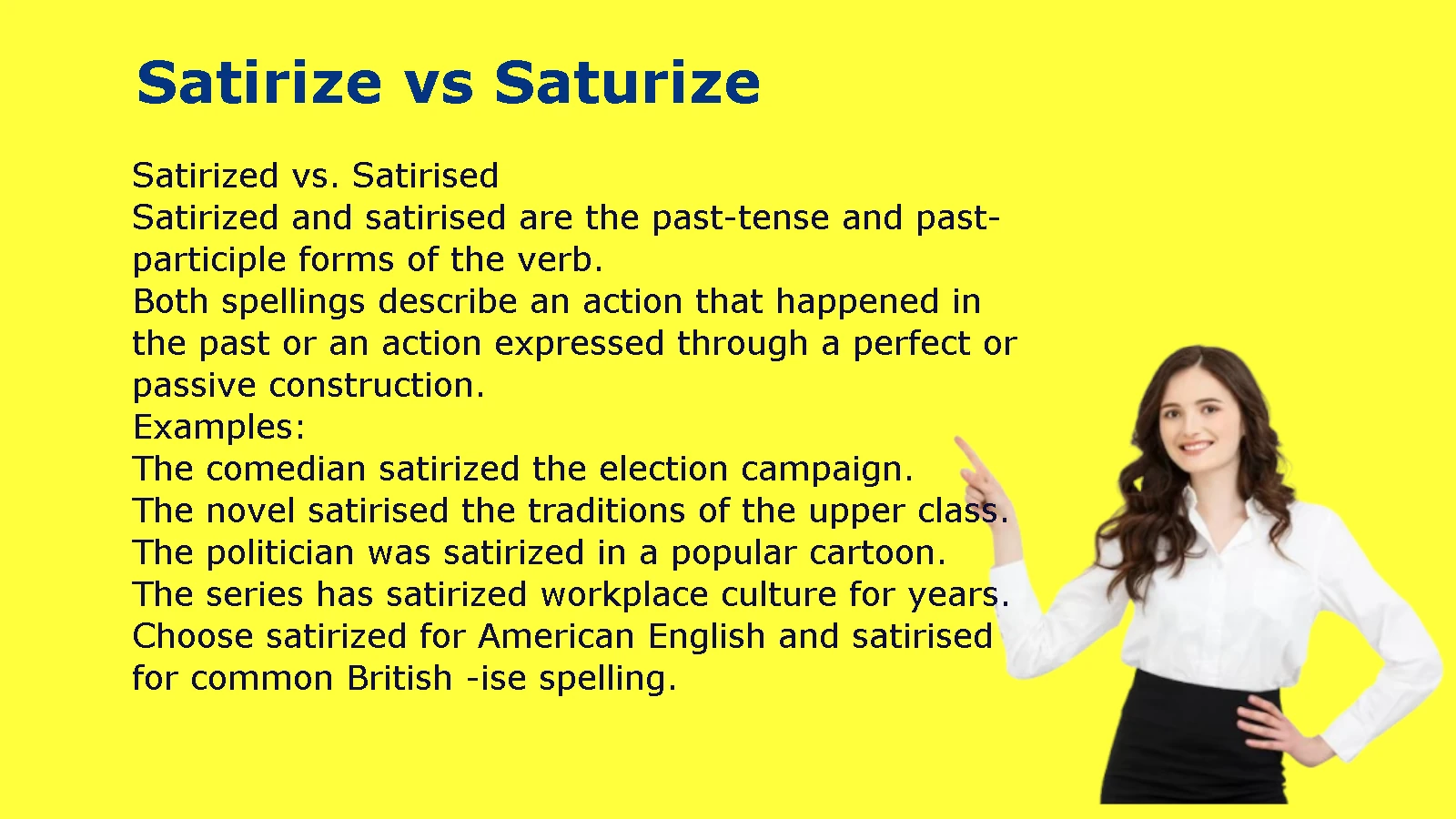
Satirized vs. Satirised
Satirized and satirised are the past-tense and past-participle forms of the verb.
Both spellings describe an action that happened in the past or an action expressed through a perfect or passive construction.
Examples:
- The comedian satirized the election campaign.
- The novel satirised the traditions of the upper class.
- The politician was satirized in a popular cartoon.
- The series has satirized workplace culture for years.
Choose satirized for American English and satirised for common British -ise spelling.
Satirizing vs. Satirising
Satirizing and satirising are the present participle and gerund forms of the verb.
Examples:
- The writer is satirizing consumer culture.
- She enjoys satirizing unrealistic expectations.
- Satirizing powerful institutions can attract public attention.
- The film succeeds by satirising social pretensions.
The spelling follows the same regional pattern as the base verb.
Remember that the -ing form does not automatically indicate present tense. Its grammatical role depends on the sentence.
How to Pronounce Satirize
Satirize is commonly pronounced SAT-uh-ryze in American English. Its final syllable rhymes with rise. The word has three syllables, with primary stress on the first syllable. Satirise has the same pronunciation because it is simply an alternative spelling of the same verb.
Pronunciation: /ˈsætəˌraɪz/
Simple pronunciation guide: SAT-uh-ryze
The most important feature is the final sound, which rhymes with eyes.
Satirize Pronunciation in American English
In American English, satirize is generally pronounced:
SAT-uh-ryze
Break it into three syllables:
- SAT: The first syllable receives the main stress.
- uh: The middle syllable has a reduced vowel sound.
- ryze: The final syllable contains a long i sound and ends with a voiced z.
The pronunciation can vary slightly among speakers, but the basic stress pattern remains recognizable.
Try saying the word slowly, then gradually increase your speed.
Satirize Pronunciation in British English
British English speakers also pronounce satirize and satirise with the same basic syllable pattern.
A common British pronunciation is represented as:
/ˈsætɪraɪz/
The vowel in the middle syllable may sound different from the reduced vowel in many American pronunciations.
Regional accents can affect the precise vowel quality.
The important point is that satirize and satirise are not pronounced differently simply because their spellings differ.
Common Pronunciation Mistakes
English learners sometimes struggle with satirize because its spelling does not make the stress pattern immediately obvious.
Avoid these mistakes:
- Putting the main stress on the final syllable.
- Pronouncing the ending as -ize with a long ee sound.
- Adding an extra syllable.
- Confusing the word with similarly spelled terms.
Practice sentence: The comedian chose to satirize the celebrity’s extravagant lifestyle.
Reading this sentence aloud can help you practice the word in a natural context.
Satirize in a Sentence: Examples and Usage
Satirize works when a person uses satire to criticize or expose something. You can use it with a direct object, such as a person, institution, belief, habit, or social trend. The word often appears in writing about comedy, literature, politics, television, cartoons, and cultural criticism.
Satirize in Everyday Sentences
Here are original examples showing how to use satirize naturally.
- The cartoon satirizes people’s obsession with expensive smartphones.
- My favorite comedy show satirizes office meetings that accomplish nothing.
- The novelist uses humor to satirize social inequality.
- Her latest sketch satirizes the pressure to look perfect online.
- The comedian satirized the manager’s habit of taking credit for other people’s work.
- The film satirizes wealthy characters who pretend to care about ordinary people.
- The advertisement satirizes brands that make exaggerated promises.
- His short story satirizes the competition between neighbors.
Each example uses satirize to describe criticism through satire.
Notice that the word can take different direct objects. You can satirize an individual, an idea, a custom, or an entire institution.
Satirize in Academic and Professional Writing
Satirize also works in formal writing, especially when analyzing literature, media, politics, or culture.
Examples:
- The playwright satirizes corruption through exaggerated characters.
- The editorial satirizes the company’s unrealistic productivity targets.
- The author satirizes consumerism by portraying shopping as a social competition.
- The television series satirizes public relations strategies through absurd situations.
When you use the word in an essay, explain what the satire criticizes.
For example:
Weak analysis: The novel satirizes society.
Stronger analysis: The novel satirizes society’s obsession with wealth by portraying characters who sacrifice their relationships to maintain an impressive public image.
The second sentence identifies both the target and the method.
This approach makes your writing more specific and informative.
Common Sentence Patterns With Satirize
You can use satirize in several common sentence structures.
Satirize someone or something
- The comedian satirized the mayor.
- The novel satirizes social expectations.
Satirize a practice or belief
- The sketch satirizes workplace favoritism.
- The article satirizes the belief that success requires constant productivity.
Be satirized for something
- The company was satirized for its confusing advertising campaign.
- The influencer was satirized for promoting an unrealistic lifestyle.
Use satire to satirize something
- The writer uses satire to satirize political hypocrisy.
This last construction is grammatically correct, but it may sound repetitive. A cleaner version is:
The writer satirizes political hypocrisy through humor.
Is Satirizing a Word?
Yes, satirizing is a standard English word. It is the present participle and gerund form of satirize. Writers use it in continuous verb constructions, such as is satirizing, and as a gerund, such as satirizing hypocrisy can reveal social problems.
The word follows the regular spelling pattern for verbs ending in a silent e: remove the final e and add -ing.
Satirize becomes satirizing.
When to Use Satirizing
Satirizing can perform different grammatical roles.
As a present participle
Use satirizing with a form of be to describe an ongoing action.
Examples:
- The comedian is satirizing the fashion industry.
- They were satirizing the company’s leadership.
- The show is satirizing modern dating culture.
As a gerund
A gerund functions like a noun.
Examples:
- Satirizing public figures can attract attention.
- She enjoys satirizing unrealistic expectations.
- Satirizing hypocrisy is a central theme of the novel.
As a participial modifier
The word can also describe a person or thing performing an action.
Example:
The writer satirizing the institution received mixed reviews.
Here, satirizing the institution identifies which writer the sentence describes.
Satirize Verb Forms
The following table shows the main forms of satirize.
| Verb form | American English | British variant |
| Base form | Satirize | Satirise |
| Third-person singular | Satirizes | Satirises |
| Past tense | Satirized | Satirised |
| Past participle | Satirized | Satirised |
| Present participle | Satirizing | Satirising |
These forms follow standard English grammar.
For example:
- I satirize social trends in my articles.
- She satirizes popular culture.
- They satirized the company’s advertising.
- He has satirized political leaders.
- We are satirizing outdated traditions.
Satirizes vs. Satirize
Satirizes is the third-person singular present-tense form of satirize in American English. Satirize is the base form, used with subjects such as I, you, we, and they, as well as after modal verbs and infinitive markers.
Compare these sentences:
| Subject or construction | Correct example |
| I | I satirize unrealistic trends. |
| You | You satirize public behavior. |
| He | He satirizes corporate culture. |
| She | She satirizes political speeches. |
| It | The show satirizes celebrity culture. |
| We | We satirize common misconceptions. |
| They | They satirize social expectations. |
| Modal verb | She can satirize the issue effectively. |
| Infinitive | He wants to satirize the trend. |
A common mistake is writing she satirize instead of she satirizes.
Remember the subject-verb agreement rule: singular third-person subjects usually take the -s form in the simple present tense.
Satirizes Synonym: Words You Can Use Instead
Useful synonyms for satirizes include mocks, ridicules, lampoons, and makes fun of. The best replacement depends on the context. Satirizes suggests criticism through satire, while some alternatives emphasize humor, contempt, imitation, or personal ridicule instead.
Choosing the right synonym can make your writing more precise.
Common Synonyms for Satirizes
| Synonym | Meaning or emphasis | Example |
| Mocks | Makes fun of someone or something | The sketch mocks corporate jargon. |
| Ridicules | Makes something appear foolish | The article ridicules the proposal. |
| Lampoons | Criticizes through sharp humor | The cartoon lampoons political corruption. |
| Parodies | Imitates a style or work, often humorously | The video parodies celebrity interviews. |
| Derides | Expresses contempt or scorn | The editorial derides the company’s excuses. |
| Sends up | Uses humor to imitate or criticize | The show sends up reality television. |
| Makes fun of | Uses informal humor or ridicule | The comedian makes fun of social habits. |
These words overlap, but they are not perfect replacements in every sentence.
For example, a writer can mock someone without making a broader social point. Satire usually carries a critical purpose beyond simple amusement.
Satirize vs. Mock vs. Ridicule vs. Parody
Understanding these distinctions helps you select the most accurate verb.
Satirize focuses on exposing faults through satire.
Example: The novel satirizes the obsession with wealth.
Mock focuses on making fun of someone or something.
Example: The comedian mocked the manager’s dramatic speeches.
Ridicule emphasizes making someone or something seem foolish or deserving of scorn.
Example: The article ridiculed the company’s unrealistic claims.
Parody often involves imitating a recognizable style, genre, person, or work.
Example: The sketch parodied a famous detective series.
A parody can also satirize its target, but imitation alone does not always amount to satire.
How to Choose the Right Synonym
Use these practical guidelines:
- Choose satirize when you want to communicate criticism through humor, irony, or exaggeration.
- Choose lampoon when the criticism is sharp, pointed, and often directed at a public figure or institution.
- Choose parody when imitation is a central feature.
- Choose mock for general humor at someone’s expense.
- Choose ridicule when the sentence emphasizes humiliation or exposing foolishness.
- Choose deride when you want to emphasize contempt.
Consider this example:
Original: The cartoon satirizes the company’s obsession with meetings.
Possible revision: The cartoon mocks the company’s obsession with meetings.
The revision is understandable, but it loses some of the original sentence’s implication that the cartoon offers broader social criticism.
Writing tip: Do not replace a precise word with a synonym simply to avoid repetition. Preserve the meaning first.
What Is the Adjective of Satire?
Satirical is the most common adjective form associated with satire. It describes something that uses, contains, or relates to satire. Satiric is another accepted adjective with a similar meaning. Writers use these adjectives to describe novels, cartoons, performances, commentary, humor, and other forms of creative expression.
Examples:
- A satirical novel
- A satirical cartoon
- Satirical humor
- A satirical article
- Satiric commentary
If you are unsure which form to choose, satirical is a reliable choice for general writing.
Satirical vs. Satiric
Both satirical and satiric relate to satire.
Their meanings overlap, so writers can often use either word without changing the central meaning.
| Adjective | Example | Usage |
| Satirical | The magazine published a satirical article. | A common general-purpose choice |
| Satiric | The play uses satiric humor. | Also correct, often a stylistic choice |
The choice may depend on the rhythm of the sentence, editorial preference, or established terminology.
For example:
The film takes a satirical approach to celebrity culture.
The film takes a satiric approach to celebrity culture.
Both sentences are acceptable.
However, satirical often feels more familiar in everyday writing, so it makes a good default option.
Satire, Satirical, Satirist, and Satirize
These related words serve different grammatical purposes.
| Word | Part of speech | Definition |
| Satire | Noun | A form of expression that uses humor, irony, or ridicule to criticize faults |
| Satirical | Adjective | Relating to or using satire |
| Satiric | Adjective | Relating to satire |
| Satirist | Noun | A person who creates or uses satire |
| Satirize | Verb | To criticize through satire |
Examples in context:
- Satire: The novel uses satire to criticize social inequality.
- Satirical: The author wrote a satirical novel.
- Satiric: The performance included satiric commentary.
- Satirist: The satirist exposed hypocrisy through humor.
- Satirize: The comedian chose to satirize celebrity culture.
Learning these forms helps you avoid awkward word choices.
For example, the author satirical society is incorrect because satirical is an adjective, not a verb.
A better sentence is:
The author satirizes society.
Or:
The author writes satirical stories about society.
How to Use Satirize Correctly
Use satirize when you want to describe criticism that relies on satire. The word works best when the target and critical message are clear. It can describe humor directed at individuals, institutions, social norms, popular beliefs, or cultural trends.
However, not every joke or humorous comment qualifies as satire.
When Satirize Is the Right Word
Satirize is particularly useful when a writer or performer exposes a flaw through humor, irony, exaggeration, or ridicule.
Common targets include:
- Political hypocrisy
- Corporate greed
- Social inequality
- Unrealistic beauty standards
- Consumerism
- Workplace habits
- Public relations tactics
- Cultural expectations
For example:
The series satirizes the belief that working longer hours always leads to success.
This sentence works because the series criticizes a specific belief through satire.
Another example:
The cartoon satirizes companies that advertise environmental responsibility while ignoring wasteful practices.
The humor may entertain readers, but it also encourages them to recognize a contradiction.
Satirize vs. Criticize
Satirize and criticize are related, but they do not mean exactly the same thing.
Criticize means to express disapproval or evaluate something negatively. Satirize means to criticize through satire.
| Word | Main emphasis | Example |
| Criticize | Expressing disapproval or evaluating flaws | The journalist criticized the policy. |
| Satirize | Using satire to expose faults | The cartoonist satirized the policy. |
A journalist can criticize a policy by presenting evidence and explaining its weaknesses.
A cartoonist might satirize the same policy by exaggerating its consequences or portraying its supporters in an absurd situation.
Both approaches can make a serious point, but they use different methods.
Practical rule: Use criticize for general disapproval or evaluation. Use satirize when humor, irony, or ridicule plays a meaningful role in the criticism.
Satirize vs. Parody
Satire and parody often appear together, but they serve different purposes.
Satire focuses on criticism.
Parody focuses on imitation, often for humorous effect.
A parody might imitate the style of a detective story, a news broadcast, or a commercial.
That imitation may entertain readers without criticizing a serious issue.
For example:
A comedy sketch imitates the dramatic music and exaggerated dialogue of a detective series.
This is a parody.
If the sketch uses that imitation to criticize the entertainment industry’s obsession with predictable plots, it may also function as satire.
The distinction matters when you describe books, films, comedy sketches, and online videos.
Quick Tips to Avoid Confusing Satirize and Saturize
Use this quick checklist before publishing:
- Check the meaning: Are you describing satire or saturation?
- Identify the target: Does the sentence discuss a behavior, belief, institution, or person being criticized?
- Check the spelling: Use satirize in American English or satirise if your chosen style prefers that form.
- Check the grammar: Use satirizes with third-person singular subjects in the simple present.
- Check the tone: Make sure the verb accurately describes the author’s purpose.
- Read the sentence aloud: Confirm that the wording sounds natural.
If your intended meaning involves humorous criticism, satirize is generally the right choice.
Practical Case Study: Choosing Between Satirize, Mock, and Parody
Imagine a writer wants to describe a fictional comedy video about a company that holds endless meetings.
The video shows employees attending a meeting about planning another meeting. Everyone uses complicated business phrases, but nobody makes a decision.
Which verb should the writer use?
Option one: Satirize
The video satirizes inefficient workplace culture.
This is a strong choice because the video uses an absurd situation to criticize a broader workplace problem.
Option two: Mock
The video mocks managers who use complicated language.
This works if the emphasis falls on making fun of the managers.
Option three: Parody
The video parodies corporate training videos.
This works if the video imitates the familiar style of corporate training materials.
What This Example Teaches
The three verbs can describe the same creative work, but each emphasizes a different feature.
- Satirize highlights criticism.
- Mock highlights ridicule.
- Parody highlights imitation.
A single video can satirize workplace culture, mock managerial behavior, and parody corporate training videos at the same time.
This distinction is useful for writers who review entertainment, analyze literature, or describe humorous content.
Frequently Asked Questions
Is satirize or saturize the correct word?
Satirize is the correct word when you mean to criticize or expose faults through satire. Saturize is not a standard substitute for satirize, so avoid it in this context.
Is satirise or satirize correct in British English?
Both spellings are accepted. Satirise is common in British English, while satirize is preferred in American English. Some British publications also use -ize spellings.
What is a synonym for satirizes?
Common synonyms include mocks, ridicules, lampoons, and parodies. Choose a word that matches the intended meaning because these alternatives emphasize different aspects of humor and criticism.
How do you pronounce satirize?
Satirize is commonly pronounced SAT-uh-ryze, with three syllables and primary stress on the first syllable. Its final syllable rhymes with rise.
Is satirizing a real word?
Yes. Satirizing is the standard -ing form of satirize. It can function as a present participle, as in she is satirizing the trend, or as a gerund, as in satirizing hypocrisy can expose social problems.
What is the adjective form of satire?
Satirical is the most common adjective associated with satire. Satiric is also correct. For example, you can describe a novel as satirical or satiric.
Conclusion: Satirize vs Saturize
The difference between Satirize vs Saturize comes down to meaning and correct word choice.
Satirize means to criticize or expose faults through satire. Satirise is an accepted alternative spelling, commonly used in British English. Saturize should not replace either spelling when you mean humorous or ironic criticism.
Keep these key points in mind:
- Use satirize in American English.
- Use satirise when following a British -ise spelling preference.
- Use satirizes with third-person singular subjects.
- Use satirizing as the -ing form.
- Choose satirical or satiric when you need an adjective.
- Use synonyms such as mock, ridicule, lampoon, or parody only when they preserve your intended meaning.